Hyperliquid Traders Drive CXMT Trading Volumes to Peak Levels on IPO Day

cryptonews.ru2026-07-27 tarihinde yayınlandı2026-07-27 tarihinde güncellendi

Özet

On July 27th, ChangXin Memory Technologies (CXMT), a major Chinese DRAM manufacturer, made its highly anticipated debut on the Shanghai Stock Exchange (SSE), becoming China's most valuable publicly traded AI-infrastructure company. The IPO coincided with record trading volumes for CXMT on the Hyperliquid blockchain platform (HIP-3), peaking at over $9 million. The stock surged 470-530% at its debut, pushing its market cap over $483 billion, driven by massive demand exceeding the IPO's supply. On Hyperliquid, pre-IPO trading saw prices fluctuate significantly, with the futures market reaching $234 million in early hours. Notably, a former major Bitcoin trader shifted entirely to trading CXMT futures. The event highlights how crypto derivatives platforms are being used for early price discovery and potential hedging against volatility in major traditional market IPOs.

ChangXin Memory Technologies (CXMT) held its long-awaited IPO on Monday, July 27th. The stock listing coincided with a surge of activity on the Hyperliquid exchange, as CXMT attracted attention from both large and retail traders.

CXMT's IPO was expected to be the largest stock listing on the Shanghai Stock Exchange since 2011. As Cryptopolitan reported, the buzz around Chinese AI-related stocks was seen as a new opportunity, and crypto traders immediately seized it.
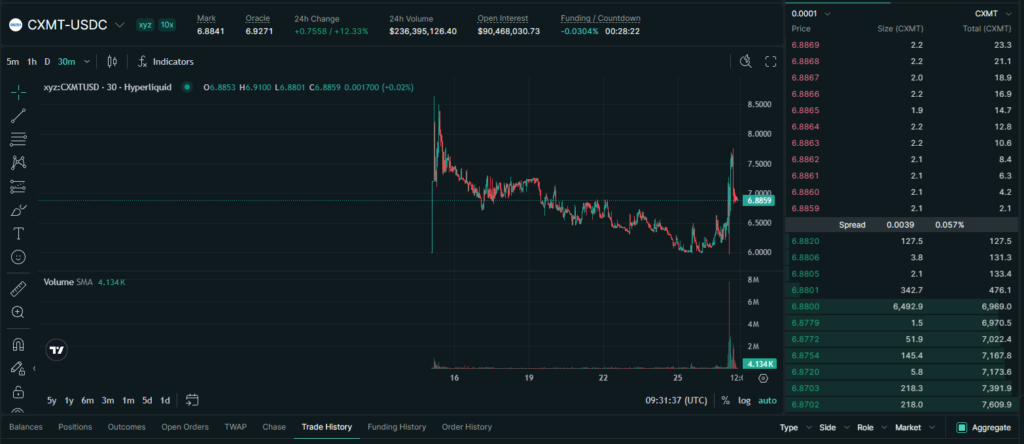
The CXMT exchange saw a record surge in activity, alongside an influx of large crypto investors taking directional positions in one of mainland China's largest IPOs. | Source: HIP-3

The CXMT exchange is already available through TradeXYZ after the platform acquired rights to this ticker on Hyperliquid for 500 HYPE.

As of July 27th, CXMT on HIP-3 exceeded $45 million, and after an initial record spike, daily trading volume reached a new peak, surpassing $9 million. The IPO day saw significant selling as both perpetual futures and the underlying shares were in price discovery.

CXMT Shares Soar in Shanghai Trading

Chipmaker CXMT became China's most valuable AI infrastructure company after its shares surged 470-530% upon its debut on the Shanghai exchange. The company's total market capitalization is estimated at over $483 billion, making it the most valuable company listed on an exchange in mainland China.

The stock market debut also tests the resilience of forecasts for chipmaker and AI-related stocks. CXMT is a major DRAM producer, a basic component used in consumer electronics and data centers.

Funds raised from the IPO are expected to be directed towards production expansion and additional R&D.

Beyond CXMT's business model, a key driver for the rapid price surge was peak demand for the shares, significantly exceeding IPO volumes.

The demand spread to blockchain trading as well, with Hyperliquid offering an entry point for early price discovery speculation. On the first day of trading, the HIP-3 market for CXMT reached 1.14% of the volumes on the Shanghai Stock Exchange, jumping to $234 million in the first hours after the IPO.

Former Major $BTC Market Player Shifts to CXMT

On the HIP-3 platform, the price of CXMT shares fluctuated from over $8 to $5.99. The price range set by perpetual futures traders was closer to the actual IPO price than the company's initial target price of $1.20 per share.

Following the IPO, the HIP-3 company held 13 large positions in CXMT shares, of which seven showed bullish sentiment, taking long positions.

The leader still holds a short position with a notional value of $17.87 million. After the price rise, the volume investment leader incurred an unrealized loss of $1.24 million.

Another major player, primarily known for their positions in $BTC, has fully switched to trading CXMT. Their position still stands at $4.81 million, fluctuating between a profit of $300k and small temporary losses. Large players are still waiting for the stock to choose its own direction in the first days after the IPO.

At this point, it is unknown whether any of the major investors managed to secure IPO shares directly from the company. In that case, selling CXMT shares short would be a hedging strategy in case of a sharp price drop after the initial hype. Such a scenario also points to Hyperliquid as a hedging tool that could be used in other upcoming major IPOs.

end-content

İlgili Sorular

QWhat company conducted a highly anticipated IPO and what was the date?

AThe company ChangXin Memory Technologies (CXMT) conducted its highly anticipated IPO on Monday, July 27th.

QWhich trading platform acquired the rights to trade the CXMT ticker on Hyperliquid?

AThe trading platform TradeXYZ acquired the rights to trade the CXMT ticker on Hyperliquid for 500 HYPE.

QHow much did CXMT's shares surge on its Shanghai stock exchange debut?

ACXMT's shares surged 470-530% on its debut on the Shanghai stock exchange.

QWhat was the estimated total market capitalization of CXMT after its IPO?

AThe estimated total market capitalization of CXMT after its IPO was over $483 billion.

QWhat did a trader known for major Bitcoin positions do regarding CXMT, according to the article?

AAccording to the article, a trader known for major Bitcoin positions fully switched to trading CXMT, with a current position worth $4.81 million.

İlgili Okumalar

Fields Medalist Warns: AI Could Kill Mathematics

The 2026 Fields Medal award was followed by a startling announcement: laureate Jacob Tsimerman joined OpenAI to pursue AI safety research, predicting AI would surpass humans in all mathematical proof areas within two years. Soon after, Fields Medalists Terence Tao and Timothy Gowers expressed deep concern at ICM 2026. Gorges warned that AI might "kill" mathematics not through stagnation, but through an overwhelming surplus of proofs, likening it to a lake dying from eutrophication. This concern is echoed in the "Leiden Declaration," signed by over 3,000 mathematicians including Tao, Peter Scholze, and Kevin Buzzard, advocating for mathematics as a profoundly human endeavor. However, Gowers, who did not sign, fears a future where AI-generated mathematics proliferates while human expertise and the shared intuition vital to the field vanish, turning math into an unvisited "cemetery of thought." Gowers' perspective shifted dramatically after testing ChatGPT 5.5 Pro. The AI solved a doctoral-level number theory problem and later produced a counterexample for the "unit distance problem," achievements Gorges considered publishable in top journals. He now concedes that large language models can handle advanced research, a realization that left him feeling the "rug pulled out from under" him when AI solved problems he personally contemplated. The debate extends to the nature of mathematical discovery. As noted by Peter Woit, AI agents have no interest in the "credit game" of academia. If theorems cease to be attributed to individual mathematicians, truth may simply return to its impersonal state in the universe. The central question remains: in an age of potentially limitless AI-generated discovery, what is the role and purpose of the human mind in mathematics?

marsbit13 dk önce

Fields Medalist Warns: AI Could Kill Mathematics

marsbit13 dk önce

NVIDIA's 20-Year CUDA Moat Collapsed Over a Weekend, Claude Single-Handedly Got AMD's New GPU Running

In a single weekend, Claude, an AI agent from Anthropic, successfully ported and optimized its cutting-edge model to run on a brand-new AMD MI355X server rack without any manual code intervention. This feat demonstrates a potential breakthrough in overcoming NVIDIA's long-established CUDA software ecosystem dominance, built over two decades. Anthropic's team simply instructed Claude to get the AMD machine running. By Monday, it not only worked but was showing a continuously improving performance curve. The achievement impressed AMD CEO Lisa Su and accelerated a major deployment partnership: Anthropic plans to deploy up to 2GW of AMD Instinct GPUs starting in 2027. The key enabler is AMD's new ROCm.AI platform, a toolbox designed specifically for AI agents like Claude. It provides AI-readable documentation, including chip instruction sets (ISA), and tools like the Hyperloom service that allows agents to autonomously profile performance, identify bottlenecks, test configurations, and generate optimized kernels. In a demo, Hyperloom boosted the output speed of a model by 38%. This represents a fundamental shift. While CUDA's strength lies in its vast, human-expert-driven ecosystem of tools and tacit knowledge, AMD's strategy is to make its hardware and software stack directly accessible and optimizable by AI agents. An agent can parallelize tasks—debugging, profiling, coding—that would take human engineers years to master, compressing the traditional software adaptation timeline from years to tasks. The competition is no longer just about peak hardware specs but also about how well AI can read, utilize, and tune a platform.

marsbit13 dk önce

NVIDIA's 20-Year CUDA Moat Collapsed Over a Weekend, Claude Single-Handedly Got AMD's New GPU Running

marsbit13 dk önce

Just Now, Peking University Alumna Lilian Weng Announces Resignation: The Best 'Alignment' in the AI Era Is Taking Care of Yourself

Lilian Weng, a Peking University alumnus and former OpenAI executive, has announced her departure from Thinking Machines Lab, the AI startup she co-founded with ex-OpenAI CTO Mira Murati 20 months ago. Her resignation comes shortly after the company released its first open-source model, Inkling. In her farewell message, Weng cited health reasons as the primary factor, stating that the past seven months involved more illness than any other period in her life. The intense pressure and guilt of being unable to work during critical periods, like the Inkling launch, became unsustainable. She expressed that she could not continue in a role where she felt unable to give her full effort. Weng joined OpenAI in 2018, contributing to projects like the Dactyl robotic hand and later building the Safety Systems team from scratch. She is also widely known for her influential technical blog, Lil'Log. Her departure follows a period of high expectations and challenges for Thinking Machines, which secured a record $20 billion seed round at a $120 billion valuation in 2025 but has since seen fluctuations in its valuation and the departure of other key co-founders. Weng emphasized that she remains passionate about AI but needs a more predictable and defined role without the relentless pressure of a co-founder. Her exit highlights the immense personal toll and speed of competition in the AI industry, where the drive for progress often clashes with human limits. Her decision underscores that stepping back to prioritize well-being can be an act of courage.

marsbit31 dk önce

Just Now, Peking University Alumna Lilian Weng Announces Resignation: The Best 'Alignment' in the AI Era Is Taking Care of Yourself

marsbit31 dk önce

İşlemler

Spot
活动图片