Racing with Robinhood, Is Lighter Playing a Big Game?

Foresight NewsPublished on 2026-07-03Last updated on 2026-07-03

Abstract

"Lighter, a perpetual and spot exchange founded in 2022 by Vladimir Novakovski, is making strategic moves. After raising $68 million in November 2025 from investors like Founders Fund and Ribbit Capital, the project has recently updated its tokenomics and deepened its partnership with Robinhood. Key updates include a shift to permanent token burns from protocol revenue, with the first burn scheduled post-Q2 2026, and a change in staking rewards to be funded from the ecosystem reserve instead of protocol revenue. In July, Lighter was designated as Robinhood's official perpetual contracts partner and integrated directly into the Robinhood Wallet, gaining access to its vast user base. The partnership includes a $11 million LIT rewards program for users. Furthermore, Lighter plans to launch options trading in Q3 2025 and is reportedly working with the CFTC towards becoming a compliant decentralized exchange in the US. The LIT token has a fixed supply of 1 billion, with significant portions allocated to the team and investors subject to a 1-year cliff followed by a 3-year linear vesting schedule, starting from the Token Generation Event in December 2025."

Author: Ma He, Foresight News


Recently, the perpetual contract exchange Lighter has been making frequent moves. The official announced updated tokenomics at the end of June, followed by launching on the Robinhood Chain mainnet, with Lighter being directly integrated into the Robinhood wallet.


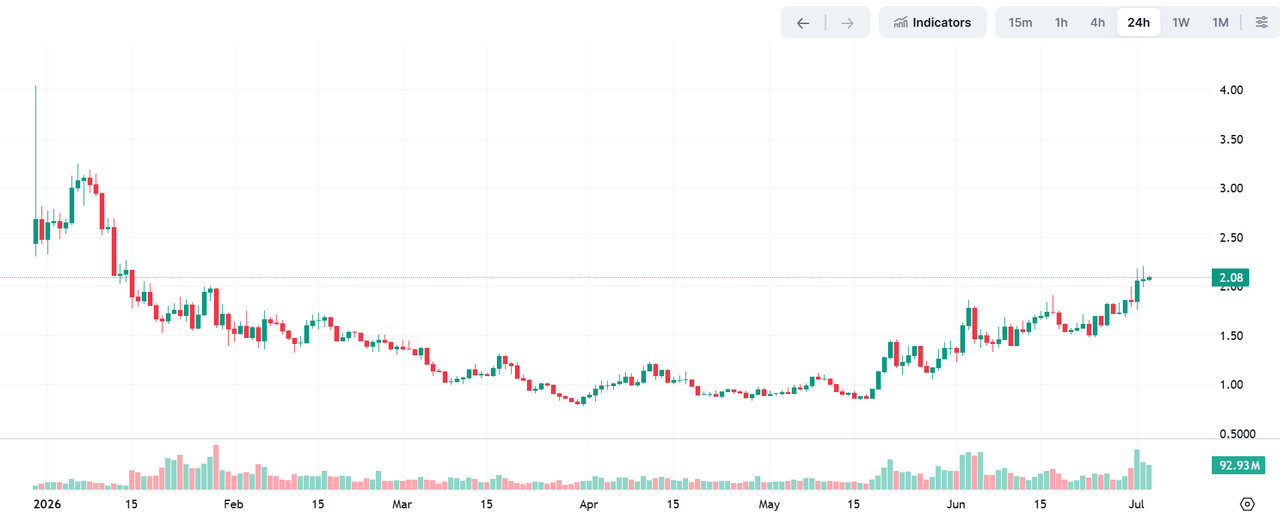
Currently, LIT is priced at $2.08, with a market cap of approximately $510 million, an FDV of around $2.08 billion, and 24-hour trading volume nearing $100 million.


Lighter was founded in 2022 by Vladimir Novakovski (referred to as Vlad) and is an on-chain perpetual and spot exchange. In November 2025, Lighter completed a $68 million funding round led by Peter Thiel's Founders Fund and Ribbit Capital, with participation from Haun Ventures, Robinhood, and others, achieving a post-money valuation of about $1.5 billion.


First Batch of Burns to Be Executed After Q2, Staking Rewards to be Distributed from Ecosystem Reserve Tokens


On June 30th, the Lighter official team updated the details of its tokenomics, focusing on two major adjustments: "Permanent Buyback and Burn" and "Sustainable Staking Rewards." Since TGE, the protocol has programmatically repurchased approximately 15.5 million LIT tokens through exchange revenue, accounting for about 6.3% of the circulating supply at the time.


Previously, buybacks were mainly conducted within the exchange. This update clarifies that repurchased LIT tokens will be withdrawn and sent to the Ethereum mainnet burn address for permanent supply reduction. The first batch of burns is scheduled to be executed within weeks after the end of Q2 2026.
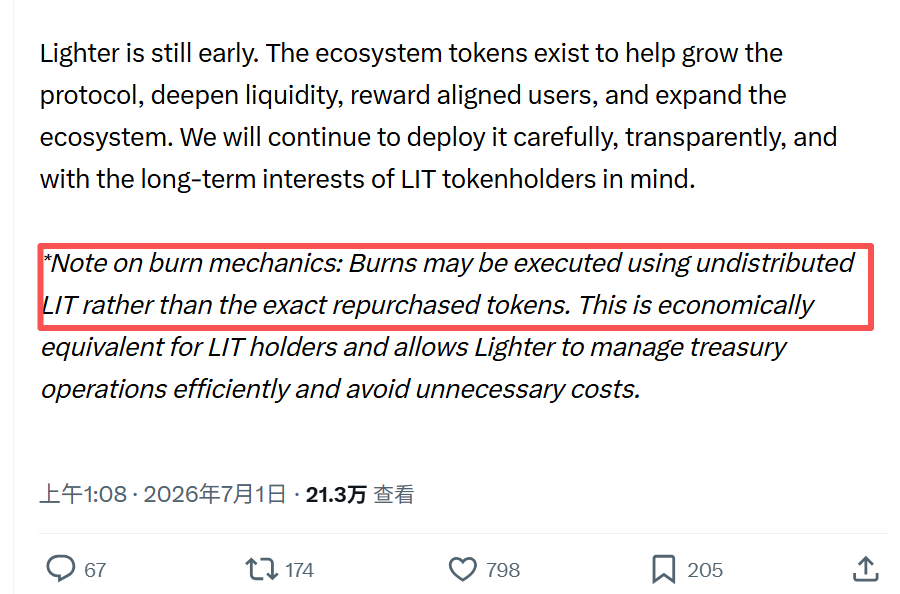


It's noteworthy that the announcement notes that the burn might use unallocated LIT tokens rather than the repurchased tokens. The implication is that potentially still-locked tokens could be burned. This introduces a slight discount in transparency—the community might question whether "tokens bought back are truly burned." However, from a fundamental perspective, as long as the protocol continues to generate real revenue, the buyback + burn cycle creates a positive feedback loop.


To date, Lighter's staking program has distributed approximately 3.72 million LIT tokens to stakers (about 170,000 of which came from the fee rebate program). Early rewards were funded by pre-TGE revenue and company funds, but the official stated this is unsustainable in the long term. Therefore, going forward, Lighter will transition to using the remaining ecosystem token reserve to distribute staking rewards.

This shift by Lighter to the ecosystem reserve instead of continuously consuming revenue, choosing to redirect inflationary pressure back onto the overall ecosystem pool, might also exert some negative pressure on the token price.


Partnership with Robinhood


In July, Lighter was designated as Robinhood's * official perpetual contract partner and directly integrated into the Robinhood wallet.


Specifically, eligible users in applicable jurisdictions can now directly trade perpetual contracts on Lighter within the Robinhood wallet, experiencing a self-custody, on-chain settlement process. Lighter has committed to allocating $11 million worth of LIT tokens to the Robinhood community: Users trading perpetual contracts on Lighter can earn points (2x points for trading via Robinhood wallet, 1x points via the Lighter web app), which can be directly redeemed for LIT (subject to Lighter's terms and conditions).


Robinhood is building tokenized stocks on its chain, while Lighter is expanding its Perps to crypto-native and equity-like assets.


Robinhood is not an ordinary partner; it is a platform with over 20 million users, extremely high brand recognition, strong distribution capabilities, and a growing DeFi/RWA infrastructure.


The active user base for most pure crypto perpetual DEXs typically ranges from hundreds of thousands to a few million, while Robinhood's active user base demonstrates a significant order-of-magnitude advantage. Furthermore, Robinhood users are primarily retail investors with a high acceptance of leveraged trading. Perpetual contract products naturally fit their trading habits.
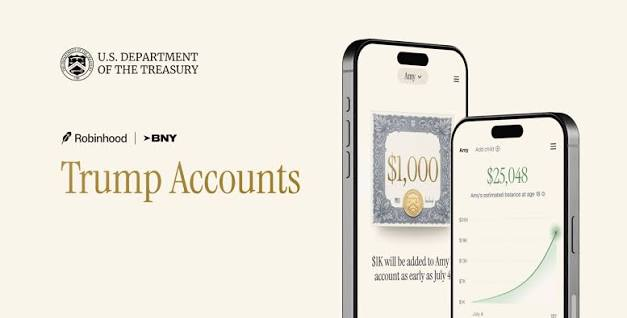


Robinhood is a core partner and designated broker for the US "Trump Account" program. Its brand trust can provide "mainstream legitimacy." Some traditional investors may have reservations about purely crypto platforms but are familiar with and trust Robinhood. Robinhood's coverage in over 30 countries also opens doors to its potential users. For Robinhood, Lighter becomes a "compliant regulatory testing ground" for expanding into overseas, offshore markets.


Partnering with them equates to Lighter gaining a super lever of "retail traffic entry + mainstream endorsement + future synergistic growth." This will positively impact Lighter's trading volume, user growth, LIT token demand (through points, potential fee sharing, buybacks, etc.), and overall ecosystem positioning.


Options Launching in Q3 This Year


Unlike many crypto projects where "token launch is the end," Lighter held an investor conference call around 10 PM on July 2nd. The call primarily reviewed its achievements and outlined future plans, including that Lighter is working closely with the CFTC with the intention of becoming a compliant decentralized perpetual contract exchange in the United States.
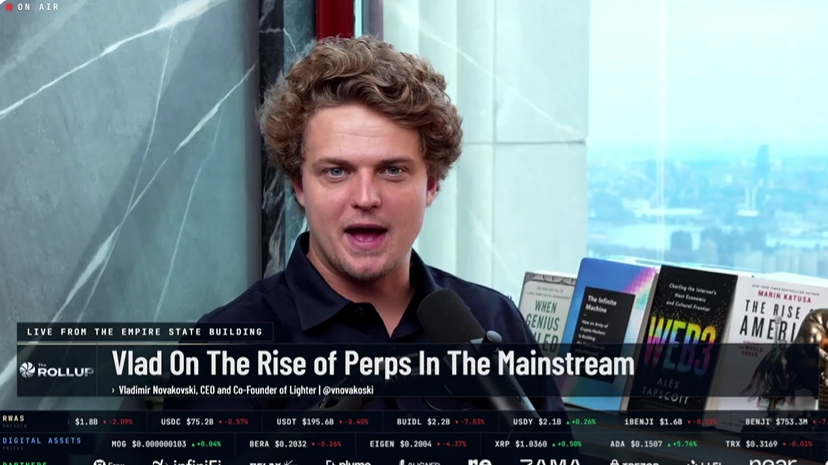


On the same day, Lighter CEO Vladimir Novakovski provided a detailed breakdown of this partnership in an interview with The Rollup, also revealing plans to launch options products in Q3 this year.


Options are a crucial component of the derivatives market, catering to the hedging, arbitrage, and structured yield needs of advanced traders. After launching options, users can combine perpetual contracts, options, and structured yields within the same platform, often improving user retention and lifetime value.


Currently, regarding LIT tokens, the team and VC portions remain unlocked.
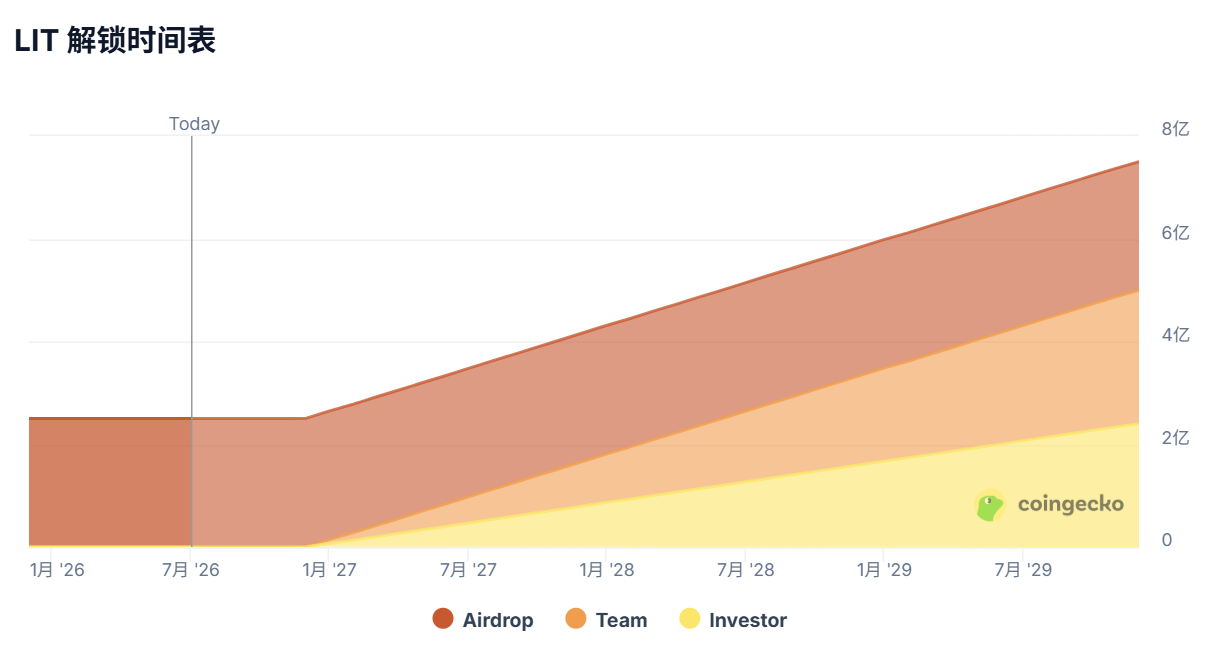


Lighter's LIT token has a fixed total supply of 1 billion. Team allocation (26%, approximately 260 million tokens): Subject to a 1-year cliff (starting from TGE on December 30, 2025, ending around December 30, 2026), followed by linear vesting over 3 years (approximately 36 months). VC allocation (24%, approximately 240 million tokens): Same as the team, 1-year cliff + 3-year linear vesting.


Before the massive token unlock at year-end, whether Lighter can maintain strong performance will depend on the overall market environment, treasury transparency, and the execution capabilities of the team.

Related Questions

QWhat are the two main adjustments to Lighter's tokenomics announced on June 30th?

AThe two main adjustments are the implementation of a 'permanent buyback and burn' mechanism and a shift to distributing staking rewards from the ecosystem token reserve instead of from protocol revenue and company funds.

QWhat is the strategic significance of Lighter's partnership with Robinhood?

AThe partnership provides Lighter with access to Robinhood's over 20 million retail users, high brand trust, and distribution power. It offers Lighter a 'retail traffic entrance, mainstream endorsement, and future synergistic growth' super-leverage, which is expected to positively impact trading volume, user growth, and LIT token demand.

QWhen is Lighter planning to launch its options product?

ALighter plans to launch its options product in Q3 of this year.

QWho were the lead investors in Lighter's $68 million funding round in November 2025, and what was the post-money valuation?

AThe funding round was led by Peter Thiel's Founders Fund and Ribbit Capital, with participation from Haun Ventures and Robinhood. The post-money valuation was approximately $1.5 billion.

QWhat is the current status of the LIT token supply, specifically regarding the team and VC allocations?

ATeam (26%) and VC (24%) allocations are currently locked. Both have a 1-year cliff from the TGE date (Dec 30, 2025) followed by a 3-year linear vesting schedule, meaning their tokens will start unlocking around the end of 2026.

Related Reads

How Far Are We from the End of the Crypto Bear Market?

How Much Longer Until the Crypto Bear Market Ends? A persistent negative Coinbase Bitcoin Premium Index, reaching a record 46 consecutive days of negative values, underscores the ongoing crypto bear market. The downturn accelerated in late May/early June when MicroStrategy (referred to as "Strategy" in the text), a major BTC holder, sold a small amount of Bitcoin (32 BTC), shattering market confidence and triggering sharp declines in BTC, ETH, and SOL. This was compounded by sustained net outflows from US spot Bitcoin ETFs. June saw Bitcoin briefly fall below $60,000, its worst weekly performance since 2022, breaking below the critical 200-week moving average—a signal some analysts consider confirmation of a bear market. While some institutional analyses in mid-June suggested the bottom might be near (e.g., around $53,600 based on realized price, or a potential end during the 2026 World Cup summer), further price drops quickly disproved these optimistic forecasts. Key bear market indicators include: the severe de-pegging of MicroStrategy's preferred shares (STRC) from their $100 NAV, which later recovered partly due to company stabilization plans; a record number of BTC (over 10.83 million) and a significant portion of long-term ETH holders now in unrealized loss; and Bitcoin's price trading below its 200-week moving average. Predictions for the bear market's end vary. Some, like investor Yilihua, suggest July-August 2026 could present a final buying opportunity. Others, like miner Jiang Zhu'o'er, predict a bottom between $42,000-$44,000 in October-December 2026, based on the historical lag between MicroStrategy's mNAV ratio bottom and Bitcoin's price bottom. Technical indicators like the BTC 4-year average price index dipped briefly below 1, and the Coinbase Premium Index remains negative, suggesting a need for a price rebound to around $77,000 for a return to positive territory. In the absence of major external catalysts, the consensus leans toward the bear market persisting for another 2-3 months, with late September to early October 2026 being a potential turning point window.

Odaily星球日报49m ago

How Far Are We from the End of the Crypto Bear Market?

Odaily星球日报49m ago

Solana Ecosystem Shows Signs of Recovery: On-Chain Governance Upgrade, Tokenized Stocks and Meme Coins Heat Up

Solana Ecosystem Shows Signs of Revival: Governance Upgrades, Tokenized Stocks, and Memecoins Heat Up While the broader crypto market faces a downturn, Solana has shown relative strength with its price rising nearly 15% recently. This resilience is attributed to warming ecosystem activity, particularly in tokenized stocks and memecoins, coupled with a major upgrade to its on-chain governance. In the Real World Assets (RWA) sector, Solana now leads all public chains in both the number of unique holder wallets and the quantity of RWA assets. Its tokenized stock weekly trading volume has surged to a record $1.42 billion, capturing about 96% of the market share, largely driven by the Backpack exchange. Simultaneously, the Solana memecoin sector has reignited, fueled by the rapid ascent of the ANSEM token following endorsements from a prominent crypto influencer. This has boosted activity across platforms like Pump.fun and increased fee revenue for several Solana-based exchanges. A key development is the launch of Solana Governance Proposals (SGP), a new on-chain mechanism. It allows validators with at least 100,000 SOL delegated to submit proposals for community vote, enhancing decentralized decision-making. SGP will operate alongside the existing technical proposal process (SIMD), focusing on broader ecosystem governance. Despite these positive signals in specific areas, overall on-chain activity and transaction volumes still lag behind previous bull market peaks, indicating the recovery remains partial rather than ecosystem-wide.

marsbit1h ago

Solana Ecosystem Shows Signs of Recovery: On-Chain Governance Upgrade, Tokenized Stocks and Meme Coins Heat Up

marsbit1h ago

While Semiconductor Stocks Plunge, Anthropic Plans to Develop a 2nm Chip

Anthropic, the AI company behind Claude, is exploring the development of its own custom AI chip, according to a report from The Information. The company is in early discussions with Samsung Electronics to manufacture the chip using Samsung's most advanced 2-nanometer process and packaging technology. While the project is still in preliminary stages, including defining chip specifications, and could be abandoned, it marks a strategic step for Anthropic. The move comes as the company seeks greater control over its computing costs and hardware optimization, particularly for inference tasks to run its models more efficiently and cheaply. Samsung's potential involvement follows its participation as a strategic investor in Anthropic's recent $65 billion funding round. For Samsung, partnering with a major AI lab represents a significant opportunity for its foundry business to compete with market leader TSMC in advanced semiconductor manufacturing. Anthropic's CEO, Dario Amodei, has previously highlighted the immense financial challenge of securing enough computing power for anticipated growth, making cost-effective inference a critical focus. The company would join other tech giants like Google, Amazon, Microsoft, Meta, and OpenAI in pursuing custom AI silicon. However, analysts note this trend creates deeper interdependencies rather than independence, as US AI labs become more tightly woven into Asian semiconductor supply chains. Despite this move, Anthropic remains heavily reliant on a multi-cloud, multi-vendor strategy for its immediate computing needs. It has secured massive, long-term commitments for capacity from Amazon Web Services (Trainium chips), Google (TPUs), and even leased a large GPU cluster from xAI. For now, Nvidia continues to dominate the AI chip market, with its share reportedly growing to 74%.

链捕手1h ago

While Semiconductor Stocks Plunge, Anthropic Plans to Develop a 2nm Chip

链捕手1h ago

Trading

Spot
活动图片