Derive [DRV] gains 40% on Upbit news – THIS zone marks next major hurdle

ambcrypto2026-07-14 tarihinde yayınlandı2026-07-14 tarihinde güncellendi

Özet

Derive (DRV) surged approximately 40% following news of its upcoming listing on the South Korean exchange Upbit, with trading in KRW, BTC, and USDT pairs set to begin on July 14th. The announcement triggered aggressive buying, raising the price from $0.1147 to a peak of $0.19, though it later settled near $0.1471. Market capitalization reached roughly $109.64 million, and 24-hour trading volume spiked by over 1744% to $9.38 million. Technical indicators like the RSI hitting 84.43 prompted early profit-taking, suggesting overheated momentum. The key challenge for DRV is to prove sustained demand beyond the initial listing hype. Maintaining support above $0.131 will be crucial to confirm continued buyer interest, while metrics like holder growth, stable volumes, and exchange flows will determine if the rally can evolve into a stronger, long-term market foundation or follow a typical post-listing reversal pattern.

Derive [DRV] will enter one of Asia’s largest crypto markets after Upbit announced KRW, Bitcoin [BTC], and Tether [USDT] trading pairs. Trading will begin on 14th of July, expanding access following Derive’s migration from Lyra Finance.

The listing opens the protocol to South Korea’s active retail market and could attract broader global participation. Greater accessibility could deepen liquidity and strengthen price discovery across multiple trading pairs.
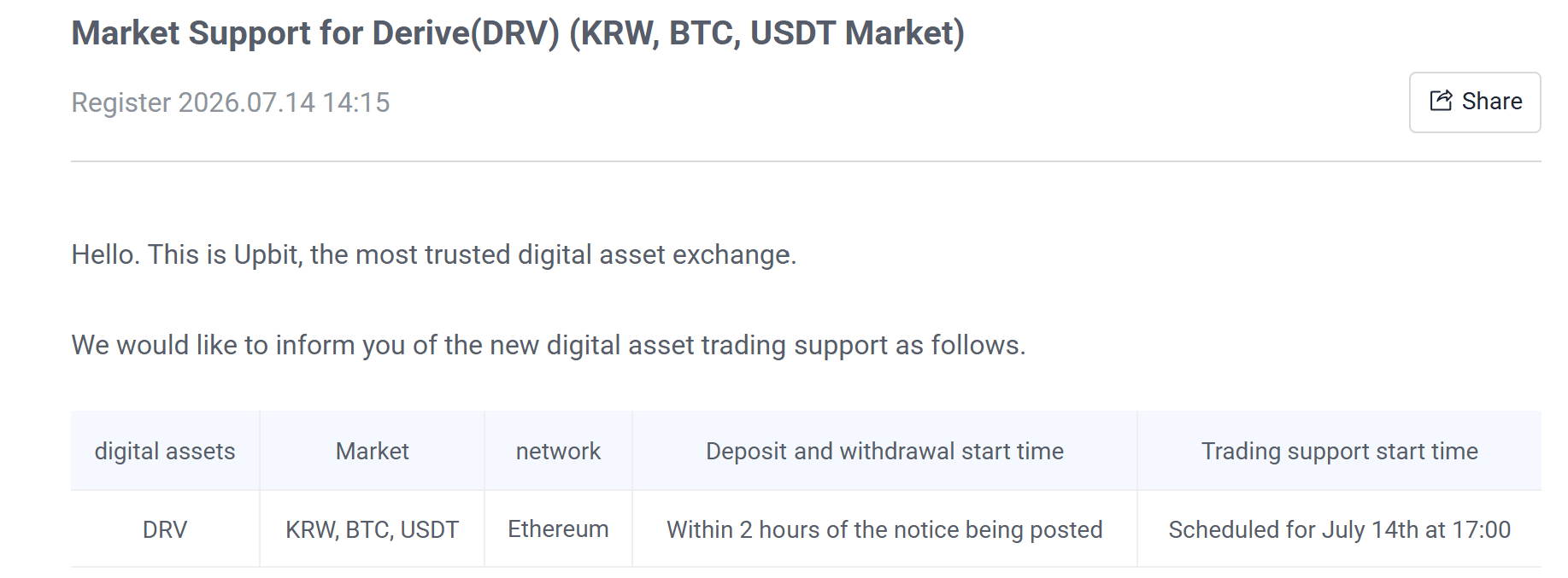
Source: UPbit

Derive has continued expanding its on-chain options and perpetual futures ecosystem following its 2024 rebranding.

However, it is unlikely that simply receiving additional Exchange support will help to create long-term demand.

Traders must deliver stronger volumes, deeper order books, and consistent participation. Those metrics will reveal whether broader accessibility strengthens Derive’s market position beyond its initial listing.

Why did DRV rally?

The announcement quickly changed DRV’s market dynamics. Rather than waiting for trading to begin, buyers aggressively repriced the token in anticipation of stronger liquidity and broader market participation.

The price rose by approximately 40%, or from $0.1147 to $0.19, before falling to $0.1486. Meanwhile, market capitalization rose to approximately $109.64 million.

Notably, 24-hour trading volume grew by 1744.3% to $9.38 million. These developments suggested that the rally attracted fresh capital instead of isolated buying.
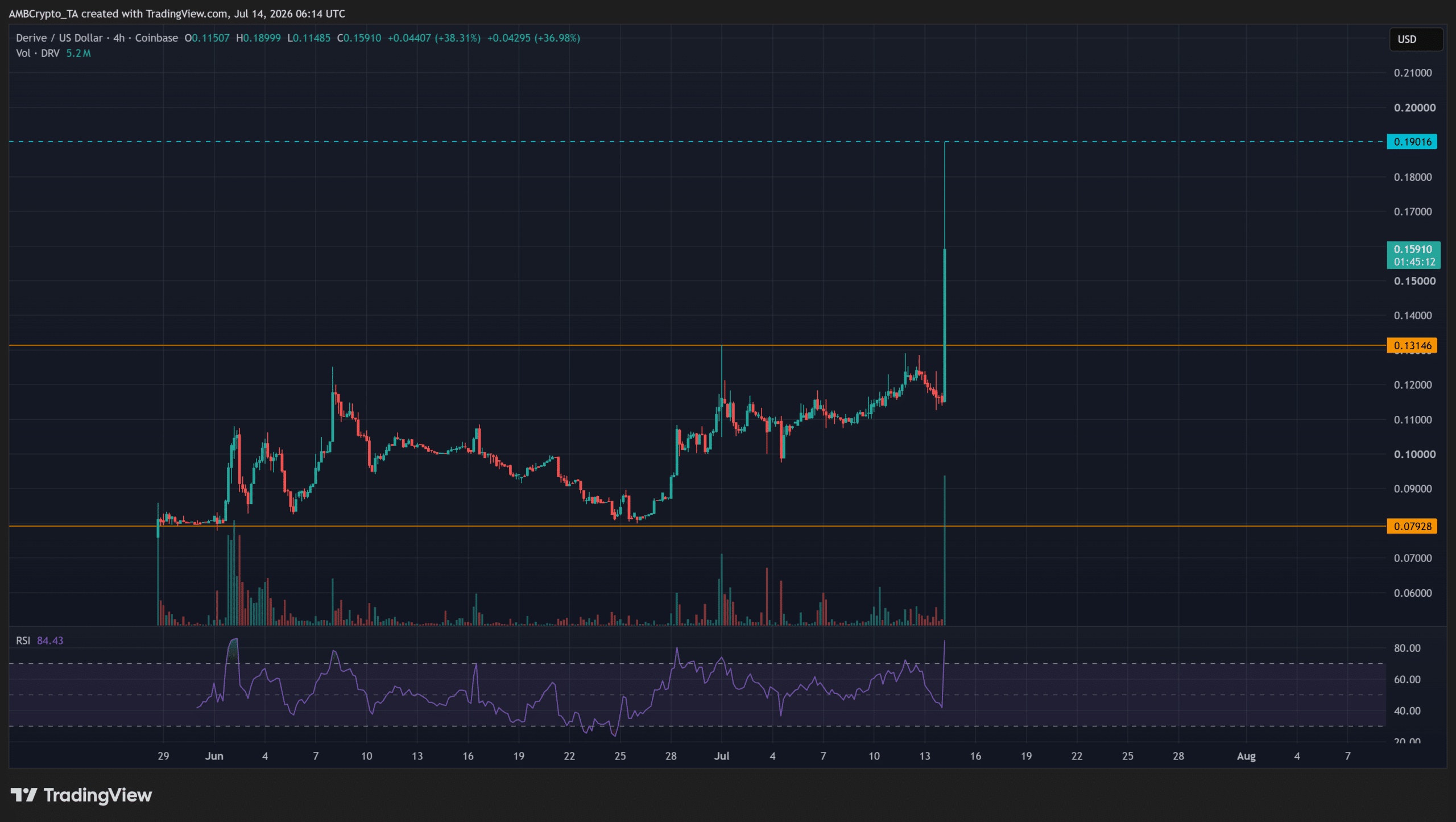
Source: DRV/USD on TradingView

However, the Relative Strength Index (RSI) reached 84.43.

As a result, it prompted early profit-taking as momentum became overheated.

That reaction implied that traders were locking in gains rather than abandoning the breakout completely. At the press time, the token was trading near $0.1471.

Still, holding above $0.131 would confirm buyers continue absorbing supply, whereas losing that level would suggest speculative demand is fading.

Can DRV build on the listing rally?

Early investor enthusiasm for the token has been evident in recent price action. The next challenge is proving that demand extends beyond the listing catalyst.

In many cases, speculative buying by short-term traders drives early price movement. However, sustained price appreciation requires continued investment over time after the immediate hype from the listing wears off.

Rising holder growth would indicate investors are accumulating rather than flipping tokens. Meanwhile, stable trading volumes and improving market depth would suggest liquidity is becoming more resilient.

More importantly, exchange net flows will also reveal whether buyers continue absorbing supply or early participants dominate selling.

Together, those indicators will determine whether DRV develops a stronger market foundation or follows the familiar pattern of post-listing reversals.


Final Summary

  • Derive [DRV] is set to gain broader liquidity and market access as Upbit prepares to open KRW, BTC, and USDT trading.
  • Derive now turns its focus from securing a major exchange listing to proving the rally reflects lasting demand.

İlgili Sorular

QWhy did DRV's price rally by approximately 40%?

AThe price rallied by approximately 40% following the announcement of DRV's upcoming listing on Upbit. Buyers aggressively repriced the token in anticipation of stronger liquidity and broader market participation from the new trading pairs.

QWhat are the new trading pairs for Derive (DRV) on Upbit and when does trading begin?

AUpbit announced KRW, Bitcoin (BTC), and Tether (USDT) trading pairs for Derive (DRV). Trading is set to begin on the 14th of July.

QWhat key price level does the article suggest buyers must hold above to confirm continued demand?

AThe article suggests that holding above $0.131 would confirm buyers continue absorbing supply, whereas losing that level would suggest speculative demand is fading.

QWhat does the article say is needed to create long-term demand for DRV beyond the initial listing hype?

AThe article states that simply receiving additional exchange support is unlikely to create long-term demand. It requires stronger trading volumes, deeper order books, consistent participation, rising holder growth, and resilient liquidity to build a stronger market foundation.

QWhat did the high RSI reading of 84.43 prompt among traders, according to the article?

AThe high RSI reading of 84.43 prompted early profit-taking as momentum became overheated, indicating traders were locking in gains.

İlgili Okumalar

How Long Will the Storage Boom Last?

Title: "How Long Can the Memory Boom Last?" (Author: Takashi Yunoue) Summary: The semiconductor industry, especially the memory market, is experiencing an unprecedented, explosive boom. Data (WSTS, 1991-2026) shows that while other categories like micros, logic, and analog grew steadily, memory shipments, particularly DRAM and NAND flash, have seen a near-vertical spike since 2024. Monthly memory shipments surged from ~$5.6B in 2016 to ~$63.3B in 2026, an 11x increase, with year-on-year growth reaching a staggering 285%. This dwarfs the previous peak of ~60% during the 2017-2018 memory bubble. The primary driver is not volume but a ~10x price surge for both DRAM and NAND, fueled by insatiable demand from AI data centers. Hyperscalers like Amazon, Google, Microsoft, and Meta are making massive capital investments (projected at $755B in 2026, ~36x growth since 2015), creating a "black hole" that absorbs GPUs, High Bandwidth Memory (HBM), and high-performance storage. This has diverted production capacity, causing severe shortages and price hikes for memory in consumer electronics (PCs, smartphones). While forecasts now predict the global semiconductor market will hit $1.5 trillion in 2026 and memory alone may surpass $1 trillion by 2027, the author warns this boom is unsustainable. Historical analysis of memory market growth rates over 35 years shows that periods of sustained annual growth have never exceeded five consecutive years, inevitably followed by a downturn due to the "silicon cycle" (demand surge → price rise → overinvestment → oversupply → price crash). Given the current boom started from a low in 2023/2024, a peak is expected by 2027-2028 at the latest. Furthermore, a fundamental rule applies: "The higher the peak, the deeper the valley." The unprecedented 285% growth peak suggests the subsequent recession could be the most severe in industry history. The author cautions that the current soaring stock prices and wealth creation in the memory sector are based on inflated expectations and urges companies to use this prosperous period to prepare practically for the inevitable downturn.

marsbit23 dk önce

How Long Will the Storage Boom Last?

marsbit23 dk önce

İşlemler

Spot
活动图片