Editor's Note: Microsoft was once one of the first tech giants to place a winning bet on OpenAI in the generative AI wave. Thanks to its investment in OpenAI and exclusive cloud partnership, Microsoft was initially seen as the most certain winner of the AI era: Azure gained model advantages, and its Office, Bing, GitHub, and enterprise software lines were fully integrated with Copilot. Satya Nadella, like he did leading Microsoft's shift to the cloud, was expected to orchestrate another platform-level migration.
But two years later, Microsoft's advantages have become more complicated. OpenAI is no longer just Microsoft's technology supplier, but also a direct competitor vying for enterprise customers. Models like Claude and Gemini have rapidly caught up, diminishing the sense of lead brought by GPT's exclusivity. The emergence of AI Agents further challenges the long-term SaaS business model that Microsoft relies on. Stock price pullbacks, slower-than-expected Copilot paid adoption rates, and GitHub Copilot being overtaken by Cursor and Claude Code have forced Microsoft to re-evaluate its AI strategy.
The most noteworthy aspect of this article is not whether Microsoft can catch up to OpenAI, Anthropic, or Google in model capabilities, but that Microsoft is attempting to redefine its position: it is no longer betting entirely on a single model, but shifting towards an "model-agnostic" enterprise AI platform strategy. In other words, Microsoft wants to become the foundational layer connecting models, data, security, workflows, cloud computing, and enterprise software. Models can come from OpenAI, Anthropic, or even in the future from Microsoft's own Superintelligence team. What truly stays within Microsoft's ecosystem is the enterprise customer's work platform, data assets, development environment, and security framework.
This is also the context for Nadella personally getting involved in Copilot product development. For Microsoft, the AI competition is no longer just a model race between labs, but a systematic competition about organizational speed, product form, customer relationships, and capital expenditure. Claude Code and Claude Cowork have shown that AI Agents could reshape software development and office workflows; open-source projects like OpenClaw indicate that an "always-on" AI assistant is moving from concept to reality. What Microsoft must do is package these more radical AI-native experiences within the security, compliance, and governance frameworks acceptable to enterprise clients.
However, the cost of this path is not low. To catch up with cutting-edge models and support agent-based products, Microsoft is pushing the AI competition towards "gigawatt-scale" infrastructure investment: more data centers, larger chip clusters, higher capital expenditure. By 2026, Microsoft's capital expenditure is expected to reach about $190 billion. In other words, Microsoft in the AI era must both experiment rapidly like a startup and sustain heavy asset investments like a cloud computing giant.
The real problem Microsoft faces is not whether it can remain the sole winner of the AI era, but whether it can continue to hold the core gateway to enterprise software amid rapidly commoditizing models and ongoing disruption of software business models by Agents. For Nadella, this may not be an ordinary product adjustment, but more like Microsoft's second startup phase during this AI platform migration.
The following is the original text:
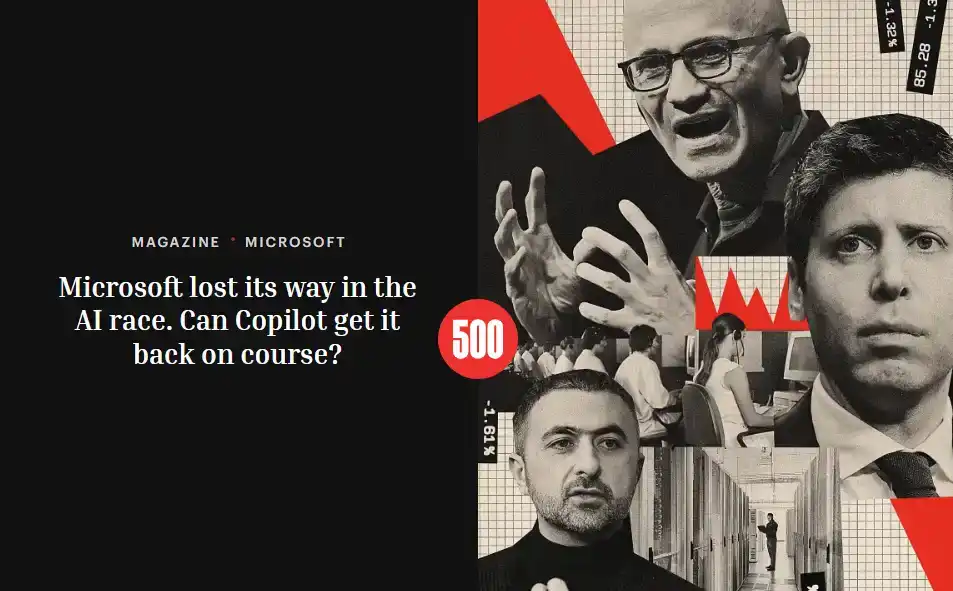
Mid-January 2026, Redmond, Washington. The weather was cold, gray, and dark, the kind of morning perfect for hitting the snooze button. But inside Building 92 on Microsoft's sprawling campus, a team of engineers had already arrived early.
They were fighting a tough battle, and they were already behind.
This team was developing a new AI product. It was more of a personal assistant, capable of helping users book flights, reply to emails, even find a reliable local plumber. The team members were well aware that other tech companies were developing similar products. Right at that moment, Microsoft CEO Satya Nadella arrived on the scene. He wanted to show them something.
Nadella opened his laptop and launched an application. It was a system for directing and controlling multiple AI Agents, which he called a "Chain of Debate." Nadella demonstrated it while explaining to the engineers. Team members exchanged knowing glances, like seasoned basketball players suddenly realizing a new teammate actually knew how to play.
Because this application wasn't something Nadella had asked someone else to build for him; he had written it himself using an AI tool called "vibe coding."
"It really set the tone for how hard the team was going to push over the coming weeks," recalls Jacob Andreou, Microsoft Executive Vice President in charge of Copilot design. Nadella was in the same room with them, almost standing behind the engineers, opening his own laptop and participating.
Seeing the CEO so excited about building a new product hands-on energized the team. By late February, the sprint concluded, and Microsoft launched Copilot Tasks—an AI tool that acts as a personal assistant capable of using a computer. The prototype Nadella had built also served as a reference model for a feature called "model council" within Copilot and other components.
But the fact that Nadella is diving this deeply and frequently into AI product teams, even personally building prototypes, itself speaks to Microsoft's current situation. After all, this is a $3 trillion tech giant, not a scrappy startup where the CEO frequently codes alongside developers during sprints.
Nadella's concern about Microsoft's AI strategy is evident enough. Last October, he announced he would step back from some commercial duties to focus more on AI research, product innovation, and AI data center construction.
This concern is not unfounded. Microsoft's stock had gone through a tough period. After hitting an all-time high last October, over the next five months, Microsoft's stock price fell by about 34%. Meanwhile, AI-related revenue for Microsoft's cloud platform Azure more than doubled over the past year.
Microsoft also became a poster child for the so-called "SaaSpocalypse" (SaaS Armageddon sell-off). The emergence of AI coding Agents triggered a collective sell-off of software stocks. Many investors began to believe such products meant companies would no longer buy AI products from SaaS vendors like Microsoft in the future, and might not even buy off-the-shelf software at all.
Between October 28, 2025, and March 27, 2026, Microsoft's stock price fell by 34%. Sales of Microsoft's enterprise Copilot product were also slower than the company expected. Among the 450 million users of the Microsoft 365 office suite, less than 4.5% currently pay for Copilot features. Meanwhile, usage of the consumer-facing Copilot chatbot also lags far behind ChatGPT, Gemini, and Claude. The once-leading AI coding assistant GitHub Copilot was also overtaken by AI startups Cursor and Anthropic's Claude Code.
Two years ago, Microsoft looked like one of the earliest winners of the AI era. Thanks to Nadella's foresighted bet on OpenAI, Microsoft gained exclusive access to the models of this rapidly growing AI startup and could integrate them into its own product suite. If enterprises wanted to use OpenAI's technology, the only cloud service provider they could choose was Microsoft Azure. Microsoft even once believed OpenAI gave it its best chance in years to challenge Google Search.
At that time, Nadella had been at Microsoft's helm for a decade. He had led Microsoft's platform migration from desktop software to the cloud, and now seemed poised to replicate that success in the AI era.
But AI changes too fast. Two years is already a long cycle. The story that follows is how Microsoft missed its early AI lead, and how it is trying to regain the initiative.
What Went Wrong
Microsoft's initial position at the forefront of the AI race was precisely due to its partnership with OpenAI; but what partly put it on the back foot was also this same partnership.
Microsoft spotted this young San Francisco company early, first investing $1 billion in 2019, with total committed investment in OpenAI reaching $13 billion later. Microsoft used OpenAI's technology to launch a series of AI products branded as Copilot across its consumer and enterprise software lines.
But after ChatGPT's release in late 2022, OpenAI's explosive growth and rapidly expanding ambitions quickly strained the relationship. The two companies clashed on multiple issues: on computing resources, OpenAI always wanted more; on intellectual property, Microsoft believed OpenAI wasn't fulfilling contractual obligations to share technological innovations promptly enough; on customer relationships, OpenAI began directly pitching AI models to the same enterprise customers Microsoft was also selling Copilot to; and when OpenAI sought restructuring, they disagreed over how much equity Microsoft should receive in the new for-profit company.
Nadella knew betting Microsoft's AI strategy on a single, not-yet-fully-proven startup was inherently risky. In November 2023, that risk was laid bare: the non-profit board controlling OpenAI's for-profit business fired CEO Sam Altman for "not being consistently candid," notifying Nadella only minutes before announcing the decision publicly.
Nadella had to quickly reassure investors, emphasizing Microsoft still had access to OpenAI's technology; simultaneously, he collaborated with Altman to pressure the board to reverse its decision. Nadella announced Microsoft was prepared to hire Altman and any OpenAI employees willing to follow him to Microsoft. The threat of a mass exodus ultimately forced the board to relent and reinstate Altman.
Within OpenAI, this five-day crisis later became known as "the blip." But according to people familiar with Nadella's thinking, it shook him deeply. He had to find a hedge for Microsoft's AI bets.
"When Nadella joined an AI engineer team's sprint, it really set the tone for how hard the team was going to push over the coming weeks." —Jacob Andreou, Microsoft Copilot Executive Vice President
Microsoft's Plan B was Mustafa Suleyman.
Suleyman is a co-founder of Google DeepMind who later left to start his own AI startup, Inflection. In March 2024, Microsoft hired Suleyman and Inflection's technical team in a $650 million deal, also licensing its technology. Suleyman was then appointed CEO of Microsoft's new AI division, abbreviated as MAI. Its responsibilities were twofold: first, building Microsoft's own cutting-edge models as a hedge against OpenAI risk; second, expanding the user base of Microsoft's Copilot chatbot.
But this step didn't go smoothly. Microsoft's partnership agreement with OpenAI prohibited it from training models beyond a certain size. Suleyman told Fortune: "We were essentially limited to training Microsoft's own native models, and only up to the scale of SLMs, or small language models."
MAI's first publicly tested general-purpose language model, named MAI-1 preview, launched in August 2025 but ranked quite low on various performance leaderboards and was never widely released.
MAI also failed to turn the Copilot chatbot into a consumer hit. According to media reports, a year after Suleyman took over, Copilot usage stagnated at around 20 million weekly active users, while ChatGPT's user base soared, eventually approaching 900 million. In 2025, Microsoft attempted a major upgrade of Copilot to make it more like a personal assistant capable of performing tasks, but this upgrade did not reignite growth. As for the new AI-powered version of Bing search, it also barely dented Google's share of the search market.
Meanwhile, Plan A also began to encounter trouble.
In 2023, OpenAI's GPT models led the industry by a wide margin. But by early 2025, Anthropic's Claude was often topping AI leaderboards, and many enterprises preferred it for complex tasks. Google's Gemini also became increasingly competitive in visual tasks. Yet Microsoft's Copilot products were still entirely powered by GPT. The engine that once underpinned Microsoft's AI strategy was starting to feel like a heavy burden.
Microsoft Commercial CEO Judson Althoff admits the company made several mistakes. First, naming both consumer and enterprise products "Copilot" was inherently confusing. Althoff, who holds a private pilot's license, quipped: "The only thing worse than not having a copilot is having more than one copilot."
Microsoft also incentivized sales reps to promote both free and premium versions of the enterprise M365 Copilot, but only the premium version truly delivered value for enterprise clients. "We got that wrong," he said.
Microsoft was also struggling to keep pace with the speed of AI evolution. A key turning point came in 2025 when Anthropic released Claude Code. Developers simply describe what they want, and it can autonomously write complete programs. This was no longer a "copilot," but "autopilot." Within six months, it reshaped software development.
Then in January this year, Anthropic launched Claude Cowork. This is an Agent capable of using software, including Microsoft productivity tools like Excel and PowerPoint, and autonomously completing tasks.
Claude Cowork poses a serious challenge to M365 Copilot and the AI Agents Microsoft has been pushing clients to adopt. In fact, it threatens not just Microsoft, but most commercial software. It was this realization that triggered the so-called "SaaSpocalypse" software stock sell-off. Ultimately, over $2 trillion was wiped from tech market value, including a single-day $357 billion plunge in Microsoft's market cap.
How Microsoft is Correcting Course
By the fall of 2025, Nadella realized Microsoft had to reboot its AI strategy. Since then, the company's actions reflect a difficult balancing act: on one hand, it must innovate quickly like an AI startup; on the other, it must still reliably serve investors and enterprise clients like the steady Microsoft of old.
Nadella handed off many commercial and day-to-day operational duties to Microsoft veteran Althoff so he could focus on AI product development. Althoff says he handles "Horizon Zero and Horizon One," while Nadella handles "Horizon Two and Horizon Three." Meanwhile, Nadella began breaking down internal silos, making Microsoft faster, flatter, and more agile.
In March this year, Nadella merged the consumer and enterprise Copilot teams. Suleyman no longer oversees consumer AI products, instead leading a renamed model development project: the Superintelligence team. Suleyman says the name reflects the team's ambition and helps attract top researchers.
Jacob Andreou joined Microsoft in 2025, previously at Snap and venture firm Greylock. He now oversees both consumer and enterprise Copilot Experience and reports directly to Nadella. Joining Suleyman and Andreou on the Copilot leadership team are three other Microsoft Executive Vice Presidents: Charles Lamanna, responsible for Copilot, AI Agents, and platform; Ryan Roslansky, responsible for Microsoft Office and LinkedIn; Perry Clarke, serving as Applications Chief Technology Officer.
Lamanna says: "We want it to be a back end, a brain, driving both the consumer side and the work side." Nadella himself attends the Copilot leadership team's weekly stand-up and participates in a dedicated Teams channel discussing Copilot development progress.
Microsoft faces a delicate balance: it must innovate fast enough to catch up with AI rivals like Anthropic and Google, yet must remain a reliable partner in the eyes of large enterprise customers.
Andreou points to two new products as evidence the unified Copilot team is operating as Nadella envisioned: one is Copilot Tasks for consumers, the product Nadella personally helped prototype in January; the other is Copilot Cowork for enterprise clients.
He says: "Both of those are basically frontier-level experiences, one for consumers, one for enterprise users. And they were both put together by our team pulling resources together and building them in a matter of weeks."
Microsoft has also agreed to OpenAI's long-pending restructuring, with significantly less restrictive terms. The software giant received a 27% equity stake in OpenAI. If OpenAI goes public as widely expected, this provides potential upside. But the exclusivity arrangements in the old agreement have been abandoned: OpenAI can now partner with other cloud providers, and Microsoft can use models from other AI companies.
Suleyman says the new agreement finally allows Microsoft to build larger, more capable frontier AI models and ultimately achieve self-sufficiency. But he adds it will still take Microsoft two to three years to catch up with top AI labs.
The reshaped partnership also allows Microsoft to embrace OpenAI's main rival, Anthropic. Last November, Microsoft pledged up to $5 billion in investment in Anthropic and began offering its models on Azure. The ability to power Copilot with Claude has proven popular with enterprise clients and helped Microsoft build Copilot Cowork.
"You've got to give credit: OpenAI and Anthropic are helping us go faster." —Judson Althoff, Microsoft Commercial CEO
But Microsoft isn't simply swapping dependence on one loss-making AI startup for another. The investment in Anthropic reflects Microsoft's judgment about industry direction: AI models will become increasingly commoditized. At least in the enterprise market, the real value won't concentrate solely in the AI "brain," but will shift to the tools, data, security, cloud computing, and workflow systems surrounding that brain.
This is precisely where Microsoft believes it can win.
It already possesses many key assets: software tools, security systems, data warehouses, and cloud computing capabilities. Microsoft has also built a series of products branded with "IQ" to help companies create customized workflows, aggregate their own data, and build, deploy, and monitor Agents running those workflows based on any AI model from any supplier.
Althoff says: "We don't believe enterprises will change their information work platform, their development environment, their security environment every time a new model drops."
This strategic pivot also brings a new business model.
Previously, Microsoft typically charged per-user licensing fees, such as $30 per user per month for Copilot. Customers liked this model because budgets were easier to plan. But if the AI Agents within these products use models Microsoft doesn't own, Microsoft must pay corresponding token usage fees to the AI supplier.
Therefore, Microsoft has begun shifting to a hybrid pricing model: a base portion still charged per user license, including a limited token quota; any excess is billed per token. This is to avoid the "model-agnostic" strategy eroding profit margins.
For cost control, Microsoft has also started streamlining its workforce. In April this year, Microsoft announced its first-ever voluntary employee severance program, primarily targeting its longest-tenured employees. The company said about 7% of its U.S. workforce, roughly 8,750 employees, were eligible for the program, with an expected cost of $900 million.
There are signs Microsoft's adjusted enterprise strategy is working. As of the end of March, Azure revenue grew 40% year-over-year, and Microsoft's overall AI business reached $37 billion in annualized sales, up 123% year-over-year. Currently, 20 million M365 users pay for Copilot, a quarter of whom signed up in the first four months of 2026. Althoff says adoption is accelerating.
UBS analyst Karl Keirstead says more Microsoft customers are telling him they're starting to see Copilot's value. But overall user numbers remain unsatisfactory. He says: "I don't think they're at a penetration rate yet that Wall Street would be happy with."
Microsoft's "model-agnostic" strategy may also have a vulnerability: what if those high-profile AI startups also begin building Microsoft-style enterprise tools and connective systems?
This is no longer hypothetical. In February this year, OpenAI launched its Frontier platform for enterprises, offering many capabilities Microsoft is building into its new tools. Anthropic is also moving in this direction, launching Claude Managed Agents service.
Microsoft's argument is that decades of enterprise customer relationships, reputation for reliability and security, and deep integration with customers' existing software systems give it an advantage. Althoff says he welcomes the competition. "You've got to give credit: OpenAI and Anthropic are helping us go faster," he says.
But some question whether a company of Microsoft's size can truly match the agility of AI-native startups. UBS's Keirstead says: "Microsoft, and frankly all software companies, are facing something they haven't faced in over a decade: highly innovative, brand-new competitors. Expecting a large incumbent like Microsoft to pivot as quickly as OpenAI and Anthropic is probably asking too much."
Bank of America analyst Tal Liani sides with "Team Nadella." He believes AI companies are unlikely to build the full suite of products Microsoft offers. This means Microsoft doesn't necessarily have to win the AI race; it just needs to not lose it.
He says: "It doesn't have to be the best, as long as it's good enough, and when you bundle it you get a high value, that's really Microsoft's value proposition."
Yet, even just "not losing" comes at a high cost.
Like other hyperscale cloud providers, Microsoft is spending huge sums on data centers and specialized chips. In fiscal year 2025, Microsoft's capital expenditure reached $88.2 billion, roughly on par with peers like Google Cloud and Amazon AWS. But in hindsight, this was still too conservative. Surging demand left Microsoft short on computing power and unable to recognize signed AI revenue as actual revenue at the expected pace.
"I thought we would catch up," CFO Amy Hood admitted on last October's earnings call. "We have not."
Now, Microsoft is doubling down. The company expects capital expenditure in 2026 could reach about $190 billion, more than triple its 2024 spending. Wall Street, once nervous about such spending levels, now seems willing to tolerate these massive investments. But if investor sentiment reverses, Microsoft will be more exposed to risk than ever before.
In November 2025, an independent developer named Peter Steinberger released OpenClaw. This is a free, open-source system that can turn any AI model into a long-running, autonomous, always-on Agent: it can develop software, act as a virtual executive assistant, even manage inventory for an online store.
OpenClaw became popular among developers and AI power users. Reportedly, Nadella is one of them.
But OpenClaw, while popular, has a clear problem: to truly function, it needs access to systems, data, payment information, and passwords, making it extremely risky. It also consumes tokens at a staggering rate.
Nadella said at a tech conference in San Francisco in March: "I can't launch OpenClaw at Microsoft. I don't have the authority to do that, because it would be considered Microsoft releasing a virus. But at the same time, it is an incredible innovation."
Nadella has tasked the unified Copilot team with building Microsoft's version of OpenClaw: one that retains the fun and ease-of-use of a consumer-grade product while having the security and governance capabilities enterprises require. Andreou sees this as a test for the new organization: "That's what we call winning here."
Lamanna believes this could be the key to igniting Copilot growth. He says: "The hardest problem has always been: how do you help people change the way they work?"
If a perpetually running AI assistant is truly feasible, it will make that change easier to happen. It also means the basic unit of AI will shift from "model" to "always-on Agent." This is precisely the kind of paradigm shift that will test whether Microsoft's "connective tissue" strategy can hold when the core form factor changes. Lamanna says an enterprise-grade Microsoft version of OpenClaw is not far off.
"Gigawatt" Scale
The week of March 30, Suleyman gathered the new Superintelligence team in Miami for a three-day offsite. The team, about 500 people from around the world, met to chart a roadmap for achieving "gigawatt-scale" AI training runs. Training at this scale would enable Microsoft to compete directly with OpenAI, Anthropic, Google DeepMind, Meta, and xAI.
Suleyman says this is crucial for Microsoft to achieve self-sufficiency by 2030. Microsoft will lose access to OpenAI's technology in 2032.
The entire team gathered in a large ballroom to hear keynote speeches from Suleyman and Nadella and participate in an "Ask Me Anything" session. According to Suleyman, Nadella described this moment as Microsoft's "refounding of the company" in response to the AI platform shift.
This is a telling statement.
After the keynote, the meeting broke into different workstreams. Teams huddled around 40 whiteboards placed around the ballroom, brainstorming and planning eight-week sprints. Nadella didn't leave; he stayed.
For the next three hours, he moved from table to table, talking with researchers, offering suggestions, sharing ideas.
If this is truly a "refounding," then Nadella is playing the role of startup CEO. He takes no advantage for granted. He knows Microsoft could lose everything, and still has everything to fight for.