a16z Proposes "Staked Media": A New Game Using Deposits to Combat Misinformation

比推Pubblicato 2025-12-17Pubblicato ultima volta 2025-12-17

Introduzione

a16z has proposed a concept called "Staked Media" to combat misinformation using cryptographic technology and economic incentives. In an era where AI-generated content and fake news are widespread, the idea requires content creators or media organizations to cryptographically sign and stake a certain amount of cryptocurrency (such as ETH or USDC) when publishing content. This acts as a verifiable and unchangeable commitment on-chain. If the content is proven false, the staked funds are slashed; if true, the stake can be returned or even rewarded. The staking amount may vary based on the creator’s influence and content importance. To determine truthfulness, a combination of community voting (by users who also stake tokens) and algorithmic analysis is used. Disputes can be escalated to an expert committee. Malicious voters or creators may also face penalties. Repeat offenders would suffer reputational damage and higher staking requirements in the future. The system aims to incentivize truthfulness through financial stakes, reputation mechanisms, and potential legal accountability. It is suggested that such a model could be implemented within two years.

Recently, a16z proposed a concept called "Staked Media," which is quite interesting. Considering that social media is now filled with AI accounts, and fake news looks as real as the truth, ordinary users simply don't have the time or energy to distinguish between what's true and false.

The prediction of "Staked Media" is not far-fetched. It might emerge within the next two years.

So, what is Staked Media?

Simply put, it uses encryption technologies like zk to allow media or individuals to prove their credibility, similar to "making a written pledge" online. This "pledge" would be recorded on the blockchain, making it tamper-proof. But just making a pledge isn't enough; there also needs to be "staking something" as collateral, such as ETH, USDC, or other crypto tokens. This serves as proof that the published content is true and reliable. If the content is proven to be false, the staked assets would be slashed. This creates an environment that encourages truth-telling.

Nowadays, AI-generated articles and videos are everywhere, and fake news is rampant. Staked Media aims to make content publishers more cautious rather than speaking recklessly. For a simple example, imagine a YouTuber posting a video praising a certain product. They would have to "make a pledge" on the Ethereum chain and stake some ETH or USDC. If the video is fake, the money is lost, and viewers can rest assured. Another example: suppose you're a blogger recommending a mobile phone. You'd need to stake $100 worth of ETH on the Ethereum chain, making a pledge like, "If the phone's beauty filter doesn't achieve a certain effect, I will compensate." Viewers see that you've staked money and consider you trustworthy. If the video is fabricated by AI, the $100 is gone.

How could staking be implemented? Let's imagine.

Whether it's a big V/influential media or a small V, when posting content, they would need to "make a pledge" on the chain (e.g., Ethereum) (by signing for verification) and simultaneously deposit a certain amount of tokens (like ETH/USDT) into a specific smart contract. If the content is false, this money would be slashed (given to victims or burned). If the content is verified as true, the money could be returned after a certain period, and they might even receive rewards (such as tokens issued by the Staked Media platform itself or funds slashed from other fake content).

The specific amount staked could be determined based on the platform's rules. For major media/influencers publishing important news, the staked token amount would be higher, perhaps worth hundreds or thousands of dollars or even more. For small V's posting daily content, maybe a few dozen dollars would suffice. It could be linked to the content's influence (with a floating algorithm)—the greater the influence, the more that needs to be staked.

For media, staking indeed adds a financial cost, but it can gain the trust of the audience, which is a necessary cost in the era of fake news.

However, how to determine truth or falsehood? Through a dual verification system of community and algorithms. On the community side, users with voting rights (who need to stake crypto assets) would vote on the chain. If a certain threshold, say 60% or higher, votes that the content is false, it would be deemed false. Additionally, algorithms would analyze data to assist. If the content publisher disagrees, they can initiate arbitration, which would then be handled by an expert committee. If voters are found to be maliciously manipulating, their funds would be slashed. Participating in voting and being a member of the expert committee would come with rewards. Rewards would come from slashed funds and the media's own tokens, etc.

Furthermore, content creators could use zk technology to generate proof of authentic source from the very beginning, such as creating videos with zk technology.

What if wealthy individuals cheat? A wealthy person might stake a large amount to spread fake news, as long as the benefits are substantial enough.

It's not just about staking funds; there's also historical record and a reputation system. Accounts with slashing records would be labeled, and the required staking amount for their future content would increase. If an account is slashed 3 or 4 times, people would be less likely to trust their content later on. There could also be legal accountability. Therefore, falsifying information carries significant costs—not only financial but also the trust built over time, historical records, reputation systems, and real-world legal responsibilities.

Perhaps Staked Media projects are already on the way.


Twitter:https://twitter.com/BitpushNewsCN

Bitpush TG Discussion Group:https://t.me/BitPushCommunity

Bitpush TG Subscription: https://t.me/bitpush

Original link:https://www.bitpush.news/articles/7596328

Domande pertinenti

QWhat is the core concept of 'Staked Media' proposed by a16z?

AStaked Media requires content creators to cryptographically prove their credibility by staking assets (like ETH or USDC) as collateral when publishing content. If the content is proven false, the staked assets are slashed, creating an incentive for truthfulness.

QHow does the staking mechanism work in Staked Media to combat misinformation?

AContent creators must sign a verifiable 'pledge' on a blockchain (e.g., Ethereum) and lock tokens in a smart contract. If the content is deemed false through community voting and algorithmic analysis, the staked tokens are forfeited. Honest content results in the return of tokens or potential rewards.

QWhat role does the community play in verifying content truthfulness in Staked Media?

ACommunity members with voting rights (who also stake crypto assets) vote on-chain to determine if content is false. A threshold (e.g., 60% votes) triggers penalties. Malicious voters risk losing their staked funds, while honest participants may receive rewards from slashed tokens or platform incentives.

QHow does Staked Media address potential abuse by wealthy actors who might stake large amounts to spread false news?

ABeyond financial stakes, the system incorporates historical record and reputation tracking. Accounts with prior penalties face higher staking requirements and distrust. Repeated violations (e.g., 3-4 slashes) lead to loss of credibility and potential legal accountability, making abuse costly and unsustainable.

QWhat technological tools are suggested to enhance content authenticity in Staked Media?

AZero-knowledge (zk) cryptography is proposed to generate proof of authentic content origin, such as zk-based video verification, ensuring the content's integrity from creation to publication.

Letture associate

The Rise of Prediction Markets: DeFi's Next High-Value Piece in 2026

Prediction markets are emerging as a high-value component within DeFi, expected to mature significantly by 2026. These markets, which blend information discovery with financial speculation, exhibit a natural monopolistic tendency, leading to the development of a layered ecosystem comprising core platforms, peripheral services, and external integrations. Unlike traditional financial instruments, prediction markets (exemplified by platforms like Polymarket and Kalshi) thrive on highly certain underlying events (e.g., election dates) but uncertain outcomes (e.g., election winners). This structure allows real-time information to shape market sentiment, often becoming a self-fulfilling prophecy. Current innovations are focusing on DeFi integration of prediction market assets. Rather than creating clone platforms or simple tooling, the most promising direction involves leveraging the idle capital locked in prediction market positions before outcomes are determined. Proposals include using these assets within DeFi lending protocols (e.g., via platforms like Gondor or Morpho) or developing cross-market arbitrage mechanisms that offer users discounted entry prices funded by yield generated from DeFi strategies. This approach benefits all parties: users get better pricing and additional yield, prediction platforms gain increased volume and integration into broader DeFi ecosystems, and liquidity providers achieve higher capital efficiency. The deterministic nature of settlement dates makes these assets uniquely suitable for structured financial products. With major events like the 2026 World Cup and U.S. midterm elections approaching, prediction markets are poised to capture significant attention and capital, further accelerating their convergence with DeFi.

比推21 min fa

The Rise of Prediction Markets: DeFi's Next High-Value Piece in 2026

比推21 min fa

Space Review|2026 Outpost: Narrative Recedes, Value Flows to Resilient Ecosystems with Real Yield

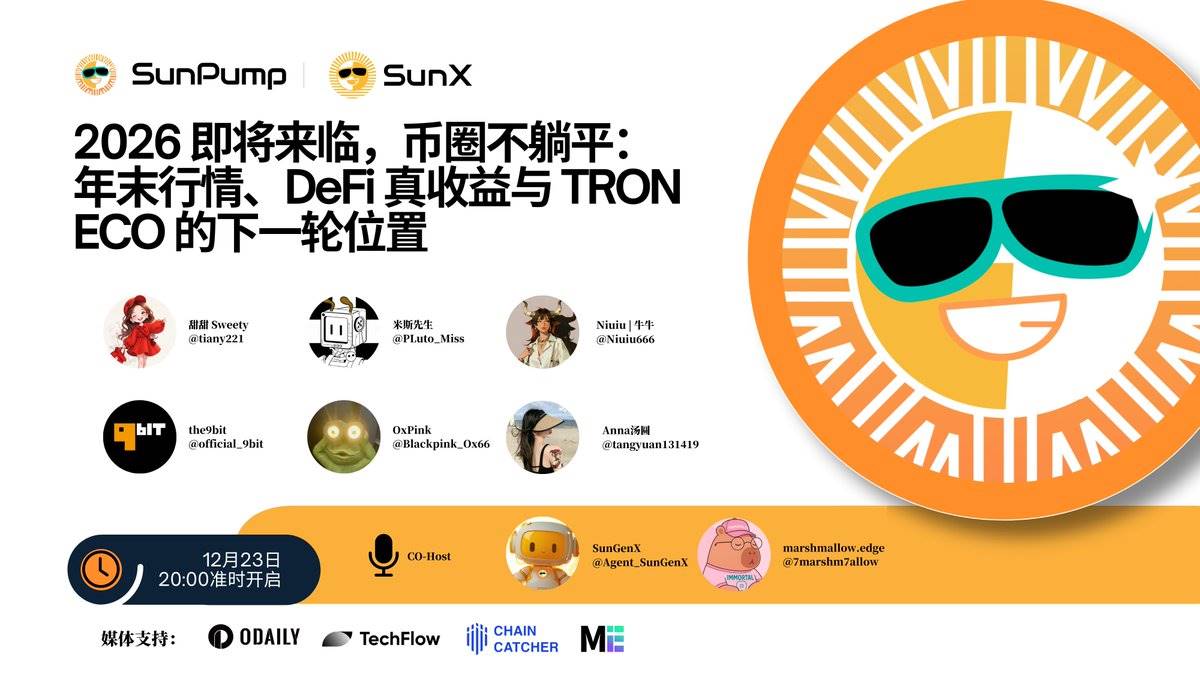
As 2025 draws to a close, the crypto market is shifting from hype-driven speculation to a focus on sustainable value. The recent SunnPump roundtable, "2026 is Coming, No Laying Flat in Crypto," explored this transition, emphasizing that the path to 2026 depends on ecosystems with real utility and organic demand, not short-term narratives. Experts agreed that the market is moving towards a phase driven by genuine cash flows and capital efficiency. Tron was highlighted as a prime example of a mature "digital financial infrastructure," distinguished by its dominant role in stablecoin settlements. With nearly $80 billion in on-chain USDT circulation—half the global market—and daily stablecoin transfers of $20-24 billion, Tron has built a resilient ecosystem anchored in real-world use cases like payments and lending. Its TVL of ~$24 billion, including $10.4 billion in JUST Protocol, reflects deep liquidity and organic activity. The discussion on DeFi sustainability centered on projects with real revenue generation, not subsidized yields. Protocols like JustLend DAO exemplify this with a diversified income model from staking services and lending, using fees to buy back and burn its JST token, creating a deflationary feedback loop. This aligns protocol success with tokenholder value. Tron’s $204 million in protocol revenue in November 2025, leading all public chains, underscores the power of its real economic activity. In conclusion, the key to enduring market cycles lies in ecosystems like Tron’s that provide essential, high-utility services—low-cost transfers, reliable staking, and lending—forming an organic, self-sustaining financial infrastructure with inherent resilience.

深潮42 min fa

Space Review|2026 Outpost: Narrative Recedes, Value Flows to Resilient Ecosystems with Real Yield

深潮42 min fa

Trading

Spot
Futures

Discussioni

Benvenuto nella Community HTX. Qui puoi rimanere informato sugli ultimi sviluppi della piattaforma e accedere ad approfondimenti esperti sul mercato. Le opinioni degli utenti sul prezzo di A A sono presentate come di seguito.

活动图片