Author: David, Shenchao TechFlow
Hollywood is searching the internet for a Chinese person. But the person being sought didn't even leave a usable contact method.
On the evening of May 10th, PJ Ace, founder of the Los Angeles AI film studio Genre.ai, reposted an AI short film called "The Scavenger" on X. PJ Ace is probably one of the most influential figures in the AI video circle, with his own content garnering over 300 million views across platforms.
His evaluation of this short film was extremely high, "This is one of the best short films I've seen in recent years."
The concept of the short is roughly this: a robot cowboy rides an ostrich through a post-apocalyptic wasteland, battles zombies, and has a romance with a plastic mannequin. Besides the sufficiently cyberpunk and fantastical theme, the visuals and music also have a distinct blockbuster quality.
(Viewers who haven't seen it can click here to experience it.)
A few hours after PJ's post went up, the view count reached 5 million.
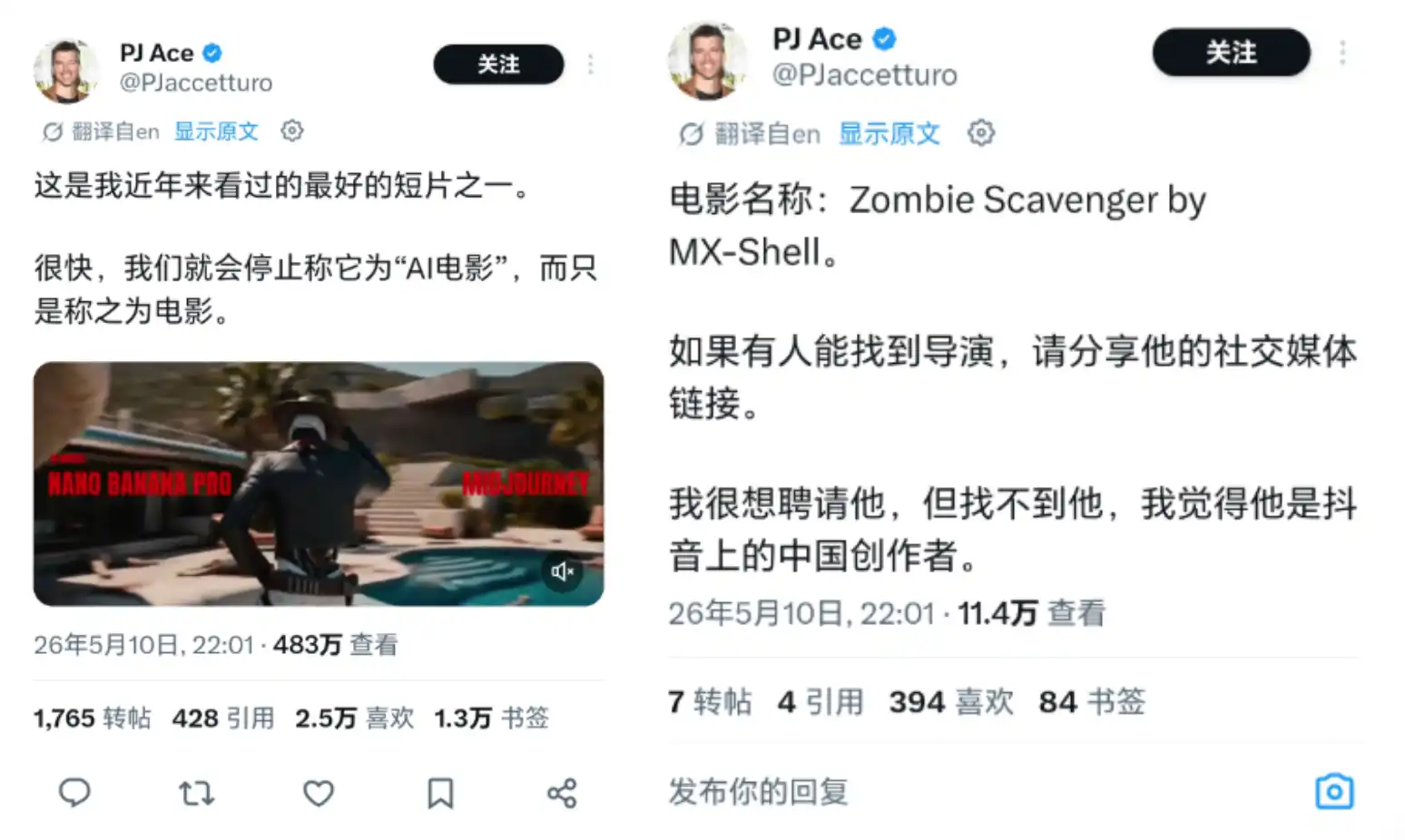
He immediately followed up with a missing person post: "I would love to hire the director of this short, but I can't find him. I think he's a Chinese creator on Douyin."
A person holding Hollywood content production resources, posting on Twitter like a lost and found notice to find a Chinese person? The author feels this scene itself is more surreal than the short film...
His reasoning was that, before AI, something of this quality would have cost at least $500,000 and six months to produce, yet this author achieved this level using only his own creative effort. The replies to the post quickly turned into a search party, with people searching for the author ID MX-Shell, and others tracing clues to Bilibili.
A massive cross-platform search from Hollywood to Bilibili's comment section had begun.
However, on the same day PJ Ace was anxiously posting missing person notices on Twitter, this short film hadn't made much of a splash on Bilibili or Douyin yet, lying quietly in the information feeds.
A short film made by a Chinese person using Chinese AI tools had to first become popular across the Pacific, before being noticed back home. The process of this large-scale cross-platform search returning to China itself became a case of reimported goods.
Making a Hobby Visible
The person PJ Ace was looking for had labeled himself with five words on Bilibili: amateur hobbyist.
The author, Mx-Shell, commented claiming to be a vocational school graduate from Yunnan, having never attended university or worked for any film company. The "non-professional amateur hobbyist" written in his Bilibili bio seems like genuine humility.

It is reported that "The Scavenger" was made by him using ByteDance's AI video tool Seedance 2.0. Alone, without a team or investment, he independently completed it from conception to final product, even creating the background music himself.
The production cycle was about 10 days, with Token costs roughly equivalent to about 3,000 RMB.
Then comes what the author finds the most fascinating part of the whole story.
PJ Ace's missing person post was seen by millions on X, but Mx-Shell himself couldn't see it at all, unaware that a Hollywood director across the Pacific was looking for him.
When the news eventually made its way back to China, the comments section under the video exploded, but Mx-Shell himself didn't understand English, lacked channels to connect with overseas media, and even posted his QQ email address, asking netizens to forward it to the other side.
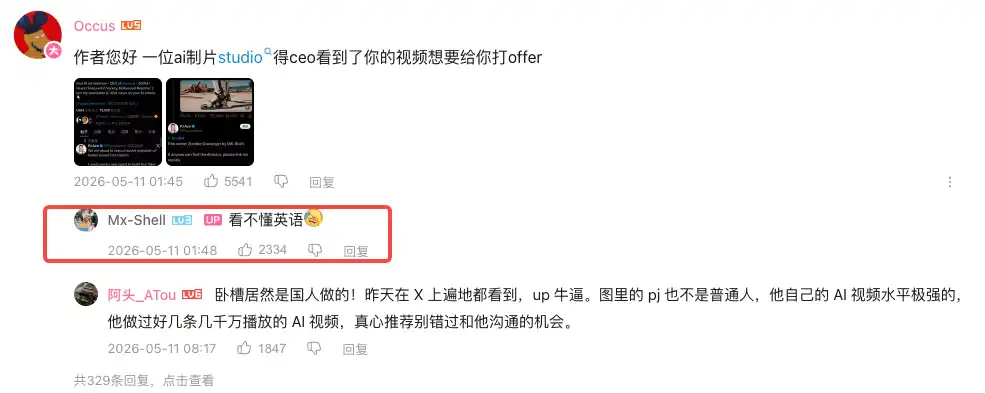

Hollywood was looking for him in English on Twitter, he was looking for Hollywood with a QQ email address in the Bilibili comments section. With the help of netizens, this cross-platform conversation had a happy ending.
Currently, PJ has already sent him an email via the address. In the letter, PJ Ace said he runs a film studio in Los Angeles, the short film garnered over 4 million views on the day it was shared, and then asked, "Would you be interested in becoming a Hollywood director?"
An amateur hobbyist receiving an olive branch extended by Hollywood—perhaps this is also a kind of wonderful, serendipitous discovery of talent in the AI era.
Talent Going Global, Reimported Goods
Back to why this short film was quiet on Bilibili initially but exploded when posted on X.
On Bilibili, a short film labeled "Contains AI-Generated Content" has to compete for the same information feed as professional animations from million-follower UP owners, game live streams, and popular fan creations. Mx-Shell had only a few thousand followers at the time, no recommendation spots—a grain of sand falling into the desert.
X is a completely different world. The overseas AI creator community has grown its own ecosystem over the past two years, with top bloggers, evaluation consensus, and mature dissemination networks.
PJ Ace is a core node in this ecosystem. What he saw in "The Scavenger" was the work itself; AI was just the tool. The fan base amplified the spread, exploding this piece of content in a matter of hours.
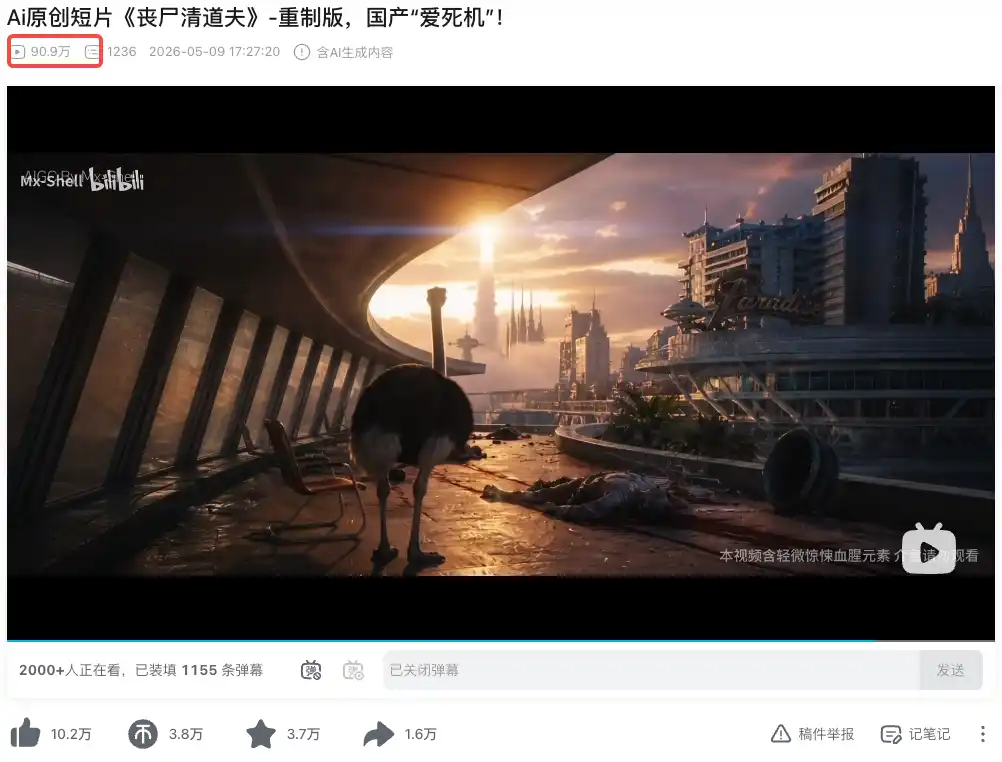
The later reimported data also illustrates this point. Domestic viewers recognized its merit too, with over 900,000 plays and 100,000 likes on Bilibili. In the AI era, content is never the primary problem; the problem is whether it gets delivered to the right people.
This reminds the author of a similar phenomenon: Token export.
Chinese large language models sell computing power globally via APIs. The electricity never leaves China's power grid, but value is delivered cross-border through Tokens. Mx-Shell's story is the creative version of the same logic. Talent and aesthetics never left his computer, but the work also achieved cross-border delivery through a short film. Seedance is ByteDance's, the computing power is from Chinese data centers, the creator is from Yunnan, but the first large-scale audience to see this film was across the Pacific.
If Token export is power export, "The Scavenger" is talent export.
Why did this path start from China? Probably because China simultaneously has two things. The world's most fiercely competitive AI video tool market—ByteDance, Alibaba, Kuaishou trampling over each other to drive generation costs to the floor. Mx-Shell's use of Seedance 2.0 was relatively low-cost in terms of spending.
And a large number of creative people who previously had no outlet—people with taste and ideas, lacking only a handy tool.
The former gave the latter a key. Once the door opened, the global market was outside.
AI is a Good Shovel, But You Have to Dig Yourself
The story isn't over yet.
After Mx-Shell connected with PJ Ace, he posted a lengthy article responding to the external attention. Thirteen points, each one substantial. The author feels this text itself is worth a closer look.
He said the style of "The Scavenger" is called atompunk, a form of retro sci-fi. Creative inspiration came from Pixar's "WALL-E," and it was made to the standard of the popular Netflix series "Love, Death & Robots."
One of the creative intentions was to show overseas audiences the current level of domestic AI production.

Shot control relied on text prompts, the prompts were basically crafted manually. Post-production was done by one person. Even the background music was original. Looking at these details together, one realizes Mx-Shell is far from just being "lucky to encounter AI tools."
He has visual aesthetics, being a photographer by background. He has auditory aesthetics, being an independent musician. He has a sense for narrative, setting a high bar for himself with the "Love, Death & Robots" standard.
AI tools gave him production capacity, but the taste and judgment were his own.
So the author feels the saying "AI allows everyone to make movies" is only half right. AI indeed pushes production barriers to the floor, but computing power can be bought, taste cannot.
Anyone can use Seedance 2.0. Why was it Mx-Shell who made something that prompted a Hollywood missing person post? The tools are equal, but the people using them are vastly different.
This leads to another interesting angle.
ByteDance's investment in Seedance 2.0 is unknown to the outside world, but so far, the best advertisement for this tool might be what a Yunnan vocational school graduate created.
ByteDance's marketing department couldn't have planned such a story because the story's persuasiveness lies precisely in it being spontaneous, organic, and unplanned.
The strongest proof for a platform product is always users creating things that exceed the platform's expectations. Taobao's early benchmark stories were rural women earning millions selling local specialties. YouTube's benchmark was bedroom teenagers making shows better than TV. Seedance 2.0's benchmark story is more creators like Mx-Shell.
According to DataEye data, the overseas AI short drama and comic drama market size is expected to reach $650 million in 2026, a sixfold year-on-year increase. Currently, two paths are running in this market:
One is the industrialization route. Domestic teams produce AI short dramas in bulk—zombies, werewolves, underdog revenge stories—packaged into genre shells familiar to Western audiences, monetizing through TikTok ad campaigns. Reports say several works have already achieved tens of millions of views. This path competes on capital, team, and production capacity, somewhat like the short video factories of the past.
The other is the path Mx-Shell took. One person, one computer, not relying on ad campaigns or scale; the content itself is the transmission force. Token costs a few thousand, cycle less than two weeks, exchanged not for platform revenue share, but for Hollywood actively reaching out.
Both paths can work, but the author finds the second path more noteworthy.
Because the barrier for the first path is money—if you have money, you can do it, not much related to the individual creator. The barrier for the second path is the person—the taste, the judgment of content. These things AI can't give you, and money can't buy them either.
He won't be the last person to walk this path.
China has a large number of creators with taste, ideas, and a desire to express. Previously, what blocked them was equipment, funds, teams, academic qualifications. Now, these barriers are being dismantled one by one by AI tools. The remaining problem is only one: how to be seen.
Mx-Shell's answer was a QQ email address and a group of enthusiastic netizens. The next person might have other methods.
But before the domestic ecosystem for AI creation truly matures, this detour of reimported goods will probably have to continue for a while longer.