Written by: Xiaojinya, Zimu AI
Apple has "bowed its head".
On January 12 local time, Apple and Google issued a joint statement:
"After careful evaluation, Apple believes that Google's artificial intelligence technology provides the most robust foundation for the Apple base model, and is excited about the innovative experiences it will unlock for Apple users."
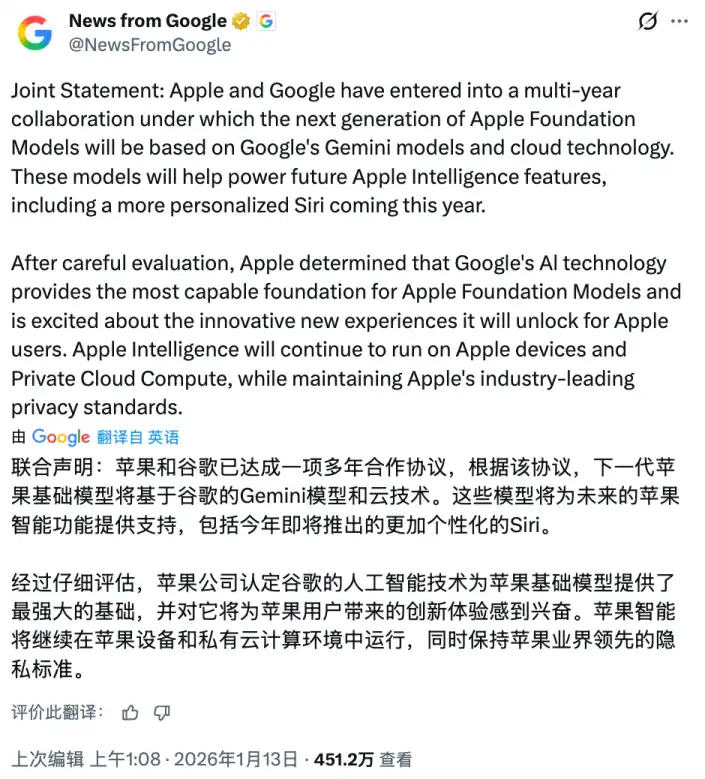
The two companies stated that these models will help support future Apple Intelligence features, including a more personalized Siri set to launch later this year.
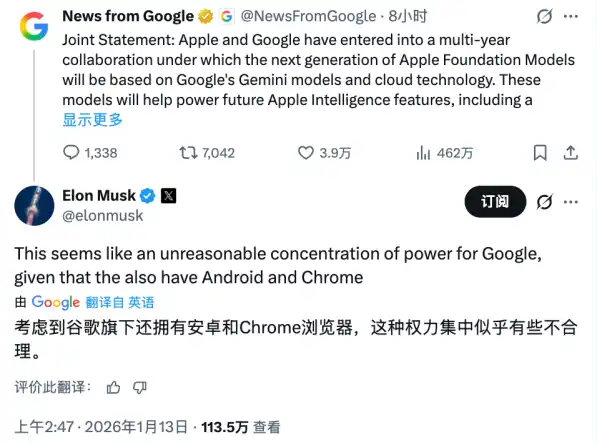
As soon as the news broke, Musk was the first to express displeasure, commenting on X that this kind of "power concentration" is unreasonable, given that Google also owns Android and the Chrome browser.
This is tantamount to saying that Google now controls Apple's AI as well. But Apple would certainly disagree with this statement.
For Apple, this is a temporary bowing of the head, but by no means an admission of defeat or surrender.
The introduction of Google Gemini is more like a temporary worker Apple has found for the transition period; it will not completely replace Apple's self-developed model. Moreover, Apple is still developing a trillion-parameter model.
Gemini Has Not Replaced Apple's Self-Developed Model
The statements released by Apple and Google are limited and deliberately vague, but one thing is clear: Gemini will participate in the construction of the new Apple base model.
This matter was reported by Bloomberg's Mark Gurman back in November last year, when he cited sources familiar with the matter saying that Apple would pay Google about $1 billion annually.
However, this is not a simple "one-for-one" swap of the Gemini model for the Apple base model, but rather a system architecture that allows Apple to continue using its own model while not providing any data to Google.
As the initial rumor pointed out, Gemini will not be directly embedded into Apple's operating system.
Instead, everything will still be presented externally with the Apple base model at its core, but at the underlying architectural level, Gemini will become its "foundation." In other words, Apple's use of Gemini falls somewhere between "shelling" and "distillation," and of course, given the cooperation between the two parties, this is certainly legal.
This is crucial; interpreting this news as "Apple's AI will be powered by Gemini" is inaccurate.
When you buy an iPhone, it internally uses chips manufactured by TSMC, displays from Samsung, and various components from all over the world. But no one would therefore claim that Samsung is "powering" the iPhone.
The on-device Apple Intelligence will still be powered by the Apple base model.
In other words, the Gemini model will serve as a tool to help train the Apple base model, enabling it to better perform the various tasks Apple sets for it.
Last year, Gurman's report mentioned that, according to the agreement between Google and Apple, Google's Gemini model would be responsible for Siri's summarization and planning functions—components that help the voice assistant synthesize information and decide how to execute complex tasks. Some of Siri's functions will continue to use Apple's self-developed model.
The report also stated that the model would run on Apple's own private cloud computing servers, ensuring user data is completely isolated from Google's infrastructure. Apple has allocated AI server hardware to support the operation of this model.
As the current public statements from both sides are ambiguous, the above content has not been refuted.
This deal is fundamentally different from the "Google Search" type of cooperation because it is completely invisible to the end user. When conversing with Siri, there will be no Gemini branding, nor should there be.
Apple Has Not Given Up
Further cooperation with Google is Apple's "transitional" choice.
Apple users have been looking forward to the new Siri since 2024, when Apple showcased it at WWDC and said it would be rolled out gradually. But since then, it has been repeatedly delayed, becoming a major embarrassment for Apple.
Currently, multiple media reports indicate that the new Siri will be released in March with iOS 26.4.
In addition, Apple Intelligence itself has not been progressing smoothly either; the initially launched features like "News Summaries" have been questioned for making errors.
Worse still, when Meta suddenly initiated a "war for AI talent" last year, Apple also suffered heavy losses. The most well-known case was the head of Apple's AI base model team at the time, Ruoming Pang, being poached, reportedly offered a sky-high compensation of $200 million by Meta.
In this situation, if delays continue, it would not only mean falling behind in the AI race for Apple but would also severely damage market trust.
At this point, turning to a third party to push forward the most urgent matters (like the new Siri) according to the schedule and deliver results to users is Apple's top priority.
And choosing Google is not surprising.
Apple and Google have a long-standing cooperative relationship; for example, Google has been paying Apple over $20 billion annually for years to remain the default search engine in Apple's Safari browser.
Their cooperation has attracted antitrust lawsuits, but the latest ruling only required adjustments to specific practices; the $20 billion cooperation between the two is still permitted.
Furthermore, Gemini is currently one of the strongest models. According to previous coverage, Apple tested several mainstream models including Gemini, GPT, and Claude, and ultimately selected Gemini.
As an aside, Apple's emphasis on "user privacy" in this new cooperation with Google Gemini, stressing that everything runs on the "Apple Private Cloud" and that no data will be shared with Google, is also a lesson learned from past collaborations with Google. In 2012, the "Safari tracking cookie scandal" occurred, where Google was accused of exploiting a privacy setting vulnerability in the Safari browser to place tracking cookies, bypassing the policy of blocking third-party cookies by default. Ultimately, Google was fined $22.5 million by the FTC and required to make changes. Additionally, Google reached a $17 million settlement with 37 states and the District of Columbia to resolve a class-action lawsuit.
In summary, this cooperation between Apple and Google can be called a temporary "bowing of the head," but by no means "admitting defeat" or "giving up."
Apple is still developing its own trillion-parameter model, expected to be launched around 2027.
Even when that model is released, Apple will likely still retain Gemini for reinforcement training, comparative analysis, and further optimization. Using it as a "tool" to strengthen itself is precisely what Apple expects from Google Gemini.
The One Who Benefits Most is Still Google
Although we just spent a long篇幅 trying to clarify what this deeper cooperation between Apple and Google is and is not.
But it can be foreseen that the perception that "Apple's AI relies on Gemini" will be difficult to eliminate.
Some can't help but imagine: Imagine if by March or April, Siri suddenly becomes super easy to use......
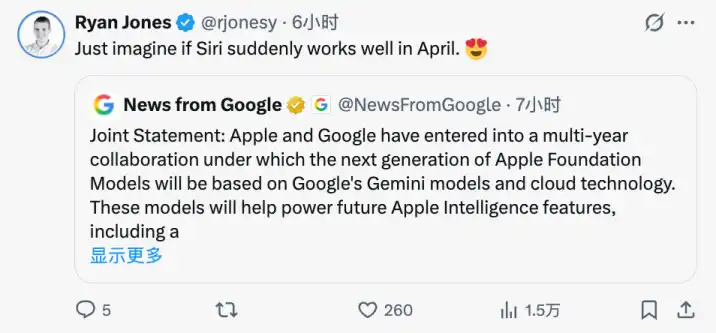
This isn't hard to imagine. The awkward situation Apple faces now is that if the introduction of Gemini indeed has an immediate effect and significantly accelerates the progress of Apple Intelligence and Siri, then the evaluation that "Apple really isn't up to it" would be confirmed.
In this case, even if Apple successfully develops its own trillion-parameter model and moves from the transition phase to self-reliance, Gemini would still be considered the功臣 (meritorious servant), not Apple itself.
As for Google, the market has already given it positive feedback.
After the joint statement from Apple and Google was released, Alphabet's stock price rose by up to 1.7%, and its market capitalization closed the day by breaking through the $4 trillion mark for the first time, setting a company record, while Apple's stock price rose by less than 1%.
This cooperation also puts other peers under pressure.
Elon Musk, who spoke out to express dissatisfaction, is one of them. He criticized Google, which controls Android and Chrome, for now also penetrating Apple, calling it an embodiment of "excessive concentration of power," hinting at monopolistic tendencies.
Another who might be uncomfortable is OpenAI's Sam Altman. OpenAI previously reached a cooperation agreement with Apple, where ChatGPT would serve as a "supplementary option" when Siri answers user questions. That is, just as Siri sometimes lists web search results now, it would, when necessary, provide answers from ChatGPT in the future.
This cooperation had previously brought glory to OpenAI, but now it pales in comparison to the new cooperation between Apple and Google.
Clearly, this cooperative status of being a "supplementary option" on the front stage is far inferior to Google Gemini's status as a "foundational helper" in the back stage. It's like the Apple club is putting on a show: OpenAI is performing on stage, but Google is working the lights backstage. Altman has not yet commented on this.
And in the Chinese market, whether Apple is also looking for a "transitional helper" before it builds its trillion-parameter self-developed model remains to be seen.