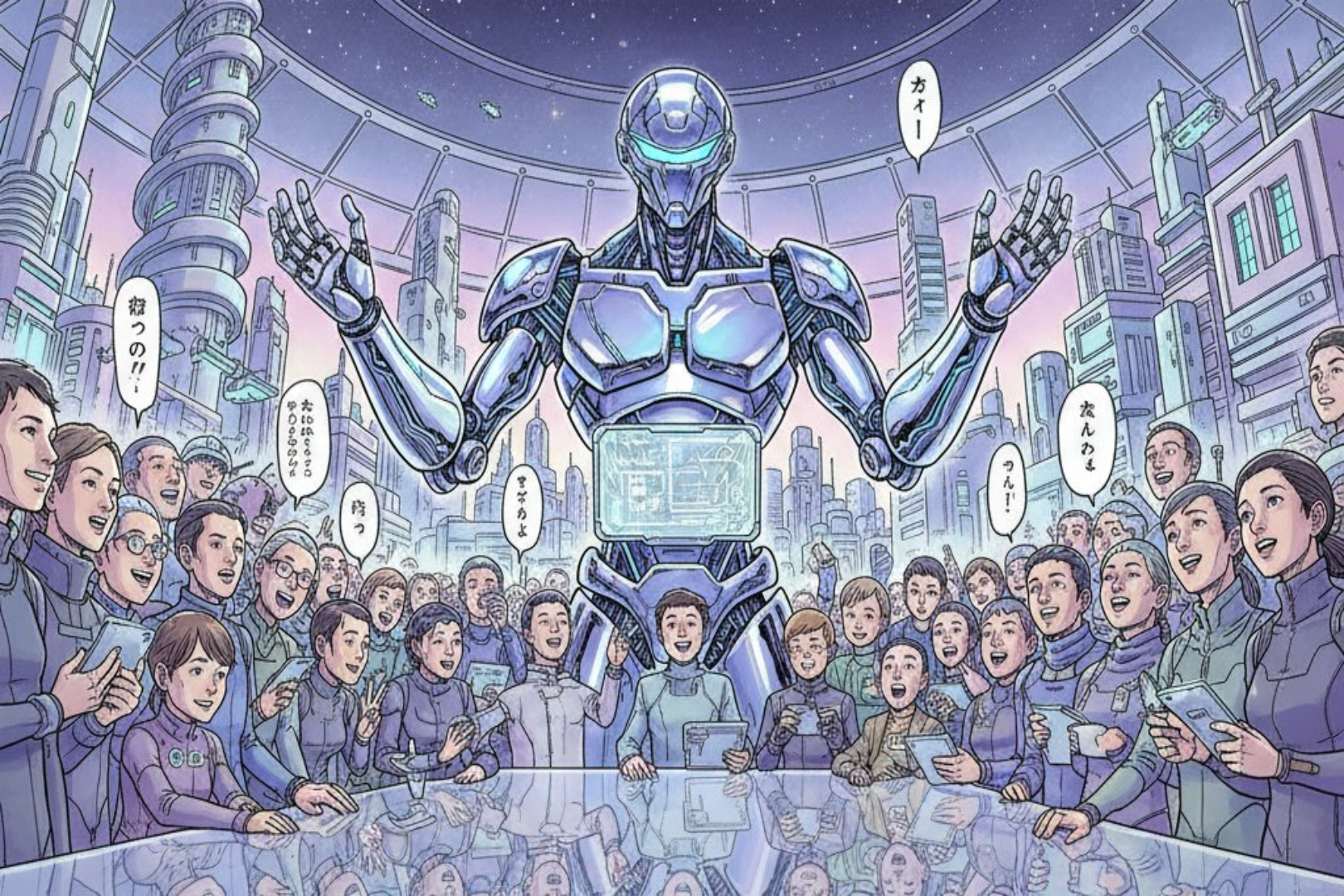
The AI Era: When the 'Gap Between Human and Dog' Shrinks to the 'Gap Between Humans'

深潮Published on 2025-12-24Last updated on 2025-12-24

Abstract

The article discusses how AI era is narrowing the cognitive gap between humans, using a hypothetical scoring system to illustrate the idea. Originally, the difference between individuals (e.g., a elementary student at 10 points vs. Einstein at 100) could be as vast as the difference between humans and dogs. However, with the advent of AI, which is estimated to contribute significantly to human capability (e.g., 80 points in the near term), even a less knowledgeable person equipped with AI can approach the performance of an expert. While some argue that skilled AI users (e.g., prompt engineers) may widen the gap initially, the author believes this is temporary. As AI becomes more intelligent and user-friendly, the barrier to leveraging its full potential will lower. Eventually, AI could reach a point where it contributes so much (e.g., 1000 points) that individual human differences become negligible—like two fighters using rocket launchers, where their original martial arts skills matter little. In the long run, AI will reduce relative disparities between people, even if absolute gaps persist, making expertise more accessible and diminishing the advantage of innate or highly trained human intelligence.

Author: 0xTodd

I didn't expect my last post to spark so much discussion. Essentially, we're all talking about the same thing, just with slightly different descriptions of the numbers.

We've all heard the saying: sometimes the gap between two people is bigger than the gap between a person and a dog. But this saying was born before the current wave of AI.

Today, I'll try to quantify this. The numbers are all rough estimates, just for fun—don't take them too seriously.

Let's say a primary school student's cognitive ability is 10 points, a PhD is 60 points, a university professor is 75 points, and Einstein is 100 points.

The difference between 10 and 100 points is indeed huge—a full 10x difference. It's not wrong to call it the difference between a person and a dog.

However, the AI of 2025 is worth at least 40 points. Considering AI is a generalist, while PhDs and professors are usually specialists, AI's actual value could be at least doubled to 80 points.

So we have:

- Primary student + AI = 90 points

- PhD + AI = 140 points

- Professor + AI = 155 points

- Einstein + AI = 180 points

With AI, the absolute gap between the primary student and Einstein is still 90 points, but the relative gap has shrunk from 10x to 2x.

This is my point: AI is narrowing the gap between humans.

Some might object: That's not right. A primary student certainly can't develop AI like a professor can.

It's like in One Piece, where characters develop their Devil Fruit abilities differently. The same Gomu Gomu no Mi, Luffy in first gear definitely can't beat Luffy years later in fourth gear (a novice vs. a seasoned expert).

Indeed, if AI is worth 80 points:

- Someone who doesn't know how to use it well (e.g., only asks an occasional question) might only get 20 points out of it;

- Someone very skilled at using AI (e.g., high-intensity vibe coding) might overclock it to get even 100 points.

So:

- Primary student + AI novice = 30 points

- Einstein + AI expert = 200 points

The gap has widened from 90 points to 170 points! So with AI, the gap between people has actually increased!

This is the view held by teachers Lao Bai and Alvin, and they are not wrong.

However, I must add a 'but'. While my view seems to conflict with theirs, the core idea is actually similar. Why?

Because I assume AI will continue to evolve:

First, it will become smarter;

Second, it will become easier to use.

The year 2025 is just a transitional period. The further we go, the easier it will become to be a Prompt engineer. The barrier will get lower and lower, to the point where 'having a mouth is enough'. Learning how to use AI will definitely become easier, not harder.

Let's assume that as AI gets smarter, it might reach 240 points. Then the level of utilization could range from low to high: 200, 240, 280 points.

Then:

- Primary student: 10 + 200 = 210 points

- Einstein: 100 + 280 = 380 points

The gap is 170 points, but it's not even 2x anymore—it's only 1.8x. The absolute gap has increased, but the relative gap has shrunk.

What about in 10 years? Let's be super optimistic and assume AI's cognitive ability evolves to around 1000 points.

Then:

- Primary student: 1010 points

- Einstein: 1100 points

(If this day ever comes) Even Einstein won't be able to pull far ahead of the primary student.

People think that the birth of AI has widened the gap between humans. I believe this is only a *temporary state* because AI is just emerging, and currently, people's ability to utilize it varies greatly.

But AI has replaced writers, replaced illustrators, replaced dancers, replaced artists... As these professions fall one by one, are you still worried that AI won't replace the training teachers who 'teach people how to 100% unlock AI's potential'?

Come on, that's its specialty.

In the future, it will be the norm, not the exception, for humans to utilize 80%-120% of AI's potential on average.

The smarter AI gets, the smaller the human role becomes, and the smaller the gap between humans becomes.

It's like two martial arts masters suddenly finding out they are allowed to use rocket launchers. What difference does it make if one has practiced fists and feet for 10 years and the other has practiced sword fighting for 15 years?

Related Questions

QWhat is the main argument of the article regarding the impact of AI on human intelligence gaps?

AThe article argues that while AI initially seems to widen the absolute gap between individuals (e.g., a novice and an expert user), its long-term effect is to reduce the *relative* gap. As AI becomes smarter and easier to use, the cognitive advantage of highly intelligent individuals (like Einstein) over less intelligent ones (like a elementary student) will diminish, making the difference between humans smaller.

QHow does the author use a numerical example to illustrate the initial effect of AI on a student and a professor?

AThe author assigns a cognitive score of 10 to an elementary student and 75 to a university professor. A 2025 AI is valued at 80 points. When combined, the student scores 90 (10+80) and the professor scores 155 (75+80). The absolute gap is large (65 points), but the relative gap is smaller than the original 'human vs. dog' difference.

QAccording to the author, why do some people believe AI increases the gap, and how does he respond to this view?

ASome believe AI increases the gap because a skilled user (an 'AI expert') can get more value (e.g., 100 points) from an AI than a novice (20 points), thus widening the absolute difference between them. The author agrees this is a temporary state but argues that as AI evolves, it will become easier to use, and the skill of maximizing its potential will be commoditized, reducing the relative gap long-term.

QWhat is the author's prediction about the future development of AI and its usability?

AThe author predicts AI will continue to evolve in two key ways: it will become significantly smarter (e.g., reaching a cognitive score of 1000), and it will become much easier to use, lowering the barrier to entry. Using AI will become as simple as 'having a mouth' (i.e., just speaking to it), and the need for specialized training to unlock its potential will be largely eliminated.

QWhat analogy does the author use to summarize the effect of advanced AI on human competition?

AThe author uses the analogy of two martial arts masters who are suddenly allowed to use rocket launchers. In this scenario, the difference between 10 years of fist-fighting training and 15 years of sword mastery becomes irrelevant because the new technology (the rocket launcher) is the dominant factor, drastically reducing the competitive advantage of individual skill.

Related Reads

After OpenMind's Token Launch: A Quick Guide to Unreleased Token Projects in the Robotics Sector

Following the recent token launch by OpenMind, a leading project in the crypto robotics sector, which generated significant community discussion and airdrop rewards, the broader robotics narrative is gaining momentum. This was further amplified by the high-profile showcase of embodied intelligence companies during the 2026 Spring Festival Gala. Against this backdrop of increased capital and public attention, the article highlights several promising, yet-to-launch token projects in the robotics space for potential early interaction and airdrop opportunities. Key projects featured include: - **PrismaX**: An open coordination layer connecting remote operators, users, and robot companies. It completed a $11 million funding round and offers an interactive platform where users can earn points through daily logins, quizzes, and even paid access to control robots remotely. - **Konnex**: A decentralized platform enabling robots to act as independent economic agents, collaborating on tasks and settling payments with stablecoins. It recently secured $15 million and has launched a points program for user engagement. - **BitRobot Network**: A decentralized, incentive-driven platform focused on Embodied AI research. It raised $8 million and is currently accepting applications for early access to its network. - **Axis Robotics**: A project aiming to bridge diverse human intelligence with Robotics General Intelligence (RGI), moving from "AI that chats" to "AI that acts." It provides an interactive hub for users to complete tasks by operating robots. The article provides basic interaction guides for each project, suggesting that the robotics sector is a key area to watch for potential airdrops and growth in the first half of the year.

Odaily星球日报1h ago

After OpenMind's Token Launch: A Quick Guide to Unreleased Token Projects in the Robotics Sector

Odaily星球日报1h ago

Aave's Internal Conflict Escalates, Morpho Quietly Doubles: Is the Lending Throne About to Change Hands?

The article discusses the escalating internal conflicts within Aave and the rising prominence of Morpho in the decentralized lending space. Aave, the current market leader, is facing significant governance disputes, including a controversial $51 million funding proposal and accusations of financial mismanagement, leading to internal friction and potential delays in decision-making. In contrast, Morpho has transitioned to Morpho Blue, a modular, permissionless lending protocol that allows isolated markets with risk parameters set by independent curators rather than global DAO votes. This design reduces governance friction and enables faster adjustments. Morpho has demonstrated strong growth, with TVL surpassing $9.5 billion, active loans exceeding $3.5 billion, and quarterly revenue around $50 million. User growth has also been robust, expanding from 30,000 to 400,000 active addresses. A significant catalyst for Morpho is the involvement of Apollo Global Management, which plans to acquire 90 million MORPHO tokens (9% of supply) over 48 months, valued at approximately $162 million. This partnership may signal Apollo’s strategic move to leverage Morpho’s infrastructure for enhancing yields on its tokenized real-world assets (RWA), addressing liquidity challenges in the RWA market. While Aave’s governance issues may hinder its progress, Morpho’s innovative structure and institutional backing position it as a potential challenger for the lending throne. However, risks remain, including a major token unlock in March that could impact short-term liquidity.

marsbit1h ago

Aave's Internal Conflict Escalates, Morpho Quietly Doubles: Is the Lending Throne About to Change Hands?

marsbit1h ago

Aave's Internal Conflict Escalates, Morpho Quietly Doubles: Is the Lending Throne About to Change Hands?

The article discusses the escalating internal conflicts within Aave and the rising prominence of Morpho in the decentralized lending space. While Aave remains the largest lending protocol by total value locked (TVL), it is facing significant governance disputes, including a controversial $51 million funding proposal and accusations of poor fund utilization by its team. These issues have slowed decision-making and created internal division. In contrast, Morpho has gained attention due to its modular, permissionless lending infrastructure, Morpho Blue, which allows for isolated markets with independent risk parameters set by curators rather than relying on slow global governance. This design reduces friction and enables faster adaptation. Morpho’s metrics show strong growth: TVL surpassed $9.5 billion in late 2025, active loans exceeded $3.5 billion, and quarterly active addresses grew from 30,000 to 400,000. Protocol revenue remained stable around $50 million per quarter. A major catalyst for Morpho is the involvement of traditional finance. Apollo Global Management plans to acquire up to 90 million MORPHO tokens (9% of supply) over four years, worth approximately $162 million at current prices. This signals institutional interest, potentially using Morpho’s leveraging RWA (real-world asset) products for higher yields. Despite Morpho’s growth, it still trails Aave in TVL. However, Aave’s governance challenges may provide an opportunity for Morpho to capture market share. The article concludes that a shift in lending leadership may be underway, though Morpho must sustain growth and navigate upcoming token unlocks in March.

Odaily星球日报1h ago

Aave's Internal Conflict Escalates, Morpho Quietly Doubles: Is the Lending Throne About to Change Hands?

Odaily星球日报1h ago

Trading

Spot
Futures

Hot Articles

Come comprare ERA

Benvenuto in HTX.com! Abbiamo reso l'acquisto di Caldera (ERA) semplice e conveniente. Segui la nostra guida passo passo per intraprendere il tuo viaggio nel mondo delle criptovalute.Step 1: Crea il tuo Account HTXUsa la tua email o numero di telefono per registrarti il tuo account gratuito su HTX. Vivi un'esperienza facile e sblocca tutte le funzionalità,Crea il mio accountStep 2: Vai in Acquista crypto e seleziona il tuo metodo di pagamentoCarta di credito/debito: utilizza la tua Visa o Mastercard per acquistare immediatamente CalderaERA.Bilancio: Usa i fondi dal bilancio del tuo account HTX per fare trading senza problemi.Terze parti: abbiamo aggiunto metodi di pagamento molto utilizzati come Google Pay e Apple Pay per maggiore comodità.P2P: Fai trading direttamente con altri utenti HTX.Over-the-Counter (OTC): Offriamo servizi su misura e tassi di cambio competitivi per i trader.Step 3: Conserva Caldera (ERA)Dopo aver acquistato Caldera (ERA), conserva nel tuo account HTX. In alternativa, puoi inviare tramite trasferimento blockchain o scambiare per altre criptovalute.Step 4: Scambia Caldera (ERA)Scambia facilmente Caldera (ERA) nel mercato spot di HTX. Accedi al tuo account, seleziona la tua coppia di trading, esegui le tue operazioni e monitora in tempo reale. Offriamo un'esperienza user-friendly sia per chi ha appena iniziato che per i trader più esperti.

193 Total ViewsPublished 2025.07.17Updated 2025.07.17

Discussions

Welcome to the HTX Community. Here, you can stay informed about the latest platform developments and gain access to professional market insights. Users' opinions on the price of ERA (ERA) are presented below.

活动图片