Algorand Introduces Protocol for Managing AI Agents

cryptonews.ruPublicado em 2026-08-26Última atualização em 2026-08-26

Resumo

The Algorand Foundation has introduced AC2, an open protocol designed to enable secure user interaction with and control over AI agents. The protocol is blockchain-agnostic, establishing an encrypted direct connection between a user's wallet or application and an AI agent. AC2 allows agents to request user permission for various actions, such as executing payments, signing code, or accessing APIs. Users review and approve or deny these requests directly within their wallet interface, eliminating the need to share private keys with the AI. The protocol supports multiple operational scenarios. For instance, a software agent can seek approval before signing, while a payment agent can send transaction details to a user's wallet for verification. Shopping agents can operate within pre-set user-defined limits on permissible items and spending amounts. For messaging, AC2 utilizes DIDComm v2.0, and for authentication, it employs passkeys via Liquid Auth, which is based on FIDO2 and WebAuthn standards. The protocol supports text and voice interaction, signature delegation, and can function without a centralized intermediary or even a blockchain.

The Algorand Foundation has introduced AC2 — an open protocol that allows users to securely interact with and control the actions of AI agents. The protocol is not tied to a specific blockchain and provides an encrypted direct connection between the user's wallet or application and the AI agent.

AC2 allows agents to request permission for various actions: conducting payments, signing code, or gaining access to APIs. The user sees the request in their wallet and decides whether to allow the action or not. There is no need to transfer private keys to the AI agent.

The protocol is designed for various operational scenarios. A software agent can request permission before signing, while a payment agent can send transaction data to the user's wallet for verification. Shopping agents can operate within pre-set limits: the user defines what the agent is allowed to buy and how much it is permitted to spend.

For message exchange, AC2 uses DIDComm v2.0, and for authentication, it uses passkey via Liquid Auth, based on FIDO2 and WebAuthn standards. The protocol supports text and voice interaction, signature right delegation, and can operate without a centralized intermediary and even without a blockchain.

Image: Magnific

end-content
Perguntas relacionadas

QWhat is AC2 and what organization introduced it?

AAC2 is an open protocol introduced by the Algorand Foundation.

QWhat is the primary function of the AC2 protocol according to the article?

AThe primary function of AC2 is to allow users to securely interact with and control the actions of AI agents.

QAccording to the article, what are two types of actions an AI agent might request permission for via the AC2 protocol?

ATwo types of actions an AI agent might request permission for are making payments and signing code.

QWhat communication and authentication standards does the AC2 protocol utilize?

AThe AC2 protocol uses DIDComm v2.0 for message exchange and passkey via Liquid Auth (based on FIDO2 and WebAuthn standards) for authentication.

QAccording to the article, can the AC2 protocol operate without a centralized intermediary and without a blockchain?

AYes, the article states that the protocol can work without a centralized intermediary and even without a blockchain.

Leituras Relacionadas

Is Bitcoin Price Lagging? Record Global M2 Money Supply Could Be a Springboard for BTC's Rise

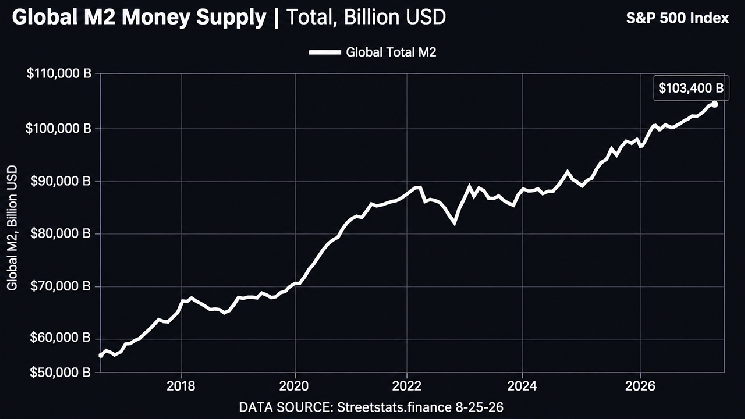
Bitcoin Price Lagging? Record Global Money Supply M2 Could Springboard BTC Growth The global money supply (M2) is expanding rapidly, similar to global debt. The US M2, representing all money circulating in its economy, has reached a record $23.16 trillion. Combined with figures from major economies like the Eurozone, China, and Japan, the global M2 is approximately $103 trillion. Some estimates, however, place it closer to $195 trillion. This surge in liquidity is significant because excess capital often seeks higher returns in assets like precious metals, stocks, and cryptocurrencies. Bitcoin's recent price surge above $81,000 has brought the global M2 metric back into focus. Following a sharp rise in early August after a US Treasury bond buyback announcement, BTC still trades about 37% below its October 2025 all-time high exceeding $126,000. This gap presents a potential "catch-up" trade thesis. Bitcoin's fixed supply of 21 million contrasts with governments' ability to print fiat currency, making scarce assets like BTC attractive if monetary expansion continues. Historically, Bitcoin's bull cycles in 2017-2018 and 2020-2021 coincided with M2 expansion and increased liquidity. Over the past year, the correlation seemed broken as M2 grew while Bitcoin's price fell sharply from its peak. Observers believe fresh dollars may have remained locked in cash-favorable investments. Some, like Ash Crypto, now suggest a long-awaited alignment between Bitcoin and M2 may be starting, especially as a weakening US Dollar Index this month has seen assets like gold and Bitcoin surge. A softer dollar pressures cash havens and prompts holders to act. While record M2 doesn't guarantee higher Bitcoin prices, a sustained influx of liquidity, a weak dollar, and capital flowing into alternative assets could trigger a catch-up rally sooner than expected. However, changes in these conditions could lead to the opposite outcome.

cryptonews.ruHá 27m

Is Bitcoin Price Lagging? Record Global M2 Money Supply Could Be a Springboard for BTC's Rise

cryptonews.ruHá 27m

Blockchain Capital Partner: Tokenization Will Reshape the Underlying Structure of Capital Markets

"Blockchain Capital partner Aleks Larsen argues that tokenization will fundamentally restructure capital markets by solving a costly 'packaging' problem in finance. Currently, assets like mortgages, private equity, and stocks exist in fragmented, incompatible systems, creating huge friction and slowing capital flow. Tokenization introduces a standardized, machine-readable interface for assets—akin to shipping containers for finance. Just as containerization standardized global trade, enabling massive efficiency gains and economic growth, tokens standardize financial rights. This allows platforms, lenders, and custodians to interact with assets directly on a shared network without rebuilding infrastructure for each one. Stablecoins demonstrate this potential, processing volumes rivaling Visa with far lower cost and faster settlement. Beyond payments, tokenization is expanding to assets like U.S. Treasuries, commodities, and private credit, now totaling nearly $400 billion on-chain. This shift changes financial service access: instead of depending on relationships with institutions, services become accessible based on the asset's tokenized properties themselves. DeFi protocols like Aave exemplify this, where assets meeting criteria can be used as collateral programmatically. Ultimately, tokenization will reorganize capital markets around open networks of specialized services, lowering barriers to entry and reducing costs. This could unlock global capital for currently underserved assets—small receivables, regional infrastructure, emerging market credit—integrating them into a seamless, programmable financial system. Combined with AI, tokenization promises to make capital allocation more efficient, transparent, and globally accessible, reshaping how economic value is created and distributed."

marsbitHá 31m

Blockchain Capital Partner: Tokenization Will Reshape the Underlying Structure of Capital Markets

marsbitHá 31m

Trading

Spot
活动图片