Caltech Uses AI to Crack 60-Year-Old Quantum Chemistry Problem: 1 GPU Does the Work of 7800

marsbitPublicado em 2026-08-26Última atualização em 2026-08-26

Resumo

California Institute of Technology researchers have developed an AI model that dramatically accelerates quantum chemistry simulations, a 60-year-old challenge. By using a Fourier Neural Operator (FNO) to replace the most computationally expensive step in Density Functional Theory (DFT) calculations, the team reduced the complexity from cubic to near-linear scaling. The model, named Kohn-Sham FNO, learns a forward mapping within the iterative DFT process, akin to a "chain of thought" in LLMs, providing stability and self-correction. This approach outperforms direct-prediction AI models, which suffer from poor extrapolation. Trained on only 8,504 structures covering elements from the first five rows of the periodic table, the model successfully simulated systems with up to 82,500 electrons on a single NVIDIA B300 GPU. In contrast, a comparable 2019 calculation required approximately 7,800 NVIDIA V100 GPUs. The work demonstrates a path for AI to replace repetitive, costly computations in physics without replacing the underlying theory. The researchers have founded a company, Accelerated Understanding, to further develop AI for physical simulation.

The quantum behavior of 100 electrons, if calculated by brute force, would take longer than the age of the universe.

A single drug molecule often contains thousands of electrons, and a battery material even more. Simulating them is a fundamental need for drug, battery, and chip development.

On August 24, a team led by Anima Anandkumar at Caltech published a paper, using an AI model to reduce the computational complexity of such calculations from cubic to nearly linear scaling.

https://x.com/AnimaAnandkumar/status/2092031815448248594

The results are stunning: a simulation of a metal defect containing 82,500 electrons was completed on a single GPU, a task that in 2019 required approximately 7800 GPUs.

A 60-Year Bottleneck

The most widely used computational method in quantum chemistry is Density Functional Theory (DFT), a Nobel Prize-winning theory essential for drug screening, catalyst design, and battery material research.

The problem is its slowness: as the system grows slightly larger, the computational cost increases cubically—a tenfold increase in electrons leads to a thousandfold increase in computation.

For 60 years, physicists have sought ways to accelerate it, but without a substantial breakthrough.

AI has tried two approaches.

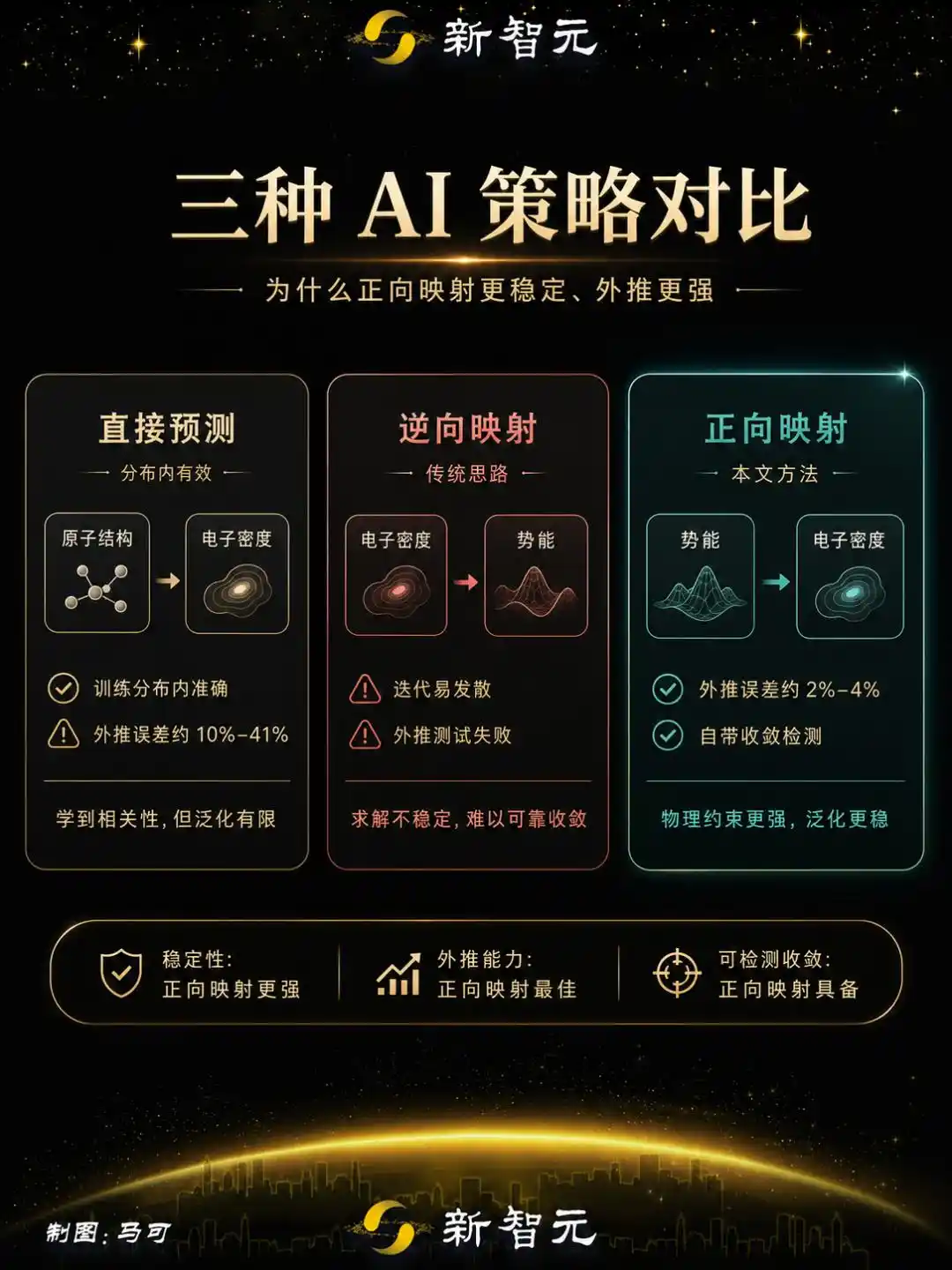
One approach trains a model to directly predict the final result in one step.

It works well within the training distribution but extrapolates poorly: once the molecule exceeds the size seen during training, errors spiral out of control.

The paper's experiments showed that when extrapolating from small molecules to drug-sized molecules, the error of direct-prediction models surged from less than 1% to around 10%, peaking at 41%.

The other approach follows the old path of physicists, having AI learn an inverse mapping.

This path is mathematically unstable; in the paper's control experiments, all calculations diverged after a few iterations, a complete failure.
Iterating Like a Chain-of-Thought Instead of Guessing the Answer in One Step

This paper takes a different direction.

The DFT calculation process is iterative: each round takes a set of input conditions, calculates the electron density, then uses the density to update the input conditions, repeating until the result stabilizes.

The traditional method gets stuck because each iteration requires solving a computationally massive step, which scales cubically.

The Anandkumar team's approach is: use AI to replace this step.

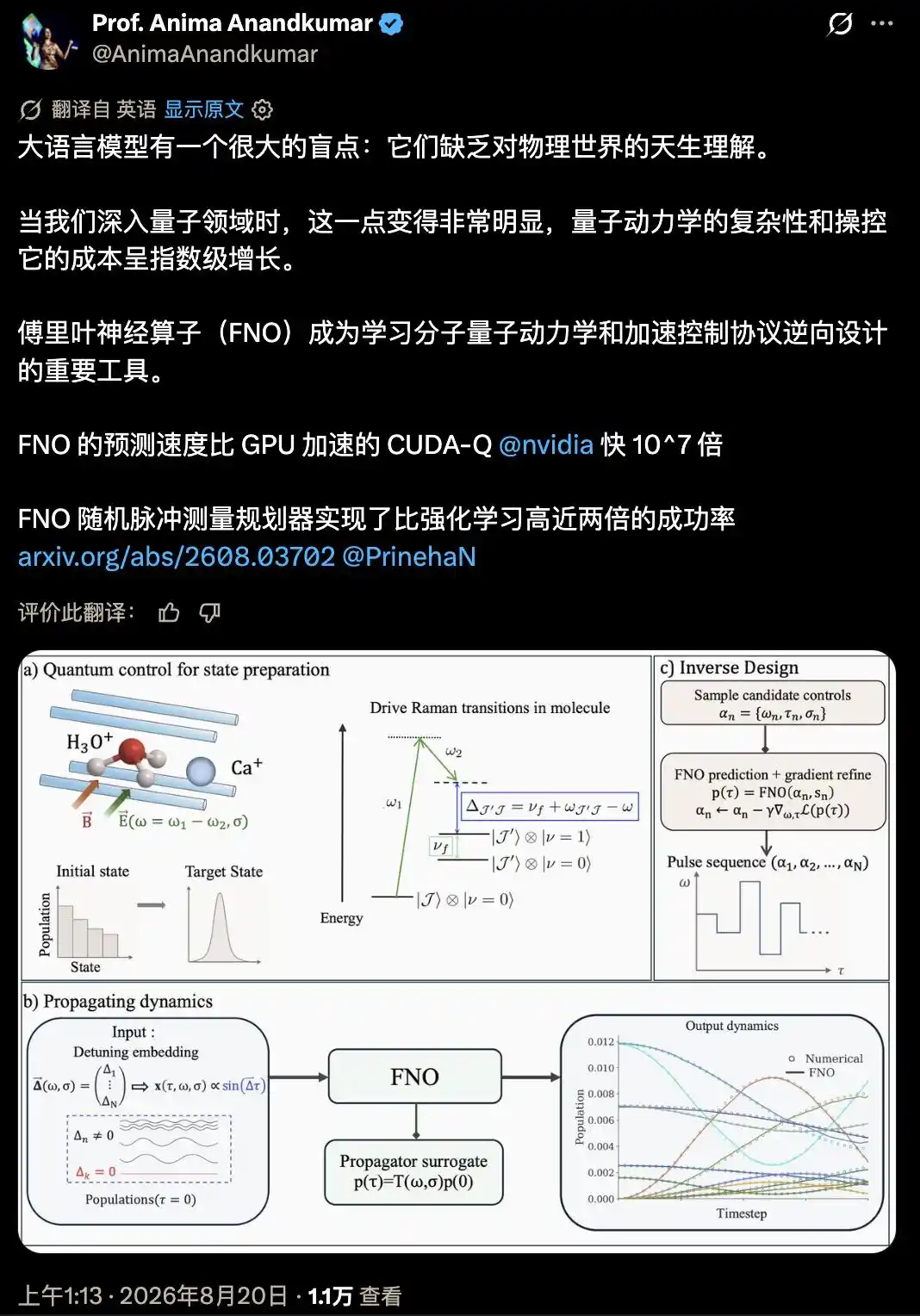
They train a Fourier Neural Operator (FNO) to learn the forward mapping of "given input conditions, output the corresponding electron density," reducing the computational complexity from O(N³) to O(N log N).

Then they embed the model back into the original iterative loop, keeping other steps unchanged.
https://x.com/AnimaAnandkumar/status/2090125110309204371

One can understand it this way: the direct-prediction model is like asking an LLM to give the final answer to a difficult problem in one step—fine for simple questions, but prone to errors on hard ones.

The Kohn-Sham FNO is like asking the model to perform a chain-of-thought reasoning, deducing step-by-step, with each step capable of self-verification; if it's wrong, subsequent iterations will pull it back.

This design also has an advantage that direct-prediction models lack: a safety valve.

If the model is pushed beyond its capabilities, the iteration will diverge, immediately alerting researchers that the result is unreliable.

The magnesium dislocation experiment in the paper verified this on the first attempt: using a general pre-trained model directly, all calculations diverged immediately—the divergence itself was the alarm.

A direct-prediction model gives an answer, but you have no way to judge if it's right or wrong.

The training data used only 8,504 structures. One model handles both molecules and solid-state materials, covering the first five rows of the periodic table.

This is thanks to a domain-invariant FNO variant designed by the team: systems of different sizes share the same learned filters, with small molecules and large crystals using the same model.

When extrapolating to drug-sized molecules not seen in the training set, the density error of Kohn-Sham FNO was 2.23%, compared to 9.97% for the direct-prediction model.

The larger the molecule, the more pronounced the gap: at 45 heavy atoms, the direct-prediction error skyrocketed to 41%, while Kohn-Sham FNO's was only 4%.

1 GPU, 80,000 Electrons

The team conducted a large-scale validation using a magnesium dislocation structure.

In 2019, a study nominated for the ACM Gordon Bell Prize performed full DFT calculations on 6,164 magnesium atoms, utilizing approximately 7,800 NVIDIA V100 GPUs on the Summit supercomputer.

The new Kohn-Sham FNO completed calculations for 8,250 atoms (82,500 valence electrons) on a single NVIDIA B300 GPU, with all results converging.

The measured scaling exponent was 1.03 (close to perfect linear), compared to 3.37 (cubic) for the traditional method.

Comparing 1 B300 to 7,800 V100s is not a hardware-equivalent comparison, but the scaling exponent is hardware-independent: one is nearly linear, the other cubic; the larger the system, the more irreversible the gap.

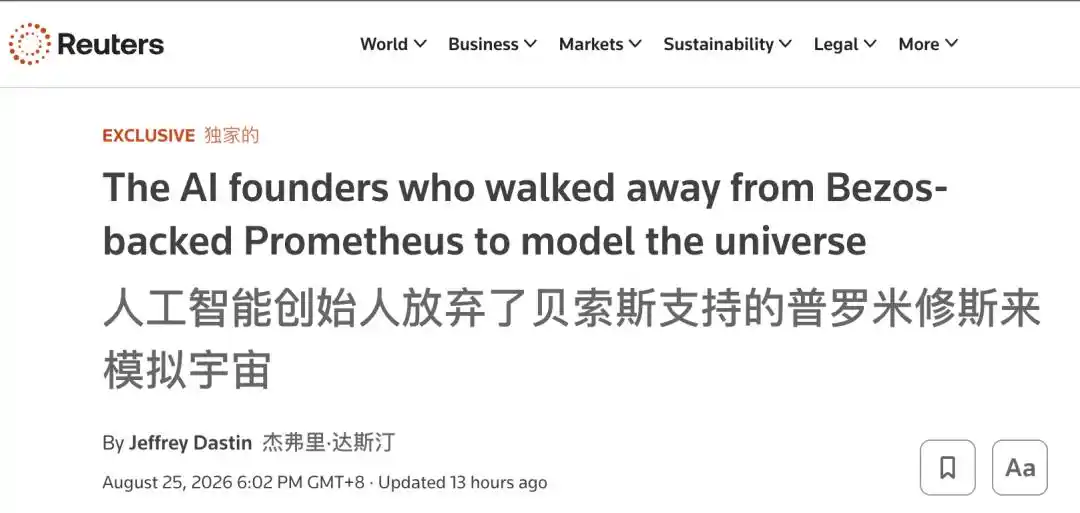
On the same day the paper was released, Anandkumar announced the founding of AI physics simulation company Accelerated Understanding, later reported by Reuters.
https://www.reuters.com/business/ai-founders-who-walked-away-bezos-backed-prometheus-model-universe-2026-08-25/

According to her introduction on X, the company's AI model simulates physical phenomena in 4D space, with a reasoning context length exceeding 5 trillion.
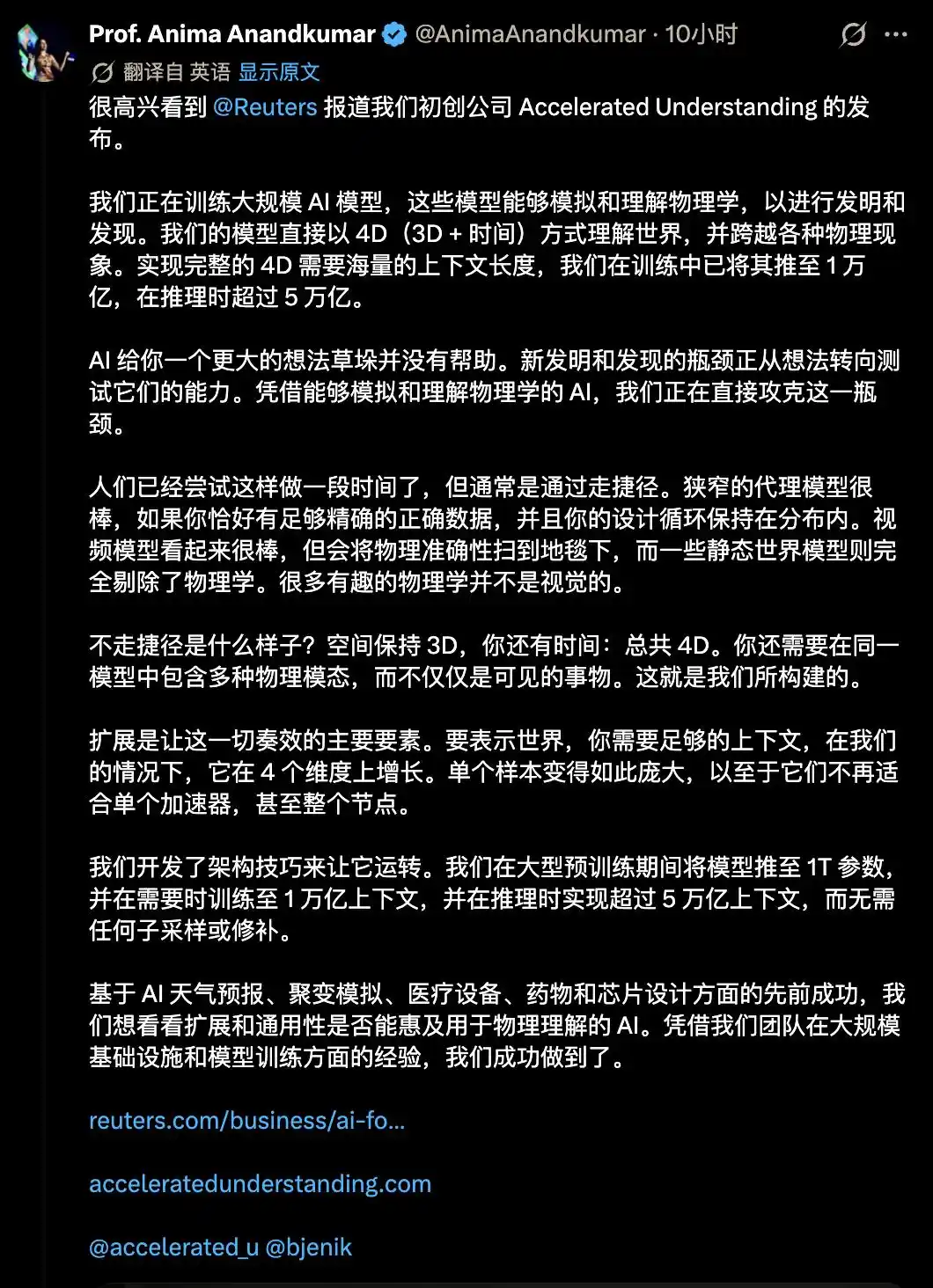
https://x.com/AnimaAnandkumar/status/2092236528898675014

Currently, Kohn-Sham FNO has only learned one step in the calculation pipeline; a post-processing step is still needed for complete energy calculations.

But the path is clear: AI is not replacing physics, but rather the most computationally expensive step of repetitive calculations in physical simulations.

The team's next plan is to fill in the remaining steps, at which point post-processing could also be eliminated. The future looks promising.

Team founders group photo

Reference: https://tensorlab.cms.caltech.edu/users/anima/ks_fno.html

This article is from the WeChat public account "Xin Zhi Yuan" (New Wisdom Source), author: ASI Apocalypse; Editor: Marco


Perguntas relacionadas

QWhat is the 60-year-old bottleneck in quantum chemistry that the Caltech AI model addresses?

AThe bottleneck is the cubic scaling (O(N^3)) computational complexity of the most widely used method, Density Functional Theory (DFT). This means that as the size of the system (e.g., number of electrons) increases, the required computation grows drastically, making simulations of large systems like drug molecules or battery materials extremely slow or practically impossible.

QHow does the Kohn-Sham FNO model's approach differ from previous AI attempts to accelerate DFT calculations?

APrevious AI attempts either directly predicted the final energy (poor extrapolation) or learned the inverse mapping (mathematically unstable, leading to divergence). The Kohn-Sham FNO learns the forward mapping from input conditions to electron density within the iterative DFT loop, replacing the most computationally expensive step. This is analogous to a 'chain-of-thought' reasoning, allowing step-by-step correction, unlike a single, potentially flawed, final answer.

QWhat key advantage in terms of reliability does the iterative, 'chain-of-thought' design of Kohn-Sham FNO provide over direct prediction models?

AIt provides a 'safety valve'. If the model is pushed beyond its capabilities, the iterative process will diverge, immediately alerting researchers that the result is unreliable. In contrast, a direct prediction model might produce a plausible-looking but completely wrong answer with no inherent warning, making its errors harder to detect.

QWhat was the practical performance demonstrated in the magnesium dislocation experiment regarding computational scale and efficiency?

AThe Kohn-Sham FNO model successfully simulated a system of 8,250 atoms (82,500 valence electrons) on a single NVIDIA B300 GPU, achieving convergence. In 2019, a similar full DFT calculation for 6,164 magnesium atoms required approximately 7,800 NVIDIA V100 GPUs on the Summit supercomputer. The new model demonstrated a near-perfect linear scaling exponent of 1.03, compared to the cubic scaling (exponent ~3.37) of traditional methods.

QWhat innovation allows the Kohn-Sham FNO model to be applied to systems of vastly different sizes (small molecules and large crystals) using the same training data?

AThe team designed a 'domain-invariant' variant of the Fourier Neural Operator (FNO). In this architecture, systems of different sizes share the same set of learned filters. This allows a single model trained on smaller structures to generalize and effectively process much larger systems, like bulk crystals, that it was not explicitly trained on.

Leituras Relacionadas

Bitcoin Is Ready for "Parabolic Growth". Is Altseason Upon Us?

Amid a general market uptrend, experts are discussing the potential start of an 'altcoin season', where major cryptocurrencies could outpace Bitcoin's growth. This follows Bitcoin surpassing $81,000, predictions of a new bull market, and a capital shift from AI stocks toward Bitcoin and gold. Since August 17th, the crypto market has risen over 22%, primarily driven by Bitcoin (BTC) and Ethereum (ETH), which gained 25% and 30% respectively, reaching highs last seen in May. Analysts suggest the Bitcoin bear cycle has ended, anticipating a historically strong rally, with renewed institutional demand for cryptocurrency ETFs. BitMEX founder Arthur Hayes, in a recent interview, declared the start of a new bull market, predicting Bitcoin could quickly reach "hundreds of thousands" of dollars. Market observers interpret this as an expectation for 'parabolic growth.' Signs of a bull market revival include Bitcoin ETFs re-entering the top 10 most-traded ETFs, displacing some AI-focused funds. Analysts at CryptoQuant note capital is flowing from Bitcoin into riskier altcoins, with their bull market indicators showing the most optimistic signals since October 2025. However, the reality is more nuanced. The current surge is a rebound from yearly lows; Bitcoin's price is still down nearly 40% from its October peak. The Altcoin Season Index has dropped to 39 from 67 in early August, and Bitcoin's dominance remains around 60%, indicating investor focus is still on Bitcoin rather than altcoins. Experts predict the market is entering a phase where project fundamentals and real revenue, rather than speculation, will increasingly determine asset value.

cryptonews.ruHá 11m

Bitcoin Is Ready for "Parabolic Growth". Is Altseason Upon Us?

cryptonews.ruHá 11m

$120 Million Vanishes Overnight! Crypto's 'Steadiest Giant' Stumbles in South America

Summary: Tether's $120 million Bitcoin mining venture in Uruguay, initiated in May 2023, was abruptly shut down in July 2025 when the national power utility UTE cut off electricity. The project, developed in partnership with local firm Microfin in Florida province, was touted as a model for leveraging the country's nearly 98% renewable energy grid. The collapse stemmed from a fundamental contract dispute over electricity supply. Tether interpreted the agreed power volume as a "minimum guaranteed supply," expecting to request more as the mining operation expanded. UTE, however, viewed it as a "strict maximum cap." This disagreement led to frequent power curtailments for the 24/7 mining facility, causing significant revenue loss from lost computing power. Following the 2025 election of left-wing President Yamandú Orsi and a management change at UTE, negotiations broke down. Microfin stopped paying electricity bills in May 2025, formally notified UTE of contract termination in June, and did not attend a final meeting where UTE presented a revised contract. By the July 25 power cut, Microfin's debt approached $5 million. The operation ceased, laying off 30 of its 38 local staff, with all outstanding debts settled by December 2025. The failure highlights key risks for heavy-asset overseas investments: Uruguay's green energy proved not to be cheap energy, especially after the 2024 Bitcoin halving squeezed industry profits. Furthermore, political changes can swiftly alter utility company policies, undermining the long-term regulatory stability critical for such projects. While financially absorbable for Tether, the incident underscores that operational success depends on unambiguous contracts and genuine cost advantages, not just technological scale.

marsbitHá 36m

$120 Million Vanishes Overnight! Crypto's 'Steadiest Giant' Stumbles in South America

marsbitHá 36m

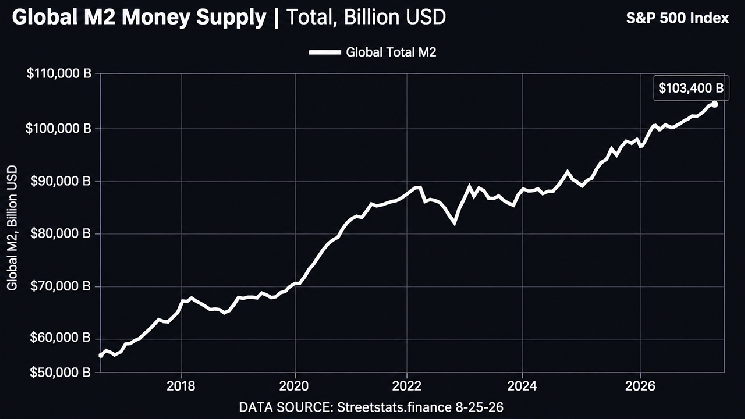
Is Bitcoin Price Lagging? Record Global M2 Money Supply Could Be a Springboard for BTC's Rise

Bitcoin Price Lagging? Record Global Money Supply M2 Could Springboard BTC Growth The global money supply (M2) is expanding rapidly, similar to global debt. The US M2, representing all money circulating in its economy, has reached a record $23.16 trillion. Combined with figures from major economies like the Eurozone, China, and Japan, the global M2 is approximately $103 trillion. Some estimates, however, place it closer to $195 trillion. This surge in liquidity is significant because excess capital often seeks higher returns in assets like precious metals, stocks, and cryptocurrencies. Bitcoin's recent price surge above $81,000 has brought the global M2 metric back into focus. Following a sharp rise in early August after a US Treasury bond buyback announcement, BTC still trades about 37% below its October 2025 all-time high exceeding $126,000. This gap presents a potential "catch-up" trade thesis. Bitcoin's fixed supply of 21 million contrasts with governments' ability to print fiat currency, making scarce assets like BTC attractive if monetary expansion continues. Historically, Bitcoin's bull cycles in 2017-2018 and 2020-2021 coincided with M2 expansion and increased liquidity. Over the past year, the correlation seemed broken as M2 grew while Bitcoin's price fell sharply from its peak. Observers believe fresh dollars may have remained locked in cash-favorable investments. Some, like Ash Crypto, now suggest a long-awaited alignment between Bitcoin and M2 may be starting, especially as a weakening US Dollar Index this month has seen assets like gold and Bitcoin surge. A softer dollar pressures cash havens and prompts holders to act. While record M2 doesn't guarantee higher Bitcoin prices, a sustained influx of liquidity, a weak dollar, and capital flowing into alternative assets could trigger a catch-up rally sooner than expected. However, changes in these conditions could lead to the opposite outcome.

cryptonews.ruHá 1h

Is Bitcoin Price Lagging? Record Global M2 Money Supply Could Be a Springboard for BTC's Rise

cryptonews.ruHá 1h

Trading

Spot
活动图片