DeepSeek's $10 Trillion Path: Leveraging Open Source to Pivot a Trillion-Dollar Hardware Ecosystem

marsbitPubblicato 2026-05-25Pubblicato ultima volta 2026-05-25

Introduzione

This article proposes a strategic analysis of DeepSeek, arguing its goal is not short-term application-layer monetization but a long-term, foundational play to reshape the AI hardware ecosystem. It posits that DeepSeek's series of architectural innovations—MoE, MLA, DSA, CSA, Engram, TileLang—are fundamentally designed to drastically reduce the computational and memory (especially HBM) requirements for training and serving state-of-the-art AI models. By making AI feasible on hardware with lower performance (e.g., using NAND/SSD for KV Cache, LPDDR for weights and Engram storage), DeepSeek aims to foster and benefit from a viable alternative AI hardware supply chain, particularly in China. This strategy could unlock a trillion-dollar valuation for DeepSeek by enabling and owning a stake in a new, massive hardware ecosystem, rather than competing directly on subscriptions or multi-modal features.

Original Title: DeepSeek's 10 trillion USD grand strategy

Original Author: @bookwormengr

Original Compilation: Peggy, BlockBeats

Editor's Note: Over the past year, discussions about DeepSeek have mostly focused on model performance, open source strategy, and price wars. However, understanding DeepSeek solely from perspectives like "selling subscriptions or not," "having multimodal capabilities or not," or "being able to act as a coding agent or not" might underestimate what it truly aims to change.

This article proposes a more radical judgment: DeepSeek's goal might not be short-term monetization through the application layer, but rather to reshape the cost structure of AI training and inference through a series of foundational architectural innovations, and indirectly catalyze the formation of a new hardware ecosystem. From MoE and MLA to DSA, CSA, mHC, Engram, and further to Dual Path and TileLang, DeepSeek's technical roadmap consistently revolves around one core question: how to achieve stronger models with less high-end computing power, under constraints of HBM, advanced manufacturing processes, packaging, and the CUDA ecosystem.

The most noteworthy aspect of this article is not "whether DeepSeek can earn a few hundred million dollars through APIs or subscriptions," but whether it is binding model capabilities, memory architecture, and the domestic hardware ecosystem together. KV Cache compression reduces reliance on HBM, NAND and SSDs can accommodate long-term caching, LPDDR can be used for weight streaming and Engram storage, and TileLang attempts to weaken the CUDA moat. If these innovations continue to proliferate, the beneficiaries won't be just DeepSeek itself, but also storage, ASICs, GPUs, networking chips, and the entire AI infrastructure chain.

Of course, the judgments in the article about a "$10 trillion industrial ecosystem" and a "$1 trillion valuation" still carry a strong speculative tone. But it provides an important path to understanding DeepSeek: open source doesn't necessarily mean abandoning commercialization, and low prices aren't necessarily just about subsidizing the market. For DeepSeek, the real business might not be at the application layer, but in making more hardware viable and enabling lower-cost AI supply. In other words, what it's selling might not be the model itself, but the feasibility of the next generation of AI infrastructure.

Original Article:

Have you ever wondered how DeepSeek is actually going to make money, and potentially a lot of it?

It hasn't launched competitive coding subscription plans like GLM, MoonShot, and MiniMax; it doesn't have multimodal, audio, or video models. So far, it doesn't even have its own harness—the outer runtime framework for model invocation, tool integration, and task execution—though they have recently started hiring for related positions to build this system.

Meanwhile, DeepSeek seems to be a long-term, steadfast proponent of open source, even happily sharing its "secret sauce." Isn't this crazy? Isn't it just burning money for nothing? Are the investors ready to pour in $10 billion just throwing their money down the drain?

I personally believe the answer is quite the opposite.

Next, based on what DeepSeek has done so far, I'll offer some observations and analyze the strategy it appears to be following. DeepSeek CEO Liang Wenfeng's ambitions likely extend far beyond the current model competition. He might be aiming for a much bigger prize: DeepSeek has the opportunity to reach a $1 trillion valuation while catalyzing the formation of a new $10 trillion industry.
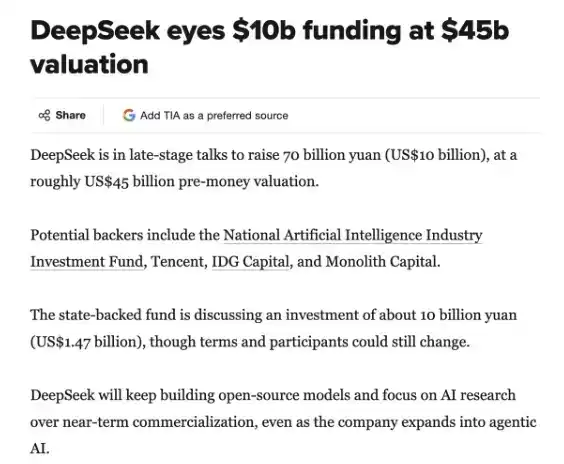
TechInAsia report on DeepSeek's latest funding round

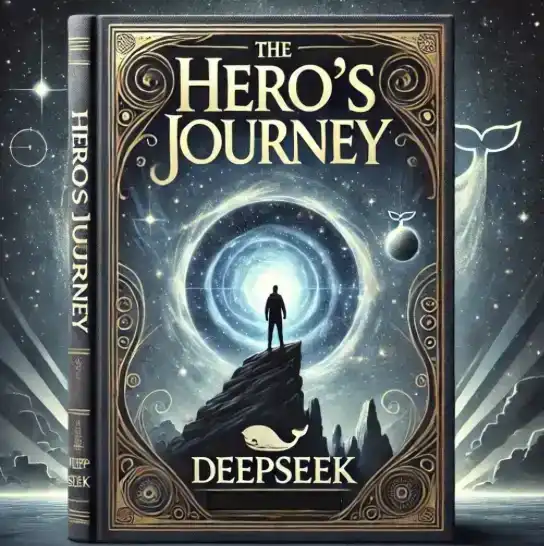
Revisiting DeepSeek's "Hero's Journey"

DeepSeek has always been going against the grain. It hasn't chosen to continuously release slightly better models and hastily package them as directly monetizable applications, like coding subscriptions. On January 27, 2025, I posted a widely circulated tweet about what I saw as DeepSeek's "Hero's Journey." Now, that story has become even more interesting.

While others were still trying to build dense models, DeepSeek chose the more difficult-to-train Mixture of Experts (MoE).

They adopted a "first principles" approach, inventing the new GRPO algorithm to replace the then-mainstream but costlier-to-implement PPO reinforcement learning algorithm.

They found that Reinforcement Learning from Verified Rewards (RLVR) was a key strategy for improving model reasoning capabilities.

They also proposed a simple speculative decoding strategy through "Multi Token Prediction," while also making training signals more dense.

They perfected the "ZERO bubble" pipeline to improve the utilization efficiency of limited GPU resources.

They released an expert load balancer, making it easier for everyone to deploy MoE models. Particularly, with the "Wide Expert Parallel" strategy, models can serve with larger batches, significantly reducing inference costs.

They invented mechanisms like MLA, DSA, CSA, HCA to reduce KV Cache requirements and keep the computational demand increase with context length as close to constant as possible.

They invented Engram, trading memory for computational efficiency.

They also invented mHC, enabling stable training even as model size scales. And there are many more examples like these.

In the "Hero's Journey," the most universal narrative structure, the hero never decides at the outset where their journey will ultimately lead. They learn along the way, gradually discovering their truly great mission and accomplishing it against formidable obstacles. They face many doubters but choose to ignore them. They also face malicious actors. They have apparent flaws or weaknesses but ultimately overcome them to fulfill their mission. They face seemingly insurmountable challenges but find ways to form alliances and learn to use their limited, precious resources wisely. This is precisely what makes the audience cheer for the hero. This is also why DeepSeek has won followers, global respect, and detractors.

As I will detail next, DeepSeek has been on this path for a long time and is gradually discovering its ultimate destiny: its goal is not to sell coding subscriptions, but to propel a $10 trillion Chinese AI hardware ecosystem and achieve a $1 trillion valuation for itself. In the process, it will also create opportunities for many new entrants in the Western hardware ecosystem.
Let's start with some interesting KV Cache calculations

Take a look at this very timely recent tweet by @SemiAnalysis_:
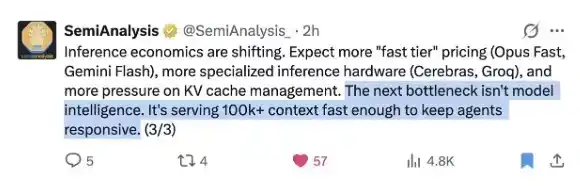
DeepSeek has solved this problem better than anyone else!

Let's do some fun KV Cache calculations. Don't worry, even if you don't like math. We'll use the recently released KV Cache calculator to see how much KV Cache savings DeepSeek V4 Pro brings and compare it with the latest GLM and Qwen models.

Here I calculate for a 1 million context length, assuming 8-bit KV precision and 16-bit indexer precision. You can also try this calculator yourself: https://kvcache.ai/tools/kv-cache-calculator/
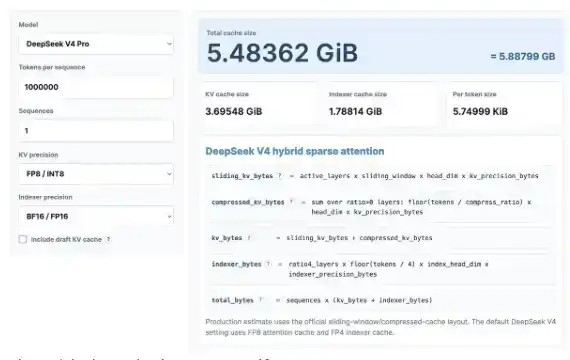
You can also try the calculator yourself!

At 1 million context length:

· DeepSeek V4 requires only 5.48GB HBM;

· GLM-5 requires 60GB HBM;

· Qwen3-235B-A22B requires a whopping 89GB HBM.

Note that:

· DeepSeek is a 1.6 trillion parameter model;

· GLM-5 is about 700 billion parameters and has already adopted DeepSeek's MLA and DSA, though not the latest compressed attention mechanisms;

· Qwen3-235B-A22B is about 235 billion parameters, using GQA attention mechanism.

DeepSeek has made fundamental contributions to alleviating memory pressure. If such innovations are widely adopted, they will significantly reduce the operating costs of long-horizon agents and unlock the next batch of new applications.
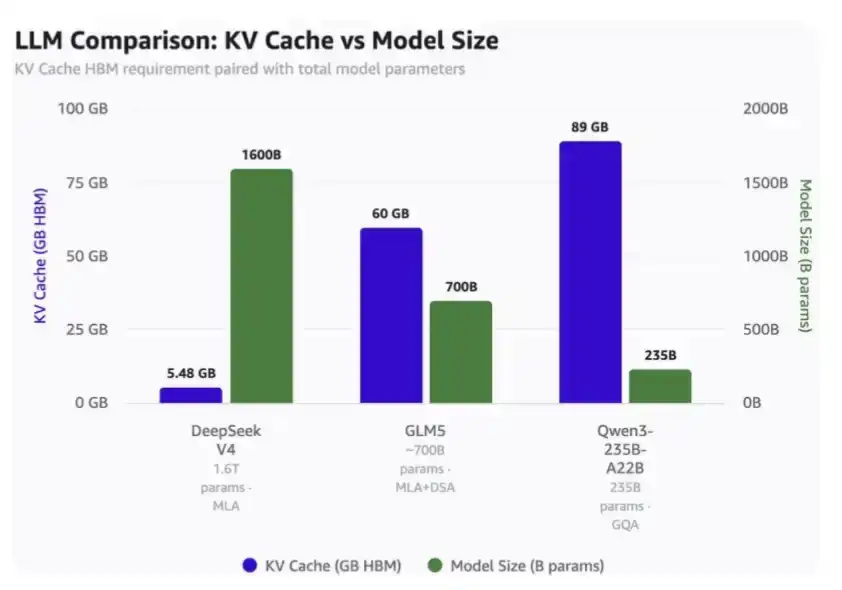
KV Cache occupancy comparison for 1 million token context and model sizes

The methodology behind the "madness"

The ability to keep the KV Cache volume so small without sacrificing model quality is precisely why DeepSeek can offer long-term caching at extremely low prices—less than 3% of Sonnet 4.6's cache hit price—and DeepSeek can keep the cache for hours.

For long-horizon tasks, a smaller KV Cache means it can be offloaded to SSD more economically and reloaded when needed. This reduces reliance on HBM. From the perspective of China's AI hardware industry, HBM is not only in tight supply but also one of the most difficult memory types to manufacture.

Furthermore, DeepSeek has developed technology to load KV Cache from SSDs faster, as described in its Dual Path paper.
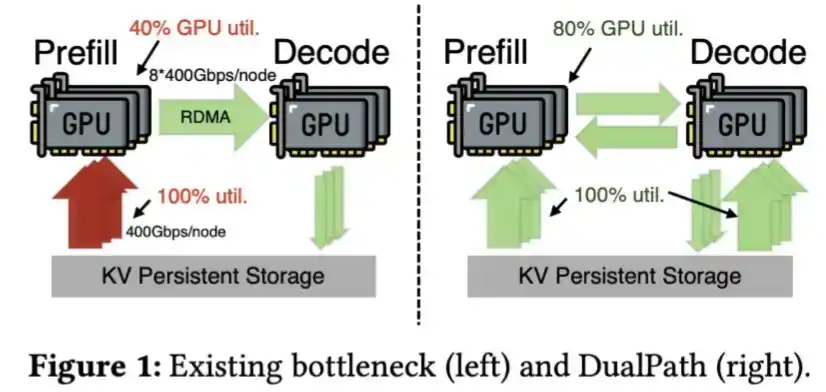
DeepSeek V4's compression of KV Cache is so significant that this step might not even be necessary.

So, who are the most direct beneficiaries of KV Cache compression?

Who supplies SSDs at scale? Don't forget, YMTC (Yangtze Memory Technologies Co.) is growing into a giant in the 3D NAND field. NAND can help DeepSeek avoid recomputing KV. In turn, DeepSeek creates a huge market for NAND and SSDs—benefiting not just YMTC but other related players.
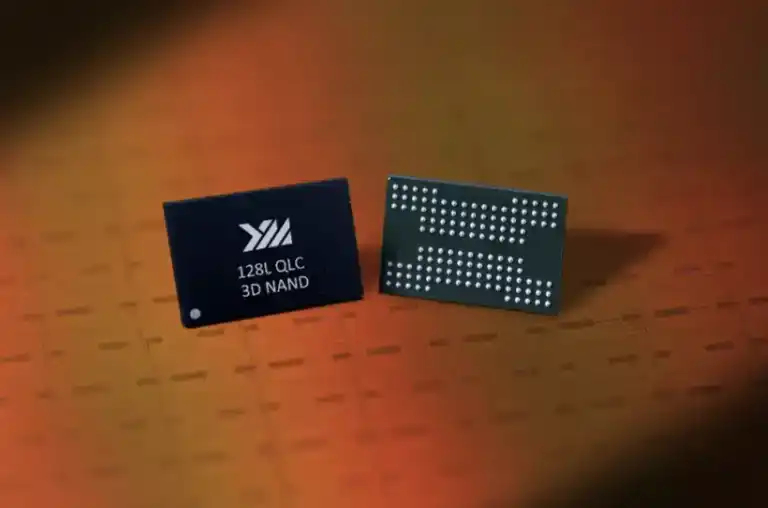
But it's not just about NAND and SSDs.

LPDDR memory also has huge potential. It can serve as a place to store model weights and stream them into HBM on demand, alleviating pressure on HBM. The SGLang team published a great blog post introducing this. The image below shows how this scheme works.

While DeepSeek hasn't specifically designed for this scheme, its MoE architecture, large number of expert models, and 4-bit weight characteristics all make this scheme easier to implement.
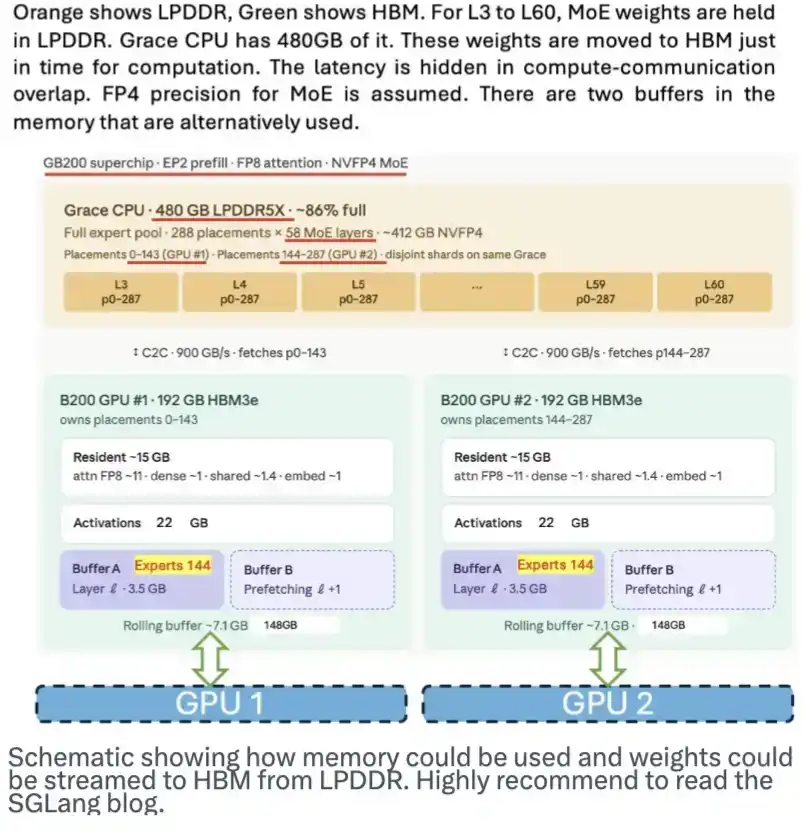
This schematic shows how memory might be used and how model weights are streamed from LPDDR to HBM. Highly recommend reading SGLang's blog post.

If this innovation is combined with extremely compact and lossless KV Cache, it will significantly reduce the demand for HBM.

So, who produces LPDDR in China? The answer is CXMT, ChangXin Memory Technologies. They are only about half a generation behind in LPDDR speed and one generation behind in density—not a huge gap.

Besides ample NAND, the Chinese AI ecosystem will also have ample LPDDR supply in the near future. Can this ease compute pressure? Answer: Yes. Keep reading.
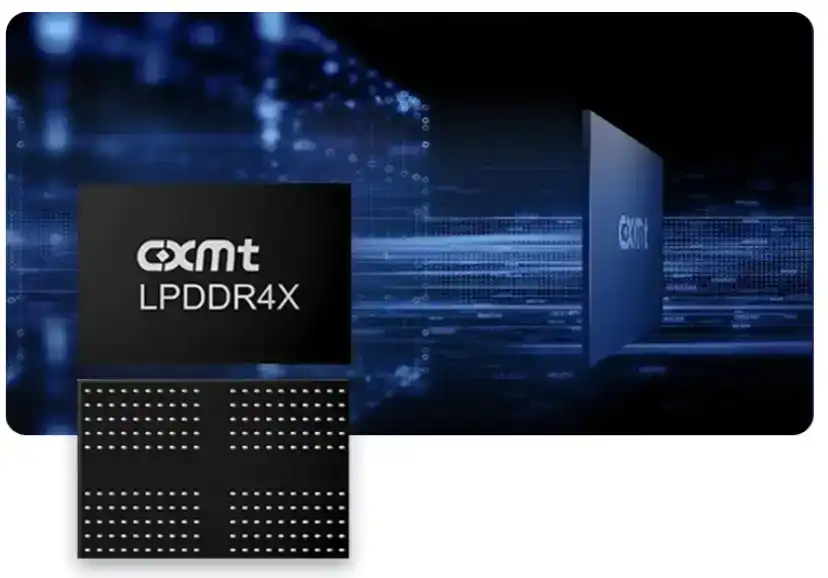
Intelligent memory usage can also alleviate GPU/ASIC pressure

The role of using NAND to store KV Cache is easy to understand: it allows KV Cache to be retained longer, reduces pressure on HBM, avoids recomputing KV Cache, and thus alleviates the computational burden on GPUs and ASICs.

Can LPDDR play a similar role? Besides serving as a storage location to stream weights "just-in-time" into HBM on demand, can it further reduce computational pressure?

Answer: Yes.

LPDDR can be used to store a large amount of content called Engram. In DeepSeek's Engram paper, they point out that MoE can expand model capacity through conditional computation, but the Transformer itself lacks a native "knowledge lookup" mechanism. Therefore, Transformers often have to inefficiently simulate retrieval through computation.

To solve this, DeepSeek proposed the Engram module. It modernizes classic N-gram embeddings, transforming them into a hash-based O(1) lookup mechanism, creating a complementary sparsification path they call conditional memory.

This saves computation but also requires memory to host the embedding table, which itself can be very large.

Essentially, this is a classic "trade memory for compute" scheme. But the key insight is: from a per-bit read cost perspective, the "memory" side is much cheaper—one LPDDR lookup is far cheaper than having data go through multiple Transformer layers for one full forward pass. Therefore, at scale, this is a very cost-effective trade-off.

This is how DeepSeek sacrifices some memory to gain computational savings.
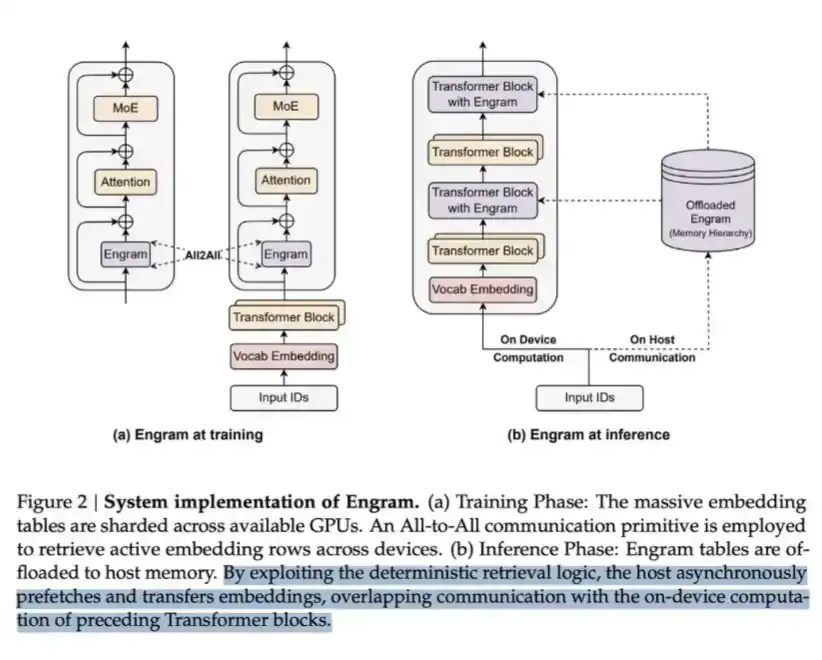
A worthwhile trade-off

Without comparable chip transistor density or EUV, Chinese GPUs and ASICs are likely to lag behind Western GPUs in raw FLOPs compute power for a long time. They also still have significant gaps in advanced packaging. Therefore, such trade-offs are very worthwhile, especially given that China can mass-produce NAND and LPDDR memory.

Reviewing DeepSeek's long-term strategy

Judging from these innovations, DeepSeek's goal doesn't seem to be making a few hundred million dollars in profit in the short term. Many of its past choices illustrate this: still no multimodal capabilities, no voice models, and video models are out of the question.

What it's really engaged in is a patient, potentially $10 trillion long-term game: catalyzing the formation of an alternative AI hardware ecosystem.

This is not only to make Chinese memory manufacturers key players in the Chinese and even global AI hardware markets but also to fundamentally reduce resource requirements, making AI model training and serving more cost-efficient. This way, many GPU, ASIC manufacturers, and networking chip vendors can become viable options.

At the same time, these innovations will also benefit the Western open-source ecosystem and the new generation of hardware manufacturers.

All the signs are already there. Let's review these innovations proposed by DeepSeek so far in detail:

1. Mixture of Experts (MoE) and MLA introduced in DeepSeek V2

DeepSeek introduced MoE and MLA in V2. MoE reduced the computation required to train high-intelligence models by about 40-50%; MLA reduced KV Cache by 90%.

This made offloading KV Cache to SSDs quite efficient.

These ideas first appeared in the DeepSeek V2 paper released in May 2024. Later, they also laid the foundation for training DeepSeek V3. At the time, DeepSeek trained a system close to closed-source model performance using only 2048 weakened H800 GPUs.
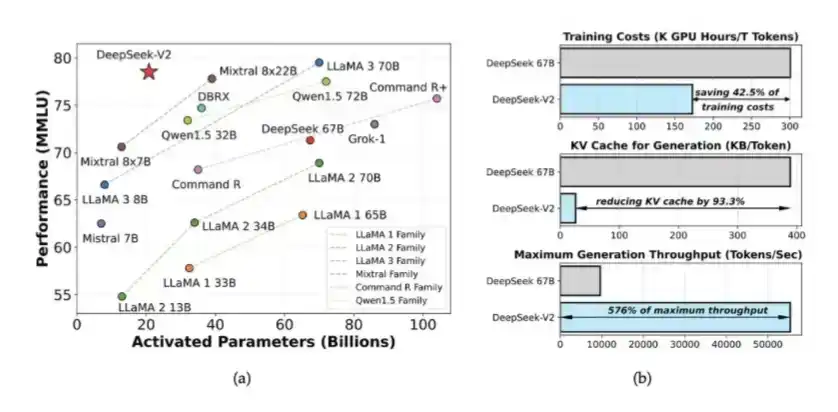
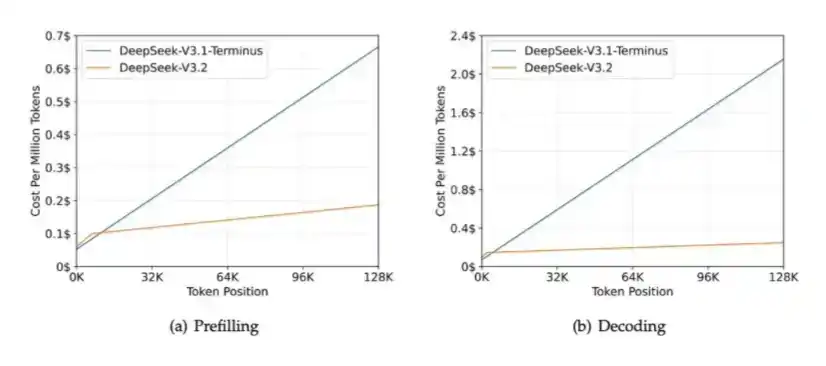
2. DSA: Introduced in DeepSeek V3.2 Exp to reduce computational overhead in long-context scenarios and alleviate HBM bandwidth pressure.

The core role of DSA is to ensure computational load doesn't continuously grow with increasing context length. Look at the chart below: as context length increases, DeepSeek-V3.2's processing time remains largely flat.
3. mHC: Proposed by DeepSeek in December 2025 in the paper "mHC: Manifold-Constrained Hyper-Connections."

mHC is a macro-architectural innovation by DeepSeek that redesigns information flow between Transformer layers.

Since ResNet, models typically used standard residual connections, i.e., x + F(x). mHC expands the residual flow into multiple parallel information channels and allows the model to perform learnable mixing between these channels. The key is that it constrains the mixing matrix to be doubly stochastic, restricting it to the Birkhoff polytope via Sinkhorn-Knopp projection. This mathematically guarantees stable signal magnitude regardless of how deep the model stacks.

This solves the catastrophic instability problem faced by earlier unconstrained Hyper-Connections. Hyper-Connections were initially proposed by ByteDance but, without constraints, signal amplification could explode 3000x at 27 billion parameters, causing training to collapse completely.

mHC's computational cost is low: it only adds about 6.7% actual training time overhead because it doesn't change the FLOPs of attention or FFN layers, only how the outputs of these layers are routed between layers.

But the performance improvement is noticeable: at 27 billion parameters, mHC improves scores by 7.2 points on BIG-Bench Hard reasoning tasks, 3.2 points on DROP, 2.8 points on GSM8K math, and 1.4 points on MMLU general knowledge—all at the same model size and nearly the same compute budget.

Essentially, mHC provides the network with a richer, more expressive inter-layer information routing topology, achieving higher intelligence per parameter with almost no extra FLOPs.
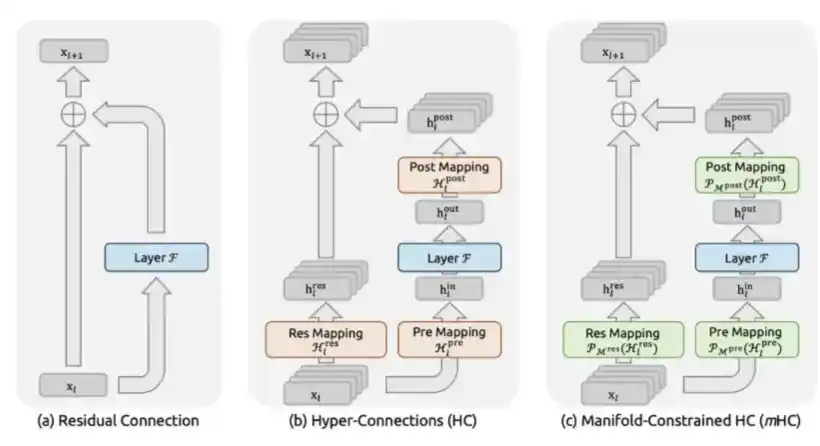
mHC is a complex architectural design, but it enables more stable training and higher intelligence per parameter.

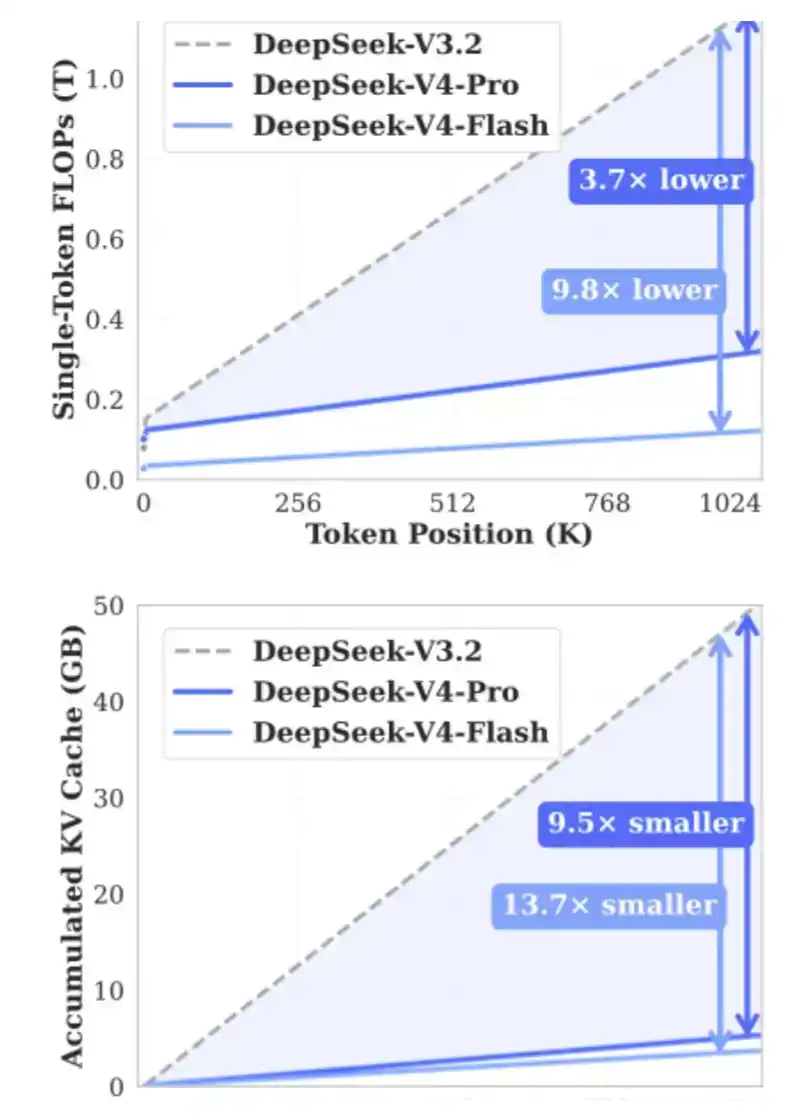
4. CSA, HSA: Introduced by DeepSeek in V4 in April 2026.

The goal of CSA and HSA is to further reduce KV Cache requirements by another 90% by compressing KV tokens, while also significantly reducing required FLOPs, thereby alleviating pressure on both HBM and GPU/ASIC.
5. Engram: Introduced by DeepSeek in Q1 2026, essentially trading memory—LPDDR memory—for computational efficiency to some extent.

As shown in the detailed chart below, Engram provides noticeable performance improvement under the same total parameter budget.
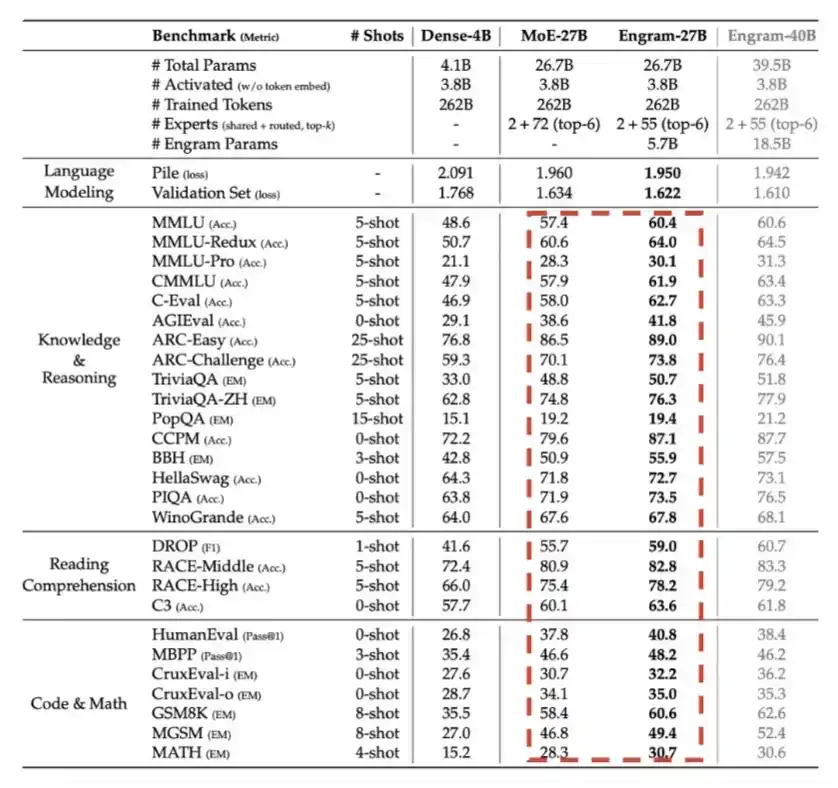
6. Engram: Introduced by DeepSeek in Q1 2026, essentially trading memory—LPDDR memory—for computational efficiency to some extent.

As shown in the detailed chart below, Engram provides noticeable performance improvement under the same total parameter budget.
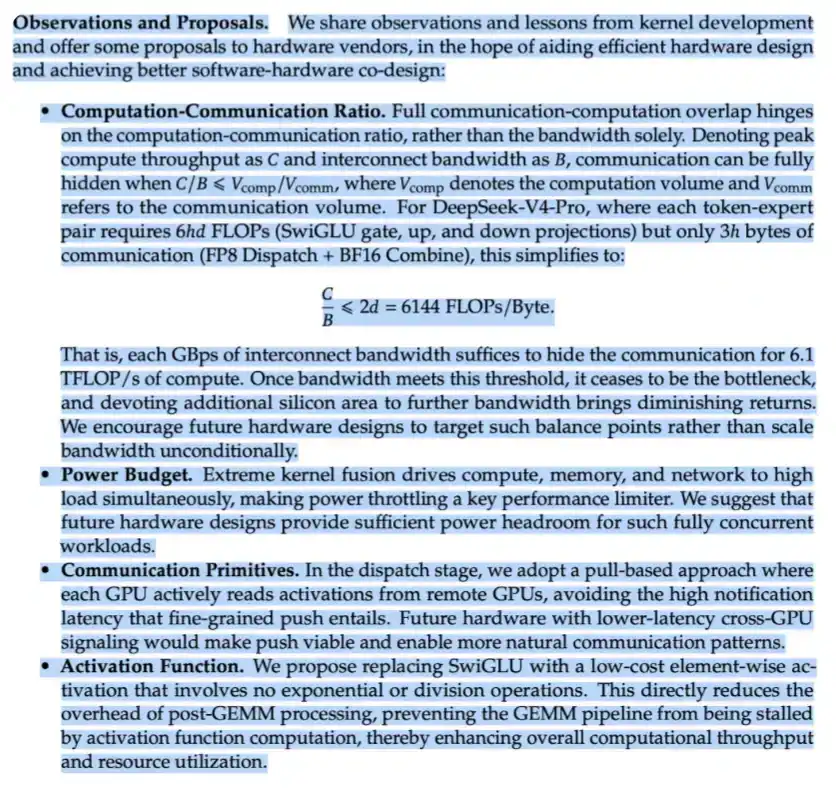
This is DeepSeek's recommendation shared with hardware vendors in the V4 paper. I'm sure in private discussions, their feedback would be even more extensive.

7. Investment in TileLang also points in the same direction: DeepSeek isn't just solving its own compute bottlenecks; it's enabling the Chinese hardware ecosystem to compete with the Western one.

With TileLang, developers can write a kernel—the low-level computational code—once and have it run successfully on multiple hardware platforms, provided those platforms have corresponding TileLang backends.

I expect other Chinese AI labs will join in gradually. This will help Chinese hardware vendors indirectly counter the so-called "CUDA moat." At the same time, it will also unlock the potential of more Western hardware, like AMD.

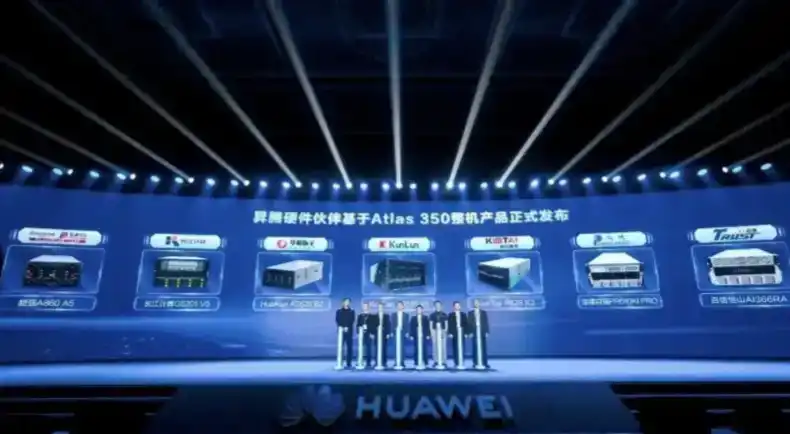
It should be noted that several Chinese AI hardware platforms already offer CUDA compatibility or CUDA translation layers. For example, Moore Threads, MetaX, Biren, and Tianshu Zhixin are Chinese chip vendors that achieve high CUDA compatibility through translation layers. So theoretically, they might not necessarily need TileLang.
Large-scale reinforcement learning and RSI

As DeepSeek gains access to more compute sources—more hardware options—and the models themselves require less computational resources, it will be able to pursue more ambitious training projects, especially reinforcement learning post-training.

Reinforcement learning requires generating a massive number of trajectories—trillions of tokens. This quickly becomes extremely expensive. Going further, training models with 1 million context length requires generating trajectories of the same length. Only training on such ultra-long trajectories can truly support long-horizon tasks.

Additionally, with more hardware options, DeepSeek will have access to more hardware resources, which will drive automated research, or RSI. RSI refers to AI designing and executing experiments itself. This involves a lot of trial and error, and costs escalate quickly. But RSI is crucial for exploring the full model design space. Before moving towards AGI, and subsequently ASI, DeepSeek must possess RSI capabilities.

What DeepSeek does today, the entire industry will follow tomorrow

DeepSeek's innovations around MoE, MLA, DSA, etc., have already been adopted by other AI labs globally and in China.

For example, ZAI, the developer of the GLM series, uses MLA and DSA. Kimi (Moonshot) also uses MLA and openly states its architecture is based on DeepSeek's design. Conversely, DeepSeek uses the Muon optimizer, which was first used at scale by Kimi (Moonshot) in large-scale training.

It should be noted:

MoE was first proposed by Google in 2017, key author Noam Shazeer. DeepSeek's contribution lies in applying MoE at scale and inventing its own accompanying techniques.

Muon, the MomentUm Orthogonalized by Newton-Schulz optimizer, was proposed by ML researcher Keller Jordan in late 2024. The Kimi (Moonshot) team was the first to use it for large-scale training.

What about the money-making issue?

We can look at the interesting example of OpenAI.

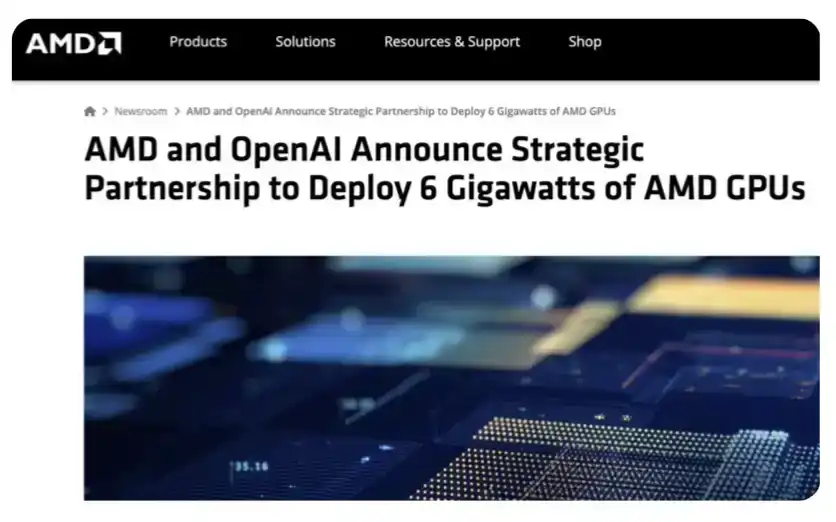
OpenAI received warrants/options to purchase AMD and Cerebras stock at a low price, tied to its compute consumption milestones. For AMD and Cerebras, this was a very good deal. Because once OpenAI commits to using their hardware, their long-term success probability increases significantly.

Here's a passage from AMD's announcement:

"As part of the agreement, to further align strategic interests, AMD issued to OpenAI warrants to purchase up to 160 million shares of AMD common stock, vesting based on the achievement of specific milestones. The first tranche vests upon completion of the initial 1 GW deployment, with subsequent tranches vesting as purchases scale to 6 GW. Vesting is also contingent on AMD achieving certain stock price targets and OpenAI reaching technical and commercial milestones required for AMD's large-scale deployment."
I expect DeepSeek will also enter into similar agreements with multiple Chinese memory, ASIC, CPU, and networking stack vendors, collaborating deeply to make these vendors' hardware stacks capable of handling leading AI workloads.

Considering the total market capitalization of AI stocks in the West, including East Asian allies, far exceeds $10 trillion, this "gain equity returns through cooperation" approach will give DeepSeek the opportunity to help China build an equally massive industry and claim its share of the pie, ultimately achieving its own $1 trillion valuation.

This would not only earn DeepSeek far more money than traditional application subscription businesses but also fulfill its stated goal of "making AGI beneficial to everyone." Liang Wenfeng is a big fan of Jim Simons and a savvy enough capital player; he couldn't miss this.

If you look back at everything DeepSeek has done so far, this is the only explanation that makes the most sense.
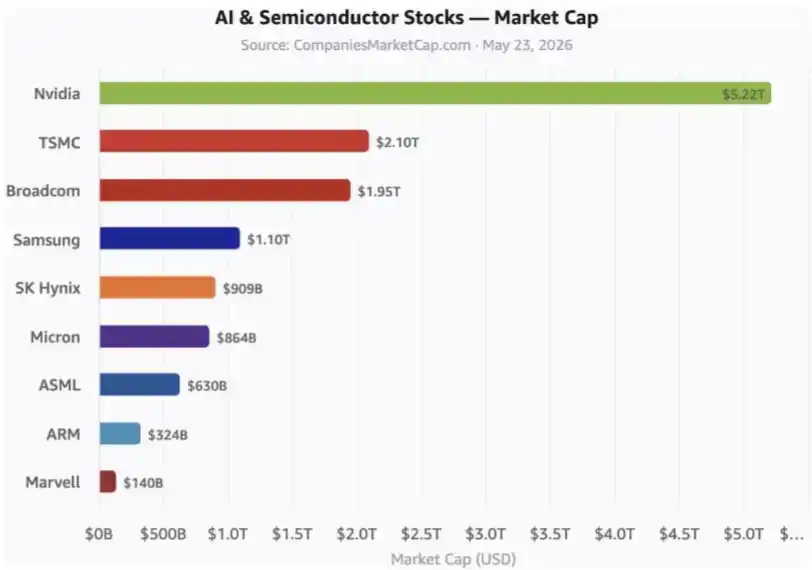
These are key AI stocks. The chart doesn't yet include hyperscalers and many other related companies.

Original Article Link

Domande pertinenti

QAccording to the article, what is DeepSeek's primary long-term strategic goal beyond short-term revenue from applications?

AThe article argues that DeepSeek's long-term goal is not immediate application-layer monetization, but rather to reshape the AI cost structure and drive the formation of a new hardware ecosystem worth $10 trillion, positioning DeepSeek itself for a potential $1 trillion valuation.

QHow does DeepSeek's work on KV Cache compression, like MLA, CSA, and HSA, benefit the broader AI hardware ecosystem according to the analysis?

ABy drastically reducing KV Cache size (e.g., requiring only 5.48GB HBM for 1M context vs. 60GB+ for competitors), DeepSeek's innovations lower dependency on high-performance HBM memory. This allows KV Cache to be offloaded to more abundant and cheaper storage like SSDs (benefiting NAND producers like YMTC) and enables efficient use of LPDDR for weight streaming and Engram storage, making a wider range of hardware, including alternative GPUs and ASICs, viable for AI workloads.

QWhat is the concept of 'Engram' proposed by DeepSeek, and what strategic advantage does it provide within the proposed hardware strategy?

AEngram is a 'conditional memory' mechanism that modernizes N-gram embeddings into a hash-based O(1) lookup system. It introduces a 'memory-for-compute' trade-off, where storing large embedding tables in cheaper, more abundant memory (like LPDDR) allows the model to retrieve knowledge efficiently, reducing the need for expensive computation through many transformer layers. This is a strategic advantage when hardware like Chinese GPUs/ASICs may lag in raw FLOPs but LPDDR supply is strong.

QWhat role does TileLang play in DeepSeek's strategy as described in the article?

ATileLang is an investment in software abstraction. It allows developers to write computational kernels once and have them run on multiple hardware platforms with supported backends. This initiative helps erode the CUDA ecosystem's moat, empowers a broader range of Chinese and Western hardware (like AMD) by improving their accessibility, and is aligned with DeepSeek's goal of fostering a competitive, diverse hardware ecosystem.

QHow does the article suggest DeepSeek could achieve a $1 trillion valuation, drawing a parallel to a similar industry deal?

AThe article suggests DeepSeek could follow a model similar to OpenAI's deals with AMD and Cerebras. By deeply collaborating with and committing to use hardware from Chinese memory, ASIC, CPU, and networking companies, DeepSeek could receive stock warrants or options tied to usage milestones. As DeepSeek's innovations make these companies' hardware viable for leading AI workloads, it helps build a massive $10 trillion industry. In return, DeepSeek gains significant equity stakes in these ecosystem players, creating a path to its own $1 trillion valuation.

Letture associate

DeFi Has Reached Its Most Dangerous Moment: The Real Vulnerabilities Are Not in the Code

DeFi in Peril: The Real Vulnerability Isn't in the Code April 2026 marked a paradigm shift in DeFi security, with over $625 million lost across 30 incidents—the worst month in crypto history by event count. Crucially, none of the major exploits (Drift Protocol: $285M, KelpDAO: $292M, Wasabi Protocol: $4.5M) resulted from smart contract vulnerabilities. Instead, failures occurred in the operational "plumbing": social engineering to compromise multi-signature councils, a single-point-of-failure 1-of-1 bridge validator, and stolen admin private keys. These events expose a fundamental misalignment: the industry's security model has long focused on code audits, while the actual attack surface has shifted to privileged access points and off-chain infrastructure. The article introduces the term "OpenFi" to describe this reality: permissionless, on-chain, yet operationally dependent on trusted third parties (admins, validators, oracles) at key junctures. The KelpDAO exploit vividly demonstrated asymmetric "contagion risk." A configuration error in a smaller protocol triggered a panic, causing approximately $13.2 billion in outflows from larger, unaffected protocols like Aave within 48 hours, as users fled uncertain collateral. The core dilemma is the double-edged sword of centralization. Operational levers like emergency councils (e.g., Arbitrum freezing stolen funds post-KelpDAO) enable crisis response but also create catastrophic attack surfaces if compromised (e.g., Drift). The path forward demands radical honesty: protocols must clearly disclose their trust assumptions, operational levers, and failure modes. The industry must treat operational security (key management, configurations, incident response) with the same rigor as code security. Survival depends on building systems whose risks can be understood, priced, and insured, moving beyond the outdated "code is law" mantra to a mature model of disclosed and managed trust.

链捕手18 min fa

DeFi Has Reached Its Most Dangerous Moment: The Real Vulnerabilities Are Not in the Code

链捕手18 min fa

Vitalik's Article Emphasizes Ethereum Must Be 'Amazing', But Foundation Is Not the Center

Vitalik Buterin has published a lengthy response to recent community criticism directed at the Ethereum Foundation (EF). Acknowledging a sense of "unease," he addresses concerns about the EF's strategic direction, its perceived disconnect from ETH's price performance, and calls for its reduced central role. Vitalik rejects the notion that the EF should be the central governing body of Ethereum, framing it instead as one "node with a clear mandate" among many within the ecosystem. He highlights the EF's limited ETH holdings (≈0.16% of supply) compared to other blockchain foundations and states it will no longer sell significant amounts of ETH. Its future focus will be on long-term, critical projects that align with Ethereum's core values of censorship-resistance and decentralization, which might not otherwise happen. A core argument is that Ethereum must be "amazing," but not by merely chasing higher transaction speeds at the cost of decentralization. He proposes focusing on the "CROPS" dimensions: creating a Cryptographically provable, Reliable, Open, Private, and Secure network. This includes pursuing goals like a formally verifiable, bug-free Ethereum client and minimizing protocol-level reliance on intermediaries. The article concludes by noting that while Vitalik clarifies the EF's refocused role, he does not directly address community suggestions for creating a new organization explicitly aligned with ETH's economic interests. This "alignment gap" is presented as a key challenge for Ethereum's future.

链捕手28 min fa

Vitalik's Article Emphasizes Ethereum Must Be 'Amazing', But Foundation Is Not the Center

链捕手28 min fa

Galxe: How a Quest Platform Evolved into Web3's Growth Infrastructure

Galxe, once perceived as a simple Web3 quest platform, has evolved into a core growth infrastructure within the Web3 ecosystem. It addresses a fundamental Web3 growth dilemma: the lack of a mature, systematic user acquisition and retention system akin to Web2's advertising and analytics platforms. While users complete quests (social tasks, on-chain interactions) for rewards, Galxe's true innovation lies in transforming these fragmented, one-off actions into lasting, verifiable identity credentials. This process of *behavioral assetization* creates a persistent record of a user's activities across projects and chains. For users, their wallet accumulates a valuable history that can unlock future access and rewards, fostering a "profile-building" mentality. For projects, Galxe provides a pre-screened user pool with rich behavioral data, enabling targeted outreach to users based on their specific on-chain history and community engagement. Galxe employs a gamefied growth path, guiding users from low-friction social tasks into deeper, valuable on-chain interactions through a structured progression of quests. This solves the incentive-behavior mismatch common in Web3, filtering users by their willingness to engage. Beyond quests, products like Passport (identity verification) and Starboard (community analytics) position Galxe as a comprehensive growth operating system. The platform's defensible advantage is its self-reinforcing data and network flywheel: more projects attract more users, enriching behavioral data; richer data enables better user targeting, attracting more projects. Ultimately, Galxe is shifting Web3's growth logic from short-term "reward-driven" traffic towards a long-term "identity-driven" relationship model, where a user's accumulated on-chain履历 becomes a core asset.

marsbit35 min fa

Galxe: How a Quest Platform Evolved into Web3's Growth Infrastructure

marsbit35 min fa

Trading

Spot
Futures

Articoli Popolari

Cosa è $S$

Comprendere SPERO: Una Panoramica Completa Introduzione a SPERO Mentre il panorama dell'innovazione continua a evolversi, l'emergere delle tecnologie web3 e dei progetti di criptovaluta gioca un ruolo fondamentale nel plasmare il futuro digitale. Un progetto che ha attirato l'attenzione in questo campo dinamico è SPERO, denotato come SPERO,$$s$. Questo articolo mira a raccogliere e presentare informazioni dettagliate su SPERO, per aiutare gli appassionati e gli investitori a comprendere le sue basi, obiettivi e innovazioni nei domini web3 e crypto. Che cos'è SPERO,$$s$? SPERO,$$s$ è un progetto unico all'interno dello spazio crypto che cerca di sfruttare i principi della decentralizzazione e della tecnologia blockchain per creare un ecosistema che promuove l'impegno, l'utilità e l'inclusione finanziaria. Il progetto è progettato per facilitare interazioni peer-to-peer in modi nuovi, fornendo agli utenti soluzioni e servizi finanziari innovativi. Al suo interno, SPERO,$$s$ mira a responsabilizzare gli individui fornendo strumenti e piattaforme che migliorano l'esperienza dell'utente nello spazio delle criptovalute. Questo include la possibilità di metodi di transazione più flessibili, la promozione di iniziative guidate dalla comunità e la creazione di percorsi per opportunità finanziarie attraverso applicazioni decentralizzate (dApps). La visione sottostante di SPERO,$$s$ ruota attorno all'inclusività, cercando di colmare le lacune all'interno della finanza tradizionale mentre sfrutta i vantaggi della tecnologia blockchain. Chi è il Creatore di SPERO,$$s$? L'identità del creatore di SPERO,$$s$ rimane piuttosto oscura, poiché ci sono risorse pubblicamente disponibili limitate che forniscono informazioni dettagliate sul suo fondatore o fondatori. Questa mancanza di trasparenza può derivare dall'impegno del progetto per la decentralizzazione—un ethos che molti progetti web3 condividono, dando priorità ai contributi collettivi rispetto al riconoscimento individuale. Centrando le discussioni attorno alla comunità e ai suoi obiettivi collettivi, SPERO,$$s$ incarna l'essenza dell'empowerment senza mettere in evidenza individui specifici. Pertanto, comprendere l'etica e la missione di SPERO rimane più importante che identificare un creatore singolo. Chi sono gli Investitori di SPERO,$$s$? SPERO,$$s$ è supportato da una varietà di investitori che vanno dai capitalisti di rischio agli investitori angelici dedicati a promuovere l'innovazione nel settore crypto. Il focus di questi investitori generalmente si allinea con la missione di SPERO—dando priorità a progetti che promettono avanzamenti tecnologici sociali, inclusività finanziaria e governance decentralizzata. Queste fondazioni di investitori sono tipicamente interessate a progetti che non solo offrono prodotti innovativi, ma contribuiscono anche positivamente alla comunità blockchain e ai suoi ecosistemi. Il supporto di questi investitori rafforza SPERO,$$s$ come un concorrente degno di nota nel dominio in rapida evoluzione dei progetti crypto. Come Funziona SPERO,$$s$? SPERO,$$s$ impiega un framework multifunzionale che lo distingue dai progetti di criptovaluta convenzionali. Ecco alcune delle caratteristiche chiave che sottolineano la sua unicità e innovazione: Governance Decentralizzata: SPERO,$$s$ integra modelli di governance decentralizzati, responsabilizzando gli utenti a partecipare attivamente ai processi decisionali riguardanti il futuro del progetto. Questo approccio favorisce un senso di proprietà e responsabilità tra i membri della comunità. Utilità del Token: SPERO,$$s$ utilizza il proprio token di criptovaluta, progettato per servire varie funzioni all'interno dell'ecosistema. Questi token abilitano transazioni, premi e la facilitazione dei servizi offerti sulla piattaforma, migliorando l'impegno e l'utilità complessivi. Architettura Stratificata: L'architettura tecnica di SPERO,$$s$ supporta la modularità e la scalabilità, consentendo un'integrazione fluida di funzionalità e applicazioni aggiuntive man mano che il progetto evolve. Questa adattabilità è fondamentale per mantenere la rilevanza nel panorama crypto in continua evoluzione. Coinvolgimento della Comunità: Il progetto enfatizza iniziative guidate dalla comunità, impiegando meccanismi che incentivano la collaborazione e il feedback. Nutrendo una comunità forte, SPERO,$$s$ può affrontare meglio le esigenze degli utenti e adattarsi alle tendenze di mercato. Focus sull'Inclusione: Offrendo basse commissioni di transazione e interfacce user-friendly, SPERO,$$s$ mira ad attrarre una base utenti diversificata, inclusi individui che potrebbero non aver precedentemente interagito nello spazio crypto. Questo impegno per l'inclusione si allinea con la sua missione generale di empowerment attraverso l'accessibilità. Cronologia di SPERO,$$s$ Comprendere la storia di un progetto fornisce preziose intuizioni sulla sua traiettoria di sviluppo e sui traguardi. Di seguito è riportata una cronologia suggerita che mappa eventi significativi nell'evoluzione di SPERO,$$s$: Fase di Concettualizzazione e Ideazione: Le idee iniziali che formano la base di SPERO,$$s$ sono state concepite, allineandosi strettamente con i principi di decentralizzazione e focus sulla comunità all'interno dell'industria blockchain. Lancio del Whitepaper del Progetto: Dopo la fase concettuale, è stato rilasciato un whitepaper completo che dettaglia la visione, gli obiettivi e l'infrastruttura tecnologica di SPERO,$$s$ per suscitare interesse e feedback dalla comunità. Costruzione della Comunità e Prime Interazioni: Sono stati effettuati sforzi attivi di outreach per costruire una comunità di early adopters e potenziali investitori, facilitando discussioni attorno agli obiettivi del progetto e ottenendo supporto. Evento di Generazione del Token: SPERO,$$s$ ha condotto un evento di generazione del token (TGE) per distribuire i propri token nativi ai primi sostenitori e stabilire una liquidità iniziale all'interno dell'ecosistema. Lancio della Prima dApp: La prima applicazione decentralizzata (dApp) associata a SPERO,$$s$ è stata attivata, consentendo agli utenti di interagire con le funzionalità principali della piattaforma. Sviluppo Continuo e Partnership: Aggiornamenti e miglioramenti continui alle offerte del progetto, inclusi partnership strategiche con altri attori nello spazio blockchain, hanno plasmato SPERO,$$s$ in un concorrente competitivo e in evoluzione nel mercato crypto. Conclusione SPERO,$$s$ rappresenta una testimonianza del potenziale del web3 e delle criptovalute di rivoluzionare i sistemi finanziari e responsabilizzare gli individui. Con un impegno per la governance decentralizzata, il coinvolgimento della comunità e funzionalità progettate in modo innovativo, apre la strada verso un panorama finanziario più inclusivo. Come per qualsiasi investimento nello spazio crypto in rapida evoluzione, si incoraggiano potenziali investitori e utenti a ricercare approfonditamente e a impegnarsi in modo riflessivo con gli sviluppi in corso all'interno di SPERO,$$s$. Il progetto mostra lo spirito innovativo dell'industria crypto, invitando a ulteriori esplorazioni delle sue innumerevoli possibilità. Mentre il percorso di SPERO,$$s$ è ancora in fase di sviluppo, i suoi principi fondamentali potrebbero effettivamente influenzare il futuro di come interagiamo con la tecnologia, la finanza e tra di noi in ecosistemi digitali interconnessi.

75 Totale visualizzazioniPubblicato il 2024.12.17Aggiornato il 2024.12.17

Cosa è $S$

Cosa è AGENT S

Agent S: Il Futuro dell'Interazione Autonoma in Web3 Introduzione Nel panorama in continua evoluzione di Web3 e criptovalute, le innovazioni stanno costantemente ridefinendo il modo in cui gli individui interagiscono con le piattaforme digitali. Uno di questi progetti pionieristici, Agent S, promette di rivoluzionare l'interazione uomo-computer attraverso il suo framework agentico aperto. Aprendo la strada a interazioni autonome, Agent S mira a semplificare compiti complessi, offrendo applicazioni trasformative nell'intelligenza artificiale (AI). Questa esplorazione dettagliata approfondirà le complessità del progetto, le sue caratteristiche uniche e le implicazioni per il dominio delle criptovalute. Cos'è Agent S? Agent S si presenta come un innovativo framework agentico aperto, progettato specificamente per affrontare tre sfide fondamentali nell'automazione dei compiti informatici: Acquisizione di Conoscenze Specifiche del Dominio: Il framework apprende in modo intelligente da varie fonti di conoscenza esterne ed esperienze interne. Questo approccio duale gli consente di costruire un ricco repository di conoscenze specifiche del dominio, migliorando le sue prestazioni nell'esecuzione dei compiti. Pianificazione su Lungo Orizzonte di Compiti: Agent S impiega una pianificazione gerarchica potenziata dall'esperienza, un approccio strategico che facilita la suddivisione e l'esecuzione efficiente di compiti complessi. Questa caratteristica migliora significativamente la sua capacità di gestire più sottocompiti in modo efficiente ed efficace. Gestione di Interfacce Dinamiche e Non Uniformi: Il progetto introduce l'Interfaccia Agente-Computer (ACI), una soluzione innovativa che migliora l'interazione tra agenti e utenti. Utilizzando Modelli Linguistici Multimodali di Grandi Dimensioni (MLLM), Agent S può navigare e manipolare senza sforzo diverse interfacce grafiche utente. Attraverso queste caratteristiche pionieristiche, Agent S fornisce un framework robusto che affronta le complessità coinvolte nell'automazione dell'interazione umana con le macchine, preparando il terreno per innumerevoli applicazioni nell'AI e oltre. Chi è il Creatore di Agent S? Sebbene il concetto di Agent S sia fondamentalmente innovativo, informazioni specifiche sul suo creatore rimangono elusive. Il creatore è attualmente sconosciuto, il che evidenzia sia la fase embrionale del progetto sia la scelta strategica di mantenere i membri fondatori sotto anonimato. Indipendentemente dall'anonimato, l'attenzione rimane sulle capacità e sul potenziale del framework. Chi sono gli Investitori di Agent S? Poiché Agent S è relativamente nuovo nell'ecosistema crittografico, informazioni dettagliate riguardanti i suoi investitori e sostenitori finanziari non sono documentate esplicitamente. La mancanza di approfondimenti pubblicamente disponibili sulle fondazioni di investimento o sulle organizzazioni che supportano il progetto solleva interrogativi sulla sua struttura di finanziamento e sulla roadmap di sviluppo. Comprendere il supporto è cruciale per valutare la sostenibilità del progetto e il suo potenziale impatto sul mercato. Come Funziona Agent S? Al centro di Agent S si trova una tecnologia all'avanguardia che gli consente di funzionare efficacemente in contesti diversi. Il suo modello operativo è costruito attorno a diverse caratteristiche chiave: Interazione Uomo-Computer Simile a Quella Umana: Il framework offre una pianificazione AI avanzata, cercando di rendere le interazioni con i computer più intuitive. Mimando il comportamento umano nell'esecuzione dei compiti, promette di elevare le esperienze degli utenti. Memoria Narrativa: Utilizzata per sfruttare esperienze di alto livello, Agent S utilizza la memoria narrativa per tenere traccia delle storie dei compiti, migliorando così i suoi processi decisionali. Memoria Episodica: Questa caratteristica fornisce agli utenti una guida passo-passo, consentendo al framework di offrire supporto contestuale mentre i compiti si sviluppano. Supporto per OpenACI: Con la capacità di funzionare localmente, Agent S consente agli utenti di mantenere il controllo sulle proprie interazioni e flussi di lavoro, allineandosi con l'etica decentralizzata di Web3. Facile Integrazione con API Esterne: La sua versatilità e compatibilità con varie piattaforme AI garantiscono che Agent S possa adattarsi senza problemi agli ecosistemi tecnologici esistenti, rendendolo una scelta attraente per sviluppatori e organizzazioni. Queste funzionalità contribuiscono collettivamente alla posizione unica di Agent S all'interno dello spazio crittografico, poiché automatizza compiti complessi e multi-fase con un intervento umano minimo. Man mano che il progetto evolve, le sue potenziali applicazioni in Web3 potrebbero ridefinire il modo in cui si svolgono le interazioni digitali. Cronologia di Agent S Lo sviluppo e le tappe di Agent S possono essere riassunti in una cronologia che evidenzia i suoi eventi significativi: 27 Settembre 2024: Il concetto di Agent S è stato lanciato in un documento di ricerca completo intitolato “Un Framework Agentico Aperto che Usa i Computer Come un Umano”, mostrando le basi per il progetto. 10 Ottobre 2024: Il documento di ricerca è stato reso pubblicamente disponibile su arXiv, offrendo un'esplorazione approfondita del framework e della sua valutazione delle prestazioni basata sul benchmark OSWorld. 12 Ottobre 2024: È stata rilasciata una presentazione video, fornendo un'idea visiva delle capacità e delle caratteristiche di Agent S, coinvolgendo ulteriormente potenziali utenti e investitori. Questi indicatori nella cronologia non solo illustrano i progressi di Agent S, ma indicano anche il suo impegno per la trasparenza e il coinvolgimento della comunità. Punti Chiave su Agent S Man mano che il framework Agent S continua a evolversi, diversi attributi chiave si distinguono, sottolineando la sua natura innovativa e il potenziale: Framework Innovativo: Progettato per fornire un uso intuitivo dei computer simile all'interazione umana, Agent S porta un approccio nuovo all'automazione dei compiti. Interazione Autonoma: La capacità di interagire autonomamente con i computer attraverso GUI segna un passo avanti verso soluzioni informatiche più intelligenti ed efficienti. Automazione di Compiti Complessi: Con la sua metodologia robusta, può automatizzare compiti complessi e multi-fase, rendendo i processi più veloci e meno soggetti a errori. Miglioramento Continuo: I meccanismi di apprendimento consentono ad Agent S di migliorare dalle esperienze passate, migliorando continuamente le sue prestazioni e la sua efficacia. Versatilità: La sua adattabilità attraverso diversi ambienti operativi come OSWorld e WindowsAgentArena garantisce che possa servire un'ampia gamma di applicazioni. Man mano che Agent S si posiziona nel panorama di Web3 e delle criptovalute, il suo potenziale per migliorare le capacità di interazione e automatizzare i processi segna un significativo avanzamento nelle tecnologie AI. Attraverso il suo framework innovativo, Agent S esemplifica il futuro delle interazioni digitali, promettendo un'esperienza più fluida ed efficiente per gli utenti in vari settori. Conclusione Agent S rappresenta un audace passo avanti nell'unione tra AI e Web3, con la capacità di ridefinire il modo in cui interagiamo con la tecnologia. Sebbene sia ancora nelle sue fasi iniziali, le possibilità per la sua applicazione sono vaste e coinvolgenti. Attraverso il suo framework completo che affronta sfide critiche, Agent S mira a portare le interazioni autonome al centro dell'esperienza digitale. Man mano che ci addentriamo nei regni delle criptovalute e della decentralizzazione, progetti come Agent S giocheranno senza dubbio un ruolo cruciale nel plasmare il futuro della tecnologia e della collaborazione uomo-computer.

521 Totale visualizzazioniPubblicato il 2025.01.14Aggiornato il 2025.01.14

Cosa è AGENT S

Come comprare S

Benvenuto in HTX.com! Abbiamo reso l'acquisto di Sonic (S) semplice e conveniente. Segui la nostra guida passo passo per intraprendere il tuo viaggio nel mondo delle criptovalute.Step 1: Crea il tuo Account HTXUsa la tua email o numero di telefono per registrarti il tuo account gratuito su HTX. Vivi un'esperienza facile e sblocca tutte le funzionalità,Crea il mio accountStep 2: Vai in Acquista crypto e seleziona il tuo metodo di pagamentoCarta di credito/debito: utilizza la tua Visa o Mastercard per acquistare immediatamente SonicS.Bilancio: Usa i fondi dal bilancio del tuo account HTX per fare trading senza problemi.Terze parti: abbiamo aggiunto metodi di pagamento molto utilizzati come Google Pay e Apple Pay per maggiore comodità.P2P: Fai trading direttamente con altri utenti HTX.Over-the-Counter (OTC): Offriamo servizi su misura e tassi di cambio competitivi per i trader.Step 3: Conserva Sonic (S)Dopo aver acquistato Sonic (S), conserva nel tuo account HTX. In alternativa, puoi inviare tramite trasferimento blockchain o scambiare per altre criptovalute.Step 4: Scambia Sonic (S)Scambia facilmente Sonic (S) nel mercato spot di HTX. Accedi al tuo account, seleziona la tua coppia di trading, esegui le tue operazioni e monitora in tempo reale. Offriamo un'esperienza user-friendly sia per chi ha appena iniziato che per i trader più esperti.

935 Totale visualizzazioniPubblicato il 2025.01.15Aggiornato il 2025.03.21

Come comprare S

Discussioni

Benvenuto nella Community HTX. Qui puoi rimanere informato sugli ultimi sviluppi della piattaforma e accedere ad approfondimenti esperti sul mercato. Le opinioni degli utenti sul prezzo di S S sono presentate come di seguito.

活动图片