Written by: David Christopher
Compiled by: Block unicorn
While reading the recent report from Galaxy Research, I gained one of the clearest perspectives on the future value of x402.
One example caught my attention: a smart agent helping a user book a trip, querying high-quality weather data via x402 to find the best dates and destination, providing flight and hotel options, and then passing all the information to the booking process. Each query is equivalent to a micro-payment. Each data source gets paid. The smart agent integrates all the information and finally makes a booking decision.
What impressed me was the perfect combination of x402 with data aggregation and management. Someone integrates decentralized data sources into proprietary data, making it more useful than any single supplier, and sells access via x402. Data managers only bear the integration cost once. Callers pay per query. Everyone benefits (provided the data volume is large enough, which we will discuss later).
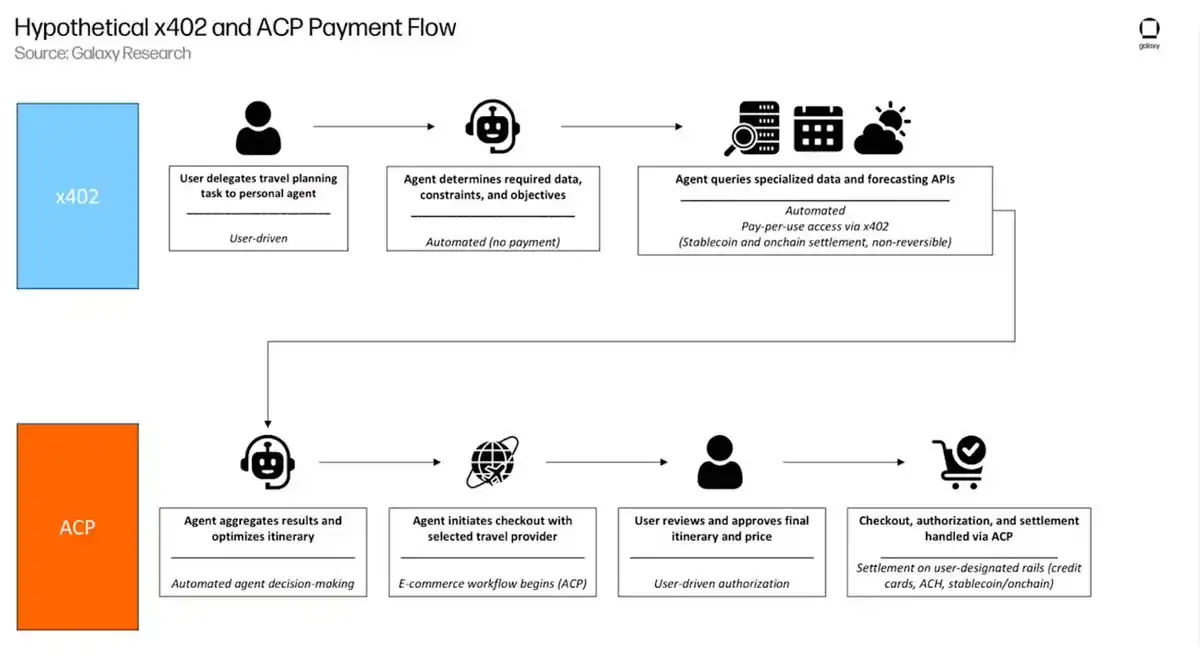
From Galaxy Research
Before such services become widespread, I still believe x402 is in its infancy. If you are a developer hoping to use x402 for development but struggling for inspiration, here are some theoretical products I would rush to try if I could use them immediately!
Skills Endpoint
Skills are carefully crafted sets of instructions written by humans for AI agents to perform specific tasks.
Currently, most skills markets adopt a fixed fee model: permanent access is priced at $5, $15, and $20 respectively. This model creates a misalignment of incentives. Occasional users overpay, while power users underpay, and skill creators cannot capture value proportional to usage. A truly useful skill, like a truly useful advisor (if such a thing exists), should be worth far more than a one-time $15.
x402 offers an alternative. Skill creators can publish their work through an x402 interface and price it based on reality: pay-per-use (one-time use), monthly subscription (a new feature in x402 V2), or both. The payment system supports both models. A skill called thousands of times a month can generate ongoing revenue for the creator. Less frequently used skills do not require users to pay upfront.
Niche Crypto News Aggregation Package
Crypto news is scattered across platforms like Twitter, Telegram groups, podcasts, RSS feeds, and Substacks. The problem is even more challenging if you want to track a specific ecosystem. Tracking all the dynamics of Sui or Starknet means monitoring a dozen sources and checking daily.
An ecosystem-specific x402 data stream can solve this. Someone aggregates Twitter user feeds, articles from website RSS feeds, and Telegram messages into a curated information stream for a specific ecosystem via an API. The agent queries: "What happened on Starknet in the last 24 hours?" and receives a structured reply. No more switching between tabs and apps.
Aggregated Ecosystem Data
Developer activity has always been difficult to measure accurately.
Electric Capital's annual report and its continuously updated dashboard are excellent open-source resources, but they also have limitations. For example, I just looked at the ecosystems with the top developer growth over the past year, and the results showed PancakeSwap, Monad, and Aleo. Of course, this is because I only filtered on one metric—but it also reflects a broader problem: developer activity data in the crypto space is very fragmented, and no single data source provides the complete picture.
If there were an x402 data source that aggregated Electric Capital data, GitHub activity, Artemis metrics, and protocol-specific data sources into a quality-weighted developer activity stream, it would fill a real gap. Agent query: "What has Solana's developer momentum been like over the past quarter?" and gets more useful information than raw commit counts.
Newsletter and Podcast Performance Tracker
An idea I would personally use: a service that clearly tracks the viewpoints proposed in podcasts or newsletters and measures their development over time.
Citron does something similar for the stock market, releasing scorecards for its annual predictions and their performance at the end of the year. But for most newsletters and podcasts, if you want to know if a media outlet's predictions have yielded returns over time, you have to research manually.
An x402 service could fill this gap by benchmarking a media outlet's predictions. Just provide the newsletter or podcast, and it tracks every prediction, adds timestamps, follows subsequent price movements, and scores the media outlet's past performance. Agent query: "How has X's asset predictions performed over the past year?" and gets a verified answer.
Security and Audit Tracker
Protocols often don't proactively announce when they are attacked. And the news cycle moves fast; if you weren't online the day the exploit happened, you might have completely missed it. By the time you need to take action, an event that should have been highly concerning is already buried under weeks of news coverage.
The situation with security reviews isn't much better. Audit reports are scattered across auditors' websites, protocol documentation, and GitHub repositories. Checking a protocol's audit history is more difficult than it should be.
It would be great to have an x402 information stream that aggregates this information into a queryable endpoint, where users could pay a few extra cents to access it before deciding on yield allocation, especially when operating through an agent interface.
Is This Really Feasible?
Everything I mentioned above faces two questions: Can the economics support the building of these streams? Can they be developed legally?
From an economic perspective, history is not optimistic. Pay-per-item models have struggled since the early days of the internet. The cognitive cost of deciding whether something is worth paying for often exceeds the cost of the payment itself. This is why the internet shifted to subscription models: predictable billing, avoiding decision fatigue, and reducing churn.
But agents change this. You top up your wallet, the agent spends on your behalf, and you top up again when the balance is low. API credits work similarly. The question shifts from "Is this few cents worth it?" to "Can the endpoint provider recoup costs at scale?" This depends on traffic volume.
In terms of legality, x402 handles payment and metering. It doesn't change the copyright issues of upstream data. If you're using licensed APIs, public data, or first-party X402 endpoints, then it's straightforward product development. But if you rely on web scraping or operate in the gray areas of terms of service, persistence and scale may be limited. Once upstream providers notice and object, you're in dangerous territory.
x402 V2 introduces dynamic payment routing, enabling revenue sharing. Data managers can return a portion of the revenue to the original data providers, aligning incentives and turning potential terms-of-service conflicts into partnerships, though this does reduce profit margins.
Whether both the economics and legality can hold up at scale remains to be seen. But if they do, these are the data streams I would pay to use.
Whether this economic and legal mechanism can work simultaneously at scale remains to be seen. But if it does, these are the data streams I would pay to use.