Circle: From Issuance to Infrastructure

链捕手Publicado a 2026-05-19Actualizado a 2026-05-19

Resumen

Title: Circle: From Issuance to Infrastructure Circle, the issuer of the USDC stablecoin, is undergoing a strategic transformation from a single-product company dependent on reserve interest income to a vertically integrated, full-stack financial platform. Its primary revenue source, earnings from US Treasury reserves backing USDC, is under pressure from declining Federal Reserve interest rates. Furthermore, Circle pays out a significant portion (~60 cents per dollar earned) to partners like Coinbase for distribution and settlement, leading to value leakage. To address these challenges and capture more value across the payment stack, Circle announced three key initiatives in Q1 2026: 1. **Settlement Layer**: Launching its own Layer-1 blockchain, **Arc**. Designed for institutional use with configurable privacy and quantum-resistant architecture, Arc uses USDC as its native gas token, allowing Circle to capture transaction fees currently paid to other blockchains like Ethereum. 2. **Distribution Layer**: Expanding the **Circle Payments Network (CPN)**, which connects financial institutions directly to Circle, reducing reliance on third-party exchanges for USDC distribution and on/off-ramps. 3. **Application Layer**: Building infrastructure for an **AI agent economy**, including tools for agent wallets, nanopayments, and a marketplace. Circle aims to monetize the high volume of AI-driven microtransactions predominantly settled in USDC. This vertical integration strategy ...

Article Compiled By: Block unicorn

The company earned billions in interest income by holding the Treasury reserves backing its stablecoin and paid fees to other platforms for distributing and settling USDC throughout the payments ecosystem. For every dollar Circle earns, it pays about 60 cents to USDC partners. This was sustainable as long as margins were wide. But with low interest rates arriving, the USDC issuer lost too much profit. For most of its history, Circle had only one product: USDC.

In its recently released Q1 2026 earnings report, the USDC issuer announced several initiatives aimed at capturing more value within its operational scope. These included a $222 million presale for its native Layer-1 token ARC at a fully diluted valuation of $3 billion, the launch of AI agent infrastructure, and an expansion of its Circle Payments Network to enable banks to facilitate stablecoin payments by bypassing the volatility of digital assets. The achievements of the past few quarters will change this status quo.

Taken together, these moves signal Circle's attempt to transform from a single-layer company into a full-stack financial platform capable of operating and capturing value at multiple levels of the payments stack.

Today, I'll assess whether Circle can leverage vertical integration to offset the shrinkage of its yield business, which shrinks with each Federal Reserve interest rate cut.

The Disappearing Float

In Q1 2026, Circle's total revenue was $694 million, up 20% year-over-year. This growth was entirely due to an increase in the circulating stablecoin supply, with no improvement in USDC itself. The circulating stablecoin supply grew from $235 billion in March 2025 to $315 billion in March 2026, an increase of over 30%. Over the same period, USDC's market share declined by 62 basis points.

Circle faces a bigger problem. The era of low interest rates has arrived, with the Fed rate dropping from 4.5% a year ago to 3.75% now.

Although the average circulation of USDC increased 39% year-over-year in Q1 2026, Circle's reserve income only grew 17% to $653 million. This is because the average reserve rate fell 66 basis points year-over-year, from 4.16% in Q1 2025 to 3.50% in Q1 2026, significantly offsetting the growth mentioned above.

This is not a one-time phenomenon. Over the past four quarters, the gap between Circle's reserve income growth rate and USDC supply growth rate has been narrowing continuously.
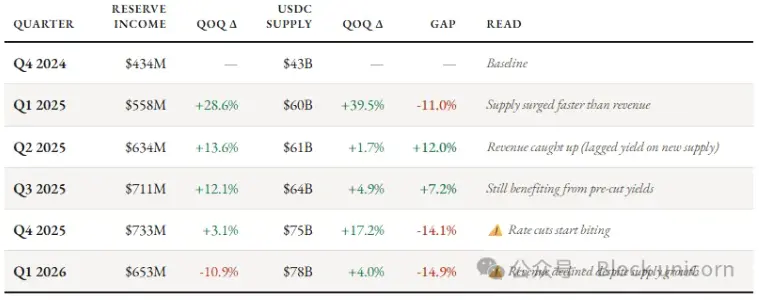
Circle's primary revenue source is not growing proportionally with its circulating stablecoin supply.

The company also faces a value leakage problem.

The 60 Cent Awakening

This means that for every dollar Circle earns, it pays over 60 cents to platforms that hold and distribute USDC. Of the $405 million in USDC distribution costs in Q1 2026, Circle paid $330 million (about 80%) to Coinbase alone. Out of $653 million in reserve income this quarter, Circle paid $405 million to partners for distribution and transaction costs.

In an industry where new players are constantly expanding and integrating across every layer of the tech stack, this is a significant amount of money left on the table.

All signs point to Circle facing reality. Interest rates keep falling, reducing its reserve income; distribution costs remain high, causing persistent value leakage; and Circle's core business remains a proxy for yield, whose value shrinks with each Fed rate cut. Under President Donald Trump, expectations for a dovish Fed stance have intensified.

What is Circle's response? The answer: vertical integration to capture more value across the business chain and reduce reliance on interest income.

To understand what Circle is building, consider what it currently owns.

The USDC issuer started at the bottom of the stablecoin stack—the issuance layer—and has spent years watching others capture value on every layer above it.
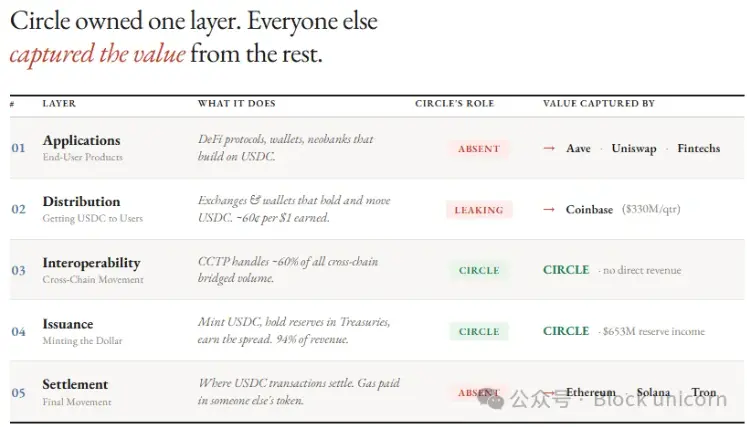
At the issuance layer, Circle issues USDC and EURC, holds US Treasury reserves via the Circl Reserve Fund managed by BlackRock, manages the 1:1 peg, and handles issuance and redemption via Circle Mint. 94% of its total revenue comes from government bond reserve yield.

Subsequently, Circle expanded into the interoperability layer with its Cross-Chain Transfer Protocol (CCTP), which transfers USDC between blockchains and handles about 60% of cross-chain bridging volume. Although this mechanism routes USDC between chains, CCTP itself runs on chains owned by others. Therefore, Circle cannot derive significant direct income from it.

All other layers in the stack belong to others.

The settlement system runs on Ethereum, Solana, and Tron. Every USDC transaction pays gas fees in other tokens (ETH, SOL, TRX), and Circle has no control over congestion, fees, or governance on these chains.

Distribution channels rely primarily on Coinbase, exchanges, and wallets. Circle must pay revenue shares, incentive program fees, and integration costs to get USDC into users' hands.

Third parties, such as DeFi protocols, fintechs, neobanks, and prediction markets, build the applications and products that use USDC. This means the end customer, whether retail or institutional, never has to interact directly with Circle.

This structure results in Circle keeping only 40 cents of every dollar it earns.

Taking Control of the Stack

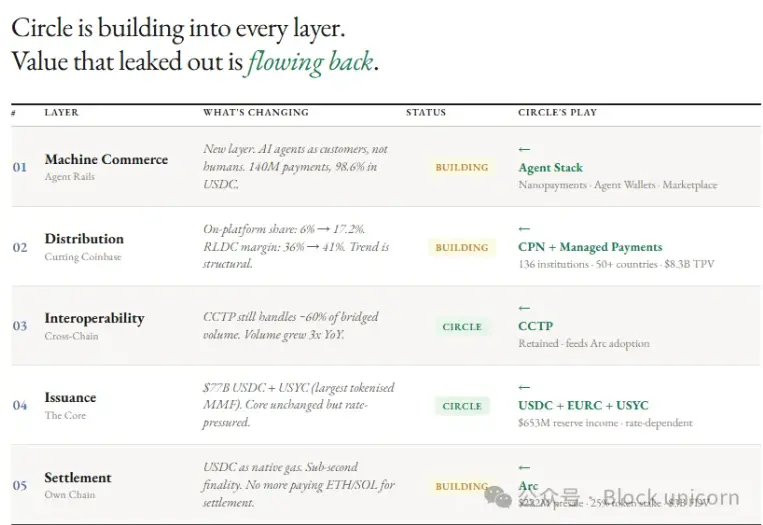
On May 11th, Circle announced three investment plans aimed at vertically integrating different layers of the business it did not previously own.

First is settlement. Circle owns the native Layer-1 blockchain Arc, designed to capture fees currently generated when USDC moves on blockchains like Ethereum, Solana, and Tron.

EVM-compatible Arc offers sub-second finality and uses USDC as its native gas fee token, with transaction costs around $0.001. To make its chain more attractive to institutional users, Circle offers configurable privacy and a quantum-resistant architecture. General-purpose chains like Ethereum and Solana are fully transparent and cannot provide the privacy needed for sensitive transactions like institutional payments.

Circle raised $222 million via an ARC token presale at a $3 billion valuation. This round was led by a $75 million funding round from a16z, with other investors including BlackRock, Apollo Global Management, Intercontinental Exchange (parent of NYSE), Standard Chartered, ARK Invest, SBI Group, IDG Capital, Bullish, and Haun Ventures.

Second is distribution. The Circle Payments Network (CPN) helps the USDC issuer reduce its reliance on Coinbase.

CPN connects financial institutions directly to Circle's network, allowing them to mint, redeem, and route USDC without going through an exchange. The network has 136 registered institutions (up 36% quarter-over-quarter), $8.3 billion in annualized transaction volume (up 17% quarter-over-quarter), and facilitates fiat payments in over 50 countries.

Consequently, the proportion of USDC based on Circle's own infrastructure nearly tripled, from about 6% a year ago to 17.2%. Even as reserve yields declined, the RLDC margin (revenue minus distribution and transaction costs as a percentage of revenue) steadily recovered from 38% in Q2 2025 to 41% in Q1 2026.

Circle has not yet commercialized CPN, prioritizing user growth over fees. But once commercialized, each additional dollar of CPN usage will generate usage-based revenue for Circle, independent of interest rates.

Third is the application layer. Through this third layer, Circle aims to capture ongoing value across the agent economy by charging small fees on large transactions executed by AI agents.

Circle is building a full agent economy through products like Agent Wallets, Nanopayments (supporting gas-free USDC transfers as low as $0.000001 [one-millionth of a dollar]), the Agent Marketplace (where agents can discover and pay for services), and Circle CLI (accelerating agent onboarding and wallet configuration).

How large is the market opportunity for agent payments? Last month, Circle's Head of Marketing, Peter Schroeder, posted that USDC accounted for 98.6% of the 140 million transactions completed by AI agents within nine months.
The Stack Race

Circle's expansion up the payments stack is not easy. Payments giant Stripe started at the top and gradually went deeper through a series of deals and product launches. Acquiring Bridge gave Stripe control over authorization, custody, forex, and issuing layers. Launching Tempo took Stripe into the settlement layer. Today, Stripe controls all seven payments layers, serving 5 million merchants.

Tether uses Plasma, incubated by the USDT issuer, as its settlement chain. However, Tether's regulatory oversight still lags behind USDC's.

Stripe dominates human-to-human transactions, while Tether leads in dollar transactions in emerging markets and crypto trading. Therefore, Circle is positioning itself in institutional settlement and machine-to-machine transactions, where regulatory credibility and programmable infrastructure may be more important than the checkout integrations Stripe dominates.

CRCL's Retort

Although Circle raised $222 million by preselling ARC tokens to institutional investors, the initial development funding for ARC actually came from CRCL's shareholders. Ironically, Circle's biggest challenge might be handling internal resistance.

What is the significance of the Arc token's value growth for a public company? I pointed out this issue last November.

"The nature of the native token will create some controversy in public markets. Why should the market acknowledge or value a native token that captures the value created by Arc and CPN, rather than letting that value flow back to Circle's P&L? Why should Circle's surplus fund a cost center that is not expected to return profits to shareholders? Existing shareholders will not tolerate this. Public market investors bought CRCL for its reserve yield. They are unlikely to stand by and watch a new asset absorb the value appreciation of the infrastructure they invested in."

How will Circle resolve this? Is a separate listing for Arc justified? Only in the first quarter after Arc's mainnet launch will we know the answer.

For now, Circle's long-term goal is to capture as much value as possible by expanding its presence across these layers. Every time USDC settles on Arc, Circle earns a settlement fee. When institutions transact via CPN, Circle will retain distribution profits. Finally, when agents transact via Nanopayments on Arc, Circle hopes to charge fees at that layer as well.

Preguntas relacionadas

QWhat is Circle's primary revenue source, and why is it under pressure?

ACircle's primary revenue source is the interest income from holding US Treasury reserves backing its USDC stablecoin, which accounted for 94% of its total revenue. This revenue is under pressure because the Federal Reserve has been lowering interest rates, reducing the yield on these reserves. In Q1 2026, the average reserve yield dropped to 3.50% from 4.16% a year earlier, significantly slowing revenue growth despite an increase in USDC circulation.

QWhat problem does Circle face with its distribution and transaction costs for USDC?

ACircle faces a significant value leakage problem with its distribution and transaction costs. In Q1 2026, it paid out $405 million (over 60 cents for every dollar of reserve revenue earned) to partners like Coinbase and other platforms for distributing and settling USDC. This high cost represents a major outflow of the value it generates.

QWhat three key initiatives did Circle announce to vertically integrate its business and capture more value?

ACircle announced three key initiatives to vertically integrate: 1) Launching its own Layer-1 blockchain called Arc, which uses USDC as its native gas token and aims to capture settlement fees. 2) Expanding its Circle Payments Network (CPN) to directly connect financial institutions and reduce reliance on distributors like Coinbase. 3) Building an AI agent economy infrastructure (including Agent Wallets, Nanopayments) to capture value from micro-transactions executed by AI agents on its network.

QHow does Circle's new Layer-1 blockchain, Arc, differ from general-purpose blockchains like Ethereum or Solana?

AArc differs from general-purpose blockchains like Ethereum or Solana by being specifically designed for institutional use. Key features include: EVM compatibility, sub-second finality, USDC as the native gas token (with fees around $0.001 per transaction), configurable privacy for sensitive transactions (unlike the fully transparent nature of Ethereum/Solana), and a quantum-resistant architecture.

QWhat potential internal conflict does Circle face regarding the development and value capture of its new Arc blockchain and token (ARC)?

AA potential internal conflict arises because Circle's publicly traded shareholders (CRCL) invested in the company primarily for its reserve yield business. The new Arc blockchain and its separate ARC token are designed to capture the future value generated by Circle's infrastructure (like settlement fees from Arc and CPN). Shareholders may resist this structure if the value flows to the ARC token holders instead of back to Circle's corporate profits and, by extension, to CRCL shareholders. The company will need to justify how this benefits its existing public shareholders.

Lecturas Relacionadas

When Hyperliquid Steals Solana's 'Internet Capital Market' Script

The article "When Hyperliquid Steals Solana's 'Internet Capital Markets' Playbook" discusses Solana's struggles to maintain its "internet capital markets" narrative by 2026. Despite its initial success as a high-performance "Ethereum killer," SOL's price has underperformed, dropping significantly compared to other major cryptocurrencies. Solana's vision of a global, on-chain trading network for all assets is being challenged not primarily by Ethereum, but by Hyperliquid. Hyperliquid, evolving from a perpetual contracts platform into a dedicated financial infrastructure Layer 1, has become a major beneficiary of the shift of derivatives trading from centralized exchanges to on-chain. The article argues that for high-frequency financial trading, a specialized, performance-focused chain like Hyperliquid may be more suitable than a general-purpose ecosystem like Solana. Further compounding Solana's issues was a major $200+ million exploit on its key perpetual protocol, Drift, in April, which damaged market confidence. In response, Solana founder Anatoly Yakovenko heavily promoted the protocol Phoenix as a replacement, boosting its visibility but not its trading volume, which remains far behind leading platforms. Solana supporters have launched a public critique of Hyperliquid's decentralization, pointing to its limited validators and closed-source code. Critics, however, note Solana's own declining validator count and centralization metrics. This strategy has also caused internal friction, with developers of other Solana protocols expressing discontent over the foundation's perceived favoritism towards Phoenix. The conclusion is that Hyperliquid's rise represents a challenge to the "general-purpose blockchain" narrative, proving that the core of a capital market might be a specialized trading engine rather than a broad ecosystem. If Solana cannot regain dominance in derivatives, it risks remaining a "meme coin paradise" while its grand "internet capital markets" ambition slips away.

marsbitHace 1 hora(s)

When Hyperliquid Steals Solana's 'Internet Capital Market' Script

marsbitHace 1 hora(s)

When Hyperliquid Steals Solana's 'Internet Capital Markets' Playbook

The article discusses how Solana's grand vision of becoming an "Internet Capital Markets" platform is facing significant challenges in 2026, primarily from the unexpected rise of Hyperliquid. Solana's performance has weakened, with its token SOL experiencing the largest price decline among major cryptocurrencies. Its core narrative of building a global, chain-based marketplace for all assets is under pressure both internally and externally. Hyperliquid, originally a perpetual futures exchange, has evolved into a dedicated Layer 1 financial infrastructure network. Its focused, trading-centric approach is attracting capital and challenging the assumption that a "general-purpose" ecosystem like Solana is necessary for a capital market. Hyperliquid's success suggests that for high-frequency trading, superior performance, liquidity, and user experience may be more critical than a broad application ecosystem. Internally, Solana's strategy suffered a blow from a major hack on the Drift Protocol in April, resulting in over $200 million in losses. In response, Solana founder Anatoly Yakovenko has heavily promoted Phoenix as a new decentralized perpetual futures platform on Solana. While this boosted Phoenix's visibility, its trading volume remains far behind leading platforms. Solana's community has launched a rhetorical attack against Hyperliquid, questioning its decentralization due to its limited validator set and closed-source code. Critics, however, point out Solana's own decreasing validator count and increasing centralization of stake. This focus on "decentralization metrics" has also caused internal friction, with other Solana ecosystem developers expressing discontent over the foundation's perceived favoritism towards Phoenix. The article concludes that the rise of Hyperliquid represents a challenge to the "general-purpose blockchain" narrative, proving that an efficient trading engine might be more central to a capital market than a vast ecosystem. If Solana cannot regain dominance in the derivatives space, it risks remaining a "meme coin paradise" rather than achieving its ambition of hosting global assets.

链捕手Hace 1 hora(s)

When Hyperliquid Steals Solana's 'Internet Capital Markets' Playbook

链捕手Hace 1 hora(s)

Samsung Bets on Mobile HBM: AI Moves from Cloud to Palm, a New Frontier in Semiconductor Investment?

Samsung is betting on bringing high-bandwidth memory (HBM) technology from servers to mobile devices, aiming to enable powerful on-device AI features in smartphones and tablets. This move is driven by the booming AI market, where HBM demand from data centers has fueled Samsung's record profits, with HBM4 already in mass production. By integrating mobile HBM, Samsung seeks to transform user AI experiences—making tasks like image generation and real-time translation faster, seamless, and more private by processing data locally. Strategically, this allows Samsung to leverage its vertical integration in memory, advanced packaging, and Exynos processors to differentiate its Galaxy devices against competitors like Apple and Qualcomm. It also opens a new consumer growth avenue, reducing reliance on volatile server HBM demand alone. The initiative is expected to benefit the broader supply chain, boosting demand for advanced packaging materials, thermal solutions, and other components. While promising, risks include potential delays in mobile HBM mass production beyond 2027, high initial costs, and the cyclical nature of the memory market. Nonetheless, Samsung's push signals a broader industry shift toward hybrid cloud-edge AI computing, positioning it as a key player in defining the future of AI-powered devices and presenting a potential long-term investment theme in semiconductors.

marsbitHace 1 hora(s)

Samsung Bets on Mobile HBM: AI Moves from Cloud to Palm, a New Frontier in Semiconductor Investment?

marsbitHace 1 hora(s)

Trading

Spot
Futuros
活动图片