When Hyperliquid Steals Solana's 'Internet Capital Markets' Playbook

链捕手Publicado a 2026-05-19Actualizado a 2026-05-19

Resumen

The article discusses how Solana's grand vision of becoming an "Internet Capital Markets" platform is facing significant challenges in 2026, primarily from the unexpected rise of Hyperliquid. Solana's performance has weakened, with its token SOL experiencing the largest price decline among major cryptocurrencies. Its core narrative of building a global, chain-based marketplace for all assets is under pressure both internally and externally. Hyperliquid, originally a perpetual futures exchange, has evolved into a dedicated Layer 1 financial infrastructure network. Its focused, trading-centric approach is attracting capital and challenging the assumption that a "general-purpose" ecosystem like Solana is necessary for a capital market. Hyperliquid's success suggests that for high-frequency trading, superior performance, liquidity, and user experience may be more critical than a broad application ecosystem. Internally, Solana's strategy suffered a blow from a major hack on the Drift Protocol in April, resulting in over $200 million in losses. In response, Solana founder Anatoly Yakovenko has heavily promoted Phoenix as a new decentralized perpetual futures platform on Solana. While this boosted Phoenix's visibility, its trading volume remains far behind leading platforms. Solana's community has launched a rhetorical attack against Hyperliquid, questioning its decentralization due to its limited validator set and closed-source code. Critics, however, point out Solana's own dec...

Author: Hu Tao

In the cyclical waves of the cryptocurrency market, Solana once returned to its peak with the "Ethereum killer" narrative and extreme performance. However, as we enter 2026, this once high-performance machine is facing unprecedented deceleration pressure, first evident in its price.

In the past year, SOL's price has fallen by up to 73.5% from its high, the largest decline among all mainstream cryptocurrencies. In the recent month's market pullback, SOL's gains have also been very weak, significantly lagging behind other major cryptocurrencies like BTC and ETH.

Furthermore, Solana's core vision of "Internet Capital Markets" has suffered a major blow amidst internal and external challenges, forcing the Solana Foundation's senior team to speak out frequently recently, promoting their ecosystem on the public opinion front.

Solana's Core Narrative Hits a Wall

Over the past few years, Solana has been trying to tell a story far grander than just a "high-performance public chain."

In the definition of the Solana Foundation, Solana's endgame has transformed into "Internet Capital Markets"—a global trading network that brings stocks, commodities, futures, perpetual contracts, and all real-world assets on-chain.

Now, upon opening the official Solana website homepage, the most prominent slogan immediately greeting you is still: "Capital markets for every asset on Earth."
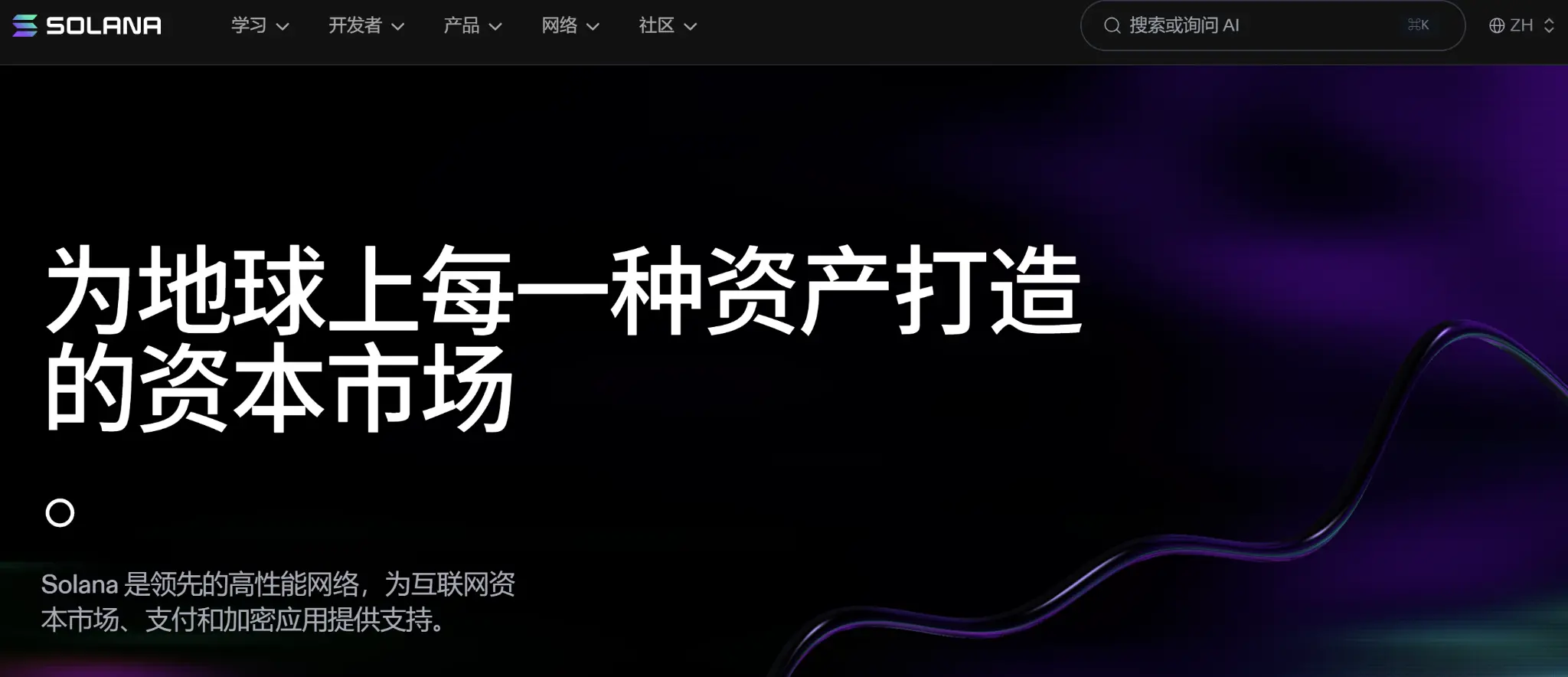
This means Solana aims not only to challenge Ethereum but also to replace traditional exchanges, brokers, and clearing systems, becoming the on-chain version of Nasdaq. High speed, low fees, high throughput, relatively mature user experience, and the strong backing of Wall Street capital once positioned Solana as the public chain closest to achieving this goal.

However, the problem is that as the "Internet Capital Markets" truly begin to take shape, the market is finding that Solana may not necessarily be at its core.

The Unexpected Impact of Hyperliquid

One of the biggest structural changes in the crypto industry over the past year has been the migration of the perpetual futures market away from traditional CEXs to on-chain platforms.

The biggest beneficiary of this trend is not Solana, nor Ethereum, Sui, or other networks, but Hyperliquid.

Initially, Hyperliquid was just an on-chain perpetual futures trading platform, but with the advancement of its Layer1 strategy, it has gradually evolved into a complete financial infrastructure network. Compared to Solana's broad and abstract "capital markets" vision, Hyperliquid has chosen a more focused, transaction-driven path.

For a long time, although the Solana ecosystem has hosted numerous DeFi projects, its core liquidity has always leaned more towards spot trading, Meme Coins, and on-chain speculation. The infrastructure truly capable of supporting institutional-grade trading depth, risk management, and high-frequency trading needs has never matured.

More critically, Hyperliquid has gradually proven something many previously overlooked: an "Internet Capital Markets" may not necessarily require a general-purpose ecosystem.

For high-frequency financial transactions, performance, matching, liquidity, and trading experience are far more important than "richness of on-chain applications." This means a vertical Layer1 specifically designed for financial transactions might be more suitable as the core of on-chain capital markets than a general-purpose public chain like Solana.

This is also why an increasing amount of capital, traders, and attention is converging on Hyperliquid.

After the Drift Incident, Solana Forced to Adjust Perpetual Futures Market Strategy

If Hyperliquid's rise externally squeezes the strategic space for Solana's "capital markets," then the Drift Protocol exploit incident tore open a massive gap from within.

In early April of this year, the Solana DeFi protocol Drift suffered a governance and oracle attack, resulting in over $200 million in losses.

As one of the most important perpetual futures protocols on Solana, Drift had been playing a central liquidity role in Solana DeFi. After the hack, the protocol's functions were directly paralyzed, a large number of assets, vaults, and associated protocols within the Solana ecosystem were affected, and market confidence rapidly deteriorated.

Perpetual futures are a fiercely contested territory in the DeFi space. Faced with the market vacuum left by Drift and the strategic gap in Solana's on-chain derivatives field, the Solana official team must vigorously promote a new alternative product to capture users and market share in this frontline battle for the "Internet Capital Markets" strategy.

At this point, the choices before Solana officials included a series of products like Pacifica, Phoenix, Jupiter, GMTrade, Bullet, and Blink. However, Solana founder Anatoly Yakovenko firmly chose Phoenix.

Over the past five days, Toly has posted at least twenty tweets or retweets related to Phoenix, either forwarding other industry figures' test experiences with Phoenix, directly recommending its use, or discussing his views on Phoenix.

Regarding such "favoritism," Toly has also explained multiple times that Pacifica does not execute trades on the Solana chain; its compatibility with Solana is as good as Hyperliquid's, while Jup is already mature, and he is more focused on early-stage teams building from 0 to 1. Meanwhile, Phoenix is decentralized and can be atomically composable with all other applications on Solana.

Driven by Toly's promotion, Phoenix's popularity has ranked among the top three on RootData's trending projects list for consecutive days, reaching its historical peak in the heat index.

However, in terms of trading volume, Phoenix still lags far behind other established perpetual futures platforms. According to DeFillama data, Phoenix's daily trading volume had long been less than $4 million, and recently, riding the market hype, it surpassed $80 million for the first time. Yet, it still ranks outside the top 20 among all perpetual platforms, with at least a 20-fold gap from the top 5 platforms (minimum $1.6 billion).

Solana's Public Relations Offensive and Internal Rifts

Faced with Hyperliquid's strong rise and the wounds within its own ecosystem, Solana supporters have chosen a seemingly "using the opponent's own spear as a shield" path—wielding decentralization as a weapon to launch a public opinion attack against Hyperliquid.

Solana Foundation member @harkl_ tweeted that Hyperliquid markets itself as a decentralized exchange, but the reality is 24 validator nodes, closed-source node code, a single bridge handling tens of billions of dollars, and a record of forced settlements during market volatility.

"Can you participate in any part of the protocol stack with your own resources without approval from a trusted third party? If not, then it's not permissionless. No matter what you do, you cannot run a Hyperliquid sequencer," Toly further stated.

This argument sparked heated debate in the crypto community. Supporters believe Toly hit Hyperliquid's core weakness—if there are fewer than 30 validator nodes, node code is not open-source, and the bridge is highly centralized, what is the fundamental difference between this so-called "on-chain capital market" and the custodial model of CEXs?

Opponents point out that Solana's own validator count has sharply dropped from 2560 to about 756, its Nakamoto Coefficient has fallen from 31 to 20, and the top twenty validators control over one-third of the staked share—in this context, discussing "decentralization" seems somewhat like "the pot calling the kettle black."

An even thornier issue comes from within the Solana ecosystem. The consistent "favoritism" shown by many Solana Foundation executives has caused discontent among developers of other protocols.

"They will promote what they think is best for themselves. Pushing others away just because a team meets a certain criterion is turning friends into enemies," said kdotcrypto, co-founder of Bulk.

The comment from Pacifica founder Constance was more restrained yet equally damaging: "We chose Solana in 2025, didn't take any funding from the Foundation, didn't raise from investors, just wanted to build the product first and let the market decide." This phrase "let the market decide" carries a veiled protest against the Solana Foundation's role as both "referee and player."

The most brutal truth of the crypto market is this: users don't care about grand narratives; they only care about depth, liquidity, and safety. Hyperliquid's rise is not just a technical victory but a dimensional strike against the "general-purpose public chain" narrative—it proves that the core of building capital markets may not be a sprawling ecosystem, but an ultimate matching engine.

Now, Solana is mired in a quagmire of competing with rivals over "decentralization metrics," and its championed Phoenix still faces a 20-fold trading volume chasm compared to mainstream derivatives platforms.

In this battle for the endgame of "Internet Capital Markets," if Solana cannot regain its dominance in the derivatives field in the second half of 2026, it may remain an excellent Meme playground, but its dream of "hosting global assets" will only drift further away.


Criptos en tendencia

Preguntas relacionadas

QWhat is the core narrative that Solana has been trying to build, and how is it currently being challenged according to the article?

ASolana's core narrative has evolved from being a 'high-performance blockchain' to becoming an 'Internet Capital Markets'—a global trading network for all assets. However, this vision is being challenged externally by Hyperliquid's rise as a vertical Layer1 for financial trading, and internally by the fallout from the Drift Protocol hack and strategic friction within its ecosystem.

QHow does Hyperliquid's approach to becoming a 'capital market' differ from Solana's, and why is it considered a threat?

AHyperliquid takes a more focused, transaction-driven path as a vertical Layer1 specifically designed for high-frequency financial trading, prioritizing performance, matching, liquidity, and trading experience. It is considered a threat because it proves that a specialized financial infrastructure may be more suitable for a capital market core than a general-purpose ecosystem like Solana, drawing away funds, traders, and attention.

QWhat internal event significantly damaged Solana's position in the perpetual futures market, and what was Solana's strategic response?

AThe significant internal event was the governance and oracle attack on the Drift Protocol in April, causing over $200 million in losses and paralyzing a core Solana DeFi protocol. In response, Solana founder Anatoly Yakovenko strongly endorsed and promoted Phoenix as a new decentralized perpetual futures platform to fill the strategic gap and regain market share.

QWhat criticism did Solana's leadership level against Hyperliquid, and what was the counter-argument from critics?

ASolana's leadership criticized Hyperliquid's decentralization, pointing to its limited number of validators (24), closed-source node code, and a single centralized bridge. Critics countered that Solana itself has seen a sharp decline in validators and an increase in stake concentration among top validators, making its focus on Hyperliquid's decentralization seem hypocritical, like 'the pot calling the kettle black.'

QWhat key challenge does the article suggest Solana must overcome to achieve its 'Internet Capital Markets' vision?

AThe article suggests that to achieve its 'Internet Capital Markets' vision, Solana must overcome its significant gap in the derivatives market. It needs to regain dominance in perpetual futures, as its promoted platform, Phoenix, still lags far behind leading platforms in trading volume. Without this, Solana risks remaining just a 'Meme paradise' rather than the global asset network it aims to be.

Lecturas Relacionadas

Behind Robinhood's Launch of Its Own Chain, the Beautifully Packaged "Tokenized Stocks" Still Have No Equity Rights

Robinhood has launched "Robinhood Chain," an Ethereum-based Layer 2 built with Arbitrum technology, and introduced "Stock Tokens." This article clarifies that these tokens are not actual on-chain equity. They are tokenized debt securities issued by Robinhood Assets Jersey Limited, offering economic exposure to reference stocks or ETFs but lacking direct ownership, voting rights, or other shareholder privileges. The legal structure is conservative, relying on traditional financial intermediaries, custody, KYC/AML controls, and specific jurisdiction rules, even though the tokens are transferable on-chain. The move is part of Robinhood's broader strategy to evolve from a retail brokerage into a global financial ecosystem, integrating services like banking, retirement, crypto, and DeFi. Robinhood Chain aims to provide a programmable settlement layer, making financial products more portable and accessible while masking underlying complexity. However, the "brokerage chain paradox" lies in balancing a simple user interface with the intricate, regulated reality of the wrapped assets. The success of this model depends on users and regulators accepting this structured approach without misunderstanding the tokens as direct stock ownership. Key components supporting this strategy include the Bitstamp acquisition (expanding institutional crypto capabilities), the Robinhood Wallet (bridging brokerage and self-custody), the Robinhood Earn program (integrating DeFi lending), and the Lighter perpetual contracts platform. While ambitious, the initiative is still early, facing challenges in achieving liquidity, developer adoption, and regulatory clarity across jurisdictions.

marsbitHace 9 min(s)

Behind Robinhood's Launch of Its Own Chain, the Beautifully Packaged "Tokenized Stocks" Still Have No Equity Rights

marsbitHace 9 min(s)

Strategy's Accounting Gimmick: The Cap on BTC Sales Far Exceeds $1.25 Billion

The article, originally from Bankless, discusses how MicroStrategy's (MSTR) recent Bitcoin (BTC) sales reveal a much larger potential selling capacity than the widely reported $1.25 billion "reserve-building" cap. On July 7, MicroStrategy disclosed a sale of 3,588 BTC (~$216M) to pay dividends for its STRAT (STRC) preferred shares and replenish its USD Reserve. Crucially, the company stated this sale did not count against its stated $1.25 billion "reserve-building capacity." The analysis explains that MicroStrategy's "BTC Monetization Plan," part of its broader "Digital Credit Capital Framework," actually outlines three main purposes for selling BTC, only one of which has the $1.25B cap: 1. **Building the USD Reserve** (capped at $1.25B). 2. **Covering preferred share/ debt costs** (replenishing the reserve after payments). 3. **Funding buybacks** (up to $10B for preferred shares and $10B for MSTR common stock). The key nuance is the accounting distinction between "building" the reserve (selling BTC before making payments) and "replenishing" it (selling BTC after using reserve funds for payments). While functionally the same—converting BTC to cash for obligations—only "building" counts against the publicized $1.25B limit. This means sales for "replenishing" and the $20B+ buyback pool allow for total potential sales exceeding $30B. The article frames this as part of MicroStrategy's shift from a simple "buy and hold" Bitcoin narrative to an "active capital management" model, where BTC becomes a balance-sheet tool to manage pressures between its common stock, preferred shares, dollar reserve, and Bitcoin holdings. This creates complex trade-offs and potential conflicts of interest. The conclusion warns investors that the $1.25B figure is not a total sales ceiling. Understanding terms like "build," "replenish," and "repurchase" in MicroStrategy's disclosures is now critical, as the company navigates a new, more complex role as an actively managed entity rather than a passive Bitcoin accumulator.

Odaily星球日报Hace 25 min(s)

Strategy's Accounting Gimmick: The Cap on BTC Sales Far Exceeds $1.25 Billion

Odaily星球日报Hace 25 min(s)

The Networking Game in Silicon Valley's Elite Circles: Those with Connections Get $50 Million, While the Truly Talented Can't Raise Money?

"Silicon Valley's Meritocracy to Relationship Game: How Networks Now Trump Talent." The article argues that Silicon Valley has shifted from a meritocracy to a "kingmaker" system where connections and background outweigh true ability. Key factors driving this change include: 1. **AI-Distorted Expectations:** Unprecedented growth curves (e.g., Anthropic) have led VCs to seek only "sure things" or pattern-match against past successes. 2. **Capital Concentration:** LP funds are concentrated in a few large, multi-stage funds, pushing VCs to overpay for hot deals to secure capital. 3. **VC Professionalization:** The industry has become a standardized career path, attracting conformist "NPCs" rather than independent thinkers. The long IPO timeline incentivizes safe, consensus bets for career advancement over risky, fund-returning outliers. This consensus capital fuels consensus founders. Startups are now a standard career option, with accelerators pressuring uniform ideas (e.g., 81% AI). Founders from elite schools (Stanford, OpenAI) easily raise millions based on pedigree, not proof. Large funds preemptively back "centrally cast" teams with $10-50M war chests to dominate categories, sidelining outsiders. The "kingmaker" strategy has downstream effects: it encourages aggressive, sometimes fraudulent, revenue reporting and allows founders to sell significant secondary shares early, attracting grifters. The author predicts a mean reversion. History shows the hottest trends rarely produce the most valuable companies. They advocate backing underestimated outsiders with "a chip on their shoulder" over anointed insiders, believing true meritocracy will ultimately win. "Those chasing the herd are set up for slaughter."

marsbitHace 41 min(s)

The Networking Game in Silicon Valley's Elite Circles: Those with Connections Get $50 Million, While the Truly Talented Can't Raise Money?

marsbitHace 41 min(s)

From 2 Million Monthly Active Users to Zero: Zapper's Demise in the "Maturation" of DeFi

From 2M MAU to Zero: The Demise of Zapper in a Maturing DeFi Landscape On July 8, 2026, Zapper co-founder Seb Audet announced the platform's full shutdown. Once a DeFi star with 2 million monthly active users, $13B in processed transactions, and $16.5M in funding, Zapper's journey ends. Born in 2020 from the merger of DeFiZap and DeFiSnap, Zapper rode the "DeFi Summer" wave. It became essential for users to track complex, multi-protocol yield farming positions across chains. At its peak, it supported 14 chains, 450+ protocols, and 7000+ tokens, with its signature "Zap" feature simplifying multi-step DeFi actions. However, sustainable revenue never materialized. Its primary model—taking small fees from DEX aggregation—faced fierce competition and squeezed margins. Meanwhile, maintaining its extensive, real-time data indexing system was costly. Crucially, the DeFi ecosystem matured, with activity and liquidity concentrating in fewer top protocols. The core demand for a complex, multi-protocol dashboard waned as user behavior simplified. Zapper attempted multiple pivots that failed to gain traction: an NFT-based points system (2021), a social app called Chainchat (2023), and plans for a ZAP token and open protocol (2024). These efforts reflected a persistent "blockchain-native" mindset focused on creating new C端 (consumer) needs rather than addressing existing pain points or bolstering its revenue-generating products. The article contrasts Zapper with DeBank, which successfully narrowed its asset-tracking focus while developing Rabby Wallet—a revenue-stabilizing, competitive product. Zapper's story serves as a cautionary tale for tooling projects: over-immersion in a purist vision, coupled with an inability to adapt business models to market shifts—like the consolidation of DeFi activity—can be fatal, even for once-dominant platforms.

marsbitHace 1 hora(s)

From 2 Million Monthly Active Users to Zero: Zapper's Demise in the "Maturation" of DeFi

marsbitHace 1 hora(s)

Trading

Spot

Artículos destacados

Cómo comprar WAVES

¡Bienvenido a HTX.com! Hemos hecho que comprar Waves (WAVES) sea simple y conveniente. Sigue nuestra guía paso a paso para iniciar tu viaje de criptos.Paso 1: crea tu cuenta HTXUtiliza tu correo electrónico o número de teléfono para registrarte y obtener una cuenta gratuita en HTX. Experimenta un proceso de registro sin complicaciones y desbloquea todas las funciones.Obtener mi cuentaPaso 2: ve a Comprar cripto y elige tu método de pagoTarjeta de crédito/débito: usa tu Visa o Mastercard para comprar Waves (WAVES) al instante.Saldo: utiliza fondos del saldo de tu cuenta HTX para tradear sin problemas.Terceros: hemos agregado métodos de pago populares como Google Pay y Apple Pay para mejorar la comodidad.P2P: tradear directamente con otros usuarios en HTX.Over-the-Counter (OTC): ofrecemos servicios personalizados y tipos de cambio competitivos para los traders.Paso 3: guarda tu Waves (WAVES)Después de comprar tu Waves (WAVES), guárdalo en tu cuenta HTX. Alternativamente, puedes enviarlo a otro lugar mediante transferencia blockchain o utilizarlo para tradear otras criptomonedas.Paso 4: tradear Waves (WAVES)Tradear fácilmente con Waves (WAVES) en HTX's mercado spot. Simplemente accede a tu cuenta, selecciona tu par de trading, ejecuta tus trades y monitorea en tiempo real. Ofrecemos una experiencia fácil de usar tanto para principiantes como para traders experimentados.

270 Vistas totalesPublicado en 2024.12.11Actualizado en 2026.06.02

Cómo comprar WAVES

Discusiones

Bienvenido a la comunidad de HTX. Aquí puedes mantenerte informado sobre los últimos desarrollos de la plataforma y acceder a análisis profesionales del mercado. A continuación se presentan las opiniones de los usuarios sobre el precio de WAVES (WAVES).

活动图片