When the World Cup Collides with Agents: From Web2 to Web3, How Are Wallets Evolving into Agentic Wallets?

marsbit2026-06-19 tarihinde yayınlandı2026-06-19 tarihinde güncellendi

Özet

World Cup as a Catalyst for Agentic Wallets: From Web2 to Web3 This article explores how the World Cup provides a real-world scenario for observing the evolution of digital wallets from simple asset managers towards "Agentic Wallets"—intelligent, AI-powered interfaces. Using the example of prediction markets like Polymarket, it illustrates how AI Agents can lower the barrier to Web3 interaction. Instead of navigating complex DApps, users can express intent in natural language (e.g., "I think Portugal will win") within platforms like Discord or web pages. The Agent then interprets this intent, finds the relevant market, and seamlessly guides the user through the on-chain transaction via their wallet. The core shift is from wallets as mere "function menus" for signing transactions to "intent interpreters" that understand user goals. The article highlights parallel developments in traditional finance, such as Mastercard's "Agent Pay" and WeChat Pay's AI tests, which focus on granting AI controlled, authorized, and auditable payment capabilities. This underscores a broader trend of AI entering the financial layer. However, the article emphasizes that the primary challenge for Agentic Wallets in Web3 is not automation but establishing clear security boundaries. Unlike traditional systems with chargebacks, on-chain transactions are often irreversible. Therefore, future wallets must ensure users retain ultimate control and comprehension. They need to transparently communicate an ...

The World Cup is an excellent scenario for observing changes in wallets.

Daily fan discussions about team qualifications, changes in championship odds, etc., become tradable, priced behaviors in prediction markets like Polymarket. Therefore, World Cup prediction events integrated by mainstream Web3 wallets, viewed over a longer timeline, can indeed be considered a lightweight entry point and starting point for users to engage with on-chain interactions (Extended reading: The World Cup Frenzy, Prediction Markets Take the Stage: How Are Polymarkets Tearing Open a Portal for Mass Adoption?).

Simultaneously, another earlier but more imaginative change is worth noting: when AI Agents begin to enter the wallet scenario, the way users interact with the on-chain world is also poised to change.

For instance, in this World Cup-related exploration, imToken started experimenting with integrating AI Agents into actual use cases. Features like the web-based proxy and the one in Discord can help users more naturally complete betting transactions based on specific prediction needs, allowing users to no longer operate solely within the wallet app but to easily participate in prediction markets in scenarios like Discord or web pages, seamlessly guided back on-chain by the Agent.

This could very well be an early form of the Agentic Wallet—the future Web3 wallet might not be limited to a wallet application but will likely be an 'AI wallet form' that is as ubiquitous as possible.
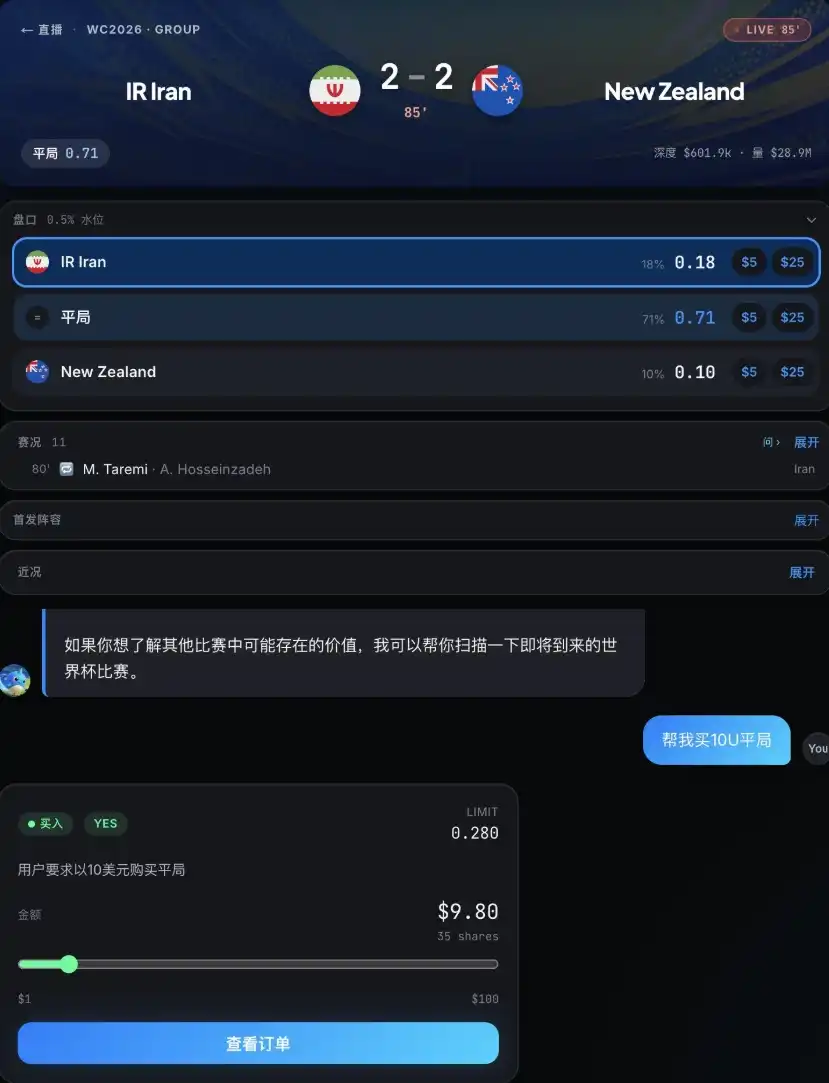
I. The World Cup Experiment: When Agents Start Understanding 'Intent'

Returning to our perennial question, over the past decade, the core problem wallets solved was clear: where assets are stored, who controls the private key, and who signs transactions.

For example, when users open imToken, it's mainly to check balances, perform transfers/interactions, and manage multi-chain assets. Consequently, wallets at this stage resemble asset and signature gateways. It's sufficient for users to know what they plan to do and then use the wallet to complete the final step.

But the change in the Agentic era lies in the fact that users might not initially know what they need to click.

In a World Cup scenario, an average user might not first think, 'I need to open Polymarket, find a specific market, evaluate the odds, and complete the transaction.' They are more likely to say, 'What are the highlights of tonight's match?', 'I'm confident Portugal will qualify; are there relevant markets?', 'Is this betting line already too low?', or 'If I just want to participate with a small amount, what's the process?'

Previously, these questions might have been scattered across WeChat groups, social media discussions, or search engines, requiring users to piece information together and execute step by step. However, with Agent intervention, the interaction method has changed significantly: users only need to express a general intent, and the Agent will proactively break it down into a path, with the wallet then responsible for turning that path into a series of on-chain actions.

So, this is definitely not as simple as adding a chat box to the wallet.

The real change is that wallets are starting to evolve from 'function menus' into 'intent interpreters.' Previously, wallets primarily required users to decide whether to transfer, swap, stake, or connect to a DApp? Future wallets might be more straightforward, requiring users to simply tell them in natural language what they want to accomplish.

This is why a mass event like the World Cup is well-suited as an entry point for Agentic Wallets. It naturally provides context, users naturally have the desire to express themselves, and they naturally need to make judgments. The Agent doesn't need to start by managing complex asset portfolios for users, especially those involving intricate asset management with higher risks. It can first help users find interaction paths within a specific scenario before handing final control back to the wallet and the user.

The web-based and Discord-based proxies capable of on-chain interaction mentioned at the beginning of the article, which imToken piloted, are typical examples. They bring wallet capabilities to a lighter-weight entry point, allowing users to find interaction paths through an Agent on an event page, within a World Cup scenario, without necessarily first opening the app or entering the traditional DApp browser.

This indicates that the boundaries of wallets are expanding outward.

Previously, wallet entry points were relatively clear: users opened the app, entered the asset page, clicked functions, and connected to DApps. Future wallet entry points might be scattered across more places, such as web pages, Discord, Telegram, AI chat boxes, event pages, developer tools, or even a lightweight wallet interface generated by the user.

From this perspective, World Cup predictions are not the main point; the key is that they allow wallets, for the first time, to more naturally position themselves ahead of 'user intent.'

II. From Agent Pay: AI is Entering the Payment Layer

If viewed only within the Crypto sphere, Agentic Wallets might still be easily understood as a narrative concept—AI helping users watch markets, find opportunities, and make trades, sounding reminiscent of the last wave of AI Agent hype.

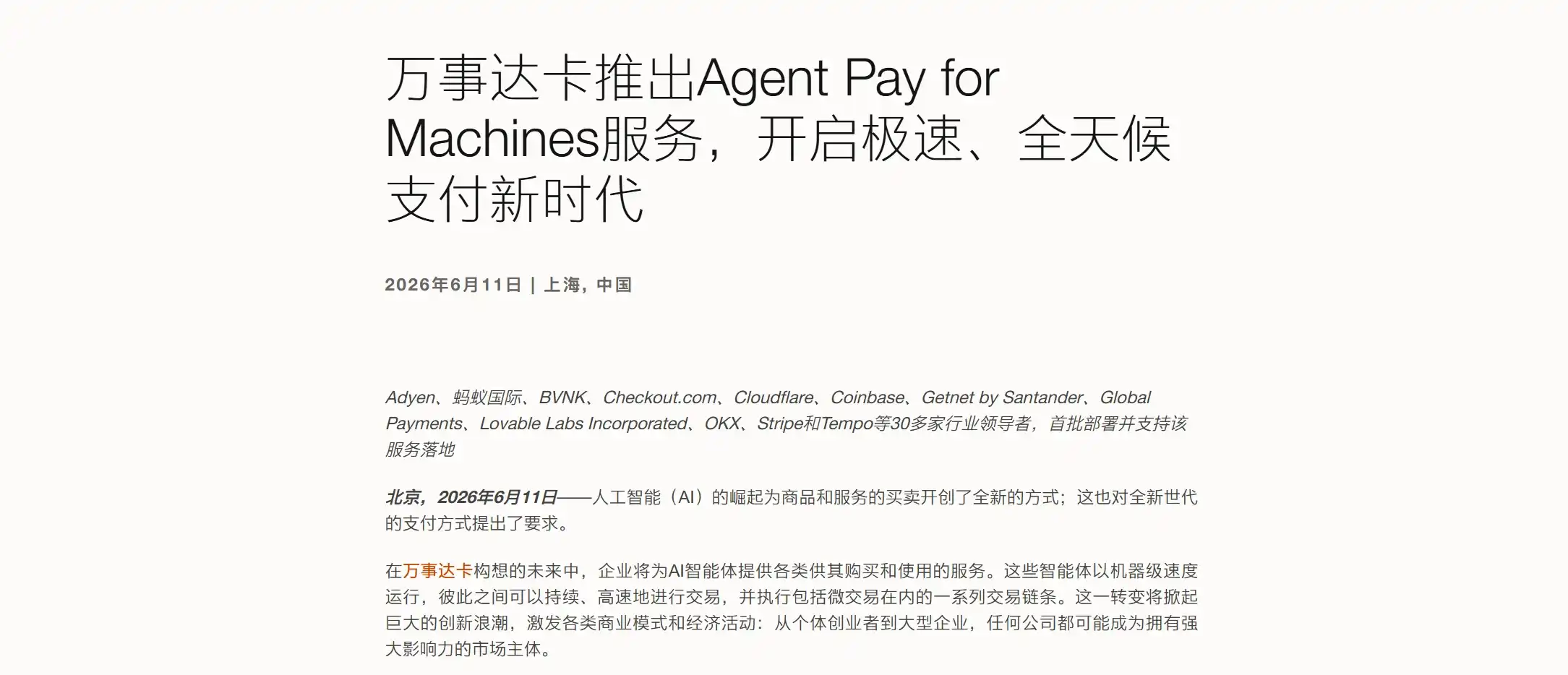
But Mastercard's launch of Agent Pay for Machines on June 10th suddenly made this matter extend beyond Web3.

Mastercard's definition of Agent Pay is clear: enabling trusted AI Agents to participate in payments with user authorization, including how Agents are identified, authorized, verified within the payment network, and how merchants, issuers, and users know a transaction was assisted by an Agent.
This is highly similar to the problems faced by Web3 wallets.

When AI only helps you write copy, the cost of errors is usually manageable. But once AI starts participating in asset interactions, the problem shifts: does it actually have permission? Is its understanding of user intent accurate? Are the services it calls trustworthy? Does the transaction it initiates exceed boundaries? If the outcome doesn't match user expectations, who provides recourse?

Mastercard's answer is to redesign the 'trusted Agent's' identity, tokens, authorization, risk control, and dispute handling within the payment network.

This signal is crucial. If the Agentic concept in the Web3 circle still carries a bit of geeky imagination, the fact that traditional financial giants are starting to design payment infrastructure for Agentic Commerce indicates this has entered a more realistic business context.

Looking closer, domestic payment giants are also moving in this direction. WeChat Pay is testing AI payment features in collaboration with Tencent's intelligent agent product WorkBuddy, such as launching an 'AI Exclusive Card' within the WeChat wallet. Based on disclosed information, the core of such products is not to let AI spend money arbitrarily but to set boundaries for intelligent agent payments through methods like recharge limits, payment authorization scopes, and password verification confirmations.

This logic aligns with Mastercard's Agent Pay: AI can participate in payments, but it must be identified, authorized, restricted, and audited.

Web3 wallets face the on-chain version of the same problem. The difference is that traditional payment systems emphasize the network, merchants, issuers, and compliance responsibilities; on-chain wallets emphasize private keys, signatures, authorizations, contract calls, and user self-custody.

Precisely because of this, Agentic Wallets cannot simply copy the traditional payment path. After all, in traditional payments, users can rely on banks, card networks, merchants, dispute resolution, and risk control systems. But in the on-chain world, once a transaction is on-chain, there's often no undo button.

The higher the efficiency brought by AI Agents, the more critical the last line of security defense borne by the wallet becomes. Therefore, future wallets cannot just let Agents 'do things'; they must ensure Agents 'can only operate within user-allowed boundaries.'

This is also why Web3 might actually be more suitable for discussing Agentic Wallets.

III. The Agentic Era: How Are Wallets Redefining On-Chain Interaction?

When many discuss AI Agents, they easily drift towards an extreme imagination: in the future, AI will automatically trade for me, manage my finances, find airdrops, and arbitrage.

This direction is certainly attractive, but for wallets, the real difficulty is not 'automation' but 'a sense of boundaries.'

Because a wallet is not an ordinary application. In ordinary apps, if AI recommends the wrong song, writes the wrong passage, or clicks the wrong page, it's at most an experience issue. But in a wallet, if AI misunderstands an instruction, calls the wrong contract, or grants excessive permissions, it could become a real asset risk (Extended reading: Sign Isn't Just Signing: When an AI Agent Signs for You, Who Holds the Control?).

Therefore, the primary question for Agentic Wallets is not 'how much can AI do for the user?' but 'how does the user know what AI is doing?'

This is also why imToken has consistently emphasized control over the past few years. From self-custody wallets to multi-chain asset management, to today's AI co-creation and Agent exploration, the truly continuous thread isn't about having more and more features, but about users always being able to understand, confirm, and control their digital world.

In the Agentic era, this thread becomes more concrete.

Wallets need to let users understand who this Agent is, what capabilities it can call, how long the authorization lasts, whether it can operate across DApps, when it requires my reconfirmation, whether I can pause or revoke it with one click... These questions might sound tedious, but they are the foundation upon which Agentic Wallets can truly be established.

Because the power of an AI Agent lies precisely in its ability to simplify complex processes. The user says one thing, and the Agent can break it down into a dozen-step execution path. This is good for experience but also a challenge for security. The longer the path and the more intermediate steps, the more the wallet needs to bring key nodes back into the user's view.

Good wallet interactions in the future might not involve showing users more technical details, but translating complex transactions into language users can understand:

  • You are authorizing a specific Agent to call a specific contract within the next 24 hours;
  • This operation can use at most a certain amount of USDC;
  • It can only access World Cup-related prediction markets, not touch your other assets;
  • Each transaction exceeding a certain amount requires reconfirmation;
  • Authorization automatically expires after a set period;
  • You can pause this Agent anytime within the wallet;

This might sound like a distant future, but it's already starting from some small scenarios. The World Cup prediction event is one event-based entry point, and imToken's pilot web-based Agent and Discord Agent are community-based entry points.

Especially at times like these, wallets cannot retreat to the background.

Trend Kriptolar

İlgili Sorular

QWhat is the main change in the way users interact with the blockchain when AI Agents enter the wallet scene, as discussed in the article?

AThe main change is the shift from users knowing exactly which functions to execute (like transfer, swap, or staking) to users expressing their general intent in natural language. The AI Agent then interprets this intent, breaks it down into actionable steps, and guides the user to complete the corresponding on-chain actions seamlessly.

QAccording to the article, why is the World Cup a suitable entry point for observing the development of Agentic Wallets?

AThe World Cup is suitable because it provides a natural context where users have a strong desire to express opinions, make judgments, and participate in prediction markets. This setting allows AI Agents to help users find interaction paths within a specific, low-risk scenario before tackling more complex asset management, making the transition to Agentic Wallets more user-friendly and gradual.

QWhat key challenge must Agentic Wallets address, as highlighted by the comparison with Mastercard's Agent Pay and traditional payment systems?

AThe key challenge is establishing clear boundaries and control for AI Agents. While AI can enhance efficiency, it must be properly identified, authorized, restricted, and audited, especially when handling financial transactions. Unlike traditional payment systems with built-in safeguards, on-chain transactions are often irreversible, making it crucial for wallets to ensure users understand, confirm, and maintain control over what the Agent is doing.

QWhat is the core principle that should remain consistent for wallets from self-custody to the Agentic era, as emphasized in the article?

AThe core consistent principle is that users must always be able to understand, confirm, and control their digital world. In the Agentic era, this translates to features that let users know who the Agent is, what permissions it has, the duration of its authorization, when reconfirmation is needed, and the ability to pause or revoke its access at any time.

QHow is the physical or conceptual 'entrance' of the wallet changing with the advent of Agentic Wallets?

AThe wallet's 'entrance' is expanding and becoming more ubiquitous. Instead of being confined to a dedicated wallet application, wallet capabilities are beginning to appear in various interfaces like web pages, Discord, Telegram, AI chatboxes, activity pages, and developer tools. This allows users to initiate and complete on-chain interactions from more diverse and lightweight starting points.

İlgili Okumalar

No Sales Team, $20 Million in Revenue: How Did AI Employee Viktor Win Over 30,000 Companies?

The AI employee Viktor, developed by a team with DeepMind background, has achieved $20 million in annual revenue without a traditional sales team, serving over 30,000 companies. Its core innovation lies in positioning itself as a "Tier 3 AI Coworker" capable of "end-to-end execution and delivery of results," moving beyond the "draft and wait for human completion" model of typical AI assistants. Users can simply mention Viktor in Slack or Microsoft Teams using natural language commands, and it autonomously performs tasks like pulling sales data from a CRM, generating reports, or even cross-tool operations like creating board meeting PPTs by aggregating data from six different sources. Key to its growth is a pure Product-Led Growth (PLG) model, eliminating complex implementation cycles and per-seat licensing. Instead, it charges based on task credits or consumption, lowering the trial barrier with a $100 free credit offer and no credit card required. This enabled viral, bottom-up adoption within organizations. Viktor's interaction paradigm removes the barrier of prompt engineering, allowing non-technical employees to delegate complex workflows seamlessly. It also features proactive, automated task execution (e.g., overnight bookkeeping, scheduled reports) based on triggers, effectively embedding AI as an automated "process layer" within business operations. However, its expansion into Microsoft Teams—a platform with 320 million users—highlights challenges. Large enterprises require stringent IT compliance, security reviews (e.g., SOC 2), and governance, potentially hindering the frictionless, user-driven adoption that succeeded in Slack. Additionally, the "black box" nature of its autonomous decision-making raises concerns about operational risks, data integrity, and the need for robust audit logs and permission controls. Balancing efficiency gains with security and trust remains a critical hurdle for Viktor and similar AI agents aiming to become core enterprise infrastructure.

marsbit54 dk önce

No Sales Team, $20 Million in Revenue: How Did AI Employee Viktor Win Over 30,000 Companies?

marsbit54 dk önce

Manus Buyback Plan Emerges: Chinese Investors Plan to Repurchase Equity with $2 Billion, Path to Hong Kong IPO Becomes Clearer

According to a report by The Information, early Chinese investors of Manus, including Tencent, Sequoia Capital China, and ZhenFund, are planning to repurchase the company from Meta for $2 billion—the same price Meta paid in its acquisition last December. This move is a direct response to the Chinese government's prohibition of the foreign acquisition in April. As part of the repurchase plan, Manus is considering establishing a Sino-foreign joint venture within China. This structure is seen as a way to ensure regulatory compliance for its Chinese investors and to pave the way for a future IPO in Hong Kong. Notably, U.S. investor Benchmark will not participate in the buyback, which will concentrate ownership even more among Chinese capital. Since its acquisition by Meta, Manus's business has grown rapidly, with its annualized revenue run rate reportedly increasing four-to-fivefold to $400-$500 million in roughly six months. This strong growth underpins the investors' willingness to repurchase at the original price. Financially, the forced unwinding of the deal may benefit the early investors, allowing them to regain equity at a cost far below the company's current implied valuation, with the added prospect of an independent future listing. However, specific terms of the repurchase, including funding proportions and the joint venture's equity structure, are still under negotiation. This "repurchase-joint venture-Hong Kong IPO" approach could serve as a reference model for other Chinese AI startups navigating cross-border M&A regulations.

marsbit1 saat önce

Manus Buyback Plan Emerges: Chinese Investors Plan to Repurchase Equity with $2 Billion, Path to Hong Kong IPO Becomes Clearer

marsbit1 saat önce

STRC Loses Peg by 11%, Can Strategy's Perpetual Motion Machine Keep Running?

The article discusses the significant and concerning depegging of MicroStrategy's (MSTR) preferred stock, STRC. Designed to trade near its $100 target par value, STRC has recently fallen sharply, reaching a low of $83.26 and closing at $88.59, representing an over 11% discount. STRC is a core component of MicroStrategy's financial strategy. As a perpetual preferred stock, it allows the company to raise capital through an "at-the-market" (ATM) issuance program without diluting common shareholders (MSTR). This capital is primarily used to purchase Bitcoin, creating a "capital flywheel": issuing STRC → raising cash → buying BTC → increasing net assets → supporting STRC's value. The flywheel's operation depends on STRC maintaining its $100 price. To enforce this, MicroStrategy employs a dynamic dividend mechanism, recently raising the rate to 11.5% and increasing payout frequency. However, this has failed to halt the depegging, indicating market concerns extend beyond yield. Analysts cite two main reasons. First, technical factors like forced liquidations from leveraged arbitrage trades may have exacerbated the sell-off. Second, and more fundamentally, is waning confidence in MicroStrategy's financial resilience. A JPMorgan report highlighted the company's limited cash relative to its ~$1.7 billion annual dividend obligation, raising liquidity concerns. While MicroStrategy counters that its massive Bitcoin holdings provide decades of coverage, this argument relies on the potential need to sell BTC—a departure from its long-standing "never sell" narrative. The company's recent sale of a small amount of Bitcoin for "testing," despite being framed as minor, has intensified these fears. The persistent depegging threatens to cripple MicroStrategy's primary funding channel. If STRC remains discounted, the company's ability to fund further Bitcoin purchases weakens. Should cash reserves dwindle while financing is constrained, the market may increasingly price in the risk of MicroStrategy becoming a forced seller of Bitcoin to meet obligations. This shift from a major marginal buyer to a potential seller could pose significant downside risk to the broader Bitcoin market.

链捕手1 saat önce

STRC Loses Peg by 11%, Can Strategy's Perpetual Motion Machine Keep Running?

链捕手1 saat önce

İşlemler

Spot
Futures

Popüler Makaleler

F Nasıl Satın Alınır

HTX.com’a hoş geldiniz! Synfutures (F) satın alma işlemlerini basit ve kullanışlı bir hâle getirdik. Adım adım açıkladığımız rehberimizi takip ederek kripto yolculuğunuza başlayın. 1. Adım: HTX Hesabınızı OluşturunHTX'te ücretsiz bir hesap açmak için e-posta adresinizi veya telefon numaranızı kullanın. Sorunsuzca kaydolun ve tüm özelliklerin kilidini açın. Hesabımı Aç2. Adım: Kripto Satın Al Bölümüne Gidin ve Ödeme Yönteminizi SeçinKredi/Banka Kartı: Visa veya Mastercard'ınızı kullanarak anında Synfutures (F) satın alın.Bakiye: Sorunsuz bir şekilde işlem yapmak için HTX hesap bakiyenizdeki fonları kullanın.Üçüncü Taraflar: Kullanımı kolaylaştırmak için Google Pay ve Apple Pay gibi popüler ödeme yöntemlerini ekledik.P2P: HTX'teki diğer kullanıcılarla doğrudan işlem yapın.Borsa Dışı (OTC): Yatırımcılar için kişiye özel hizmetler ve rekabetçi döviz kurları sunuyoruz.3. Adım: Synfutures (F) Varlıklarınızı SaklayınSynfutures (F) satın aldıktan sonra HTX hesabınızda saklayın. Alternatif olarak, blok zinciri transferi yoluyla başka bir yere gönderebilir veya diğer kripto para birimlerini takas etmek için kullanabilirsiniz.4. Adım: Synfutures (F) Varlıklarınızla İşlem YapınHTX'in spot piyasasında Synfutures (F) ile kolayca işlemler yapın.Hesabınıza erişin, işlem çiftinizi seçin, işlemlerinizi gerçekleştirin ve gerçek zamanlı olarak izleyin. Hem yeni başlayanlar hem de deneyimli yatırımcılar için kullanıcı dostu bir deneyim sunuyoruz.

214 Toplam GörüntülenmeYayınlanma 2024.12.21Güncellenme 2026.06.02

F Nasıl Satın Alınır

Tartışmalar

HTX Topluluğuna hoş geldiniz. Burada, en son platform gelişmeleri hakkında bilgi sahibi olabilir ve profesyonel piyasa görüşlerine erişebilirsiniz. Kullanıcıların F (F) fiyatı hakkındaki görüşleri aşağıda sunulmaktadır.

活动图片