Legendary Investor: 'Absolutely No Way' for Walsh to Cut Rates, AI Bull Market Could Last 1-2 More Years

marsbitPubblicato 2026-05-08Pubblicato ultima volta 2026-05-08

Introduzione

Billionaire hedge fund manager Paul Tudor Jones says incoming Fed Chair Wash is highly unlikely to cut rates and could even consider raising them, citing FOMC pushback and persistent inflation. He remains bullish on the AI-driven stock market rally, comparing it to historical tech revolutions like Microsoft's founding (1981) and the commercialization of the internet (1995). Jones believes this AI bull market is only about 50-60% complete and could continue for another 1-2 years, though he warns the current period resembles the late stages of the 1999 dot-com bubble, setting the stage for a potential sharp correction if valuations become extreme. He also cautions that AI requires eventual government regulation to mitigate long-term risks.

Source: Jinshi Data

Billionaire hedge fund manager Paul Tudor Jones made a significant statement in an interview with CNBC on Thursday, predicting that incoming Fed Chair Walsh is not only unlikely to cut interest rates but may even consider raising them. Meanwhile, he remains optimistic about the AI-driven U.S. stock bull market, believing it is in a middle stage with another 1-2 years of gains possible, though it will ultimately face the risk of a sharp correction.

No Hope for Walsh to Cut Rates, Possibly Even a Rate Hike

Regarding the policy direction of the incoming Federal Reserve Chair Walsh, Jones stated unequivocally: "Will he cut rates? Absolutely no way."

Walsh has previously expressed a dovish leaning, with the Fed's benchmark rate currently held in the 3.5%-3.75% range, unchanged since last December. However, his inclination towards easing will face significant resistance from the Federal Open Market Committee (FOMC) – the most recent meeting saw the highest number of dissenting votes in nearly 34 years, with most regional Fed presidents opposing the statement's hint at possible further easing "after three rate cuts by the end of 2025."

Jones believes that even a rate hike could be justified in the current environment: "I would consider raising rates, of course depending on the data, but I would definitely consider it. And I think he will be constrained before the midterm elections."

The current policy backdrop is complex: the labor market is stabilizing, but inflation remains persistently above the Fed's 2% target due to the war in Iran and Trump's tariff policies. According to CME Group's FedWatch tool, futures traders expect the Fed to keep rates unchanged this year, with probabilities for cuts or hikes being roughly equal and both relatively low.

Drawing Parallels to Historical Tech Waves, AI Bull Market Has 1-2 Years Left

Regarding the stock market, Jones is firmly bullish on the AI-driven rally, revealing he has recently increased his holdings in related stocks. He compares the current AI development to two major historical tech revolutions: "I think the emergence of the Claude large model in January this year is equivalent to the founding of Microsoft in 1981; and the current stage of AI proliferation is similar to the release of Windows 95 in 1995 and the acceleration of internet commercialization."

Jones noted that both those technological revolutions ushered in sustained "productivity miracles" lasting 4 to 5.5 years, driving long-term stock market gains. "This current AI bull market has probably run about 50% to 60% of its course. If I had to pick a timeframe, it could last another 1 to 2 years."

In recent years, U.S. stocks have continued hitting new highs driven by AI transformation expectations, with mega-cap tech stocks related to AI infrastructure leading the gains. Chips, cloud computing, and generative AI companies have become magnets for capital, pushing the S&P 500 index to repeated all-time highs.

Analogous to Pre-1999 Dot-com Bubble, U.S. Stocks May Face Sharp Correction Risk in Future

Despite his bullish short-term outlook, Jones draws a parallel between the current market and the prelude to the 1999 dot-com bubble – about a year before it peaked in early 2000. He warns: "Imagine the market going up another 40%, the total market cap to GDP ratio could reach 300% to 350%, and at that point, there will inevitably be a breathtakingly sharp correction."

As a macro trader, Jones said he employs a basket allocation strategy, while also emphasizing: "I always like to look for historical precedents, and this is a very unique period."

Additionally, he issued a warning about the long-term risks of AI: "The government will eventually need to step in with regulation. If left unchecked, artificial intelligence could pose a danger to humanity."

Jones gained fame for successfully predicting and profiting from the 1987 "Black Monday" stock market crash. He is also a co-founder of the non-profit organization Just Capital, which rates U.S. public companies based on social and environmental metrics.

Domande pertinenti

QAccording to Paul Tudor Jones, what is the likelihood of the incoming Fed Chair Walsh cutting interest rates?

AAccording to Paul Tudor Jones, the likelihood of the incoming Fed Chair Walsh cutting interest rates is absolutely none. Jones stated: 'He will cut rates? Absolutely not.'

QWhat historical technological revolutions does Paul Tudor Jones compare the current AI boom to?

APaul Tudor Jones compares the current AI boom to two historical technological revolutions. He compares the emergence of Claude's large model in January of this year to Microsoft's founding in 1981. He then compares the current stage of AI proliferation to the period following the release of Windows 95 in 1995, which accelerated the commercialization of the internet.

QHow much longer does Paul Tudor Jones believe the AI-driven bull market can continue?

APaul Tudor Jones believes the AI-driven bull market can continue for another 1 to 2 years. He estimates the current bull run is about 50% to 60% complete.

QWhat market period does Jones use as a cautionary analogy for the potential end of the current AI bull market?

AJones uses the period preceding the 1999-2000 dot-com bubble as a cautionary analogy. He warns that the market could resemble 1999, roughly a year before the peak in early 2000, and ultimately face a sharp correction.

QWhat long-term risk associated with AI does Paul Tudor Jones highlight?

APaul Tudor Jones highlights the long-term risk that artificial intelligence could pose a danger to humanity if left unchecked. He warns that 'government will ultimately have to step in to regulate it, and if left unchecked, artificial intelligence could be dangerous to humans.'

Letture associate

One Article to Understand $UORE: The V4 Hook Project That Packs Mining, Lottery, and NFT Into a Single Transaction

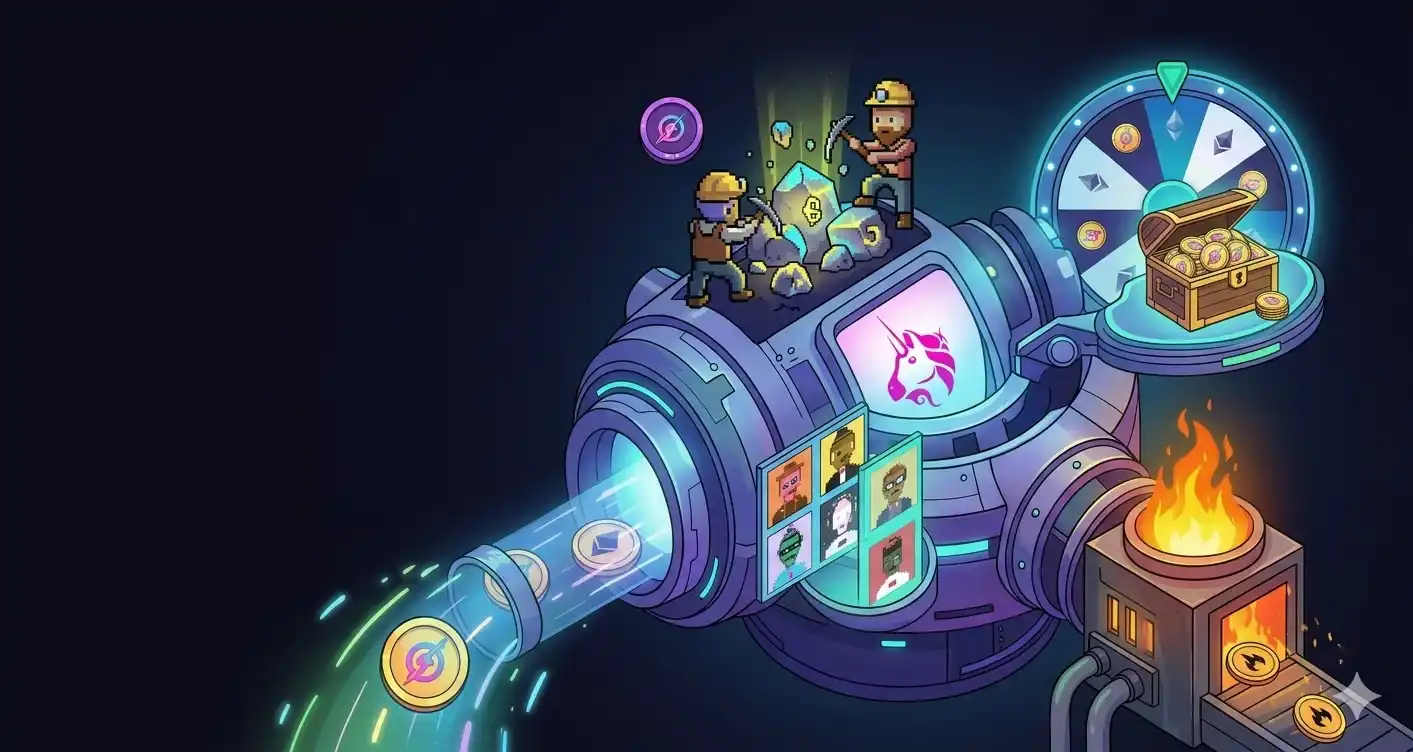
An In-Depth Look at $UORE: The V4 Hook Project Packing Mining, Lotteries, and NFTs into a Single Transaction $UORE is the latest project leveraging the Uniswap V4 Hook mechanism, following in the footsteps of projects like SATO, uPEG, and Slonks. It distinguishes itself by integrating multiple functions—on-chain mining, a buy-to-enter lottery, auto-generated pixel NFTs (Orelings), and a deflationary burn mechanism—all within a single Uniswap V4 liquidity pool transaction. This complexity results in transaction gas fees that are 2-3 times higher than a standard swap. The project's tokenomics are intricate. Each whole $UORE token held automatically mints a corresponding Oreling NFT, a 32x32 pixel miner character with random traits determined by the next block's hash. Each Oreling has a Class (rarity) and Hash value, which combine to form its Mining Power for staking rewards. Rewards are distributed daily from an emission that decays by 1% daily, with an 80/20 split between stakers and a Motherlode lottery pool. A "refined-ore boost" mechanism taxes early reward claims, redistributing 10% to remaining stakers. The Motherlode lottery awards tickets for buys of ≥0.1 ETH, with winning chances scaling up to 1% for 1 ETH purchases. Wins split the pool 50% to the buyer and 50% to a random staker. A 1% buy tax is burned, and a 1% sell tax funds an automatic buyback-and-burn mechanism triggered at 0.1 ETH. The project's code is a fork of uPEG, with claimed fixes for NFT duplication and flash loan attacks. Its creator, Noah, describes it as a fusion of Solana's ORE mining concept with uPEG's V4 Hook framework. Key challenges noted include high gas costs, the narrowing attention window for V4 Hook narratives as it's the fourth such project, and significant complexity that creates a high barrier to understanding for users. The project's whitepaper notably advises users to "Read the contracts and understand the mechanics before deploying capital," underscoring its complex and fast-moving nature within a trend where the "alpha" lifespan for new projects appears to be shrinking rapidly.

marsbit23 min fa

One Article to Understand $UORE: The V4 Hook Project That Packs Mining, Lottery, and NFT Into a Single Transaction

marsbit23 min fa

Gate Institute: Polymarket Accelerates Growth, Gate Launches New Portal to Prediction Markets

Gate Research Institute: Polymarket Growth Accelerates, Gate Expands into Prediction Markets with New Portal This analysis examines the growth of the prediction market platform Polymarket, which has evolved from an early experiment into a major event-driven trading venue. Data shows a significant, step-like increase in trading volume and active users, though growth remains heavily tied to major political, sports, and geopolitical events. Fee and revenue growth is driven by both genuine trading demand and recent changes to platform fee structures. Polymarket's market structure is highly concentrated, with over 90% of volume in these few high-profile categories. While it functions as both an information and sentiment market, its price discovery is most active during high-attention news cycles. The platform's core value lies in creating a liquid market for trading the outcome of future events, a unique niche within crypto. Gate's recent integration of Polymarket addresses different challenges. It simplifies access by allowing users to trade with exchange-held USDT, lowering friction for its existing user base. This highlights two emerging pathways for prediction markets: Polymarket's native, on-chain model versus Gate's centralized, low-friction account integration. Both paths will likely coexist, targeting different user segments. Key challenges for Polymarket include ongoing regulatory uncertainty, reliance on cyclical event-driven demand, potential oracle or settlement disputes, and achieving sustainable user retention beyond peak event periods. The platform has proven its commercial viability and ability to scale but has yet to demonstrate it can become a stable, everyday trading category independent of major news cycles.

marsbit38 min fa

Gate Institute: Polymarket Accelerates Growth, Gate Launches New Portal to Prediction Markets

marsbit38 min fa

Dissolving xAI, Musk Wants to Rebuild an AI Company Using Rocket-Building Methods

Elon Musk is making an unprecedented move by dissolving his AI startup, xAI, and folding it into his aerospace company, SpaceX, ahead of a planned public offering. This aims to package SpaceX's lucrative rocket and Starlink business with the high-cost, high-growth potential of AI. However, xAI's flagship model, Grok, has struggled to gain significant commercial or enterprise traction compared to leaders like OpenAI's ChatGPT or Anthropic's Claude. Internal turmoil led to the departure of much of xAI's founding AI talent. Musk has responded by installing SpaceX engineers as managers to transform xAI from a research lab into a high-efficiency "AI factory," focusing on infrastructure like its Colossus supercomputing cluster. Musk's vision positions the combined "SpaceXAI" as a future AI infrastructure company, addressing bottlenecks in computing power, energy, and data centers. He even proposes futuristic concepts like space-based AI data centers. To validate this story, SpaceXAI has begun sharing compute resources with former rival Anthropic. Financially, the merger appears to be a move to secure funding for xAI's massive losses by leveraging SpaceX's stable cash flow. While the combined entity targets a $1.25 trillion valuation, the market has yet to price in significant synergy. The strategic choice of SpaceX over Tesla, despite Tesla's closer ties to physical AI applications like robots and cars, is seen as Musk securing maximum control. Ultimately, Musk is betting that his proven methodology—centralized control, vertical integration, and aggressive engineering timelines—will succeed in the AI arena. But this time, he faces competitors like OpenAI and Google who are equally fast, well-funded, and determined. The merger is less about a guaranteed victory and more about ensuring Musk remains a key player at the table, regardless of the final outcome.

marsbit1 h fa

Dissolving xAI, Musk Wants to Rebuild an AI Company Using Rocket-Building Methods

marsbit1 h fa

Trading

Spot
Futures
活动图片