Either Go Full-Stack or Get Out: The Calculations Behind xAI's $60 Billion Acquisition of Cursor

marsbitОпубліковано о 2026-06-18Востаннє оновлено о 2026-06-18

Анотація

The article discusses xAI's $60 billion stock acquisition of Anysphere, the parent company of the AI coding tool Cursor, arguing that the core motivation is not market share but access to high-quality training data from its 7 million daily developers. It posits that to become a major AI player, a company must build a full-stack encompassing compute, model, and application layers. This thesis is illustrated by Anthropic's 540x revenue growth in 28 months, largely driven by its coding product, Claude Code, which captured 54% of the enterprise AI programming market. The author, a VC, contends that full-stack integration creates sustainable unit economics for model training and provides proprietary data for defensible competitive advantages, predicting a wave of model companies aggressively building or acquiring application-layer products. The central takeaway is that in an era where building products is 10x easier, ambition must be 10x greater to succeed.

Author: Tara Tan

Translation: Deep Tide TechFlow

Source: The Strange Review

Deep Tide Introduction: xAI, under SpaceX, acquired Anysphere, Cursor's parent company, for $60 billion in stock—not for market share, but for the high-quality training data generated by 7 million developers writing code every day. Strange Ventures partner Tara Tan uses this deal to put forward a judgment: to be a major AI player, you must integrate the entire stack of compute, models, and applications. This short review breaks down Anthropic's path to a 540-fold revenue increase in 28 months and explains why model companies will aggressively acquire into the application layer next. Note the author's identity as a VC, and full-stack is precisely her own investment thesis.

Code generation is by far the strongest killer application for large language models, bar none.
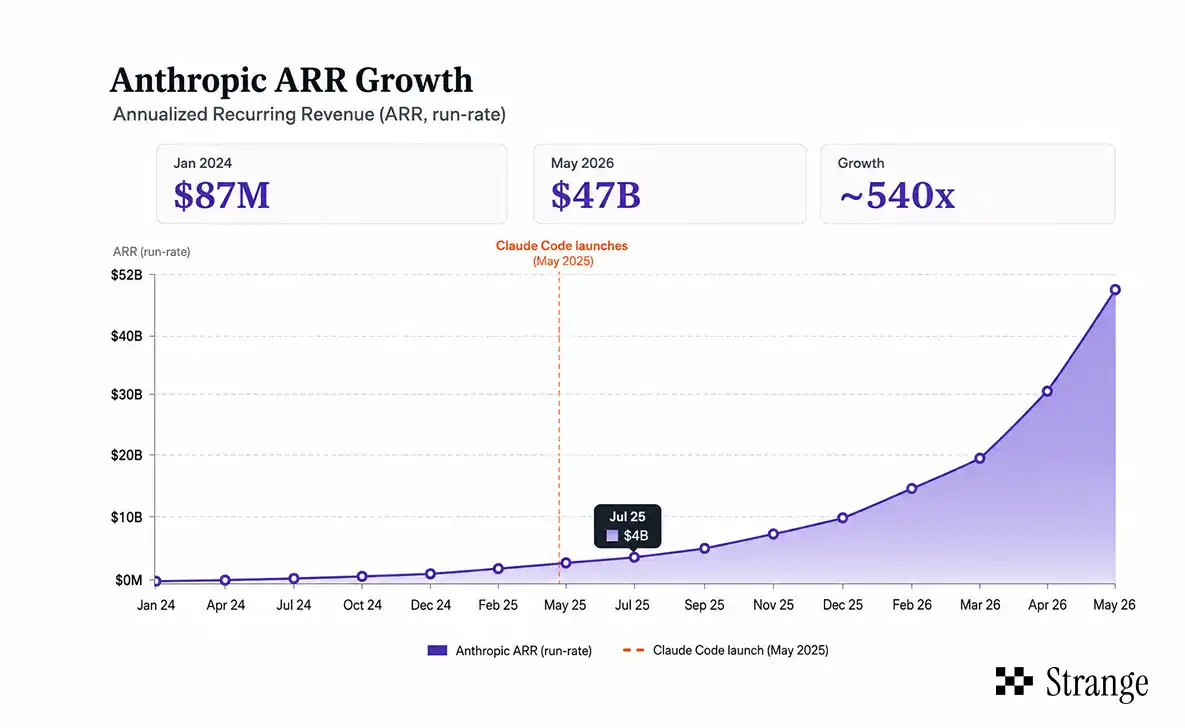
Anthropic's revenue grew from an annualized rate of $87 million in January 2024 to $47 billion in May 2026, an approximately 540-fold increase in 28 months. This growth was driven by two engines firing simultaneously: top-down enterprise partnerships (Claude is the only frontier model available on all three major cloud platforms) and bottom-up developer penetration, powered by Claude Code. This product is the fastest-growing in the company's history, going from zero to $2.5 billion in annualized revenue in 9 months. Anthropic now holds 54% of the enterprise AI programming market.

Cursor is the same bet SpaceX is making.

Yesterday, SpaceX announced the acquisition of Anysphere, the company behind Cursor, for $60 billion in stock. This AI programming tool is used daily by 7 million developers. Incubated at MIT four years ago, its annualized revenue has surged to $2 billion, making it the highest-revenue AI programming tool in its category. Over the past year, its market share has been declining, from 41% to 26%, as Claude Code gained ground. But xAI isn't buying market share.

xAI already has the full stack: Colossus for compute, Grok for the model, and X for the application. The problem is that X is for browsing, while Cursor is for writing code. The data generated by developers writing code is arguably the highest-signal training data in the AI field, and that's precisely what Grok lacks to complete its competitive edge.

This confirms a thought I've been pondering since the OpenAI-NVIDIA deal last September:

To be a major AI player, you must go full-stack.
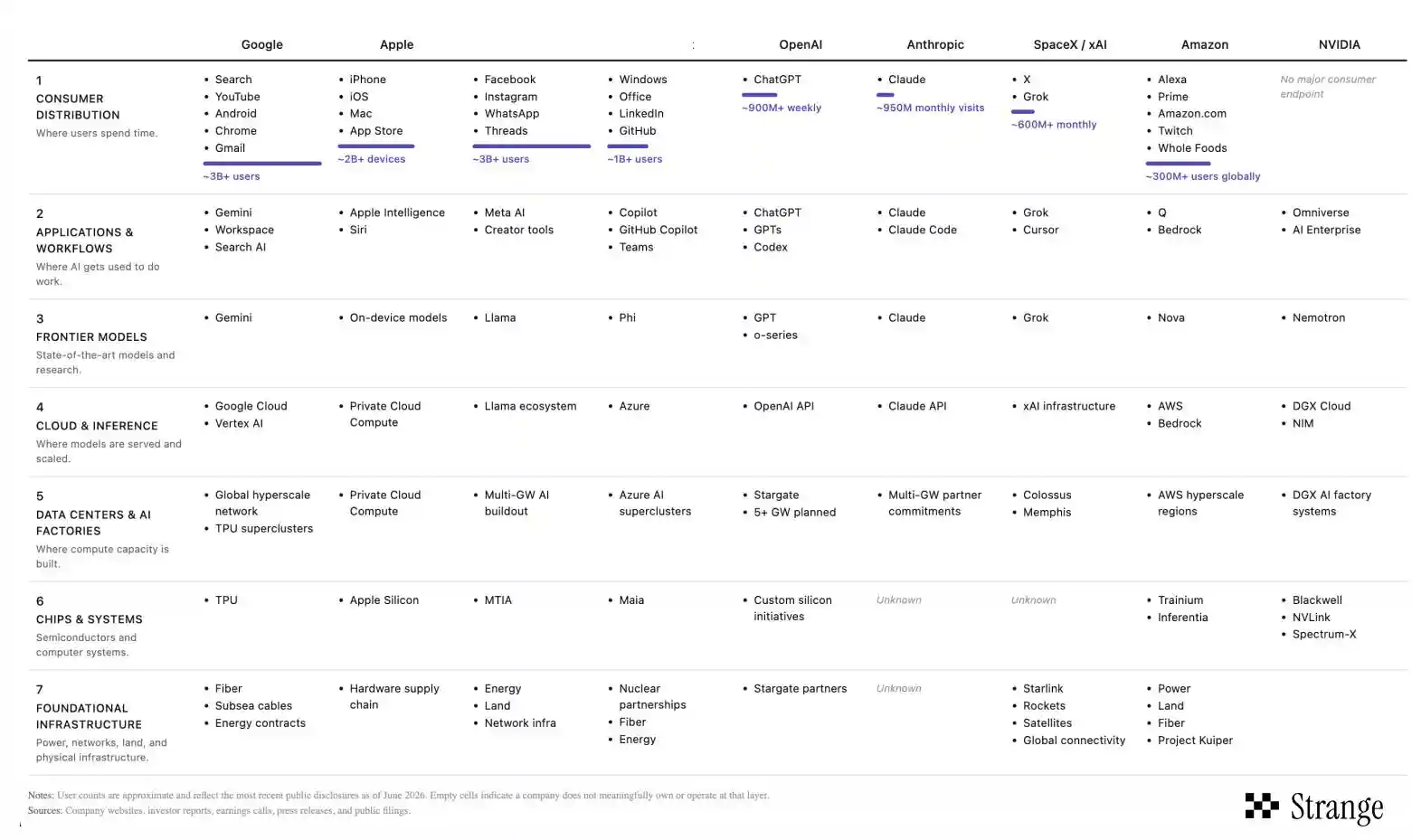
The logic is becoming increasingly clear. Better products lead to better infrastructure (more data), and better infrastructure, in turn, leads to a better experience. This has always been the core investment logic at Strange.
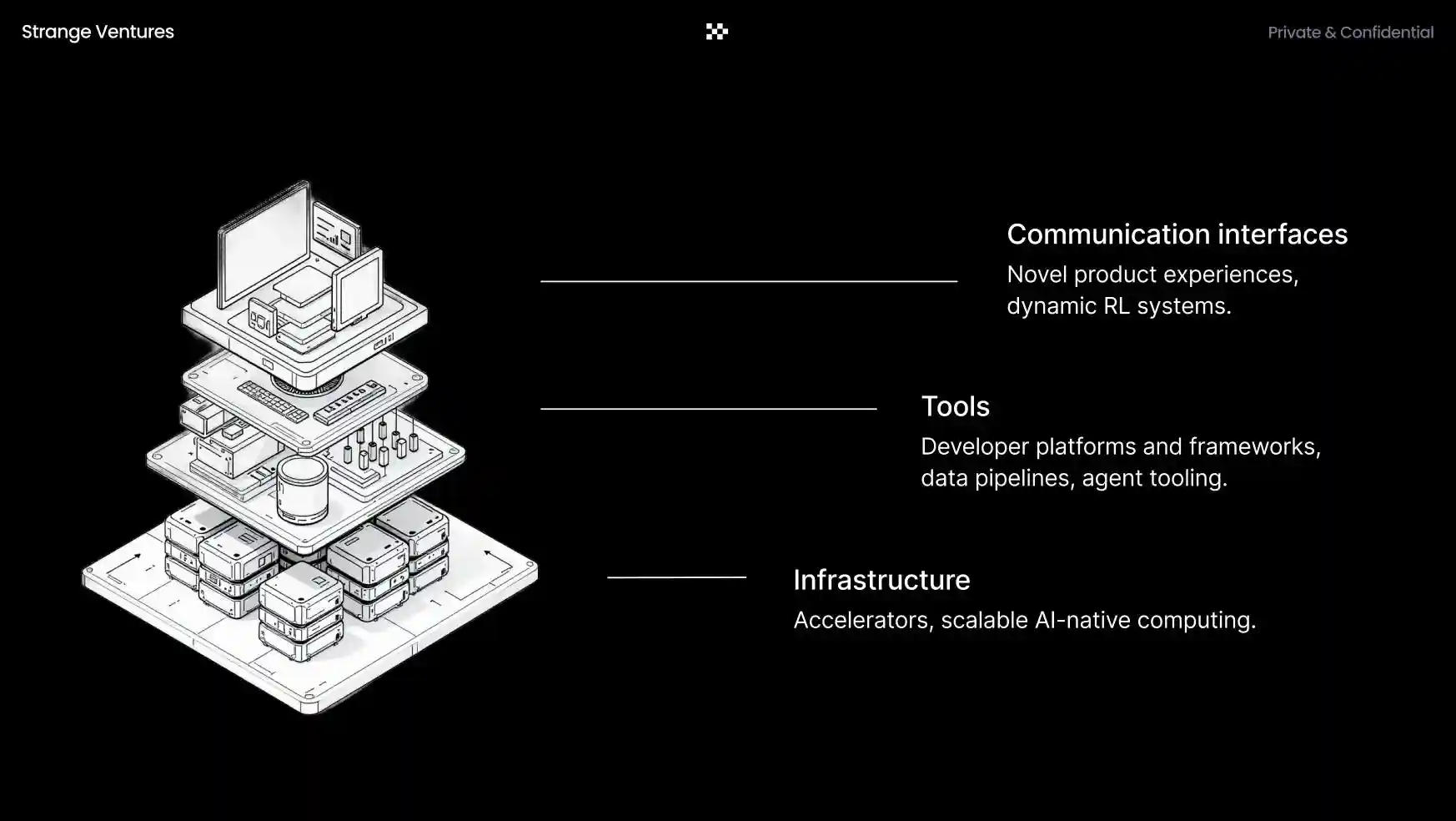
Caption: The author's team's investment logic diagram on "Full-Stack Flywheel"

Going full-stack achieves two things:

First, the unit economics of building and training models become sustainable.

Second, you gain proprietary training data from the application layer, differentiating yourself from other model vendors. User data and workflow lock-in then form a solid moat.

The next few years will likely see actions like these: model companies either internally develop applications or aggressively acquire upward, directly swallowing the application layer.

A popular saying among entrepreneurs now is: Because building products is 10 times easier than before, companies need to be 10 times more ambitious to succeed. Currently, this seems to be holding true across various sectors.

——Tara

Пов'язані питання

QAccording to the article, what is the primary reason behind xAI's acquisition of Anysphere (Cursor's parent company)?

AThe primary reason is to gain access to the high-quality training data generated by Cursor's 7 million daily developers writing code, which is considered some of the strongest signal data in AI for enhancing xAI's model, Grok. It is not about acquiring market share.

QWhat key concept does the author propose is essential for a company to become a major AI player?

AThe author proposes that to become a major AI player, a company must achieve a 'full-stack' approach, integrating and controlling the entire pipeline from computing power (infrastructure) and models to the end-user applications.

QWhat two main benefits does building a full-stack AI company provide, as outlined in the article?

AFirst, it makes the unit economics of building and training models sustainable. Second, it provides access to proprietary training data from the application layer, creating differentiation from other model companies and forming a strong competitive moat through user data and workflow lock-in.

QHow did Anthropic's revenue change from January 2024 to May 2026, and what were the two key drivers of this growth?

AAnthropic's revenue grew approximately 540 times in 28 months, from an annualized $87 million in January 2024 to $47 billion in May 2026. The two key drivers were top-down enterprise partnerships (Claude being available on all three major cloud platforms) and bottom-up developer adoption fueled by its product, Claude Code.

QWhat trend does the author predict for AI model companies in the coming years based on the full-stack thesis?

AThe author predicts that in the coming years, model companies will increasingly either build applications internally or aggressively acquire and integrate companies at the application layer through M&A (mergers and acquisitions).

Пов'язані матеріали

NVIDIA CPU Advances, China's RISC-V Responds: Semiconductor Deep Dive - Part Four

NVIDIA is set to launch its new Vera AI data center CPU in China as early as August, with high pricing. While this move offers a new option, it highlights China's continued dependence on foreign-controlled Arm architecture. In response, the Chinese semiconductor industry is increasingly turning to RISC-V as a strategic alternative for achieving high-performance computing autonomy. The article explores the concept of the "impossible triangle" in CPU development—balancing prosperity, control, and autonomy—and posits that RISC-V's open-source, modular nature offers a unique path to achieving all three. While RISC-V is already dominant in embedded systems, the focus is now shifting to data centers and AI workloads. China has become a global hotspot for RISC-V development, driven by AI-driven compute demand, supply chain concerns from export controls, cost benefits of open-source, and strong policy support. Multiple Chinese companies have reportedly crossed the key performance threshold of 15 SPECint per GHz, a benchmark for entering the high-performance CPU club. Progress extends beyond single-core benchmarks. Companies are developing complete computing subsystems, including commercial-grade coherent network-on-chip (NoC) technology and server processors with up to 40 cores that strictly adhere to the RVA23 standard to ensure software compatibility. Real-world applications are emerging in areas like video transcoding and edge AI. However, significant challenges remain. The RISC-V ecosystem faces fragmentation, immature toolchains and verification processes, and gaps in single-core performance and energy efficiency compared to mature x86 and Arm architectures. The formidable software moat, epitomized by NVIDIA's CUDA, is a long-term hurdle. In conclusion, while RISC-V cannot immediately replace offerings like NVIDIA's Vera, it represents a viable long-term path for China to develop a self-sufficient, high-performance CPU ecosystem. The journey is acknowledged to be long and arduous, requiring sustained effort to overcome technical and ecosystem challenges.

marsbit6 год тому

NVIDIA CPU Advances, China's RISC-V Responds: Semiconductor Deep Dive - Part Four

marsbit6 год тому

Торгівля

Спот
Ф'ючерси
活动图片