2-Year Return of 225x? Uncovering Mysterious Researcher Serenity's AI 'Choke Point' Investment Strategy

链捕手Pubblicato 2026-05-27Pubblicato ultima volta 2026-05-27

Introduzione

"2 Years, 225x Returns? Decoding Serenity's AI 'Chokepoint' Investment Strategy" This article profiles Serenity (formerly AleaBito on Reddit's WallStreetBets), a pseudonymous researcher known for exceptional returns by applying a "Chokepoint Theory" to AI investments. His methodology involves a bottom-up, reverse-engineering approach of the AI hardware supply chain. He identifies critical, irreplaceable physical bottlenecks (chokepoints) that could cripple entire AI systems if disrupted, bypassing Wall Street's top-down focus on major tech firms. Key examples include pinpointing essential suppliers in the emerging Silicon Photonics and Co-Packaged Optics (CPO) sector—components vital for next-generation AI data center interconnects—such as niche companies providing external laser sources, molecular beam epitaxy equipment, or ultra-pure raw materials. Similarly, he highlights geopolitical "chokepoints" in the humanoid robotics supply chain, where key hardware components and rare earth elements are concentrated in Asia. Serenity validates his investment theses through rigorous adversarial AI debates before publication. He leverages institutional blind spots, directing a sophisticated network of retail followers toward undervalued, under-covered micro-cap stocks across global exchanges, driving significant price movements in names like Sivers ($SIVE), Soitec, and Raspberry Pi ($RPI). While presenting a powerful framework for finding critical system dependencies, the strategy...

Author:BruceBlue , FormerBing Ventures GP

How did the mysterious researcher Serenity achieve over 225 times the return in 2 years?

Using the Checkpoint Theory to identify the irreplaceable physical switches in the AI era.

Employing a bottom-up supply chain reverse engineering mindset to pinpoint the choke points.

Before making any investment hypothesis, engage in fierce debates with various AI models to uncover potential flaws and limitations, comparable to a top-tier investment committee.
Foreword

Over the past few months, if you've been following the secondary market for AI infrastructure, it has been hard to miss a name: Serenity @aleabitoreddit
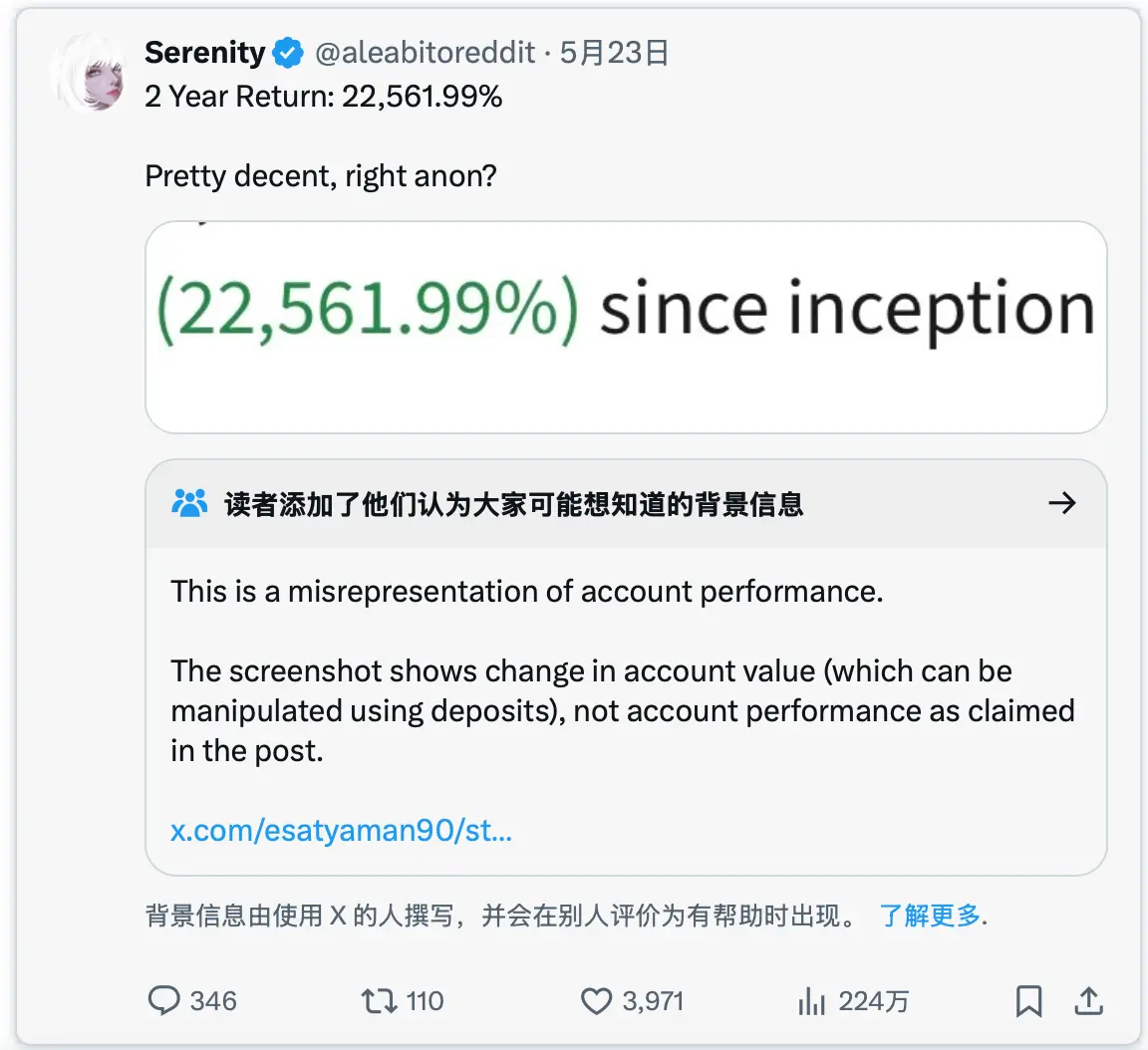
Aformer trader permanently banned by Reddit's WallStreetBets (WSB), he switched platforms, adopted an anime female avatar, and amassed over 300,000 followers in less than a year. One of his tweets can cause a FTSE 250 constituent stock to surge nearly 90% in two days, his research is cited by Bloomberg and Reuters, and some hedge funds engage in his copytrade.

The market marvels at his reported 22,561.99% return over the past two years, or questions his unverifiable background: "former AI research scientist," "Nature paper author," "RISC-V Foundation member," even claiming to have declined an offer to lead Nvidia's AI team around 2018 when its stock price was about $6.
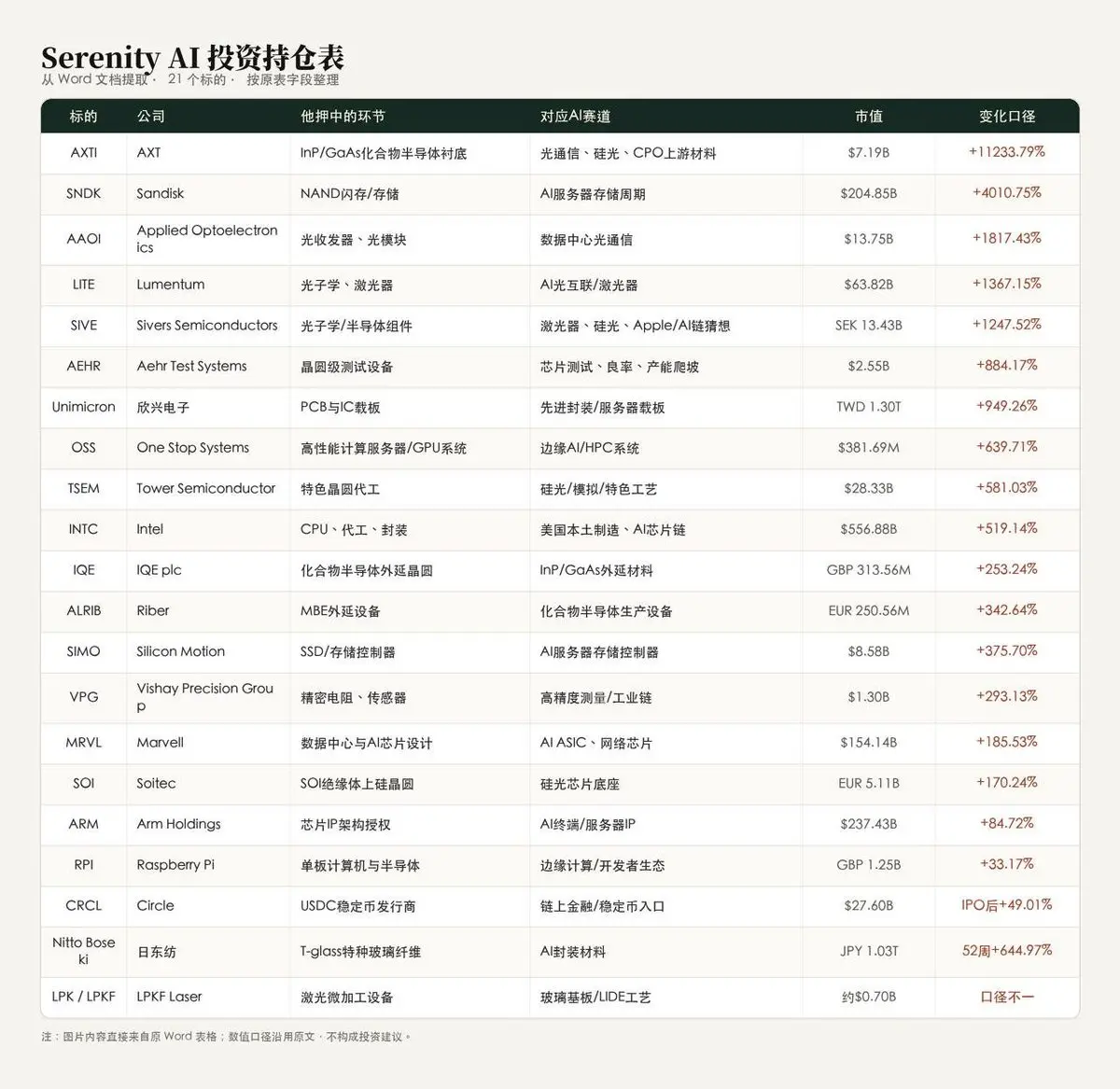
Serenity's AI Portfolio

But what truly matters isn't those dazzling numbers, nor whether he actually published in Nature.

What truly matters is this: He provides a paradigm for reverse engineering the AI era and executes violent arbitrage on information asymmetry within Wall Street's institutional blind spots.

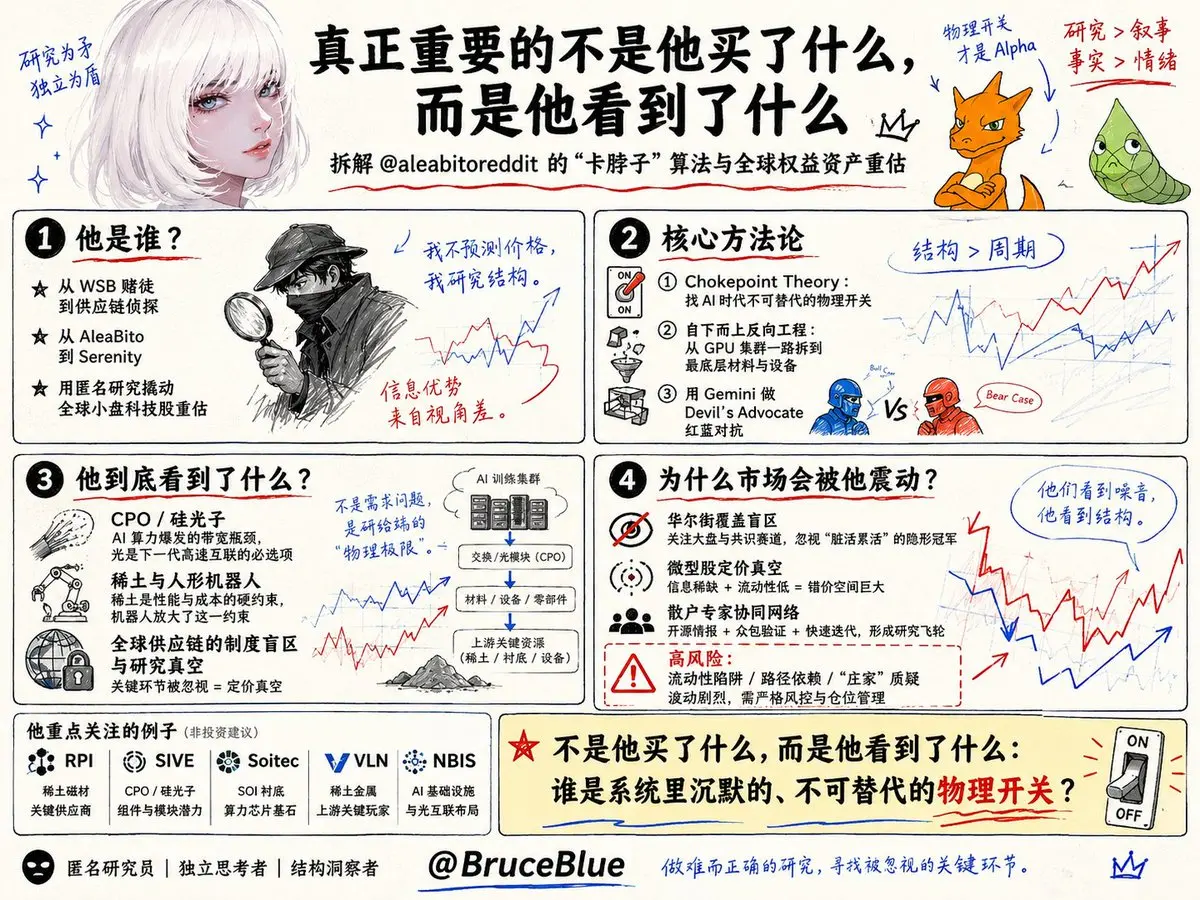
The core of this paradigm is what he calls Chokepoint Theory (Supply Chain Bottleneck Theory).

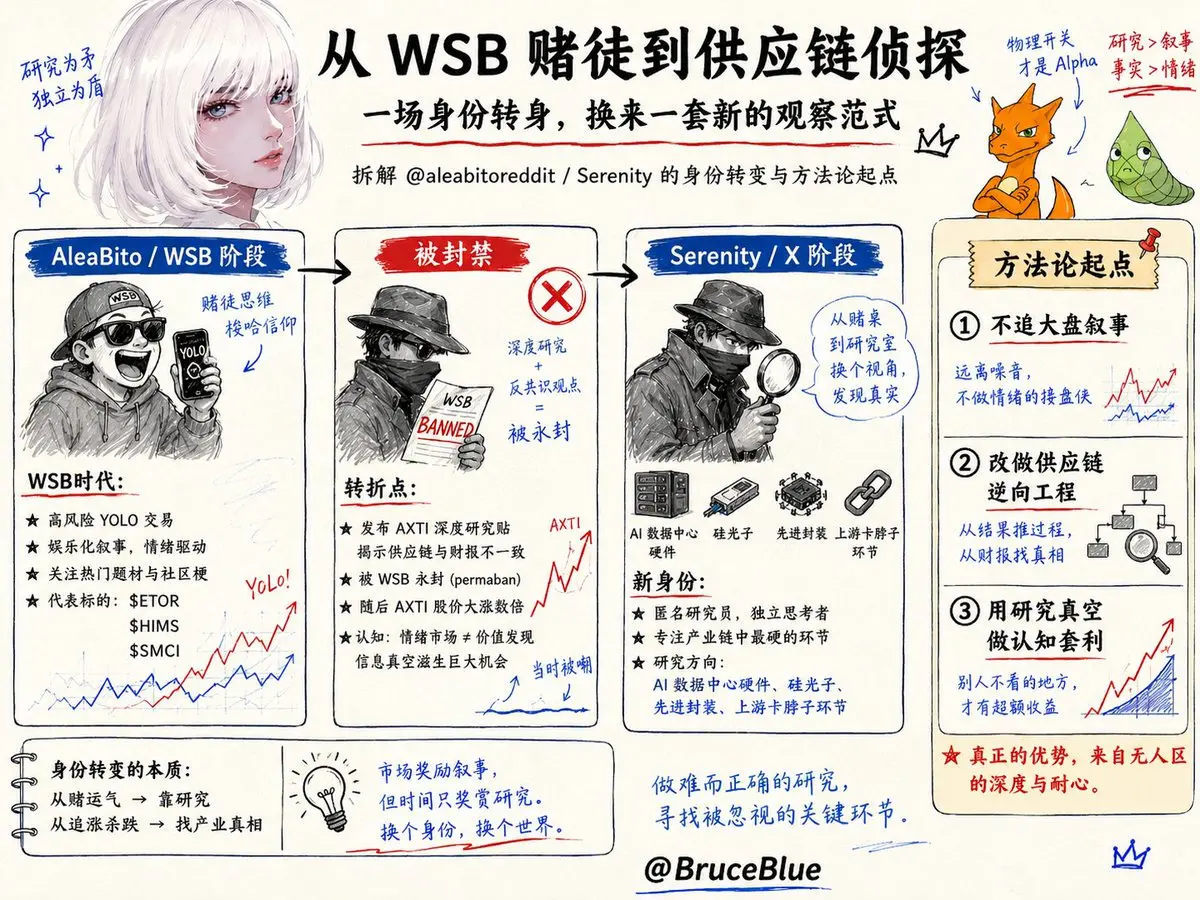
From WSB Gambler to Supply Chain Detective: An Identity Transformation

First, some background. His story began in early 2022 on the famous retail trader subreddit r/wallstreetbets (WSB).

The account then was named AleaBito, bearing the distinct colors of a WSB retail trader, keen on high-leverage, high-risk, and highly entertaining options and IPO plays. He once made a $175,000 single-sided options "YOLO" trade during the eToro ($ETOR) IPO based on the mock logic that its technical chart resembled "Bluefin Tuna Toro." In trading Hims & Hers Health $HIMS, he allocated a $100,000 position based on the "Gym Bro Formation." He also accurately predicted Super Micro Computer $SMCI would break $120 when its stock was near lows, based on developments in liquid cooling technology.

┌────────────────────────────────────────────────────────────────────────┐

│ @aleabitoreddit / Serenity's Evolution Path

├────────────────────────────────────────────────────────────────────────┤

│ Reddit Stage (Pre-2022) : AleaBito

│ Style: Hardcore financial analysis combined with highly entertaining "WSB retail" narrative, preference for high-risk "YOLO"

│ Feats:$ETOR (Tuna Toro), $HIMS (Gym Bro), $SMCI (Low-point prediction of $120 breakout)

│ X Platform Stage (2022-Present) : Serenity

│ Style: Focus on AI data center hardware, silicon photonics, advanced packaging; "bottom-up" supply chain reverse engineering

│ Feats:$RPI, $SIVE, Soitec, $VLN, $NBIS

└────────────────────────────────────────────────────────────────────────┘

The turning point occurred in early 2022. He posted a deep fundamental research report on AXT, Inc. $AXTI, a compound semiconductor substrate manufacturer, on WSB. At the time, $AXTI had a market cap of just $200 million, with a stock price around $12. The report's professional nature clashed with the forum's speculative atmosphere, leading moderators to permanently ban the account on grounds of "deliberate influence" and "pump-and-dump."

Subsequently, $AXTI soared to $70 driven by surging demand for compound semiconductors and optoelectronic substrates, resulting in over 1000% paper gains, becoming the researcher's "defining battle." This ban directly prompted the migration to X, and after renaming to "Serenity," the investment focus was completely locked onto "choke point" segments of semiconductor core hardware and the precision supply chain.
Core Framework: Finding the "Strait of Hormuz" of the AI Era

The vast majority of Wall Street sell-side institutions look at AI from a top-down perspective. They stare at Nvidia, Microsoft, Google, calculating guidance for trillion-dollar Capex, engaging in fierce mathematical modeling games around next quarter's revenue.

Serenity's perspective is bottom-up. He employs a supply chain reverse engineering model.

Using Nvidia's H100, B200, and other GPU supercomputing clusters as the physical origin, he deconstructs layer by layer downwards until uncovering ultra-micro components or raw materials at the physical level that are irreplaceable and monopolized by one or a very few companies. These extremely niche segments operate silently outside the spotlight of trillion-dollar market caps. Yet, if a supply disruption occurs, the entire downstream AI industry cluster faces physical paralysis.

He calls these nodes "Choke Points," likening them to the Strait of Hormuz controlling global oil passageways, or the indispensable yet unnoticed shiso leaf in high-end Ginza kaiseki cuisine.

  • Integration of Physical and Geographic Coordinate Maps

Serenity constructs a precise global semiconductor choke point physical and geopolitical map. This map spans US, Taiwanese, European, and Japanese stocks, integrating the geographic coordinates of production facilities, technical patent barriers, geopolitical risks, and national export control policies for each niche giant in the supply chain. When new geopolitical conflicts, export bans, or earnings reports emerge, he can quickly locate specific physical nodes on the supply chain map and execute high-conviction directional bets using his concentrated stock positions.

  • Adversarial AI Argumentation Testing

Before formally publishing any investment hypothesis, Serenity has a unique "red team/blue team" argumentation process. He inputs research drafts into different large language models, commanding the AI to play the role of an extremely demanding "Devil's Advocate," specifically picking out flaws, technical physical limitations, alternative threats, and potential valuation biases in his investment logic. Only after passing multiple rounds of technical and logical interrogation by AI does he publicly release the report.

The Physical Barriers of Silicon Photonics and Co-Packaged Optics (CPO)

Within Serenity's supply chain map, the physical evolution of data center AI computing power infrastructure is his core investment theme.
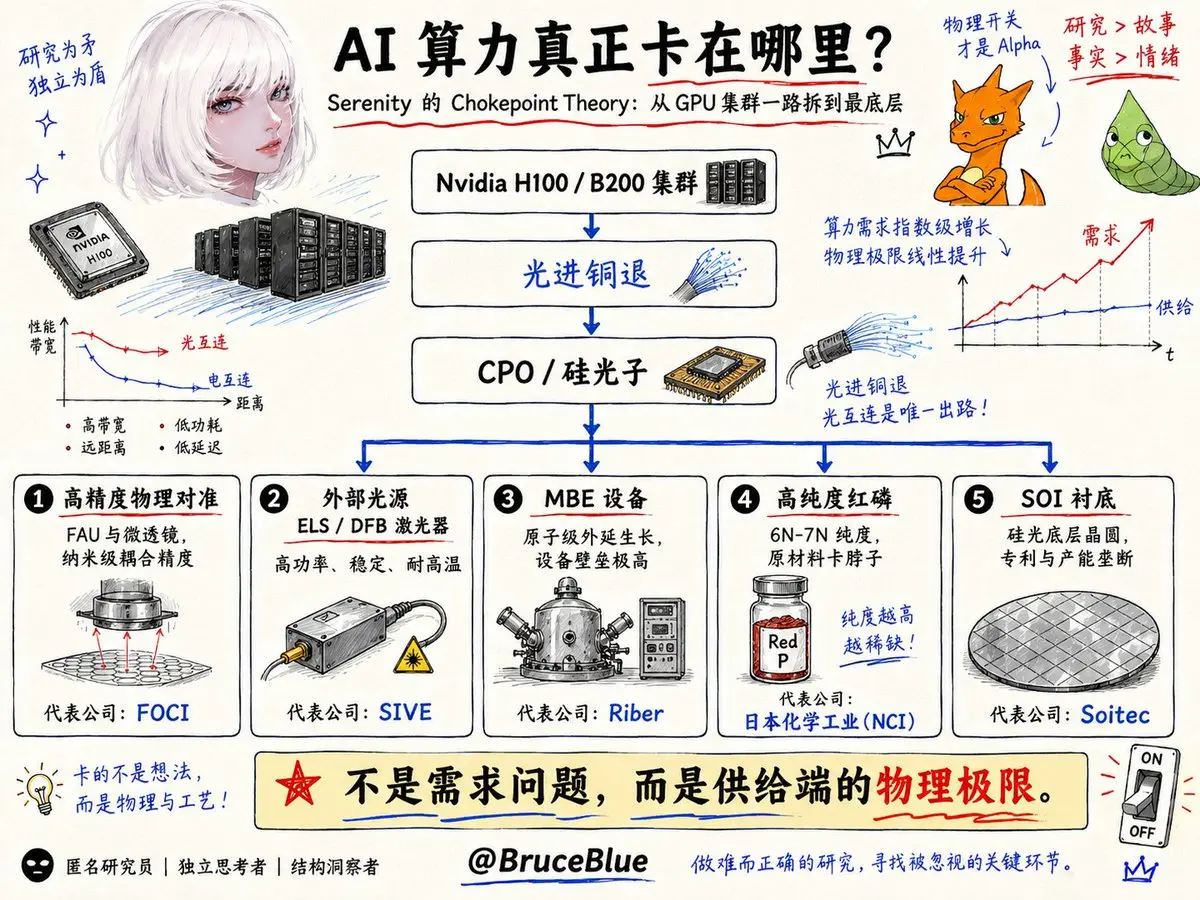
As large language model parameters grow exponentially, the interconnection of ten-thousand, hundred-thousand, or even million-card GPU clusters becomes the physical bottleneck for computing power scaling. At extremely high data throughput rates, traditional copper interconnects face insurmountable physical limits: high-frequency electrical signals in copper suffer from high attenuation, uncontrollable electromagnetic interference, and high power consumption and heat dissipation burdens.

To break this "copper wall," the process of converting electrical signals to optical signals for high-bandwidth, low-latency transmission—"optics in, copper out"—has become an inevitable path in AI infrastructure construction. The forefront of this physical layer revolution is the "Co-Packaged Optics" (CPO) architecture led by giants like TSMC and Nvidia.

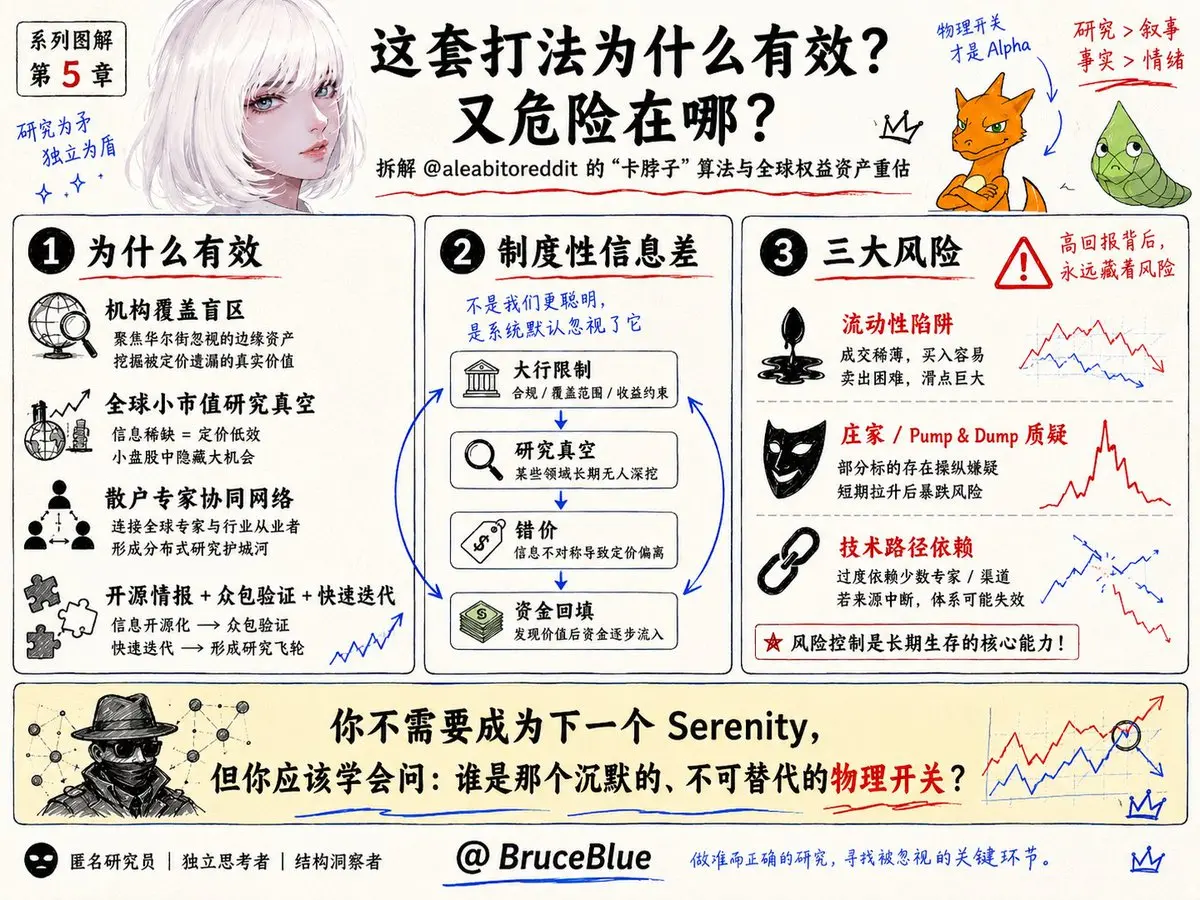
The core idea of CPO is integrating the electro-optical conversion chip directly with the core computing chip on the same multi-chip packaging substrate, shortening the electrical signal transmission distance within the package to the millimeter level. Serenity focuses on five major "choke point" technical and physical barriers in this revolutionary architecture:

Serenity's CPO (Co-Packaged Optics) Reverse Engineering Diagram:

Nvidia H100/B200 Clusters (10k-card interconnection demand)

Optics in, Copper out (Breaking copper cable physical limits: attenuation, power, heat)

┌────────────────────────────────────────────────────────────────────────┐

│ Five Physical Barriers of Silicon Photonics & CPO (Choke Points)

│ 1. High-precision Physical Alignment: Fiber Array Unit (FAU) & Micro-lenses

│ → $FOCI (Browave, Taiwan): Indispensable physical choke point status

│ 2. External Light Source (ELS) & High-Power Continuous Wave (CW) DFB Laser

│ → $SIVE (Sivers, Sweden): Extremely scarce physical asset for 1.6T LRO/CPO

│ 3. Molecular Beam Epitaxy (MBE) Equipment Barrier

│ → $ALRIB (Riber, France): Global monopolist, "choking the capacity neck" of epitaxy vendors

│ 4. High-Purity Red Phosphorus Raw Material (Purity 6N-7N, i.e., 99.9999%+)

│ → NCI (Nippon Chemical Industrial, Japan): Monopolized by very few specialty chemical giants

│ 5. Underlying Wafer: Silicon-on-Insulator (SOI) Substrate Material

│ → Soitec (France): Smart-Cut patent, absolute global technology and capacity monopolist

└────────────────────────────────────────────────────────────────────────┘

  • High-precision Physical Alignment Barrier

Since the optical waveguide dimensions inside silicon photonic chips are typically sub-micron, this requires nano-level physical alignment between the external fiber and the waveguide. Any tiny misalignment leads to severe "optical coupling loss." Serenity was the first in the English-speaking world to systematically anchor Browave (FOCI, 3363.TW), a stock highly focused on by Taiwanese retail investors, to the evolution of global CPO technology.

  • External Light Source (ELS) and High-Power Continuous Wave DFB Laser Barrier

Silicon, as an indirect bandgap semiconductor, cannot achieve efficient light emission under electrical injection. CPO architecture must rely on independent external light sources to provide high-power continuous wave laser. This laser must maintain single longitudinal mode operation in the high-temperature, high-pressure data center environment, with extremely high process requirements. Sweden-listed Sivers Semiconductors $SIVE, due to possessing relevant technology, becomes an extremely scarce physical asset in the CPO external light source supply chain.

  • Molecular Beam Epitaxy (MBE) Equipment Barrier

In the growth of epitaxial wafers for high-power lasers and other compound semiconductors, the core physical process is Molecular Beam Epitaxy (MBE), which allows for atomic-level precision growth of ultra-thin crystalline films. Serenity pinpointed the absolute monopolist of global MBE equipment: French listed company Riber $ALRIB.

  • High-Purity Red Phosphorus Raw Material Barrier

Compound semiconductor (e.g., indium phosphide substrate) manufacturing requires extremely stringent raw material purity. Serenity's reverse engineering leads to the most fundamental chemical element: high-purity red phosphorus (purity 99.9999%+). Capacity is almost entirely monopolized by a very few Japanese giants like Nippon Chemical Industrial Co., Ltd. (NCI). If supply is disrupted, downstream production halts entirely.

  • Silicon-on-Insulator (SOI) Substrate Material Barrier

Silicon photonic chips require SOI wafers as the underlying substrate. French company Soitec, with its exclusively invented Smart-Cut technology, holds absolute global technology and capacity monopoly in the silicon photonics SOI wafer market; even a giant like Japan's Shin-Etsu Chemical must pay it patent licensing fees.

The Geopolitical Game of "Physical Switches" in Humanoid Robots and Rare Earth Resources

In 2026, Serenity further horizontally expanded his "choke point" map to the geopolitical game involving humanoid robots and rare earth elements.

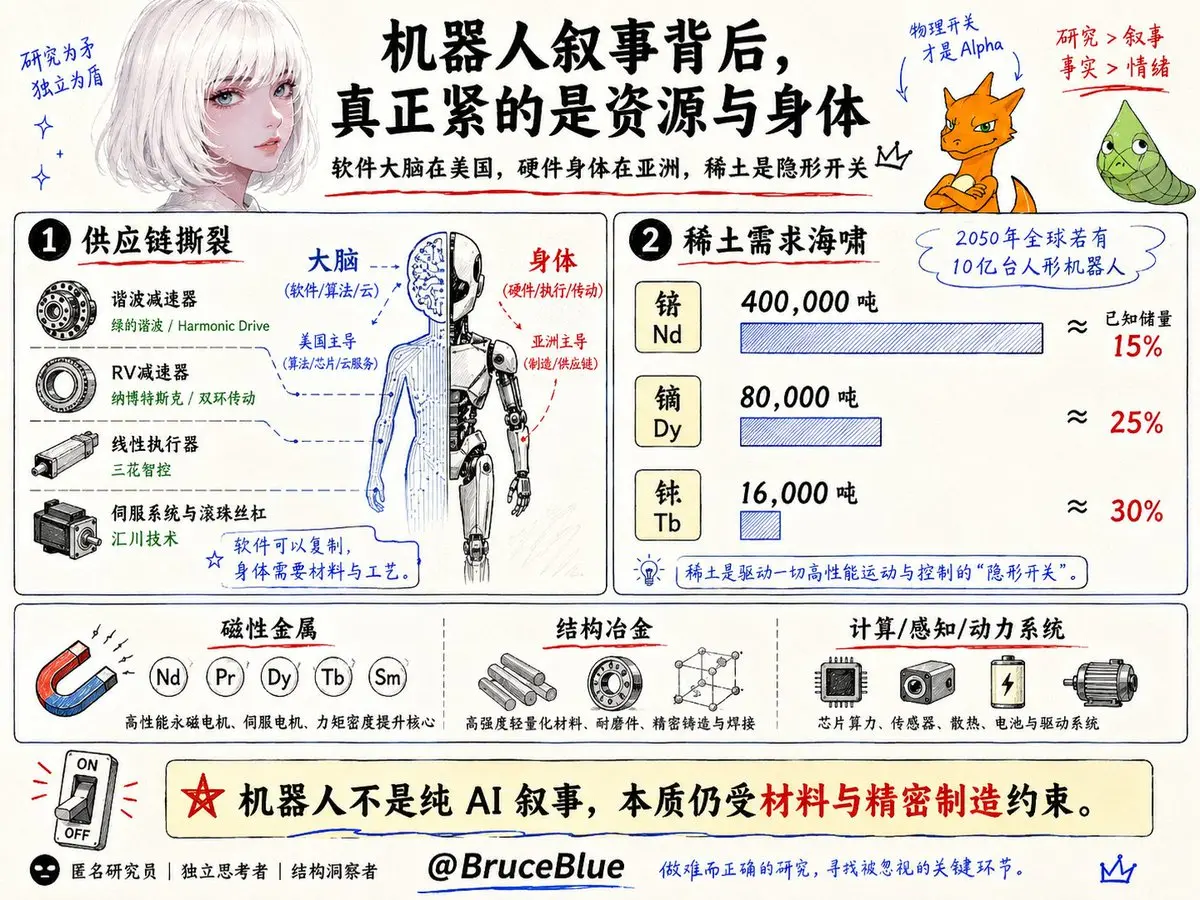
  • Supply Chain Tearing Between Software "Brain" and Hardware "Body"

Most market discussions about Tesla Optimus focus on AI algorithms and large models, overlooking a fatal physical reality: the US is losing the hardware and material manufacturing race for humanoid robots.

The humanoid robot's "brain" remains in the US, but the "body" components responsible for movement (joints, actuators, reducers, etc.) are almost entirely in the hands of Asian manufacturers:

  • Harmonic Reducers: Leader Harmonious Drive Systems (China), Harmonic Drive (Japan)

  • RV Reducers: Nabtesco (Japan), Sihuan Transmission (China)

  • Linear Actuators: Sanhua Intelligent Controls (China)

  • Servo Systems & Ball Screws: Inovance Technology (China)

To reduce costs, US robotics companies have already signed long-term contracts with these Chinese and Japanese component giants. This high dependence means that hardware supply chains face physical shutdown if geopolitical friction occurs.

  • Rare Earth "Demand Tsunami" and the Morgan Stanley Model

Serenity cites Morgan Stanley's demand forecasting model for quantitative extrapolation: if global humanoid robot stock reaches 1 billion units by 2050, its consumption of core rare earth resources will cause a catastrophic "demand tsunami":

  • Neodymium (Nd): Cumulative consumption ~400,000 tons (15% of global known reserves)

  • Dysprosium (Dy): Cumulative consumption ~80,000 tons (25% of global known reserves)

  • Terbium (Tb): Cumulative consumption ~16,000 tons (30% of global known reserves)

These are physical necessities for maintaining permanent magnet motor demagnetization resistance at high temperatures. Serenity emphasizes that if Western capital wants to ensure supply chain security, it must direct tens of billions in heavy capital towards rebuilding a local rare earth refining ecosystem.

Based on this, he lists three physical sectors that must be closely monitored:

  • Magnetic Metals: Light rare earths (Nd, Pr), heavy rare earths (Dy, Tb), specialty magnets (Sm, Co).

  • Structural Metallurgy: Precision gear materials (Ti, V, Mo), high-strength steel additives (Nb, Cr, Ni, Mn), wear-resistant elements (Ce, La).

  • Computing, Perception & Power Systems: Advanced semiconductors (Ga, Ge), batteries & wiring (each unit consumes 2kg Li, 3kg graphite, 6.5kg Cu).
Core Case Studies and Empirical Performance Evaluation

Through keen capture of technical barriers and commercialization inflection points, Serenity has successfully unearthed and led the value revaluation of multiple classic small-to-mid cap technology stocks across different global capital markets.
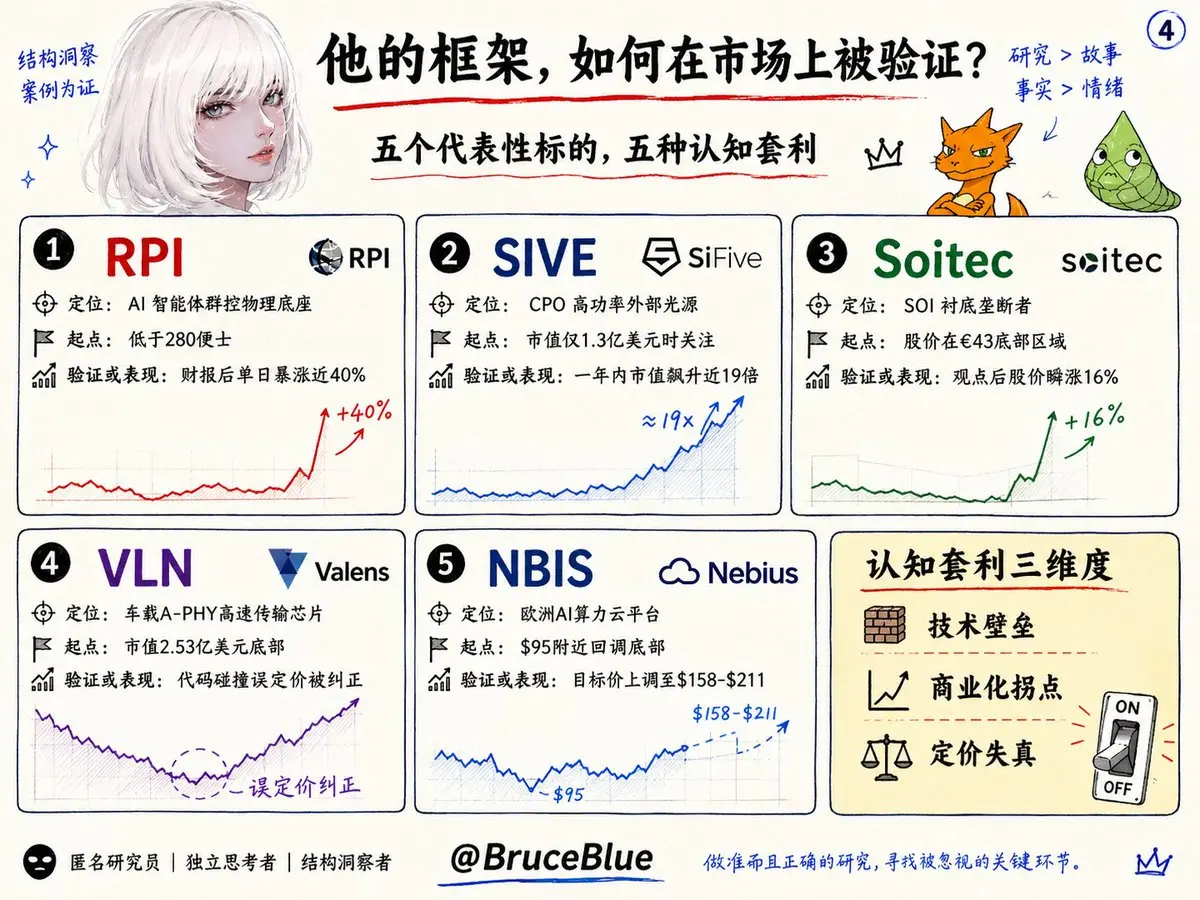
┌────────────────────────────────────────────────────────────────────────┐

│ Serenity Core Investment Picks & Empirical Performance Validation

├────────────────────────────────────────────────────────────────────────┤

│ $RPI (Raspberry Pi) | LSE UK

│ Positioning: Physical base for AI agent swarm control

│ Starting Point: Price below 280 pence (IPO price)

│ Validation: March 2026 annual report disclosed strong profit growth, chip unit sales up 47%, confirming its role as AI base logic

│ Performance: Single-day surge of nearly 40% on earnings, rebounded over 60% from lows

│ $SIVE (Sivers) | Stockholm Sweden

│ Positioning: Core supplier of high-power external light source DFB lasers for silicon photonics CPO

│ Starting Point: Market cap only $130 million when recommended

│ Validation: Secured strategic cooperation with Jabil, received $6.6M support from US CHIPS Act

│ Performance: Market cap soared nearly 19x within a year after recommendation (now over $2.3B)

│ Soitec | Euronext Paris France

│ Positioning: Global patent and capacity absolute monopolist for key silicon photonics SOI substrate material

│ Starting Point: Stock price in bottom area around €43

│ Validation: Listed as a Class 1 exclusive material standard by TSMC and Nvidia

│ Performance: European market stock price instantly surged 16% the day his view was published

│ $VLN (Valens) | NYSE USA

│ Positioning: Automotive A-PHY high-speed transmission chips

│ Starting Point: Market cap $253 million bottom (recommended with $93.5M net cash, zero debt, ~60-62% gross margin guidance)

│ Validation: Pointed out mispricing due to code collision error in scanners

│ Performance: Guided market's mine-sweeping revaluation of this asset by pointing out the "code collision" bug

│ $NBIS (Nebius Group) | NASDAQ USA

│ Positioning: Europe's largest AI GPU/Rubin computing cluster cloud service provider

│ Starting Point: Pullback bottom area around $95

│ Validation: Holding $3.7B net cash (end-2025), backlog of unexecuted contracts nearing $50B

│ Performance: Back on high-growth trajectory, analyst target price raised to $158-$211

└────────────────────────────────────────────────────────────────────────┘

Deep Analysis: Three Dimensions of Cognitive Arbitrage

  • Raspberry Pi$RPI : Relative Value Game Model

When the market viewed Raspberry Pi as a declining educational component maker, Serenity captured a dramatic shift in the AI developer ecosystem: numerous startups rushed to buy Raspberry Pis as physically isolated bases for deploying "AI agent swarm control systems." If buying Apple Mac Minis, such hoarding would be negligible in Apple's $3.7 trillion market cap; but for Raspberry Pi with a market cap of just £500 million, this is a transformative boost.

  • Valens Semiconductor$VLN : Information Arbitrage on Quantitative Code Collision

$VLN had $93.5 million net cash on the books, zero debt, ~60-62% gross margin guidance, secured Mercedes front-end design wins, yet its market cap was only $253 million. Serenity discovered a physical bug: mainstream global quantitative stock screeners had a "ticker code collision error," confusing data for $VLN with energy stock $VLO on the Toronto Exchange, causing key metrics to be severely distorted. He precisely listed the deviations, guiding funds to a "mine-sweeping" revaluation.

  • Nebius Group$NBIS : Deep Bottom Capture Amid Mechanical Panic

As a leading European AI-dedicated cloud service provider, $NBIS saw its stock price plummet to $95 due to mechanical hedging pressure from early-stage complex convertible bond share conversions. Serenity pointed out this was "mechanical panic from non-fundamental factors." At $95, the market gave this company, with 2026 revenue guidance of $30-34 billion (nearly 6x growth) and holding billions in net cash, an utterly absurd discount.

Retail Capital Synergy and Potential Structural Risks

  • Expert Retailer Synergy Network

In Serenity's framework, retail traders are no longer mere "dumb money" providing liquidity or blindly following trends but are reshaped into an "Expert Retailer Synergy Network." Traditional WSB relies on short-term options gamma squeezes or emotional memes to drive surges. In contrast, Serenity's completely free, technically high-threshold hardcore analysis subjects followers to a deep "intellectual filtration."

This highly specialized capital synergy enables them to rapidly form combined force in multiple extremely illiquid, remote micro-cap markets that Wall Street banks cannot cover, completing pricing dominance over core assets.

  • Institutional Blind Spots and Information Arbitrage

Analysts at large institutions are constrained by internal compliance, minimum market cap thresholds (e.g., not covering below $1B), and regional specialization (US equity analysts don't write on Sweden or Taiwan). This creates huge research vacuums in the global supply chain. As a completely anonymous independent researcher, Serenity ignores market cap and geographic barriers, directly guiding global long capital to violently refill these vacuums.

  • Structural Risks and Potential Game Dilemmas

However, blindly following this strategy comes with unavoidable fatal risks:

  • Liquidity Traps and Stampede Risk: Micro-cap stocks have extremely low daily trading volume. They surge instantly when the retail synergy rushes in; once technology implementation falls short of expectations, the extremely narrow exit channel leads to severe stampedes.

  • Polarized Public Opinion and "Market Manipulator" Allegations: Veteran shorts sharply criticize it as essentially a "pump and dump with high-IQ academic packaging." Its game characteristics of using massive public voice to attract retail to lift the price keep it long exposed to the shadow of compliance allegations.

  • "Fatal Minefield" of Physical Technology Single-Path Dependency: All of Serenity's core positions are built on the assumptions that "CPO is the only physical evolution path" and "humanoid robots will see a billion-unit explosion." This is a high-stakes gamble. If Nvidia finds CPO has insurmountable engineering dead ends and shifts to advanced thin-film copper cables, or if the West fails to rebuild rare earth separation chains, his entire supply chain empire built on silicon photonics, SOI, MBE equipment, and heavy rare earths could be physically dismantled in an instant.

Conclusion: Using Geek Depth to Beat Financial Breadth

Following Serenity isn't about getting a get-rich-quick stock ticker, but about acquiring an analytical framework that breaks consensus.

In this era of information overload, the most common mistake retail investors make is trying to compete with institutions on the speed of information acquisition or trading macro data that's already fully priced. Serenity demonstrates another possibility: using reverse engineering to deconstruct systems, using AI as a "Devil's Advocate" to challenge one's own logic, to find the truly controlling, silent gears of system operation.

You don't need to be the next Serenity. You don't need to buy any stock he buys.

But you should learn to ask a question like he does:

In this system, who is the silent, irreplaceable physical switch?

If you can answer that question, you already have one more perspective than 99% of market participants. The rest is just waiting for the market to catch up to your cognition.

Disclaimer:

This article does not constitute any investment advice.

All background information about Serenity himself is self-reported and unverified by third parties.

His past performance is not indicative of future results.

Conduct independent research before making any investment decisions.

NFA. DYOR.

Domande pertinenti

QWhat is the core investment framework that researcher Serenity uses to identify opportunities in the AI era, as described in the article?

ASerenity's core framework is the 'Chokepoint Theory' or '供应链瓶颈理论' (Supply Chain Bottleneck Theory). It involves a bottom-up, supply chain reverse engineering approach to identify critical, non-replaceable physical components or raw materials (the 'choke points') that are monopolized by a few companies. If these points are disrupted, the entire downstream AI industry cluster faces physical paralysis.

QAccording to the article, what is a unique step in Serenity's research process before publishing an investment thesis?

ABefore publishing any investment hypothesis, Serenity subjects his research drafts to a unique 'red-blue team' adversarial AI argumentation test. He inputs the drafts into different large language models, commanding the AI to act as a highly critical 'Devil's Advocate' to identify logical flaws, technical physical limitations, threats from alternative solutions, and potential valuation biases. He only publishes the report after it withstands multiple rounds of this AI-driven technical and logical cross-examination.

QWhat are the five major physical barriers (or 'choke points') identified in the Silicon Photonics and Co-Packaged Optics (CPO) supply chain?

AThe five major physical barriers in the Silicon Photonics and CPO supply chain are: 1. High-precision physical alignment (e.g., Fiber Array Units, micro-lenses, represented by FOCI), 2. External Light Source (ELS) and high-power Continuous Wave DFB lasers (represented by Sivers Semiconductors, $SIVE), 3. Molecular Beam Epitaxy (MBE) equipment barrier (represented by Riber, $ALRIB), 4. High-purity red phosphorus raw material (99.9999%+ purity, monopolized by Japanese chemical giants like NCI), and 5. Underlying Silicon-On-Insulator (SOI) wafer substrate material (dominated by Soitec with its Smart-Cut patent).

QWhat key risk does the article highlight regarding the humanoid robot supply chain for the United States?

AThe article highlights that the United States is at risk of losing the hardware and materials manufacturing race for humanoid robots. While the AI 'brain' (software and algorithms) remains in the US, critical 'body' components like joints, actuators, and reducers are almost entirely controlled by Asian manufacturers (e.g., Harmonic Drive in Japan,绿的谐波 in China, Nabtesco in Japan). This creates a dangerous dependency, meaning any geopolitical friction could lead to a physical shutdown of the hardware supply chain for US robot companies.

QWhat are some of the structural risks associated with following Serenity's investment strategy, as mentioned in the conclusion?

AKey structural risks include: 1. Liquidity traps and stampede risk in micro-cap stocks with low daily trading volumes, 2. Intense polarization of public opinion and accusations of being a sophisticated 'pump and dump' scheme, 3. Fatal reliance on a single physical technology path. If the foundational assumptions fail (e.g., if CPO faces insurmountable engineering hurdles or if the predicted mass adoption of humanoid robots doesn't materialize), the entire investment thesis built on related supply chains (silicon photonics, SOI, MBE, rare earths) could collapse physically and financially.

Letture associate

A Trillion-Dollar Frenzy for Memory Sellers, Halved Profits for Memory Buyers

Summary: A stark divide has emerged in the tech industry. While memory chipmaker Micron's stock soared 19% in a single day, pushing its market cap over $1 trillion, smartphone manufacturer Xiaomi reported a 43% plunge in adjusted net profit. The core driver is a severe supply crunch in memory chips, particularly for AI applications. Wall Street analysts, led by UBS and its unprecedented 204% target price hike for Micron, argue that long-term agreements (LTAs) from AI cloud giants are fundamentally ending the sector's notorious boom-and-bust cycles, justifying a re-rating from cyclical to infrastructure-like valuations. However, the "storage" market is now fragmented into three tiers. The first, AI-grade memory like HBM and server DDR5, faces extreme shortages and soaring prices driven by massive cloud capex. The second, mobile memory for smartphones, is also seeing sharp price hikes as manufacturers like Xiaomi are forced to pay more for remaining capacity, severely squeezing their margins. The third, PC retail channels, shows price declines due to existing inventory. The article questions the sustainability of the "supercycle" narrative. It highlights that Micron's revenue surge is driven almost entirely by price increases, not shipment volumes, making it vulnerable to a potential demand slowdown. While LTAs may dampen volatility, history suggests they are often tested during downturns. The current peak earnings, used to justify high valuations, represent a classic cyclical top. The piece concludes with a note of caution: when the entire Street chants "this time is different," it's wise to remember past bubbles, even as it acknowledges AI demand may indeed be structural.

marsbit12 min fa

A Trillion-Dollar Frenzy for Memory Sellers, Halved Profits for Memory Buyers

marsbit12 min fa

This New Generation of US Stock Trading Gods No Longer Read Financial Reports

The new generation of "stock gods" in the 2026 US AI bull market are not analyzing traditional financial reports. Instead of focusing on giants like NVIDIA, figures like the 22-year-old Leopold Aschenbrenner (who reportedly turned $200M into $14B) and influencers like Serenity on platforms like Reddit's WallStreetBets, X, and Substack are gaining fame and returns by targeting obscure, low-cap "micro-cap" stocks. Their strategy, dubbed "supply chain sniping," involves identifying critical, often monopolistic, bottlenecks in the AI hardware supply chain—such as specific materials or components essential for giants like Google and NVIDIA—that are missed by mainstream Wall Street analysts. Serenity's call on AXTI, a $700M company supplying indium phosphide substrates crucial for photonics and optical interconnects, saw the stock soar from ~$12 to nearly $150. Similarly, accounts like KawzInvests and PhotonCap focus on thematic, supply-chain-driven research in areas like AI infrastructure, optics, and cloud services for SMEs, bypassing traditional valuation metrics. This shift represents a cultural move away from Warren Buffett-style value investing based on deep financial statement analysis. The new approach thrives on low liquidity, early narratives, and strong community propagation on social media, similar to meme stocks or crypto. However, this "attention economy" strategy carries risks: it depends on sustained information gaps, the underlying companies' ability to deliver fundamental results, and the potential for crowded, volatile exits as narratives shift. The trend also shows crypto traders applying their narrative-sensing skills to US micro-caps, marking a significant evolution in trading culture.

marsbit14 min fa

This New Generation of US Stock Trading Gods No Longer Read Financial Reports

marsbit14 min fa

Trillion-Dollar Euphoria for Memory Sellers, Halved Profits for Memory Buyers

Title: The Trillion-Dollar Memory Seller's Carnival vs. The Buyer's Halved Profits On May 26, a stark contrast unfolded. While memory chipmaker Micron's market cap surged past $1 trillion, smartphone maker Xiaomi reported plummeting profits. Xiaomi's Q1 2026 profits fell 43% year-on-year. Executive Lu Weibing cited memory prices quadrupling from last year, adding roughly $210 to a phone's cost. To survive, Xiaomi is cutting entry-level models, sacrificing volume. Micron's stock, however, skyrocketed over 19% in a day, capping an 8x gain in a year. Major banks like UBS and JPMorgan issued bullish reports, raising price targets drastically. Their core thesis: Long-Term Agreements (LTAs) with AI cloud giants (Microsoft, Google, etc.) are eliminating the memory industry's notorious boom-bust cycle. By locking in fixed-price, multi-year contracts for AI-grade memory (HBM, server DDR5), these deals promise stable, utility-like earnings, justifying a higher valuation (20-30x P/E vs. the historical 8-15x). The article reveals a three-tiered memory market in 2026: 1) **AI Storage (HBM/DDR5/Enterprise SSD)**: Extreme shortage, soaring prices, LTAs. This is Micron's story. 2) **Mobile/Embedded Memory**: Also facing sharp price hikes as AI production crowds out capacity, severely pressuring phone makers like Xiaomi. 3) **PC Retail**: Some spot prices are falling due to channel inventory liquidation, creating a divergence from contract markets. The author questions if LTAs truly end the cycle. It hinges on sustained, hyper-growth AI demand. Micron's current profits are at a cycle peak, driven mostly by price hikes, not volume. If AI capital expenditure growth slows, the massive industry capacity expansion (e.g., Micron's $250B+ CapEx plan) could lead to a glut. Historically, using peak-cycle earnings for valuation is a classic trap. While the AI-driven structural shift might be real, the unanimous Wall Street euphoria warrants caution, echoing past bubbles like Cisco's in 2000. The memory seller's trillion-dollar狂欢 (carnival) continues, but the cycle's shadow remains.

链捕手21 min fa

Trillion-Dollar Euphoria for Memory Sellers, Halved Profits for Memory Buyers

链捕手21 min fa

Trading

Spot
Futures

Articoli Popolari

Cosa è $S$

Comprendere SPERO: Una Panoramica Completa Introduzione a SPERO Mentre il panorama dell'innovazione continua a evolversi, l'emergere delle tecnologie web3 e dei progetti di criptovaluta gioca un ruolo fondamentale nel plasmare il futuro digitale. Un progetto che ha attirato l'attenzione in questo campo dinamico è SPERO, denotato come SPERO,$$s$. Questo articolo mira a raccogliere e presentare informazioni dettagliate su SPERO, per aiutare gli appassionati e gli investitori a comprendere le sue basi, obiettivi e innovazioni nei domini web3 e crypto. Che cos'è SPERO,$$s$? SPERO,$$s$ è un progetto unico all'interno dello spazio crypto che cerca di sfruttare i principi della decentralizzazione e della tecnologia blockchain per creare un ecosistema che promuove l'impegno, l'utilità e l'inclusione finanziaria. Il progetto è progettato per facilitare interazioni peer-to-peer in modi nuovi, fornendo agli utenti soluzioni e servizi finanziari innovativi. Al suo interno, SPERO,$$s$ mira a responsabilizzare gli individui fornendo strumenti e piattaforme che migliorano l'esperienza dell'utente nello spazio delle criptovalute. Questo include la possibilità di metodi di transazione più flessibili, la promozione di iniziative guidate dalla comunità e la creazione di percorsi per opportunità finanziarie attraverso applicazioni decentralizzate (dApps). La visione sottostante di SPERO,$$s$ ruota attorno all'inclusività, cercando di colmare le lacune all'interno della finanza tradizionale mentre sfrutta i vantaggi della tecnologia blockchain. Chi è il Creatore di SPERO,$$s$? L'identità del creatore di SPERO,$$s$ rimane piuttosto oscura, poiché ci sono risorse pubblicamente disponibili limitate che forniscono informazioni dettagliate sul suo fondatore o fondatori. Questa mancanza di trasparenza può derivare dall'impegno del progetto per la decentralizzazione—un ethos che molti progetti web3 condividono, dando priorità ai contributi collettivi rispetto al riconoscimento individuale. Centrando le discussioni attorno alla comunità e ai suoi obiettivi collettivi, SPERO,$$s$ incarna l'essenza dell'empowerment senza mettere in evidenza individui specifici. Pertanto, comprendere l'etica e la missione di SPERO rimane più importante che identificare un creatore singolo. Chi sono gli Investitori di SPERO,$$s$? SPERO,$$s$ è supportato da una varietà di investitori che vanno dai capitalisti di rischio agli investitori angelici dedicati a promuovere l'innovazione nel settore crypto. Il focus di questi investitori generalmente si allinea con la missione di SPERO—dando priorità a progetti che promettono avanzamenti tecnologici sociali, inclusività finanziaria e governance decentralizzata. Queste fondazioni di investitori sono tipicamente interessate a progetti che non solo offrono prodotti innovativi, ma contribuiscono anche positivamente alla comunità blockchain e ai suoi ecosistemi. Il supporto di questi investitori rafforza SPERO,$$s$ come un concorrente degno di nota nel dominio in rapida evoluzione dei progetti crypto. Come Funziona SPERO,$$s$? SPERO,$$s$ impiega un framework multifunzionale che lo distingue dai progetti di criptovaluta convenzionali. Ecco alcune delle caratteristiche chiave che sottolineano la sua unicità e innovazione: Governance Decentralizzata: SPERO,$$s$ integra modelli di governance decentralizzati, responsabilizzando gli utenti a partecipare attivamente ai processi decisionali riguardanti il futuro del progetto. Questo approccio favorisce un senso di proprietà e responsabilità tra i membri della comunità. Utilità del Token: SPERO,$$s$ utilizza il proprio token di criptovaluta, progettato per servire varie funzioni all'interno dell'ecosistema. Questi token abilitano transazioni, premi e la facilitazione dei servizi offerti sulla piattaforma, migliorando l'impegno e l'utilità complessivi. Architettura Stratificata: L'architettura tecnica di SPERO,$$s$ supporta la modularità e la scalabilità, consentendo un'integrazione fluida di funzionalità e applicazioni aggiuntive man mano che il progetto evolve. Questa adattabilità è fondamentale per mantenere la rilevanza nel panorama crypto in continua evoluzione. Coinvolgimento della Comunità: Il progetto enfatizza iniziative guidate dalla comunità, impiegando meccanismi che incentivano la collaborazione e il feedback. Nutrendo una comunità forte, SPERO,$$s$ può affrontare meglio le esigenze degli utenti e adattarsi alle tendenze di mercato. Focus sull'Inclusione: Offrendo basse commissioni di transazione e interfacce user-friendly, SPERO,$$s$ mira ad attrarre una base utenti diversificata, inclusi individui che potrebbero non aver precedentemente interagito nello spazio crypto. Questo impegno per l'inclusione si allinea con la sua missione generale di empowerment attraverso l'accessibilità. Cronologia di SPERO,$$s$ Comprendere la storia di un progetto fornisce preziose intuizioni sulla sua traiettoria di sviluppo e sui traguardi. Di seguito è riportata una cronologia suggerita che mappa eventi significativi nell'evoluzione di SPERO,$$s$: Fase di Concettualizzazione e Ideazione: Le idee iniziali che formano la base di SPERO,$$s$ sono state concepite, allineandosi strettamente con i principi di decentralizzazione e focus sulla comunità all'interno dell'industria blockchain. Lancio del Whitepaper del Progetto: Dopo la fase concettuale, è stato rilasciato un whitepaper completo che dettaglia la visione, gli obiettivi e l'infrastruttura tecnologica di SPERO,$$s$ per suscitare interesse e feedback dalla comunità. Costruzione della Comunità e Prime Interazioni: Sono stati effettuati sforzi attivi di outreach per costruire una comunità di early adopters e potenziali investitori, facilitando discussioni attorno agli obiettivi del progetto e ottenendo supporto. Evento di Generazione del Token: SPERO,$$s$ ha condotto un evento di generazione del token (TGE) per distribuire i propri token nativi ai primi sostenitori e stabilire una liquidità iniziale all'interno dell'ecosistema. Lancio della Prima dApp: La prima applicazione decentralizzata (dApp) associata a SPERO,$$s$ è stata attivata, consentendo agli utenti di interagire con le funzionalità principali della piattaforma. Sviluppo Continuo e Partnership: Aggiornamenti e miglioramenti continui alle offerte del progetto, inclusi partnership strategiche con altri attori nello spazio blockchain, hanno plasmato SPERO,$$s$ in un concorrente competitivo e in evoluzione nel mercato crypto. Conclusione SPERO,$$s$ rappresenta una testimonianza del potenziale del web3 e delle criptovalute di rivoluzionare i sistemi finanziari e responsabilizzare gli individui. Con un impegno per la governance decentralizzata, il coinvolgimento della comunità e funzionalità progettate in modo innovativo, apre la strada verso un panorama finanziario più inclusivo. Come per qualsiasi investimento nello spazio crypto in rapida evoluzione, si incoraggiano potenziali investitori e utenti a ricercare approfonditamente e a impegnarsi in modo riflessivo con gli sviluppi in corso all'interno di SPERO,$$s$. Il progetto mostra lo spirito innovativo dell'industria crypto, invitando a ulteriori esplorazioni delle sue innumerevoli possibilità. Mentre il percorso di SPERO,$$s$ è ancora in fase di sviluppo, i suoi principi fondamentali potrebbero effettivamente influenzare il futuro di come interagiamo con la tecnologia, la finanza e tra di noi in ecosistemi digitali interconnessi.

75 Totale visualizzazioniPubblicato il 2024.12.17Aggiornato il 2024.12.17

Cosa è $S$

Cosa è AGENT S

Agent S: Il Futuro dell'Interazione Autonoma in Web3 Introduzione Nel panorama in continua evoluzione di Web3 e criptovalute, le innovazioni stanno costantemente ridefinendo il modo in cui gli individui interagiscono con le piattaforme digitali. Uno di questi progetti pionieristici, Agent S, promette di rivoluzionare l'interazione uomo-computer attraverso il suo framework agentico aperto. Aprendo la strada a interazioni autonome, Agent S mira a semplificare compiti complessi, offrendo applicazioni trasformative nell'intelligenza artificiale (AI). Questa esplorazione dettagliata approfondirà le complessità del progetto, le sue caratteristiche uniche e le implicazioni per il dominio delle criptovalute. Cos'è Agent S? Agent S si presenta come un innovativo framework agentico aperto, progettato specificamente per affrontare tre sfide fondamentali nell'automazione dei compiti informatici: Acquisizione di Conoscenze Specifiche del Dominio: Il framework apprende in modo intelligente da varie fonti di conoscenza esterne ed esperienze interne. Questo approccio duale gli consente di costruire un ricco repository di conoscenze specifiche del dominio, migliorando le sue prestazioni nell'esecuzione dei compiti. Pianificazione su Lungo Orizzonte di Compiti: Agent S impiega una pianificazione gerarchica potenziata dall'esperienza, un approccio strategico che facilita la suddivisione e l'esecuzione efficiente di compiti complessi. Questa caratteristica migliora significativamente la sua capacità di gestire più sottocompiti in modo efficiente ed efficace. Gestione di Interfacce Dinamiche e Non Uniformi: Il progetto introduce l'Interfaccia Agente-Computer (ACI), una soluzione innovativa che migliora l'interazione tra agenti e utenti. Utilizzando Modelli Linguistici Multimodali di Grandi Dimensioni (MLLM), Agent S può navigare e manipolare senza sforzo diverse interfacce grafiche utente. Attraverso queste caratteristiche pionieristiche, Agent S fornisce un framework robusto che affronta le complessità coinvolte nell'automazione dell'interazione umana con le macchine, preparando il terreno per innumerevoli applicazioni nell'AI e oltre. Chi è il Creatore di Agent S? Sebbene il concetto di Agent S sia fondamentalmente innovativo, informazioni specifiche sul suo creatore rimangono elusive. Il creatore è attualmente sconosciuto, il che evidenzia sia la fase embrionale del progetto sia la scelta strategica di mantenere i membri fondatori sotto anonimato. Indipendentemente dall'anonimato, l'attenzione rimane sulle capacità e sul potenziale del framework. Chi sono gli Investitori di Agent S? Poiché Agent S è relativamente nuovo nell'ecosistema crittografico, informazioni dettagliate riguardanti i suoi investitori e sostenitori finanziari non sono documentate esplicitamente. La mancanza di approfondimenti pubblicamente disponibili sulle fondazioni di investimento o sulle organizzazioni che supportano il progetto solleva interrogativi sulla sua struttura di finanziamento e sulla roadmap di sviluppo. Comprendere il supporto è cruciale per valutare la sostenibilità del progetto e il suo potenziale impatto sul mercato. Come Funziona Agent S? Al centro di Agent S si trova una tecnologia all'avanguardia che gli consente di funzionare efficacemente in contesti diversi. Il suo modello operativo è costruito attorno a diverse caratteristiche chiave: Interazione Uomo-Computer Simile a Quella Umana: Il framework offre una pianificazione AI avanzata, cercando di rendere le interazioni con i computer più intuitive. Mimando il comportamento umano nell'esecuzione dei compiti, promette di elevare le esperienze degli utenti. Memoria Narrativa: Utilizzata per sfruttare esperienze di alto livello, Agent S utilizza la memoria narrativa per tenere traccia delle storie dei compiti, migliorando così i suoi processi decisionali. Memoria Episodica: Questa caratteristica fornisce agli utenti una guida passo-passo, consentendo al framework di offrire supporto contestuale mentre i compiti si sviluppano. Supporto per OpenACI: Con la capacità di funzionare localmente, Agent S consente agli utenti di mantenere il controllo sulle proprie interazioni e flussi di lavoro, allineandosi con l'etica decentralizzata di Web3. Facile Integrazione con API Esterne: La sua versatilità e compatibilità con varie piattaforme AI garantiscono che Agent S possa adattarsi senza problemi agli ecosistemi tecnologici esistenti, rendendolo una scelta attraente per sviluppatori e organizzazioni. Queste funzionalità contribuiscono collettivamente alla posizione unica di Agent S all'interno dello spazio crittografico, poiché automatizza compiti complessi e multi-fase con un intervento umano minimo. Man mano che il progetto evolve, le sue potenziali applicazioni in Web3 potrebbero ridefinire il modo in cui si svolgono le interazioni digitali. Cronologia di Agent S Lo sviluppo e le tappe di Agent S possono essere riassunti in una cronologia che evidenzia i suoi eventi significativi: 27 Settembre 2024: Il concetto di Agent S è stato lanciato in un documento di ricerca completo intitolato “Un Framework Agentico Aperto che Usa i Computer Come un Umano”, mostrando le basi per il progetto. 10 Ottobre 2024: Il documento di ricerca è stato reso pubblicamente disponibile su arXiv, offrendo un'esplorazione approfondita del framework e della sua valutazione delle prestazioni basata sul benchmark OSWorld. 12 Ottobre 2024: È stata rilasciata una presentazione video, fornendo un'idea visiva delle capacità e delle caratteristiche di Agent S, coinvolgendo ulteriormente potenziali utenti e investitori. Questi indicatori nella cronologia non solo illustrano i progressi di Agent S, ma indicano anche il suo impegno per la trasparenza e il coinvolgimento della comunità. Punti Chiave su Agent S Man mano che il framework Agent S continua a evolversi, diversi attributi chiave si distinguono, sottolineando la sua natura innovativa e il potenziale: Framework Innovativo: Progettato per fornire un uso intuitivo dei computer simile all'interazione umana, Agent S porta un approccio nuovo all'automazione dei compiti. Interazione Autonoma: La capacità di interagire autonomamente con i computer attraverso GUI segna un passo avanti verso soluzioni informatiche più intelligenti ed efficienti. Automazione di Compiti Complessi: Con la sua metodologia robusta, può automatizzare compiti complessi e multi-fase, rendendo i processi più veloci e meno soggetti a errori. Miglioramento Continuo: I meccanismi di apprendimento consentono ad Agent S di migliorare dalle esperienze passate, migliorando continuamente le sue prestazioni e la sua efficacia. Versatilità: La sua adattabilità attraverso diversi ambienti operativi come OSWorld e WindowsAgentArena garantisce che possa servire un'ampia gamma di applicazioni. Man mano che Agent S si posiziona nel panorama di Web3 e delle criptovalute, il suo potenziale per migliorare le capacità di interazione e automatizzare i processi segna un significativo avanzamento nelle tecnologie AI. Attraverso il suo framework innovativo, Agent S esemplifica il futuro delle interazioni digitali, promettendo un'esperienza più fluida ed efficiente per gli utenti in vari settori. Conclusione Agent S rappresenta un audace passo avanti nell'unione tra AI e Web3, con la capacità di ridefinire il modo in cui interagiamo con la tecnologia. Sebbene sia ancora nelle sue fasi iniziali, le possibilità per la sua applicazione sono vaste e coinvolgenti. Attraverso il suo framework completo che affronta sfide critiche, Agent S mira a portare le interazioni autonome al centro dell'esperienza digitale. Man mano che ci addentriamo nei regni delle criptovalute e della decentralizzazione, progetti come Agent S giocheranno senza dubbio un ruolo cruciale nel plasmare il futuro della tecnologia e della collaborazione uomo-computer.

526 Totale visualizzazioniPubblicato il 2025.01.14Aggiornato il 2025.01.14

Cosa è AGENT S

Come comprare S

Benvenuto in HTX.com! Abbiamo reso l'acquisto di Sonic (S) semplice e conveniente. Segui la nostra guida passo passo per intraprendere il tuo viaggio nel mondo delle criptovalute.Step 1: Crea il tuo Account HTXUsa la tua email o numero di telefono per registrarti il tuo account gratuito su HTX. Vivi un'esperienza facile e sblocca tutte le funzionalità,Crea il mio accountStep 2: Vai in Acquista crypto e seleziona il tuo metodo di pagamentoCarta di credito/debito: utilizza la tua Visa o Mastercard per acquistare immediatamente SonicS.Bilancio: Usa i fondi dal bilancio del tuo account HTX per fare trading senza problemi.Terze parti: abbiamo aggiunto metodi di pagamento molto utilizzati come Google Pay e Apple Pay per maggiore comodità.P2P: Fai trading direttamente con altri utenti HTX.Over-the-Counter (OTC): Offriamo servizi su misura e tassi di cambio competitivi per i trader.Step 3: Conserva Sonic (S)Dopo aver acquistato Sonic (S), conserva nel tuo account HTX. In alternativa, puoi inviare tramite trasferimento blockchain o scambiare per altre criptovalute.Step 4: Scambia Sonic (S)Scambia facilmente Sonic (S) nel mercato spot di HTX. Accedi al tuo account, seleziona la tua coppia di trading, esegui le tue operazioni e monitora in tempo reale. Offriamo un'esperienza user-friendly sia per chi ha appena iniziato che per i trader più esperti.

937 Totale visualizzazioniPubblicato il 2025.01.15Aggiornato il 2025.03.21

Come comprare S

Discussioni

Benvenuto nella Community HTX. Qui puoi rimanere informato sugli ultimi sviluppi della piattaforma e accedere ad approfondimenti esperti sul mercato. Le opinioni degli utenti sul prezzo di S S sono presentate come di seguito.

活动图片