Top House Democrat Questions Kansas City Fed’s Approval Of Kraken Master Account

bitcoinistPublished on 2026-03-28Last updated on 2026-03-28

Abstract

Representative Maxine Waters, the top Democrat on the House Financial Services Committee, has questioned the Federal Reserve Bank of Kansas City's approval of a "limited purpose account" for crypto exchange Kraken. This approval grants Kraken's banking arm direct access to the Fed's payment system, a first for a cryptocurrency firm. Waters expressed concerns about the lack of transparency, potential risks to financial stability, and the adequacy of consumer protections, especially as this access was granted while Congress is still debating the terms for such expansions. She has requested detailed information on the services accessible to Kraken, the conditions applied, and the risk assessments conducted. The move has also drawn opposition from traditional banking groups, who warn it could threaten the U.S. payment system.

House of Representatives Ranking Member Maxine Waters has pressed the Federal Reserve Bank of Kansas City over its approval of a “limited purpose account” for Kraken, expressing concerns about the implications of granting a crypto firm access to the Federal Reserve’s (Fed) payment system.

Rep. Waters Seeks Clarity On Kraken’s Master Account Approval

On Thursday, Representative Maxine Waters, the top Democrat on the House Financial Services Committee, sent a letter to Jeff Schmid, President and CEO of the Federal Reserve Bank of Kansas City, questioning the Kansas City Fed’s recent decision to approve a “limited purpose account” to the US’s second-largest crypto exchange, Kraken.

In the letter, Waters seeks clarification from the Kansas City Fed regarding the practical implications of this approval “at a time when Congress has debated whether or not to expand access to the Fed’s payment rails and on what terms.”
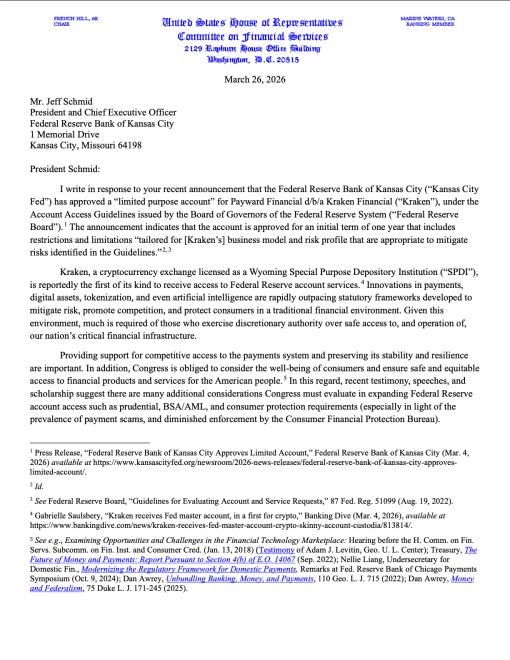
Rep. Waters' letter to Kansas City Fed's President Jeff Schmid. Source: House Financial Services Committee

Notably, Kraken Financial, Kraken’s banking arm, made history as the first crypto company to gain direct access to the Federal Reserve’s core payment system. This achievement was accomplished after Kraken secured approval from the Kansas City Fed for a Fed master account earlier this month.

As reported by Bitcoinist, the master account’s approval will enable Kraken Financial to expedite and streamline transactions for its large clients and professional traders. Additionally, it will grant Kraken’s banking unit direct access to Fedwire, a prominent interbank payment system that processes over $4 trillion in transfers daily.

The milestone represents a significant triumph for the crypto industry, which had been repeatedly denied access to the Federal Reserve system for years. Previously, the company had relied on intermediary banks to facilitate transfers to other firms.

The lawmaker highlighted that granting a cryptocurrency firm access to the Federal Reserve’s payment system for the first time raises policy, regulatory, and consumer protection concerns, arguing that it is particularly concerning given the rapid pace at which financial innovation is outpacing the rules and safeguards designed to ensure the safety of the financial system.

The Kansas City Fed’s announcement does not disclose specific information about Kraken’s access to the range of Federal Reserve financial services “due to the confidentiality of business information provided by applicants.” However, the announcement raises questions about the approval because neither statute nor the Federal Reserve Board’s Account Access Guidelines refer to a ‘limited purpose account’ type.

Crypto Access To Fed’s Payment Rails Faces Opposition

Representative Waters emphasized that access to the nation’s core payments infrastructure carries significant public responsibility and should not be extended without full transparency, clear legal grounding, and confidence that risks will be properly managed.

Therefore, she requested information no later than April 10, 2026, on the Federal Reserve services that Kraken can now access, the conditions or restrictions that apply, and the prudential, anti-money laundering (AML), and consumer protection considerations that were weighed before proceeding with the approval.

The lawmaker’s letter arrives as banking groups express significant concerns about granting crypto and fintech companies direct access to the Federal Reserve’s payment systems. Traditional banks have cautioned that even limited access could pose a substantial threat to the US payment system and overall financial stability.

For context, Kraken’s limited access to the master account is similar to the “skinny” master account concept initially proposed by the Federal Reserve Board of Governors in October 2025.

This type of restricted account would enable payment fintechs and crypto companies to access the Federal Reserve’s payment systems. However, it would exclude other advantages more closely associated with banks, such as the discount window lending facility.

In addition, the Office of the Comptroller of the Currency (OCC) approved conditional bank charters for Ripple, Circle, BitGo, Paxos, and Fidelity in December, raising concerns that it could blur the lines between banking activities and lead to regulatory arbitrage.

Last month, the American Bankers Association (ABA) urged the main banking regulator to postpone its approval of applications for crypto bank charters, suggesting that the agency should wait until the regulatory uncertainties are resolved.
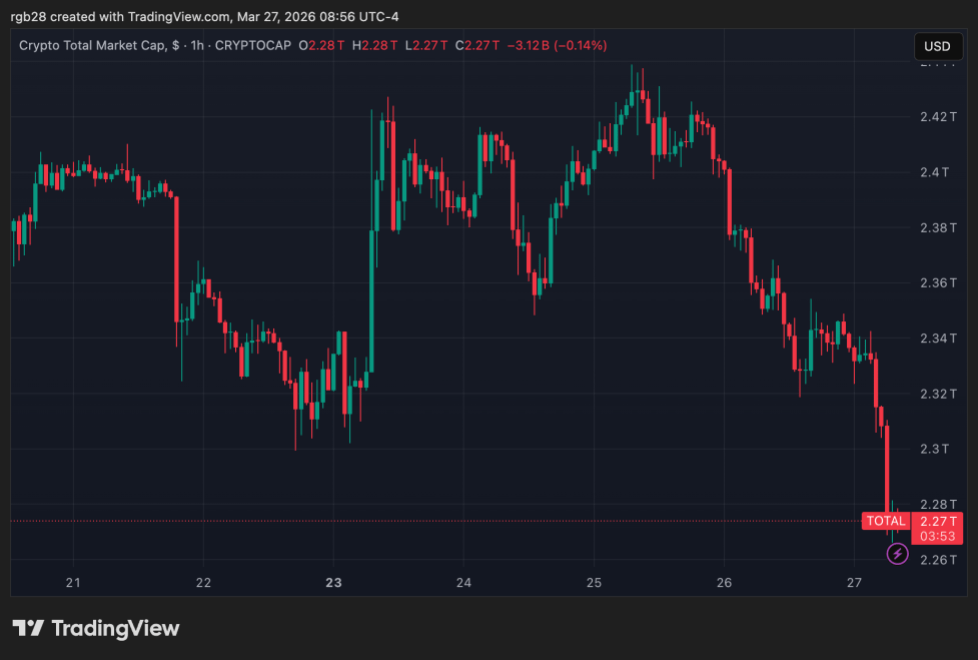
Total crypto market capitalization is at $2.27 trillion in the one-week chart. Source: TOTAL on TradingView


Related Questions

QWhat is the main concern raised by Representative Maxine Waters regarding the Kansas City Fed's approval of a master account for Kraken?

ARepresentative Maxine Waters expressed concerns about the policy, regulatory, and consumer protection implications of granting a cryptocurrency firm direct access to the Federal Reserve's payment system for the first time, arguing that financial innovation is outpacing existing rules.

QWhat specific type of account did the Federal Reserve Bank of Kansas City approve for Kraken, and why is it notable?

AThe Kansas City Fed approved a 'limited purpose account' for Kraken. It is notable because it marks the first time a crypto company has gained direct access to the Federal Reserve's core payment system, a significant milestone for the industry.

QWhat practical benefits does the master account provide to Kraken Financial?

AThe master account enables Kraken Financial to expedite and streamline transactions for its large clients and professional traders and grants it direct access to Fedwire, a major interbank payment system that processes over $4 trillion daily.

QWhat information did Representative Waters request from the Kansas City Fed, and by when?

ARepresentative Waters requested information on the Federal Reserve services Kraken can access, the conditions or restrictions that apply, and the prudential, AML, and consumer protection considerations weighed before approval. This information was requested by April 10, 2026.

QWhy are traditional banking groups opposed to granting crypto companies access to the Fed's payment systems?

ATraditional banking groups, like the American Bankers Association, are concerned that even limited access for crypto and fintech companies could pose a substantial threat to the U.S. payment system and overall financial stability, potentially leading to regulatory arbitrage.

Related Reads

Vitalik's Full Speech at the 2026 Hong Kong Web3 Carnival

In his keynote speech at the 2026 Hong Kong Web3 Carnival, Ethereum co-founder Vitalik Buterin outlined the platform’s vision as a "world computer" and detailed its technical roadmap for the next five years. Buterin emphasized Ethereum’s two core functions: serving as a public bulletin board where applications can publish verifiable data, and enabling shared computational objects like tokens, NFTs, and DAOs. He stressed the importance of Ethereum lies in its ability to provide self-sovereignty, verifiability, and permissionless participation without relying on trusted third parties. He discussed the evolution of Layer 2 solutions, arguing that meaningful L2s should complement Ethereum by integrating necessary off-chain components—such as oracles or privacy protocols—rather than simply scaling through centralization. Key short-term goals include scaling data availability and computational capacity through initiatives like increasing the gas limit and deploying zkEVM for more complex, verifiable computations. Buterin also highlighted ongoing efforts to improve quantum resistance, privacy, and efficiency through proposals like EIP-8141 for account abstraction and quantum-safe signatures. Long-term, Ethereum aims to maximize security and decentralization through formal verification, AI-assisted proof generation, and a hybrid consensus model combining Bitcoin’s longest-chain rule with BFT-style finality. The goal is a robust, easily verifiable platform that supports a wide range of applications—from finance and identity to decentralized social networks—while ensuring long-term resilience and trustlessness.

marsbit48m ago

Vitalik's Full Speech at the 2026 Hong Kong Web3 Carnival

marsbit48m ago

Trading

Spot
Futures

Hot Articles

How to Buy HOUSE

Welcome to HTX.com! We've made purchasing Housecoin (HOUSE) simple and convenient. Follow our step-by-step guide to embark on your crypto journey.Step 1: Create Your HTX AccountUse your email or phone number to sign up for a free account on HTX. Experience a hassle-free registration journey and unlock all features.Get My AccountStep 2: Go to Buy Crypto and Choose Your Payment MethodCredit/Debit Card: Use your Visa or Mastercard to buy Housecoin (HOUSE) instantly.Balance: Use funds from your HTX account balance to trade seamlessly.Third Parties: We've added popular payment methods such as Google Pay and Apple Pay to enhance convenience.P2P: Trade directly with other users on HTX.Over-the-Counter (OTC): We offer tailor-made services and competitive exchange rates for traders.Step 3: Store Your Housecoin (HOUSE)After purchasing your Housecoin (HOUSE), store it in your HTX account. Alternatively, you can send it elsewhere via blockchain transfer or use it to trade other cryptocurrencies.Step 4: Trade Housecoin (HOUSE)Easily trade Housecoin (HOUSE) on HTX's spot market. Simply access your account, select your trading pair, execute your trades, and monitor in real-time. We offer a user-friendly experience for both beginners and seasoned traders.

3.9k Total ViewsPublished 2025.04.27Updated 2025.04.30

How to Buy HOUSE

Discussions

Welcome to the HTX Community. Here, you can stay informed about the latest platform developments and gain access to professional market insights. Users' opinions on the price of HOUSE (HOUSE) are presented below.

活动图片