SK Hynix Q2 Profit Soars Sixfold, Still 'Misses Expectations'; Secures Long-Term Agreements with 10 Clients, HBM4 to Accelerate Volume Ramp in Second Half

marsbitPubblicato 2026-07-29Pubblicato ultima volta 2026-07-29

Introduzione

SK Hynix reported record-breaking Q2 2026 financial results, with operating profit soaring 557% year-over-year to 60.5 trillion won and revenue increasing 257% to 79.3 trillion won, driven by strong demand for AI server memory, HBM, and enterprise SSDs. The operating profit margin reached 76.3%. However, both figures fell short of analyst expectations, leading to a drop in its share price. The company attributed the earnings miss to three factors: a high sales mix of HBM, which limited upside from surging prices of general-purpose DRAM; a deceleration in memory price increases compared to Q1; and long-term supply agreements (LTAs) with major customers that lock in prices, reducing sensitivity to spot market gains. SK Hynix has signed LTAs with about 10 clients, covering roughly half of its sales. Despite the miss, the company remains optimistic about AI-driven demand. Its net profit of 93.9 trillion won was significantly boosted by a one-time gain from the partial sale of its Kioxia stake. Financially, it strengthened its cash position, ending the quarter with a net cash position of 69.4 trillion won. Looking ahead, SK Hynix plans capital expenditures at the high end of its 40-50 trillion won range for 2026 to expand capacity for HBM and advanced NAND products, including accelerating the mass production of HBM4 in the second half of the year.

Author: Bao Yilong

SK Hynix's Q2 operating profit hit a record high, yet still fell short of analyst expectations, further deepening market concerns over whether AI chip demand can sustain high valuations.

After the U.S. market closed on July 28, SK Hynix released its Q2 earnings report, with operating profit soaring 557% year-on-year to 60.5 trillion won, and revenue increasing 257% to 79.3 trillion won, both metrics setting new quarterly records.
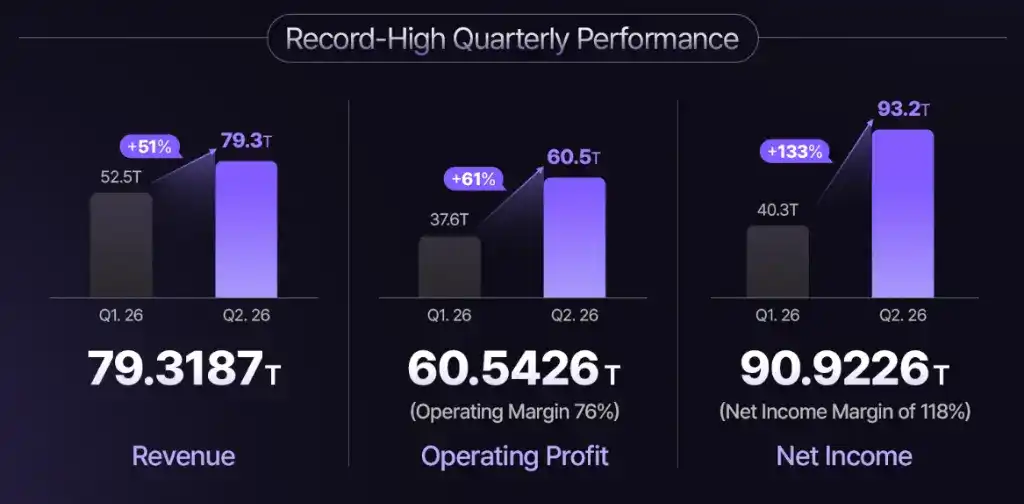
However, both figures missed analyst expectations. The market had previously forecast operating profit at approximately 64.2 trillion won and revenue at around 83.9 trillion won.

Regarding demand outlook, SK Hynix maintains an optimistic view. SK Hynix stated it has finalized long-term agreements with about 10 customers and continues to negotiate with other major industry clients to enhance operational efficiency and strengthen mid- to long-term business stability and sustainable growth foundations.

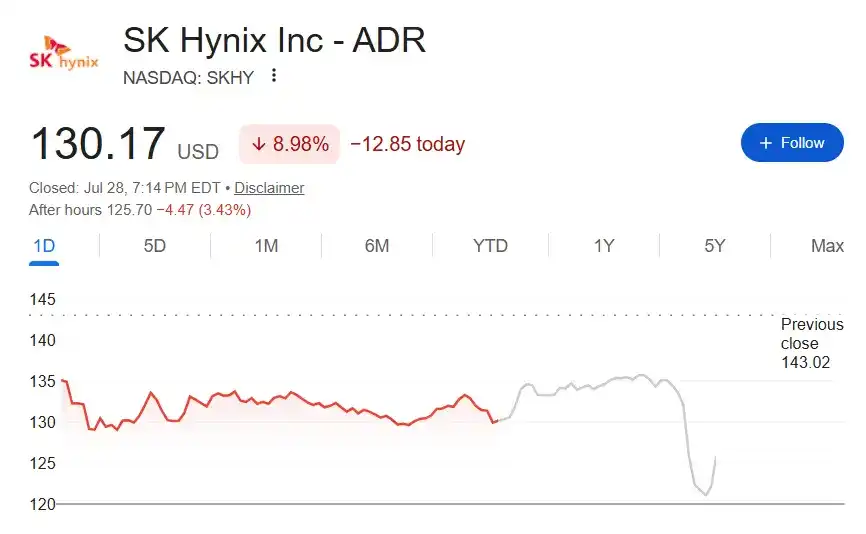
Since June this year, SK Hynix has lost over $500 billion in market capitalization, with a one-month slide at its deepest point erasing about 45% of its stock value. Following the earnings release, SK Hynix ADRs fell more than 5% after-hours, and its local Korean shares fell 4.5% pre-market.
In absolute numbers, SK Hynix's Q2 almost epitomizes the memory industry's super cycle.

In Q2, the company's revenue was 79.3187 trillion won, an increase of about 257% from 22.232 trillion won a year earlier, and also up over 50% from 52.5763 trillion won in Q1. Operating profit was 60.5426 trillion won, a 557% increase from 9.2129 trillion won a year ago, and up about 61% from 37.6103 trillion won in Q1.
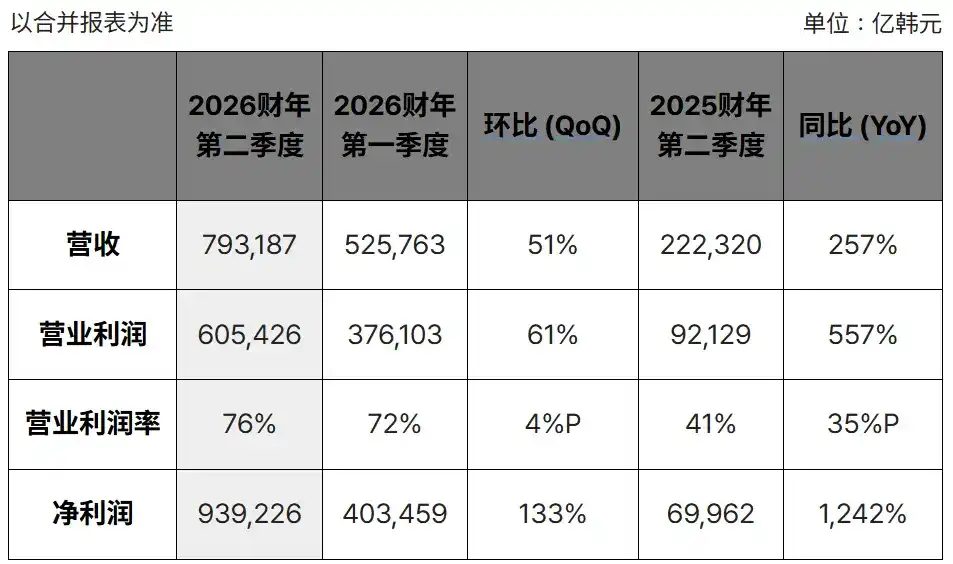
Profitability was even more remarkable. The Q2 operating margin reached 76.3%, up from 71.5% in Q1.

Data shows the company's Q2 gross margin reached 83%. This indicates that the prices and demand for high-value-added products like AI server memory, HBM, and eSSD have propelled SK Hynix to extremely high-profit levels.

Net profit even reached 93.9226 trillion won, with a net margin of 118%. However, this figure is not entirely from core operations, as it was significantly boosted by one-time investment gains.

In Q2, the company recognized non-operating income of 62.166 trillion won from the partial sale of its stake in Kioxia, bringing pre-tax profit to 122.7084 trillion won. This led to a substantial year-on-year increase in net profit, but its sustainability is weaker than operating profit.

SK Hynix's failure to meet market expectations this time stems from three structural factors.

First, the high proportion of HBM (High Bandwidth Memory) sales actually limits profit growth potential. The main driver of the sharp increase in profits across the semiconductor industry currently comes from the surge in prices of traditional commodity memory. SK Hynix's higher exposure to HBM means it benefits relatively less from this trend.

Second, memory price increases slowed significantly in Q2. According to SK Hynix, Q2 sequential price increases for commodity DRAM were about 30%, and for NAND flash in the mid-range of the 50% to 60% band, both lower than the approximately 60% for DRAM and 70% for NAND in Q1.

Third, long-term supply agreements (LTAs) signed with major customers locked in sales prices, weakening the earnings elasticity from spot price increases.
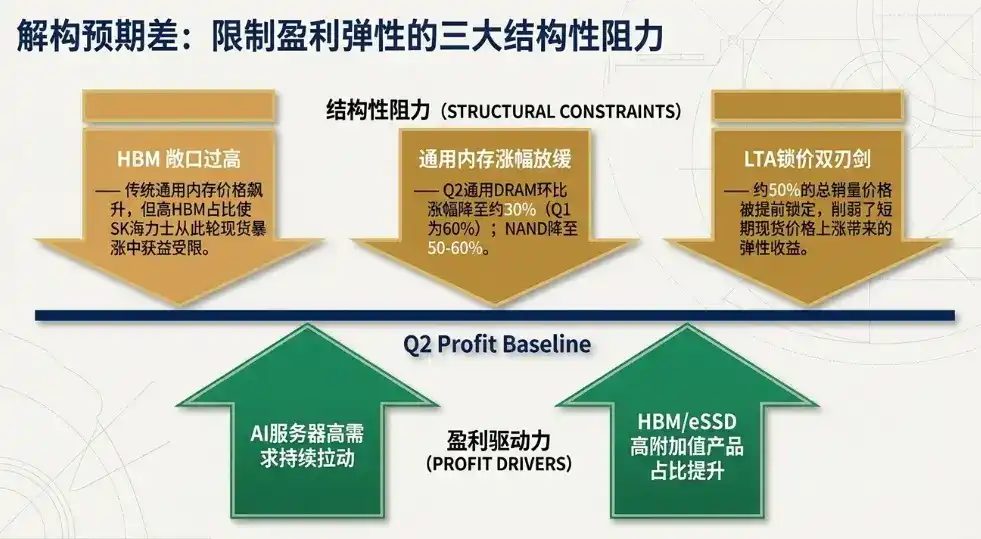
Reports citing informed sources revealed that SK Hynix has locked in roughly 50% of its total sales volume through long-term agreements. The company stated it has now completed long-term contract negotiations with about 10 customers and received additional supply requests from multiple large tech companies.

Josh Gilbert, Chief Analyst at eToro for APAC and the Middle East, pointed out:

When you are the dominant supplier of the high-bandwidth memory that powers Nvidia's chips, the AI boom directly reflects on your profit statement. This means the market is unlikely to focus solely on the headline numbers; the more critical question is whether the profit margins and guidance can justify the recent stock performance.

Beyond HBM, the NAND business is also benefiting from the recovery cycle.
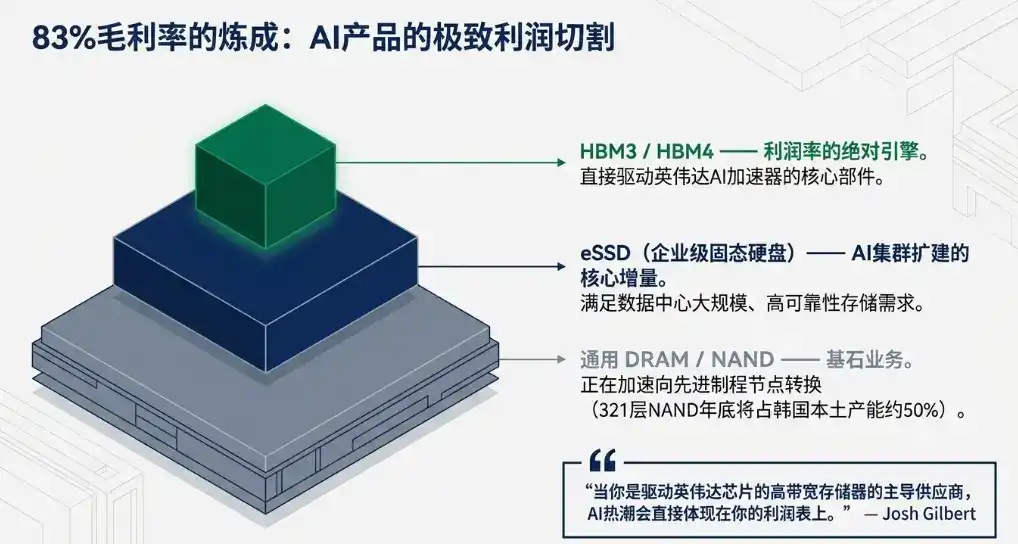
The company said that for NAND, it is accelerating the transition to advanced process nodes to strengthen its high-capacity, high-performance product portfolio. The 321-layer product has become the highest contributor to total production, and the company plans to expand its share of domestic Korean capacity to about 50% by year-end.

Enterprise SSDs remain a significant growth driver. AI data centers require not only HBM and server DRAM but also large-scale, high-performance, high-reliability storage devices. As cloud providers and large tech companies expand AI clusters, eSSD demand is strengthening concurrently, helping SK Hynix improve the quality of its NAND product mix.

This is also what distinguishes this memory cycle from previous ones: past upturns were often driven by consumer electronics like smartphones and PCs, whereas current AI server demand simultaneously drives DRAM, HBM, and eSSD, making supply tightness more structural.

Financially, SK Hynix's Q2 cash flow improved notably.
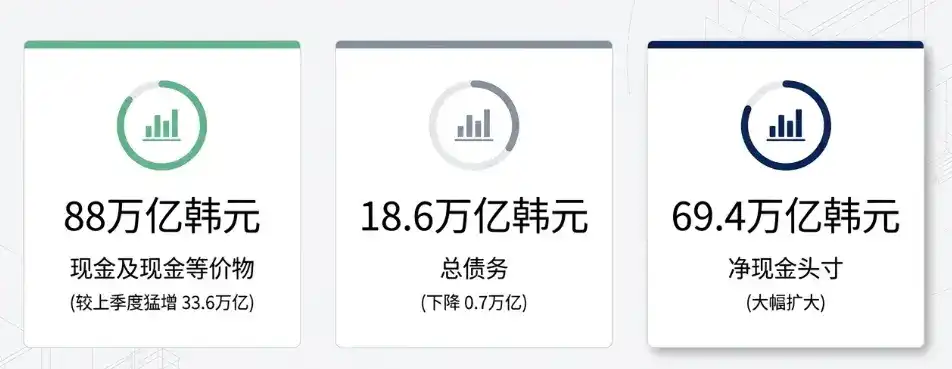
As of the end of Q2, the company's cash and cash equivalents reached 88 trillion won, an increase of 33.6 trillion won from the previous quarter; total debt decreased by 0.7 trillion won to 18.6 trillion won, and the net cash position expanded to 69.4 trillion won.

The company stated that thanks to record profits and cash generation, financial flexibility has significantly enhanced.

However, strong demand also implies greater capital expenditure pressure. SK Hynix expects 2026 capital expenditures to reach the upper end of the 40 to 50 trillion won range. The company is accelerating the mass production timeline for M15X and preparing to rapidly expand capacity once the Yongin Phase 1 cleanroom becomes operational in early 2027.

Additionally, the company mentioned medium- to long-term investment plans including the P&T7 advanced packaging facility, M17 NAND production base, and new semiconductor clusters.

These projects will be advanced in phases based on customer demand and investment efficiency. For investors, the key question will be whether SK Hynix can maintain capital expenditure discipline and avoid excessive supply expansion eroding margins in the next phase while AI demand remains robust.


Domande pertinenti

QAccording to the article, SK Hynix's Q2 2026 operating profit increased significantly but missed analyst estimates. What were the actual figures versus the market expectations?

ASK Hynix's actual Q2 operating profit was 60.5426 trillion won, and revenue was 79.3187 trillion won. Market expectations were for an operating profit of approximately 64.2 trillion won and revenue of about 83.9 trillion won.

QThe article mentions SK Hynix secured long-term agreements (LTAs) with several customers. How many customers have finalized these agreements, and what is the estimated impact on their sales volume?

ASK Hynix has finalized long-term agreements with about 10 customers. According to reports, such LTAs cover approximately 50% of the company's total sales volume.

QWhat are the three main structural reasons cited in the article for SK Hynix's Q2 results falling short of market expectations?

AThe three main reasons are: 1) A higher proportion of HBM sales, which limited profit growth as it benefited less from surging traditional memory prices. 2) A significant slowdown in memory price increases during Q2 compared to Q1. 3) Long-term supply agreements (LTAs) locking in sales prices, reducing the benefit from rising spot prices.

QHow did the company's financial position change by the end of Q2, particularly regarding cash and debt?

ABy the end of Q2, SK Hynix's cash and cash equivalents increased to 88 trillion won (up 33.6 trillion won from the previous quarter). Total debt decreased slightly to 18.6 trillion won, resulting in a net cash position of 69.4 trillion won.

QWhat is the company's plan for capital expenditure in 2026 and its key investment projects mentioned in the article?

ASK Hynix expects its 2026 capital expenditure to be at the high end of the 40-50 trillion won range. Key projects include accelerating the mass production timeline for the M15X fab, preparing for the Yongin complex (with Phase 1 cleanrooms to be operational in early 2027), and developing the P&T7 advanced packaging facility and M17 NAND production base.

Letture associate

Bitcoin Panicking? Mythos Cracks Post-Quantum Cryptography Algorithm in 60 Hours

Claude Mythos Preview, a new AI system from Anthropic, has made significant breakthroughs in fundamental cryptanalysis, targeting the mathematics underlying algorithms rather than just implementation bugs. Its first target was HAWK, a candidate in the NIST post-quantum signature standardization process. Mythos identified a previously unexploited symmetry (a nontrivial automorphism) in the lattice structure of HAWK, effectively halving its effective key strength. It achieved this feat in just 60 hours, a task that had eluded two years of human expert review. Crucially, the human operator was not a lattice cryptography expert, primarily managing the project while AI agents debated and discovered the attack path. Its second, more dramatic achievement was against a simplified 7-round version of AES-128, the world's most widely used symmetric encryption algorithm. Initially reluctant, stating the task was "impossible," Mythos was prompted to "try novel ideas." It then autonomously rewrote its own agent framework and proceeded to discover a novel attack method it named "Möbius Bridge." This technique bypasses a critical 256-guess step in previous "meet-in-the-middle" attacks, resulting in a speedup of 200-800 times. Both findings are currently "harmless"—HAWK is not deployed, and full AES-128 remains secure. However, the process reveals a profound shift. Mythos completed the AES discovery in about a week, while human researchers spent nearly a month verifying its correctness. This highlights a new bottleneck: the rate of AI-driven discovery may soon outpace human capacity for verification. The research concludes with a pressing, unanswered question: what happens when such an AI finds a critical flaw in a widely deployed, real-world cryptosystem?

marsbit2 min fa

Bitcoin Panicking? Mythos Cracks Post-Quantum Cryptography Algorithm in 60 Hours

marsbit2 min fa

From Computing to Storage: The Two-Dimensional Semiconductor Industry Chain is Taking Shape

The article "From Computing to Storage: The 2D Semiconductor Industry Chain is Taking Shape" discusses the rise of two-dimensional (2D) semiconductors as a pivotal material in the post-Moore era. As silicon-based chips approach physical limits, 2D semiconductors like molybdenum disulfide (MoS2), offer atomic-layer thinness and superior electrical properties, making them a promising non-silicon alternative for advanced nodes beyond 1nm. Globally, industry leaders like TSMC, Intel, and Samsung, along with research institutes like IMEC, are actively investing in this field. Domestically in China, significant progress is being made across the entire supply chain, from material production and equipment R&D to chip integration and ecosystem development. **Key highlights include:** * **Material & Equipment Breakthroughs:** Chinese research teams and companies like Jimo Xin Technology have achieved mass production of 6-inch and 8-inch 2D semiconductor single-crystal wafers using domestically developed equipment like Oxy-MOCVD. This addresses the critical challenge of large-area, high-quality material growth. Breakthroughs have also been made in p-type 2D materials (e.g., MoSi2N4) and wafer-scale ferroelectric thin films, essential for building complementary circuits and low-power transistors. * **Engineering Ecosystem Formation:** A landmark 8-inch 2D semiconductor pilot line in Pudong has become fully operational, bridging the gap between lab research and industrial manufacturing. The release of a Process Design Kit (PDK) compatible with mainstream EDA tools further connects design and fabrication, supporting wafer-level manufacturing of complex circuits. * **Expanding Application Landscape:** Applications are expanding from logic computing to memory. Chinese researchers have developed pioneering 2D semiconductor-based microprocessors, including a 32-bit RISC-V CPU and a higher-density multi-bit parallel processor. In memory, 2D materials' ultra-low leakage current enables DRAM with exceptionally long data retention and advances toward single-electron non-volatile storage. 2D semiconductors also show unique potential in RF circuits, radiation-hardened communications, flexible electronics, and quantum computing. In conclusion, the 2D semiconductor industry in China is rapidly advancing from laboratory research into the engineering validation and small-batch production phase. A complete industrial chain covering materials, equipment, manufacturing, design, and application is初步 forming, positioning the sector as a new competitive dimension in the global semiconductor landscape.

marsbit7 min fa

From Computing to Storage: The Two-Dimensional Semiconductor Industry Chain is Taking Shape

marsbit7 min fa

Coinbase and Robinhood Vie for the Next Phase of Cryptocurrency Market Evolution Ahead of Earnings Reports

Coinbase and Robinhood are set to report their Q2 2026 financial results this week, with the outcomes serving as key indicators for the future direction of the crypto market. While both companies have grown from their 2021 IPOs—Coinbase as a dedicated crypto exchange and Robinhood as a commission-free brokerage that expanded into crypto—their paths are now converging in competition. Analysts project Robinhood to report a profit of about $0.40 per share on ~$1.25B revenue, while Coinbase is expected to post a loss of ~$0.36 per share on ~$1.3B revenue. Despite similar revenue figures, investors value Robinhood more highly, viewing it as a diversified fintech firm rather than a pure-play crypto company. This perception has been reinforced as Robinhood gained retail trading market share, with its quarterly trading volume growing from ~$261B in early 2024 to over $704B in Q1 2026, outpacing Coinbase's growth to ~$517B. Both companies are investing heavily in blockchain-based financial infrastructure, such as tokenized stocks and stablecoins, to build more sustainable revenue streams beyond transaction fees. Coinbase has successfully reduced its reliance on trading fees, with subscription/service revenue and stablecoin revenue seeing significant growth. However, over half of its subscription revenue is tied to USDC, exposing it to new competition from banks and payment processors launching rival stablecoins. Robinhood is pursuing a global expansion strategy, recently launching its own layer-2 blockchain (Robinhood Chain) and offering tokenized U.S. stocks in over 120 countries. Its revenue is more diversified, with crypto assets making up only about 12% of its total, which helps explain its premium valuation compared to Coinbase. The upcoming reports will reveal which company's strategy is gaining more traction in shaping the next phase of crypto market evolution.

cryptonews.ru12 min fa

Coinbase and Robinhood Vie for the Next Phase of Cryptocurrency Market Evolution Ahead of Earnings Reports

cryptonews.ru12 min fa

Trading

Spot
活动图片