Balaji Srinivasan is once again making the most provocative version of a privacy argument and he’s pinning it to a specific chain: Zcash. In a Feb. 18 video shared on X, Srinivasan framed the stakes in stark terms: “The choice is clear. It’s Zcash or communism,” tying the rise of AI-enabled surveillance to what he described as a renewed appetite for wealth seizure.
In a follow-up post, he argued that AI has shifted surveillance from a state-scale project to something closer to an on-demand service. “Any scrap of information online can now be integrated, digested, and synthesized...by any state or stalker capable of running an AI model...to form a dossier more complete than anything the Soviets could ever dream of,” he wrote.
Srinivasan’s prescription was blunt: “There will be no single silver bullet. But anything you haven’t encrypted can and will be used against you.”
Srinivasan anchored his “communism requires surveillance” claim in an historical example meant to make a modern point about data exhaust. “In 1918, in the midst of the Bolshevik Revolution, Lenin gave an order to murder 100 nearby ‘kulaks,’” he said, emphasizing that such an order “required a list”: names, locations, and a population that couldn’t easily move.
His argument is that the internet reverses that asymmetry if encryption becomes the default. “Today, neo-communism is rising once again. But the Internet could change the game,” he said. “No full list, if we encrypt it. No fixed location, either. They can’t hit what they can’t see.”
Those themes carried into a longer discussion on the Never Say Podcast, where Srinivasan connected privacy to basic operational freedom. “If you’re under surveillance, you’re not sovereign,” he said. “If every move is being tracked...you don’t have the advantage of surprise. You can never launch something. You can never have private deliberations.”
Arjun Khemani, a 19-year-old Zcash researcher on the episode, echoed the AI angle from the user side: “Especially with AI, being able to recognize where you are exactly...you can’t have freedom without privacy,” he said, arguing that broadcasting every transaction and context signal is “not... the world that I want to live in.”
The choice is clear.
It’s Zcash or communism.pic.twitter.com/4sAG9WG0jA— Balaji (@balajis) February 18, 2026
Zcash As A Scaling Bet, Not Just A Privacy Stance
Srinivasan’s pitch wasn’t limited to privacy-by-principle. He positioned Zcash as a technical response to where he thinks the market has landed on scalability: on-chain throughput wins, and routing complexity loses.
Asked why “Zcash must scale” is a “moral imperative,” Srinivasan contrasted Bitcoin’s scaling reality: exchanges, custodians, and database entries with the decentralization promise many users think they’re buying. “Lightning...they’ve been saying, ‘Lightning is going to be there any day now’ for 10 years,” he said, arguing that real-world deployments tend toward “a hub and spoke topology” resembling traditional finance rails. “Within a bank, it’s fast...between banks, they do settlement,” he added, describing a dynamic he sees mirrored in major Lightning implementations.
From there, he argued crypto has effectively segmented into layers: Bitcoin for immutability and brand, Ethereum for programmability, and Solana for straightforward on-chain execution at scale. The opening he sees for Zcash is combining “Solana-like scalability” with private transactions, leaning on zero-knowledge proofs as “compression technology” as much as secrecy. “It’s what a lot of people wanted Bitcoin to be,” he said.
Srinivasan also stressed that privacy doesn’t necessarily replace transparency, it complements it. He argued that Bitcoin’s public ledger can be a feature for proof-of-reserves narratives, while Zcash’s private-by-default design targets a different threat model. His bottom line is coexistence, not conquest: “It’s possible that Bitcoin... and Zcash coexist because Bitcoin is transparent and Zcash is private,” he said, while suggesting “this could be Zcash’s moment.”
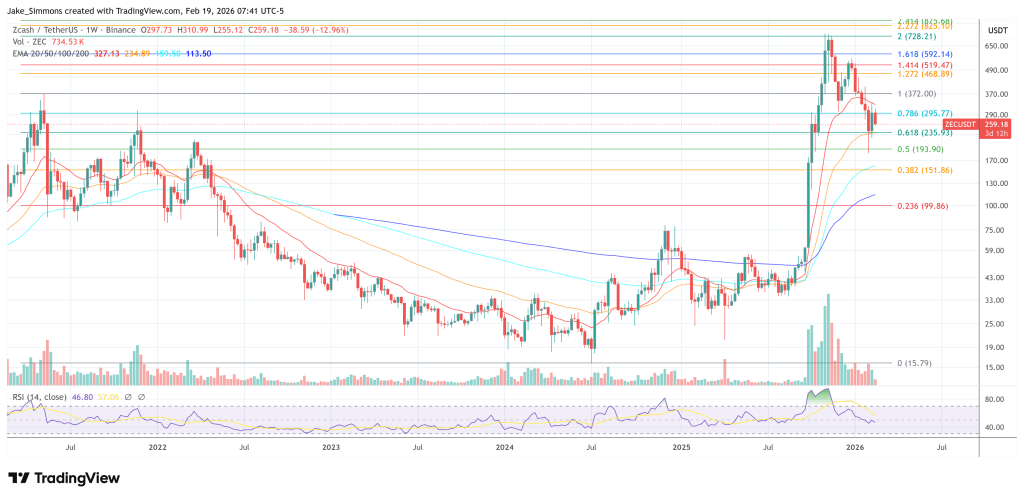
At press time, ZEC traded at $259.18.