Author: Vicky Ge Huang
Compiled by: Jiahuan, ChainCatcher
One Saturday in February, when Vala Zeinali's phone lit up with the news that President Trump had announced airstrikes on Iran, the hedge fund commodity trader calmly opened Hyperliquid.
The decentralized crypto platform Hyperliquid is open 24/7. This year, the exchange has become the go-to place for Wall Street "weekend warriors" like Zeinali, who can build or dump large positions here hours or even days before the opening bell rings.
In early 2026, before Trump announced the airstrikes, Zeinali had already bet a four-figure sum on oil derivatives, anticipating conflict in the Middle East. When the news caused crude oil prices to surge, he logged into Hyperliquid and closed his position, locking in a massive profit of up to 243%.
Zeinali said: "I thought to myself, 'Great,' because usually such volatility in the crude market subsides before Sunday's opening. So I thought, 'Okay, I can actually close my position,' and that's what I did. I sold off most of my position."
An increasing number of traditional and crypto traders are flocking to the platform to place bets on almost any asset, from Bitcoin and the S&P 500 Index to crude oil and pre-IPO giants like SpaceX.
Their market of choice is perpetual futures – a type of derivative contract that never expires, allowing users to trade at any time and use huge leverage, amplifying their bets as the notional value of their position is magnified.
Hyperliquid was founded three years ago by Jeff Yan, a former quantitative trader at high-frequency trading firm Hudson River Trading. Yan has said his inspiration came from the disastrous collapse of Sam Bankman-Fried's FTX exchange. That event made him realize that the crypto market needed a high-performance trading platform where users, not the exchange, custody their own assets.
Yan said in an interview: "The main thing is, self-custody isn't just some academic concept; it's a basic feature that users will demand. I was surprised that users didn't demand it more strongly after FTX, but it's really as simple as controlling your own funds."
Hyperliquid Labs, the developer behind the exchange and blockchain, has 11 employees. According to Blockworks Research data, the blockchain and exchange, which share the Hyperliquid name, generated about $8 billion in total revenue last year.
CoinGecko data shows that the blockchain's native token "HYPE," launched at the end of 2024, has gained over 100% in the past year, with a market cap of around $16 billion.
Hyperliquid's rapid rise highlights the convergence of cryptocurrency and traditional finance. The platform's perpetual futures, especially those tied to traditional assets like stocks and commodities, are attracting Wall Street's attention.
Recently, Benchmark venture capital firm's general partner Eric Vishria shared a photo on X: a banker, on the day AI chipmaker Cerebras landed on Nasdaq, intently watching the price of its linked perpetual futures.
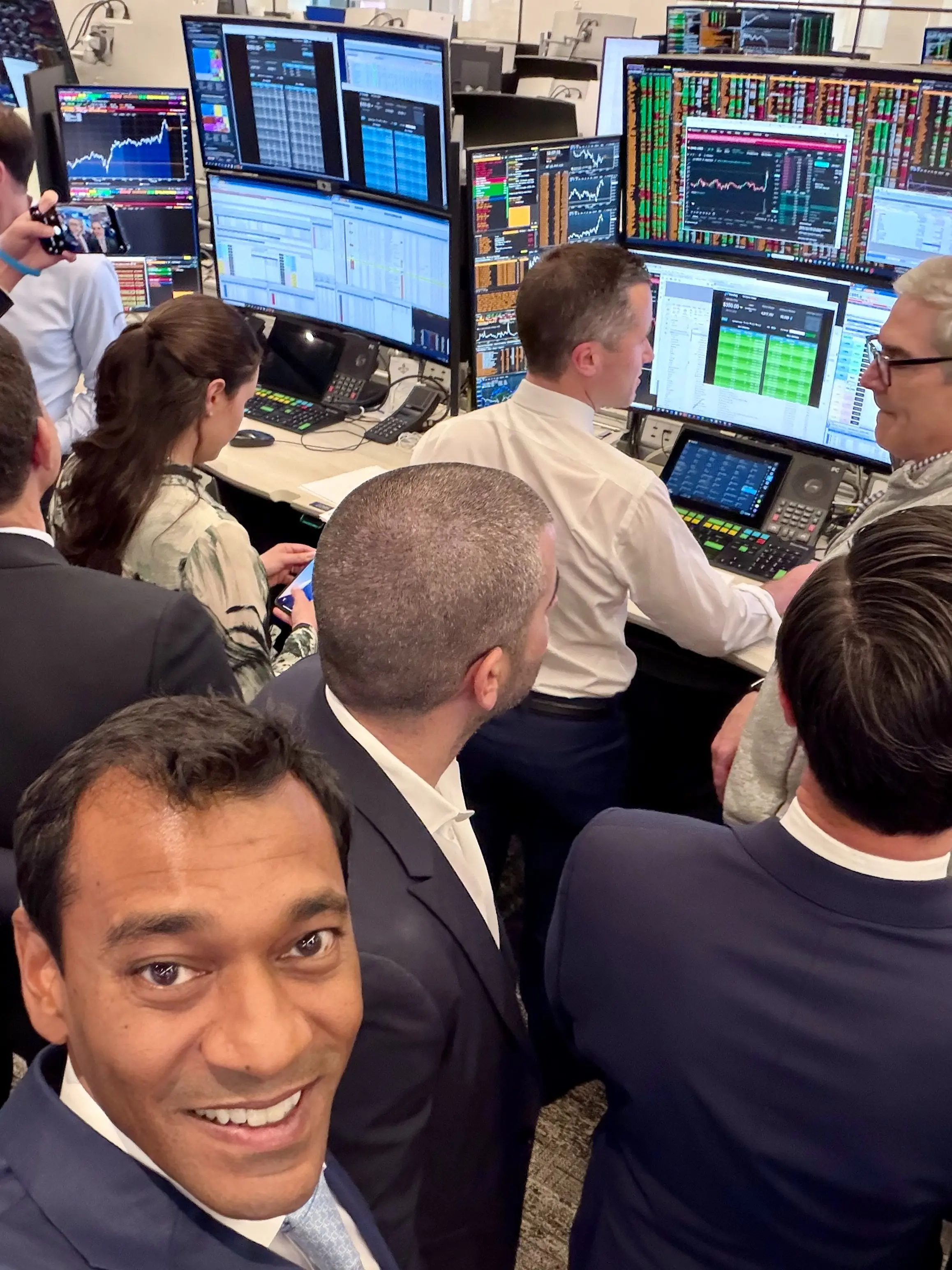
Earlier this year, S&P Dow Jones Indices licensed the S&P 500 Index to Trade[XYZ], which created some of Hyperliquid's most popular perpetual futures contracts tied to traditional financial assets.
Some traders are drawn to Hyperliquid because it offers contracts for some of the most anticipated upcoming public listings. According to data from Hyperliquid analytics platform Hyperdash, the cumulative trading volume for perpetual futures linked to Elon Musk's rocket company SpaceX, which plans to go public later this year, has reached about $280 million on Hyperliquid.
Although US residents currently cannot use Hyperliquid, that may soon change.
Last Friday, the Commodity Futures Trading Commission (CFTC) outlined a framework for registered US platforms to offer perpetual futures. The agency also approved Kalshi to list Bitcoin perpetual futures contracts and allowed Coinbase's US customers to access its global perpetual futures through an affiliate.
Perpetual futures are also high-leverage, high-risk products that can greatly amplify traders' gains or expose them to devastating losses. For example, Trump's sudden announcement on October 10th of 100% tariffs on China triggered a sharp sell-off that wiped out over $19 billion in leveraged positions, with $10 billion of that on Hyperliquid.
Yan said the real scale of liquidations across the entire crypto space was far greater than $19 billion, and Hyperliquid was singled out mainly because its liquidation data is transparent and it remained online when many platforms were not fully accessible.
Benjamin Schiffrin, securities policy director at Better Markets, an organization pushing for tighter financial regulation, said: "Perpetual futures are a complex financial product that even experienced financial professionals struggle to fully understand, and I don't think the risks of perpetual futures have been adequately disclosed to retail investors. I think it's a very dangerous combination."
None of this has stopped traders in the US and other restricted regions from using virtual private networks (VPNs) to access the platform. Traders say they are drawn to Hyperliquid because it doesn't require identity verification or standard background checks, in stark contrast to the strict identity rules enforced by traditional brokers and stock exchanges.
Hyperliquid explicitly states in its terms of use that it blocks US traders and prohibits any actions to circumvent this restriction, including using VPNs.
What keeps traders hooked is also Hyperliquid's smooth and user-friendly interface, extensive selection of tradable assets, and a strong sense of community that closely connects its user base.
Trader Pascal Lin, based in Geneva, Switzerland, said he discovered Hyperliquid in late 2023 and quickly became a heavy user. Early on, he was impressed that he could easily join the platform's Discord channel and provide feedback directly to Yan and other members of the Hyperliquid team.
"It literally felt like I was building the product myself," said Lin, who is also the head of trading at his firm, ARES Capital Management.
On Hyperliquid, Lin primarily trades the Hyperliquid blockchain's native token HYPE, but also dabbles in perpetual futures tied to oil. It was there that he caught the wave as oil prices rose from around $67 per barrel to nearly $100.
Lin said he became so addicted to Hyperliquid that he set up real-time price alerts for the HYPE token on his Apple Watch, a habit he described as "toxic" and not recommended for other traders to emulate.
He said: "With just one click, I can access Hyperliquid. Whenever I wake up in the middle of the night, one click and I can check the HYPE price."
Lin is not the only trader fascinated by Hyperliquid and its token. A large part of Hyperliquid's appeal stems from the culture of its vast ecosystem, championed jointly by individual traders and developers building on the blockchain.
On X, regardless of the topic, Hyperliquid traders jokingly append the word "Hyperliquid" to almost every post.
Many also use the platform's mascot, a smiling cat in a green jacket named "Hypurr," as their social media profile picture. Beyond internet memes, developers are actively building trader-friendly tools and data trackers around the blockchain.
Hyperdash co-founder Lawrence Wu said: "I think the reason such a large community has formed is because it tries to fulfill cryptocurrency's original vision of establishing a meritocratic, permissionless system. It's very idealistic."
Yan said Hyperliquid's ultimate goal is to house the entire financial industry. The next steps on the roadmap are to venture into prediction markets and options trading. Its first outcome contracts tracking Bitcoin prices have already generated millions in derivative trading volume since their launch in early May.