TON Revives the Gram Brand, a Name That Disappeared Six Years Ago Returns

marsbitPublished on 2026-06-10Last updated on 2026-06-10

Abstract

After a community vote with over 81% support, The Open Network (TON) is officially renaming its native token from Toncoin back to Gram (with ticker GRAM), effective June 15. This move reclaims the original name from the project's 2018 inception under Telegram, before regulatory issues forced its halt. The rebrand to Gram is part of the "Make TON Great Again" strategy and is seen as more than a simple logo change. It aims to leverage the historical brand recognition and narrative associated with Telegram’s initial vision of a global blockchain network. Gram evokes the original story of bringing crypto to Telegram's massive user base. This shift comes as TON is experiencing significant growth, driven by Telegram's over 1 billion monthly active users and viral mini-apps like Notcoin. The ecosystem is expanding in wallets, active addresses, and payment use cases. Analysts suggest the name change could strengthen TON's unique identity in a crowded Layer 1 market by deepening its association with Telegram's vast distribution channel. While potentially boosting short-term market attention, the long-term focus remains on Gram's utility within Telegram's evolving ecosystem, particularly for payments, transfers, and mini-app transactions. The ultimate goal is for Gram to become a widely used digital currency within one of the world's largest social platforms.

Author: Winnie, CryptoPulse Labs

On June 9th, the results of the TON Vote community governance were announced. Over 81% of voters supported changing the native token name from Toncoin to Gram, and the token code will also change from TON to GRAM, with the changes scheduled to take effect officially on June 15th.

On the surface, this seems like just a brand upgrade, but for old players who experienced the Telegram token issuance saga, the name "Gram" carries the initial ideals and story of TON.

More importantly, against the backdrop of Telegram's monthly active users exceeding 1 billion, the TON ecosystem re-entering a growth cycle, and the rapid expansion of its on-chain payment and Mini App ecosystem, this renaming may be far more significant than just a logo change.

I. Behind TON's Brand Upgrade: Gram Officially Returns to the Crypto Market

Let's go back to 2018. At that time, Telegram founder Pavel Durov launched the TON (Telegram Open Network) plan, aiming to build a blockchain network covering hundreds of millions of users worldwide.

The project's whitepaper explicitly stated that the name of the network's native currency would be "Gram."
During the fervent ICO era, TON once set a fundraising record of $1.7 billion and was seen as one of the blockchain projects with the greatest potential for mass adoption.

However, in 2020, the U.S. SEC sued Telegram for allegedly conducting an unregistered securities offering. Ultimately, Telegram was forced to halt project development and refund investors.

Many thought TON was over, but the story didn't end there.

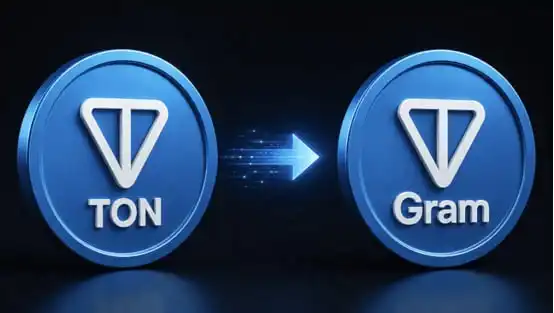
Subsequently, the open-source community took over the code and continued development. The project gradually evolved into today's The Open Network. To distinguish it from the original project, the community renamed the token to Toncoin, while keeping the token code as TON.

After several years of development, TON has re-emerged as a mainstream public chain. And now, with the token officially renamed to Gram, this name that had been dormant for years finally returns to the market's view.

An important step in the "Make TON Great Again" plan. Officials stated that this renaming is the fourth step in the "Make TON Great Again (MTGA)" seven-step strategy.

Based on public information, the TON team is driving a comprehensive brand overhaul. This upgrade mainly includes changing Toncoin to Gram, changing the TON code to GRAM, launching a new logo and visual system, synchronizing updates to wallets and ecosystem applications, and gradual adaptation by trading platforms.

It's noteworthy that only the token brand is changing; the blockchain network will maintain the name "The Open Network." In other words, the TON chain remains the TON chain, but the currency on the chain is once again called Gram.

This is similar to the Ethereum network keeping its name while ETH suddenly changes. Therefore, this is not a technical upgrade but a brand strategy adjustment.

In the crypto market, narrative is often more important than technology. For many veteran players, Gram represents TON's original dream. It is the story from 2018 that attempted to bring blockchain to hundreds of millions of global users; it is also a significant symbol of Telegram's challenge to the traditional financial system.

II. From Public Chain Competition to Brand Competition, TON is Seeking Differentiation

If we rewind two years, TON might not have had the conditions to rename, but the situation today is completely different.

Over the past year, Telegram has become one of the fastest-growing Web3 traffic portals globally. Especially after the explosion of hit applications like Notcoin and Hamster Kombat, a large number of users were exposed to on-chain assets for the first time.
The TON ecosystem's user base has rapidly expanded, with continuous growth in wallet numbers, on-chain active addresses, payment scenarios, and developer numbers.

For TON, it is no longer an experimental project; it has begun to become a large-scale ecosystem with a real user base. Against this backdrop, the timing for a brand upgrade has matured. Reviving "Gram" may be about strengthening the Telegram DNA.

In fact, "Toncoin" has always had a problem. Although it is highly aligned with the TON network name, it lacks a sufficiently distinct brand memory point.

Gram is different. This name is deeply tied to Telegram's history. Just mentioning Gram will remind veteran users of a series of keywords: Telegram, Pavel Durov, the $1.7 billion fundraising, the vision for global payments, Web3 super apps, etc. This brand equity is something Toncoin cannot provide.

For TON, re-adopting Gram is equivalent to reactivating brand value that has been dormant for years. This can help TON establish a more unique cognitive label in the fiercely competitive public chain market.

Currently, competition in the Layer1 track is intensifying. Besides Ethereum, new public chains like Solana, Sui, and Aptos are all vying for users and developers.

The technological gap is gradually narrowing, and what can truly create a difference is starting to become brand and traffic.

From this perspective, TON's biggest advantage is not TPS or gas fees, but the Telegram behind it. A global user base exceeding 1 billion is a moat difficult for other public chains to replicate. And the name Gram can further strengthen this association.

In the future, when users mention Gram, they will think not just of a token, but of the entire Telegram ecosystem. This is precisely the effect TON hopes to achieve.

III. From Token Upgrade to Ecosystem Expansion, Can Gram Open Up New Space?

Looking at historical experience, the crypto community often reacts positively to brand upgrades. Whether it's a project name change, token split, or visual upgrade, it can become a focus of short-term capital attention.

The reason is simple: a brand upgrade means a new story. And the market loves stories the most. Gram's return also possesses this attribute.
For a period of time in the future, "Gram's Revival" is likely to become a new communication theme for the TON ecosystem. For the trading market, this narrative has the potential to increase attention and capital inflows.

Of course, a name change alone cannot support prices long-term. What truly determines value remains ecosystem development. The Telegram payment system may be further improved

Compared to short-term price fluctuations, TON's future payment layout is more worthy of attention. From its inception, Gram was positioned as a digital payment currency. Its goal is not merely as an investment asset, but to become a medium of value exchange within the Telegram ecosystem.

Now, with the development of the Telegram Stars system, the expansion of the Mini App ecosystem, and the increase in on-chain payment scenarios, Gram's application space is gradually opening up.

If Telegram further integrates its payment system in the future, Gram may take on an even more central role, which is also one of the long-term logics the market is most concerned about.

Over the past few years, most public chains have been competing for developers. TON seems to have chosen a different path; it attempts to embed blockchain directly into the social platform users are already accustomed to using.

This model is somewhat similar to the development path of WeChat Pay. Users don't need to understand the underlying technology; they just need to complete payments, transfers, tipping, or game operations, with the blockchain hidden in the background.

If this model ultimately proves successful, TON could become the first Web3 network to truly achieve mass adoption by hundreds of millions of users. And Gram would be the core value carrier within this ecosystem.

Therefore, the significance of this renaming may far exceed market imagination. It is not just a brand return, but could be the beginning of TON redefining its own positioning.

Conclusion

For the market, Gram is not just a token name; it represents the dream Telegram once had of building a global digital economic network.

And now, against the backdrop of Telegram's traffic, on-chain payments, the Mini App ecosystem, and the continuous integration of AI applications, this dream may be getting a second chance.

In the coming years, what's truly worth watching may not be that TON changed its name. It is whether Gram can leverage Telegram's vast user network to grow into the crypto industry's first genuinely global internet currency.

Related Questions

QWhat was the result of the TON Vote community governance on June 9th regarding the native token's name?

AThe result of the TON Vote community governance on June 9th showed that over 81% of voters supported changing the native token name from Toncoin to Gram, with the token code changing from TON to GRAM. This change was planned to take effect officially on June 15th.

QWhat is the historical significance of the name 'Gram' for the TON project?

AThe name 'Gram' holds historical significance as it was the original name for the native currency in the 2018 whitepaper of the TON (Telegram Open Network) project launched by Telegram founder Pavel Durov. It represents the initial vision and story of TON, which was later halted due to a lawsuit from the U.S. SEC in 2020, before being revived by the open-source community.

QAccording to the article, what is the 'Make TON Great Again (MTGA)' plan and where does the token rename fit into it?

AThe 'Make TON Great Again (MTGA)' plan is a seven-step strategic initiative by the TON team. The token rename from Toncoin to Gram is the fourth step in this plan, which is part of a broader brand reshuffling effort that also includes a new logo, visual identity, and updates across wallets, ecosystem applications, and trading platforms.

QHow does the article describe the current competitive advantage of TON compared to other Layer1 blockchains?

AThe article states that TON's biggest competitive advantage is not its TPS or gas fees, but its association with Telegram and its user base of over 1 billion monthly active users. This provides a massive, unique traffic moat that other Layer1 blockchains like Solana, Sui, and Aptos cannot easily replicate. The rebranding to 'Gram' is seen as a way to further strengthen this association.

QWhat potential long-term role does the article suggest for Gram within the Telegram ecosystem?

AThe article suggests that Gram has the potential to become a core medium of value exchange within the Telegram ecosystem, similar to how WeChat Pay functions. As Telegram expands its payment systems (like Telegram Stars), Mini App ecosystem, and on-chain payment scenarios, Gram could evolve into the first truly global internet currency for the crypto industry, facilitated by Telegram's vast user network.

Related Reads

12.9 Million Candidates: The First Summer of Fate in the Hands of AI

The 2026 Chinese college entrance exam, or Gaokao, saw a novel phenomenon: AI aggressively entering the college application advice arena before results were even released. Major tech companies like Alibaba, Tencent, Baidu, and others launched free AI-powered "agents" and tools designed to generate personalized university and major recommendations for over 12.9 million candidates. For years, a lucrative industry thrived on the "information gap" in college applications, with personalized consulting services costing families thousands of dollars. AI is now disrupting this by providing similar, data-driven analysis for free. These tools process standardized data—scores, rankings, historical admission trends—to create tailored application strategies, offering a form of information parity previously unavailable, especially to students from rural or less-resourced backgrounds. This shift represents more than just a marketing trend; it signifies AI's first large-scale entry into a critical, high-stakes life decision for millions of Chinese families. The Gaokao application, with its clear inputs and outputs, is an ideal scenario for AI. Its involvement begins to level the informational playing field, potentially reducing the advantage held by families with greater social capital or access to expensive consultants. However, the article raises a profound question: while AI can optimize choices for employability and financial return based on cold data, it risks promoting a homogenized, utilitarian path. It might steer a passionate student away from a less lucrative field like literature or archaeology toward supposedly "safer" options like computer science. The core dilemma remains: as AI flattens information disparities, does it also flatten the diversity of life choices and the freedom to make—and learn from—mistakes? Ultimately, 2026 may be remembered not for exam questions, but as the year AI began formally influencing the life trajectories of ordinary Chinese people. The real test lies not in the algorithm's recommendations, but in whether individuals will retain the courage to make their own choices and bear the consequences in an increasingly algorithmic age.

marsbit21m ago

12.9 Million Candidates: The First Summer of Fate in the Hands of AI

marsbit21m ago

IC3 Top Universities Collaborative Analysis: Is AI x Crypto the Real Future or Just a Narrative Bubble?

IC3 researchers from leading universities analyze the convergence of AI and crypto. They argue meaningful integration is still nascent, with hype often outstripping progress. The report frames AI as a "translation middleware" making blockchain accessible, while crypto serves as a "trust middleware" via tools like ZK proofs and TEEs for integrity, availability, and confidentiality. Two main directions are examined: 1) **Crypto x AI**: Using AI to enhance blockchain via analysis (fraud detection), algorithmic design, and AI oracles (with accuracy varying by task). New risks include AI-driven malicious smart contracts. 2) **AI x Crypto**: Using crypto to enhance AI via decentralized infrastructure (DePIN), data markets, agent micropayments, governance, and securing AI pipelines (training/federated learning, secure inference). The "Protected Pipeline" (Props) framework combines oracles and trusted computation for secure use of private data. Key challenges are highlighted: The industry must rigorously prove decentralized AI's cost competitiveness and crypto's utility for agent payments. Major research gaps include providing systemic security for autonomous agents and addressing novel threats like unstoppable AI agents. The report concludes by debunking five common misconceptions: blockchain cannot inherently detect AI content, solve algorithmic bias, grant true AI autonomy, ensure AI trustworthiness through mere transparency, or guarantee that decentralization is always cheaper for AI tasks. The field remains in an early, evidence-seeking phase.

marsbit58m ago

IC3 Top Universities Collaborative Analysis: Is AI x Crypto the Real Future or Just a Narrative Bubble?

marsbit58m ago

Anthropic Released the "Most Powerful Model," But Most People Can't Use It

In April, Anthropic launched a preview of its "Mythos" model, which was not publicly released due to its exceptional ability to autonomously discover high-risk zero-day vulnerabilities, posing a security threat if misused. It was restricted to a trusted group of security partners under "Project Glasswing." On June 10, Anthropic officially released Fable 5 and Mythos 5. They share the same underlying model but are distributed under different rules. Fable 5 is for general users, while Mythos 5 remains locked for trusted security partners. Benchmarks show Fable 5 leading in software engineering and long-task execution, with significant improvements in generating production-ready code. However, Fable 5 includes a safety classifier that automatically downgrades requests related to cybersecurity, biochemistry, or model distillation to the weaker Opus 4.8 model. This mechanism, while intended for safety, can affect the user experience and has faced criticism for being overly conservative. Pricing is another key point. Fable 5's API costs are double that of Opus 4.8. Furthermore, after a free trial period ending June 23, it will be removed from standard subscription plans, requiring users to purchase additional credits for access. This shift signals a move towards pay-as-you-go pricing for the most advanced capabilities. The strategy highlights a growing divergence in the AI industry: while some players like DeepSeek are drastically cutting prices, Anthropic is increasing them for its top-tier model, using cost as a filter for high-value users. The article suggests the AI market is stratifying, with commoditized capabilities becoming cheaper while premium, cutting-edge models command a significant price premium.

marsbit1h ago

Anthropic Released the "Most Powerful Model," But Most People Can't Use It

marsbit1h ago

Trading

Spot
Futures

Hot Articles

How to Buy TON

Welcome to HTX.com! We've made purchasing TONCOIN (TON) simple and convenient. Follow our step-by-step guide to embark on your crypto journey.Step 1: Create Your HTX AccountUse your email or phone number to sign up for a free account on HTX. Experience a hassle-free registration journey and unlock all features.Get My AccountStep 2: Go to Buy Crypto and Choose Your Payment MethodCredit/Debit Card: Use your Visa or Mastercard to buy TONCOIN (TON) instantly.Balance: Use funds from your HTX account balance to trade seamlessly.Third Parties: We've added popular payment methods such as Google Pay and Apple Pay to enhance convenience.P2P: Trade directly with other users on HTX.Over-the-Counter (OTC): We offer tailor-made services and competitive exchange rates for traders.Step 3: Store Your TONCOIN (TON)After purchasing your TONCOIN (TON), store it in your HTX account. Alternatively, you can send it elsewhere via blockchain transfer or use it to trade other cryptocurrencies.Step 4: Trade TONCOIN (TON)Easily trade TONCOIN (TON) on HTX's spot market. Simply access your account, select your trading pair, execute your trades, and monitor in real-time. We offer a user-friendly experience for both beginners and seasoned traders.

14.6k Total ViewsPublished 2024.03.29Updated 2026.06.02

How to Buy TON

Discussions

Welcome to the HTX Community. Here, you can stay informed about the latest platform developments and gain access to professional market insights. Users' opinions on the price of TON (TON) are presented below.

活动图片