A New Player Enters at Third Place, Rothera Disrupts the Prediction Market Landscape

marsbitPublished on 2026-06-22Last updated on 2026-06-22

Abstract

"Rothera Skyrockets to Third in Prediction Market Rankings, Disrupting Industry Landscape" Rothera, Robinhood's newly launched prediction market platform, has rapidly climbed to become the third-largest player in the sector by trading volume, trailing only giants Kalshi and Polymarket. Its growth is attributed not to attracting new users, but to migrating existing Robinhood user orders away from partner Kalshi. Previously, Robinhood served as a major distribution channel for Kalshi, accounting for an estimated 25%-35% of its volume. With the launch of Rothera, Robinhood now internally executes events like World Cup contracts, capturing revenue that was previously shared with Kalshi. Data shows Rothera's weekly trading volume surged from $21.9 million to $559 million within weeks, reaching nearly one-fifth of Polymarket's volume. Analysts estimate Robinhood's prediction market business could generate around $10 billion in annual revenue at this pace, potentially surpassing its historical crypto revenue peak. In response, Kalshi is reportedly exploring new distribution channels by engaging with investment banks for a potential IPO, requiring them to integrate their systems with Kalshi to access institutional clients. This shift highlights a new competitive focus in prediction markets: controlling user access and distribution channels rather than just product offerings.

By|Azuma(@azuma_eth)

Last week, Odaily Planet Daily published an article titled "The First Prediction Market Stock Appears!", which primarily mentioned that Robinhood is intercepting orders that previously needed to be executed via Kalshi by building its own prediction market, Rothera. This move aims to reduce revenue sharing with Kalshi and retain profits within its own ecosystem.

Although it was anticipated that Rothera would not face the typical cold start problems of other competitors, its data performance over the past week has still far exceeded our previous expectations. After all, it's hard to imagine that a platform, just launched half a month ago, could directly parachute into third place in the highly competitive prediction market track, trailing only the two giants, Kalshi and Polymarket.
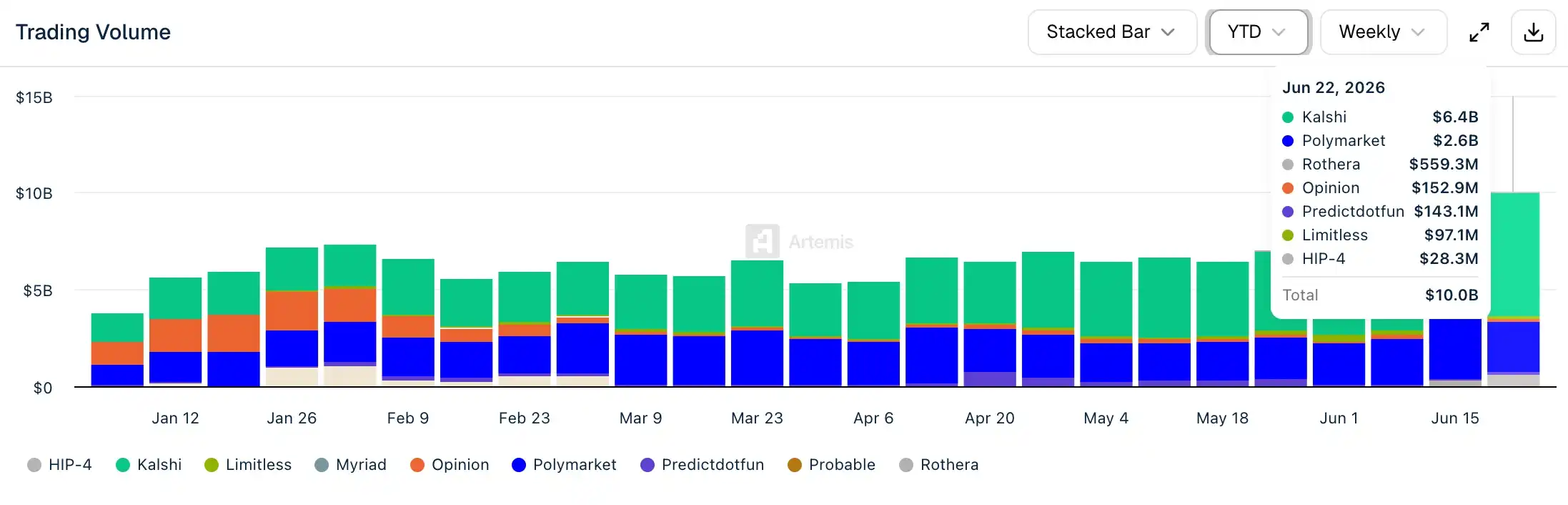
Data from Artemis shows that for the week ending June 8th, as a new platform, Rothera's weekly trading volume was only $21.9 million, still showing a significant gap compared to second-tier platforms like Opinion, Predict, and Limitless. However, for the week ending June 15th, Rothera's weekly trading volume directly jumped to industry third place, reaching $276 million. In the latest week ending June 22nd, Rothera's weekly trading volume has increased to $559 million, almost one-fifth of Polymarket's.

Atypical Growth Case (Can skip if you've read the previous article)

It's important to clarify that Rothera's rise is essentially not due to creating incremental users (though some users may have entered due to the World Cup), but rather a migration of existing orders, not the creation of new users.

Over the past year or so, Robinhood has been one of Kalshi's most important distribution channels. Leveraging tens of millions of retail users and mature access to stock, options, and cryptocurrency trading, Robinhood has funneled a large volume of orders to Kalshi. Piper Sandler analysts estimated that trades completed through the Robinhood channel accounted for about 25%-35% of Kalshi's total trading volume.

The problem is that while these orders came from Robinhood users, they didn't belong to Robinhood itself. Under the previous cooperation model, Robinhood acted more like a front-end traffic portal, while Kalshi was the true infrastructure provider responsible for matching, clearing, and settlement. Revenue generated from each transaction needed to be shared between the two parties.

Rothera is the weapon Robinhood is using to break this profit-sharing model. Since early this month, Robinhood has begun migrating some World Cup-related event contracts to be executed internally on Rothera. This means a large volume of orders that might have previously gone to Kalshi are now retained within Robinhood's own system.

Therefore, in a sense, the surge in Rothera's trading volume is less of a threat to other prediction markets like Polymarket, Predict, or Limitless, and more akin to directly "draining blood" from Kalshi.

Robinhood's Value Capture

The rapid growth of Rothera most directly strengthens Robinhood's ability to capture value from prediction market-related orders on this platform.

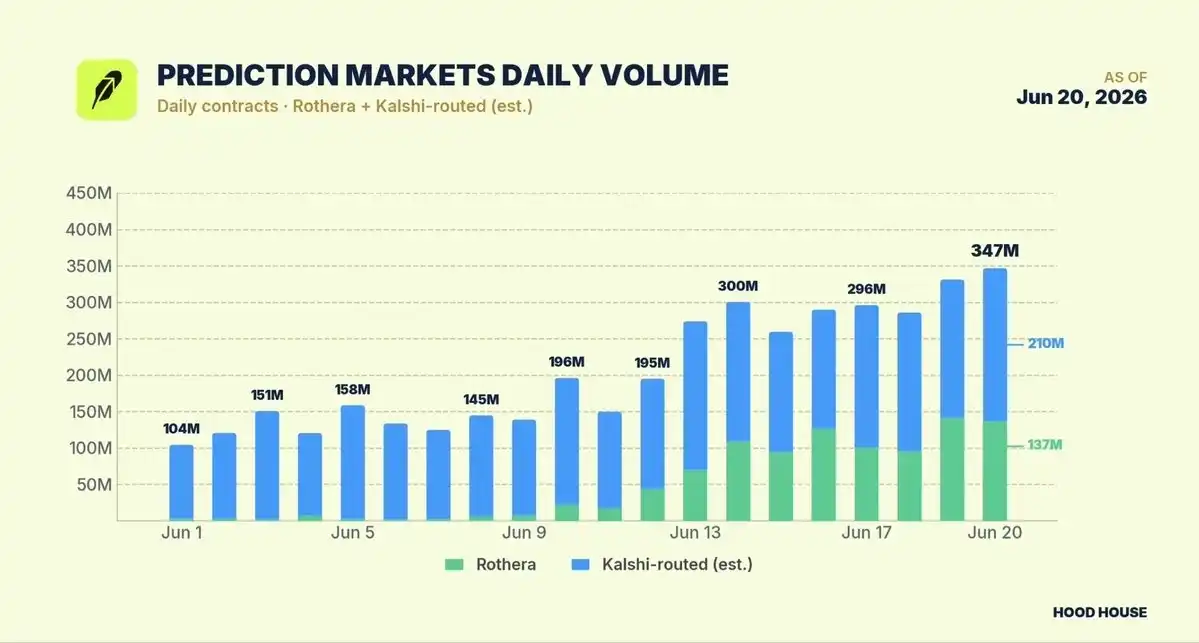
Hood House, an investment research media outlet long tracking Robinhood, combined public data to state that as of June 20th, Robinhood's prediction market business traded a total of 34,700 contracts daily, corresponding to daily revenue of approximately $4.9 million.
Hood House then disclosed its calculation logic:

  • Rothera (primarily hosting World Cup-related markets) daily trading volume had reached 137 million contracts, corresponding to a trading value of approximately $47 million;
  • For comparison, Kalshi's total daily trading volume was about 1.5 billion contracts, corresponding to a trading value of about $416 million; excluding World Cup-related markets, Kalshi's trading volume was about 1 billion contracts, corresponding to a trading value of about $260 million;
  • Considering that Robinhood users still contribute about 20% (a conservative estimate) of Kalshi's non-World Cup market trading volume, this means that about 210 million contracts and $52 million in trading value from Kalshi's non-World Cup related event contracts were completed via Robinhood.

Hood House further made an aggressive estimate based on this, stating that if this growth rate continues, Robinhood's prediction market business has the opportunity to achieve revenue on the scale of billions of dollars this year. This figure even surpasses the historical peak of Robinhood's cryptocurrency-related revenue, which was approximately $900 million achieved in 2025.

Kalshi's Countermeasure: Finding New Channels

Faced with Rothera's rapid rise, Kalshi is clearly aware of the problem.

For Kalshi, Robinhood was both a partner and one of the most important traffic sources in the past. However, as Robinhood begins migrating more and more orders to its own platform, the relationship between the two has become one of direct competition.

A recent piece of news disclosed by The Information may reveal Kalshi's response strategy. Informed sources revealed that Kalshi has begun early, informal discussions with several investment banks regarding a potential future IPO. More notably, Kalshi has presented a clear requirement in its communications with these banks — to be considered for underwriting qualifications in the future IPO, these institutions need to prioritize completing technical integration of their systems with Kalshi. This would allow their institutional clients to directly participate in trading event contracts on the Kalshi platform.

In other words, Kalshi is leveraging the IPO opportunity to find new distribution channels, integrating prediction markets into the client networks of banks, brokerages, and other financial institutions. This also represents a subtle change occurring in the competitive landscape of the prediction market industry. In the past, the focus was on who could offer more contracts or design better products. Now, as prediction markets gradually move into the mainstream financial system, the competitive focus is shifting to another dimension — whoever controls the user access points can more effectively control value.

The rise of Rothera has already demonstrated the significance of distribution capability. Parachuting into third place in the track seems effortless. Challenging Kalshi and Polymarket in the future may not seem like an impossible task either.


Related Questions

QWhat is the main reason for the rapid rise of Robinhood's prediction market platform Rothera according to the article?

AThe main reason is the migration of existing orders, not the creation of new users. Robinhood, previously a key distribution channel for Kalshi, began directing orders related to events like the World Cup to its own platform Rothera instead of Kalshi, capturing more value internally.

QHow does Rothera's weekly trading volume compare to that of the industry leader Polymarket as of the latest data mentioned?

AAs of the week ending June 22, Rothera's weekly trading volume reached $5.59 billion, which is nearly one-fifth (or approximately 20%) of Polymarket's volume.

QWhat is Kalshi's reported strategy for responding to the competition from Rothera?

AKalshi is reportedly exploring new distribution channels by discussing a potential future IPO with investment banks. A key requirement is that banks seeking underwriting roles must integrate their systems with Kalshi to allow their institutional clients direct access to trade event contracts on Kalshi's platform.

QWhat major shift in the prediction market competition is highlighted as a result of Rothera's growth?

AThe focus of competition is shifting from merely providing more contracts or better products to controlling user access points. The article states that 'whoever can control the user entry point can more effectively control the value.'

QWhat was the estimated daily revenue for Robinhood's prediction market business as of June 20, according to the Hood House analysis cited?

AAccording to Hood House's analysis based on public data, Robinhood's prediction market business generated an estimated daily revenue of approximately $4.9 million on June 20.

Related Reads

Research Report Analysis: The Fed's New Chair's Debut – New Leader, But Same Script?

Report Analysis: Federal Reserve's New Chair Debut – A New Captain, But the Same Script? Morgan Stanley's chief global economist Seth B. Carpenter analyzes the first FOMC meeting under new Fed Chair Kevin Warsh in a June 21 report. Warsh deliberately avoided providing forward guidance on interest rates, aligning with his philosophy. However, market expectations for a rate hike this year were reinforced. Key signals lie elsewhere: inflation may fall more than expected, and quantitative tightening (QT) could be more aggressive than anticipated. The FOMC's "dot plot" suggests only one rate hike in 2026. Carpenter argues that if inflation undershoots forecasts, the logic for even a single hike weakens, especially as projections indicate potential rate cuts in 2027. On QT, Warsh's stance is clear. Carpenter notes that measures like halving the Treasury's account balance could shrink the Fed's balance sheet by around $500 billion with minimal market impact. Combined with adjustments to reserve interest and liquidity rules, the ultimate QT scale may exceed expectations, though its market effect might be less disruptive unless the Fed actively sells Mortgage-Backed Securities (MBS). While Warsh initiated a review of the Fed's policy framework, the 2% inflation target remains intact for now. The report concludes that the market may be overestimating the significance of reduced forward guidance and the near-term rate hike risk, while potentially underestimating the scope and manageable nature of the coming balance sheet reduction. The key debates will hinge on upcoming core PCE data, the specifics of the QT path, and the framework review's findings.

marsbit4m ago

Research Report Analysis: The Fed's New Chair's Debut – New Leader, But Same Script?

marsbit4m ago

Critical Game Week: BTC Retracement Confirmation vs. HYPE Support Battle | Guest Analysis

This weekly analysis outlines a critical juncture for BTC and HYPE markets, focusing on key price level confirmations. **BTC Analysis:** BTC is at a pivotal point after a five-wave rally from the June 5th low of $59,100. The price has broken below a short-term rising channel's lower boundary, with the current move seen as a pullback to test this breakdown. Failure to reclaim this level could lead to a retest of the $59,000-$60,000 support zone. The core scenario hinges on this channel retest outcome. * **Key Levels:** Resistance at $64,500-$65,000 (channel boundary) and $69,500-$70,500. Support at $59,000-$60,000 and $55,000. * **Strategy:** A core bearish stance is maintained (20% short from last week), with short-term plans for tactical trades. Three detailed contingency plans (A/B/C) are provided for short positions on resistance tests or breakdowns, emphasizing strict stop-loss discipline. **HYPE Analysis:** HYPE shows strong momentum but is currently in a corrective phase after hitting a new high of $76.94. The price is retesting the crucial $64-$66 support area. * **Key Levels:** Resistance near $77 and $80-$82. Support at $64-$66 and $52-$54. * **Strategy:** The short-term approach is "buy on dips, avoid chasing rallies." A long position is considered only if clear stabilization signals appear at the $64-$66 or deeper $52-$54 support zones, with tight risk controls. **General Risk Management:** A standardized trailing stop-loss protocol is emphasized: set initial stop, breakeven at +1% profit, then trail stops upward to lock in gains. *Disclaimer: All analysis is presented as a personal trading framework, not investment advice. Market conditions are complex and require dynamic adjustment.*

marsbit17m ago

Critical Game Week: BTC Retracement Confirmation vs. HYPE Support Battle | Guest Analysis

marsbit17m ago

Research Report Interpretation: Citi Attends AWS Summit, Bullish on Cloud Business Acceleration but Data Governance Remains Key Variable

Citi analyst Tyler Radke's team attended the AWS New York Summit (June 17-18), engaging with over 10 clients and partners. In a June 19 report, they highlighted the summit's focus on scaling agent AI for enterprise deployment. Citi maintains a "Buy" rating on Amazon, forecasting AWS revenue growth to accelerate to 37% in FY27 from 30% in FY26, noting this estimate may be conservative. Key takeaways: 1. **AWS Strategy Shift:** AWS is moving from proof-of-concepts to scalable deployment. New offerings like AWS Context (building enterprise knowledge graphs), Amazon Quick (cross-application AI assistant), and security tool Continuum address core enterprise pain points for AI adoption. 2. **Data Infrastructure Beneficiaries:** Data infrastructure companies like Snowflake, Elastic, Oracle, and ClickHouse are seen as direct beneficiaries of scaling AI workloads, as evidenced by strong growth and use cases presented. 3. **Critical Role of Data Governance:** As AI agents scale from hundreds to thousands, effective data governance becomes the key variable for deploying AI in core business processes. AWS Context represents AWS's strategic extension from providing compute/models to offering a data governance infrastructure layer. The report emphasizes that without solving data governance, AI will remain confined to pilot projects. The investment thesis focuses on AWS revenue acceleration and data infrastructure vendors' growth, while monitoring signals like AWS's quarterly revenue growth, Bedrock AgentCore task volume, and pricing impacts on companies like Elastic.

marsbit24m ago

Research Report Interpretation: Citi Attends AWS Summit, Bullish on Cloud Business Acceleration but Data Governance Remains Key Variable

marsbit24m ago

Crucial Week of Contention: BTC Tests Support and HYPE's Key Level Battle | Special Analysis

**Market Enters Critical Week: Bitcoin Pullback Test and HYPE Support Battle** The market enters a crucial phase of contention this week. The marginal shifts in Federal Reserve policy expectations continue to dictate the pricing rhythm for risk assets. Meanwhile, in the crypto market, following a period of sideways consolidation, the divergence between bulls and bears is becoming concentrated at key price levels. **Bitcoin (BTC) Analysis & Strategy** * **Technical View:** The 4-hour chart suggests BTC is in a five-wave structure since the June 5th low near $59,100. Price action shows a short-term rising channel. The recent drop below this channel's lower boundary is now being followed by a pullback attempt (wave 40-41). The outcome of this retest is critical. * **This Week's Outlook:** The core focus is whether BTC can reclaim and hold above the channel's lower boundary. * **Bullish Scenario:** A successful hold could lead to a continued rebound, potentially challenging the $69,500 - $70,500 resistance zone. * **Bearish Scenario:** Failure to hold may trigger a renewed test of the $59,000 - $60,000 core support area, with $55,000 as a deeper support level. * **Operational Strategy:** The author maintains a 20% mid-term short position initiated last week near $64,500, based on a model signaling a shift to a bearish structure. Short-term tactics involve using 30% capital for potential "spread" trades, with three contingency plans (A, B, C) outlined for reacting to resistance tests, breakouts, or support breakdowns. **HYPE Analysis & Strategy** * **Technical View:** On the 4-hour chart, HYPE shows strong momentum, having recently broken to a new high since January. The current pullback presents a clear three-wave correction structure, bringing the price back to the critical $64 - $66 support zone. * **This Week's Outlook:** The focus is on the battle for the $64 - $66 support area. * **Bullish Scenario:** Holding this support could signal a continuation of the uptrend from the June 10th low, leading to new highs. * **Bearish Scenario:** A breakdown could extend the correction, potentially testing the deeper $52 - $54 support band. * **Operational Strategy:** The recommended short-term approach is "buy on dips, avoid chasing rallies." A light long position (under 30% capital) could be considered if HYPE shows stabilization signals at the $64-$66 or $52-$54 support zones, confirmed by model signals. Strict stop-loss discipline is emphasized. **General Risk Management:** A strict trailing stop-loss protocol is advised: set an initial stop; move to breakeven at +1% profit; lock in profits progressively thereafter. *Disclaimer: All analysis is presented as the author's personal technical perspective and trading log, not as investment advice. Markets are complex and dynamic; risk control is paramount.*

Odaily星球日报24m ago

Crucial Week of Contention: BTC Tests Support and HYPE's Key Level Battle | Special Analysis

Odaily星球日报24m ago

AI Agents Also Need 'Credit Checks': ERC-8126 is Filling the Gap in On-chain Trust

The article discusses ERC-8126, a proposed standard designed to address the lack of trust and verification for AI Agents operating on-chain. While ERC-8004 provides AI Agents with a basic on-chain identity (answering "Who are you?"), it does not guarantee trustworthiness. ERC-8126 aims to fill this gap by establishing a verification layer (answering "Are you reliable?"). It standardizes how independent verification providers can assess an agent's associated risks across five key areas: Token/Contract Verification (ETV), Media Content Verification (MCV), Solidity Code Verification (SCV), Web Application Verification (WAV), and Wallet Verification (WV). These providers generate a standardized risk score (0-100) and proofs based on their checks, without acting as a single authoritative certifier. This allows wallets, marketplaces, dApps, and other agents to consume these risk signals—for example, to display warnings, filter listings, or make interaction decisions. The standard also incorporates concepts like Private Data Verification (PDV) and Zero-Knowledge Proofs (ZKP) to allow verification without exposing sensitive underlying data. Positioned alongside ERC-8004 (Identity) and ERC-8183 (Commerce for agents), ERC-8126 represents a step toward building a verifiable and accountable infrastructure for the emerging on-chain AI Agent economy, shifting trust assessment from purely user-based judgment to standardized, consumable signals.

marsbit42m ago

AI Agents Also Need 'Credit Checks': ERC-8126 is Filling the Gap in On-chain Trust

marsbit42m ago

Trading

Spot
Futures
活动图片