Why Base’s $15.2B trading boom raises questions about L2 tokens

ambcryptoPublished on 2026-02-10Last updated on 2026-02-10

Abstract

Base is shifting its focus from creator rewards and social features to prioritize trading, as evidenced by the shutdown of its Creator Rewards program and Farcaster-powered social feed. The program, which distributed around $450,000 to 17,000 creators over seven months, is being discontinued to allow the platform to concentrate on tradable assets. This strategic pivot raises questions about the potential role of a native Base token, especially since discussions about its launch have quieted recently. The network's strong performance suggests a token may not be necessary. Over the past 30 days, Base-linked DEXs processed $15.2 billion in trading volume, with Aerodrome Finance (AERO) leading much of the activity. The network has also generated $190.6 million in cumulative fees and revenue, demonstrating its ability to monetize usage directly without relying on a token for growth. Coinbase's recent Super Bowl ad further indicates a focus on brand building and streamlined priorities. With trading volume and fees effectively serving the function a token typically would, a native Base token appears optional rather than essential.

The Base app is dropping creator rewards and moving its focus on trading, which says a lot about where Coinbase sees traction today.

But that raises an important question. What role, if any, will a native Base token play, especially since talk of launching one has gone noticeably quiet in recent months?

Putting trading first

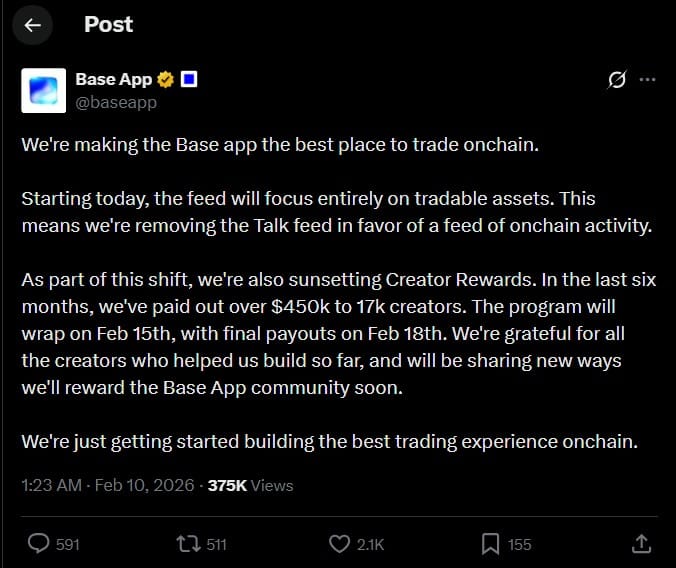
Coinbase is shutting down the app’s Creator Rewards program and its Farcaster-powered social feed, with its focus now on tradable assets. The Creator Rewards initiative, launched in July, was designed to encourage posts and engagement by paying users for activity.

In practice, the payouts were modest. Base says around $450,000 was shared among roughly 17,000 creators over seven months, averaging about $26 per person.

Source: X

According to creator Jesse Pollak, the decision came down to focus. As the app evolved, the team realized it worked best when it did fewer things well. He stated,

“…as we’ve rolled the app out, we’ve realized we need to do less, better. and by focusing on tradable assets, that’s exactly what we can do.”

The Creator Rewards program will officially end this week, with final payouts scheduled for the 18th of February. Pollak also noted that Base App was never an ideal home for Farcaster’s social feed, and expects most users to return to Farcaster’s native app.

Importantly, the changes do not affect Base’s Creator Coins feature, which remains active.

AMBCrypto previously reported that Coinbase was considering launching a native token called BASE, and that it was likely to happen this year. However, there’s not been much talk on that front since.

Do they really need a native token, though?

For now, it looks like they don’t.

Source: DeFiLlama

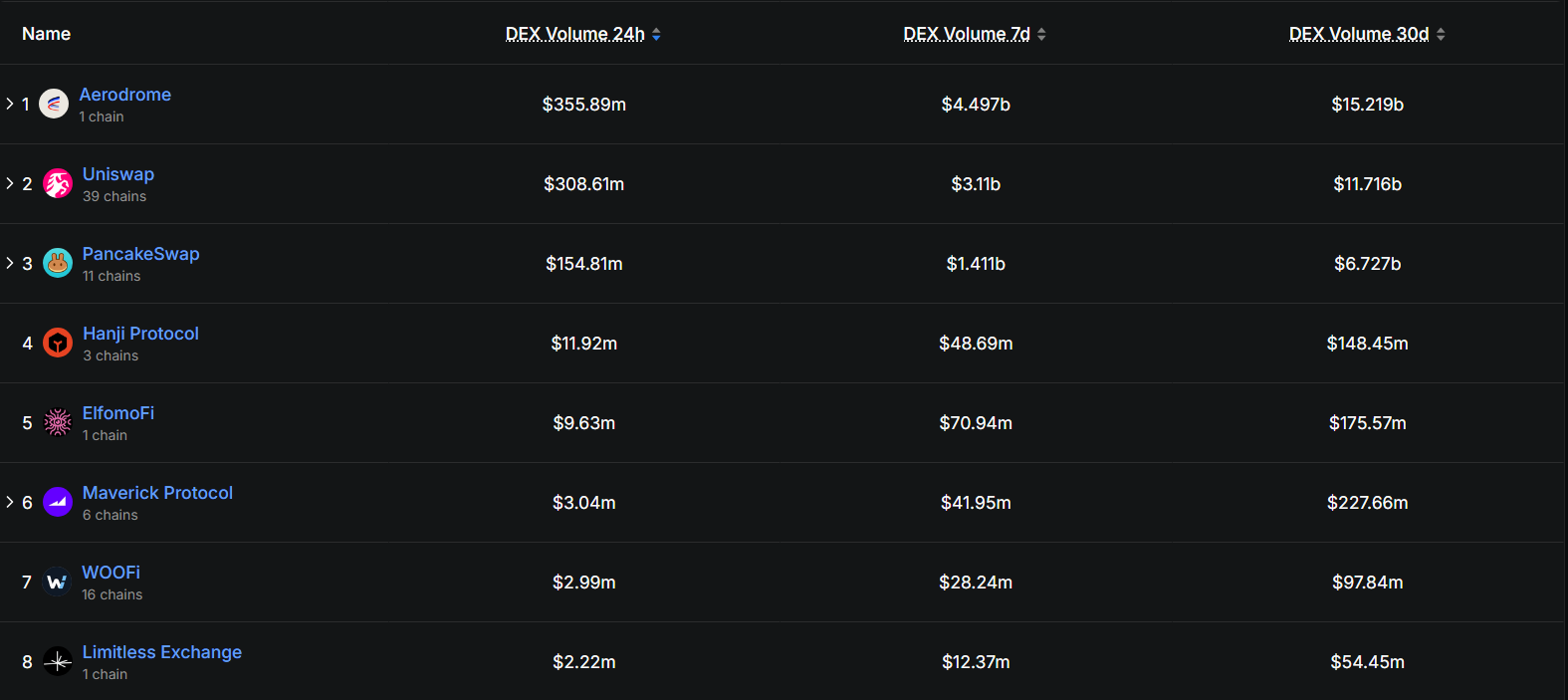
Over the past 30 days, Base-linked DEXs have processed $15.2 billion in trading volume, with Aerodrome Finance [AERO] alone accounting for the bulk of that activity. That puts them ahead of many multi-chain competitors.

Source: Token Terminal

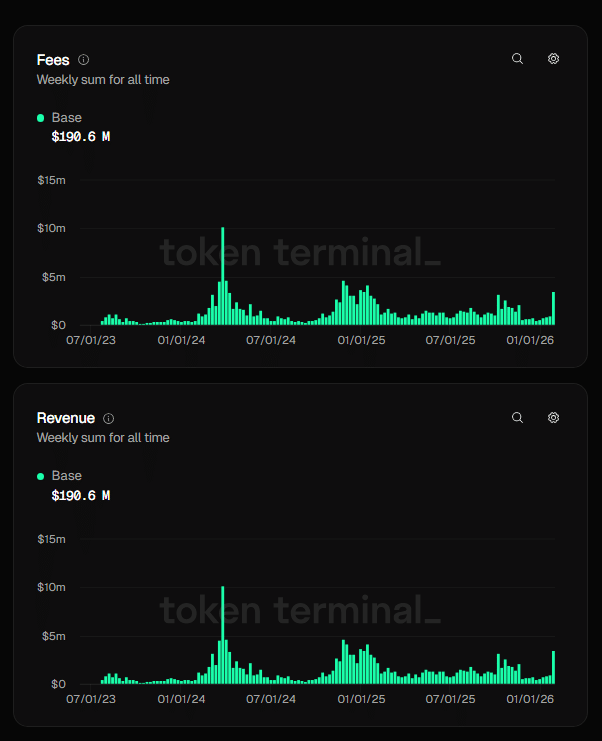
More importantly, the network is generating real money. Data per Token Terminal showed that Base has earned $190.6 million in cumulative fees and revenue to date, with steady weekly inflows.

Instead of relying on a token to bootstrap growth, Base is already monetizing usage directly.

Source: Twitter

In more recent news, this year’s Super Bowl featured just one major crypto ad, and it was from Coinbase. The streamlining of priorities makes sense as Coinbase seemingly looks to build a bigger brand.


Final Thoughts

  • Base is prioritizing trading and revenue, with volume and fees doing the work a token usually would.
  • With growth already monetized, a native Base token looks optional rather than necessary.
Next: Cardano: Why CME’s ADA futures sparked 3% drop instead of a rally
Share
  • Share
  • Tweet

Related Questions

QWhy is Base shutting down its Creator Rewards program and social feed?

ABase is shutting down these features to focus on doing fewer things well, specifically by concentrating on tradable assets, as the team realized the app works best with a more streamlined approach.

QHow much trading volume have Base-linked DEXs processed in the past 30 days?

ABase-linked DEXs have processed $15.2 billion in trading volume over the past 30 days, with Aerodrome Finance (AERO) accounting for the bulk of that activity.

QWhat is the current status of a potential native Base token launch?

ATalk of launching a native Base token has gone noticeably quiet in recent months, and with the network already generating significant revenue through fees, a token now seems optional rather than necessary.
QHow much revenue has Base generated from fees to date?

ABase has earned $190.6 million in cumulative fees and revenue to date, according to data from Token Terminal.

QWhat does Base's shift in focus and recent performance suggest about the need for a Layer 2 native token?

ABase's strong trading volume and revenue generation demonstrate that it can monetize usage directly without relying on a native token for growth, making a token launch appear optional rather than essential.

Related Reads

a16z Crypto Founder on Stablecoins: The 'WhatsApp Moment' in Money Has Arrived

Chris Dixon, general partner at a16z Crypto, argues that stablecoins are bringing about a "WhatsApp moment" for money—dramatically reducing the cost and increasing the speed of global payments, much like messaging apps did for communication. Last year, stablecoin transaction volume reached over $12 trillion, nearing Visa’s $17 trillion, but at a fraction of the cost. Stablecoins, which are pegged to assets like the U.S. dollar, are becoming mainstream for online and international payments. They offer near-instant settlement, high reliability, and programmability, effectively turning money into software. While adoption is still largely within crypto-native and global business contexts, integration with traditional finance is accelerating. U.S. policy developments, such as the proposed Clarity Act, could provide the regulatory framework needed for stablecoins to scale as part of global financial infrastructure. Major companies like Stripe, Fidelity, and SpaceX are already using or issuing stablecoins to cut costs, streamline cross-border payroll, and operate in regions with weak banking systems. A significant secondary effect is the strengthening of the U.S. dollar’s dominance. Stablecoin issuers like Circle and Tether now hold nearly $140 billion in short-term U.S. Treasury bonds, making them top holders. If growth continues, they could rank among the top 10 Treasury holders by next year. Ultimately, stablecoins are reshaping global finance by enabling borderless value transfer, much as the internet enabled borderless communication—provided clear rules and market structures support their growth.

marsbit2h ago

a16z Crypto Founder on Stablecoins: The 'WhatsApp Moment' in Money Has Arrived

marsbit2h ago

Trading

Spot
Futures
活动图片