Tether Invests $100M In Anchorage Digital While HYPER Gains Momentum

bitcoinist2026-02-05 tarihinde yayınlandı2026-02-05 tarihinde güncellendi

Özet

Stablecoin issuer Tether has invested $100 million in the federally chartered crypto custodian Anchorage Digital. This strategic move aims to support the launch of a new U.S.-focused stablecoin, $USAT, leveraging Anchorage’s regulatory compliance to attract institutional interest. Simultaneously, Bitcoin Hyper ($HYPER) is gaining traction as a Bitcoin Layer 2 solution integrating the Solana Virtual Machine (SVM) to solve Bitcoin’s scalability issues. It enables high-speed transactions and complex DeFi applications while settling on Bitcoin’s secure base layer. The project has raised over $31 million in its presale, with significant whale activity indicating strong investor confidence. $HYPER aims to unlock Bitcoin’s dormant capital by offering high-yield DeFi opportunities with Solana-like speed.

Stablecoin titan Tether has officially deployed $100M into Anchorage Digital, the San Francisco-based crypto custodian. It’s a strategic pivot.

Instead of just providing liquidity, the $USDT issuer is buying its way into the bedrock of regulated digital asset infrastructure. The capital is largely aimed at backing $USAT, a new stablecoin tailored for the US market, using Anchorage’s status as a federally chartered crypto bank as leverage.

Tether is effectively buying regulatory air cover and institutional rails. By partnering with Anchorage (which holds a charter from the Office of the Comptroller of the Currency), Tether is signaling a hard shift toward compliance-first expansion. It comes right as traditional finance firms are scrambling for ‘safe’ entry points into the digital asset economy.

But while institutions fortify the custody layers, the real infrastructure revolution is happening on the Bitcoin network itself. As Tether locks down banking rails, smart money is rotating into execution layers designed to unlock Bitcoin’s dormant capital.

This search for yield has directed massive volume toward Bitcoin Hyper ($HYPER), a project fixing the ecosystem’s single biggest flaw: Bitcoin’s inability to scale for DeFi.

SVM Integration Answers The Bitcoin Scalability Trilemma

For years, the bottleneck preventing Bitcoin from moving beyond ‘digital gold’ was technical. The network is secure, sure, but it’s notoriously slow and can’t handle complex contracts.

Bitcoin Hyper ($HYPER) is dismantling that barrier by integrating the Solana Virtual Machine (SVM) directly as a Layer 2 solution. It’s a massive architectural shift. By using the SVM, Bitcoin Hyper delivers sub-second finality and Solana-grade throughput, all while settling on the Bitcoin network.
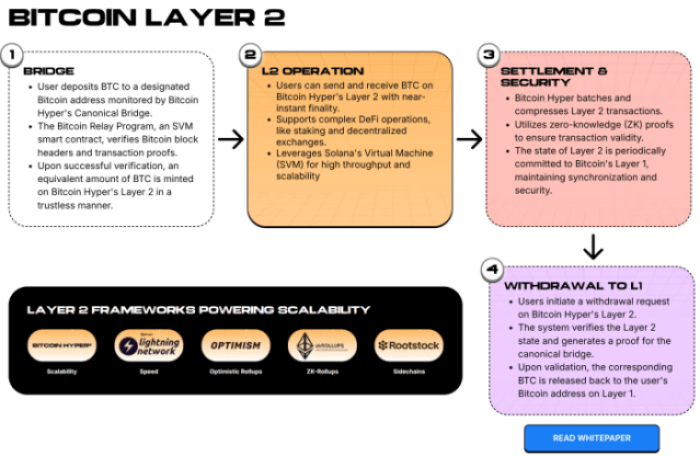
It’s the best of both worlds scenario that developers have chased for a decade. Previous Bitcoin L2 attempts usually suffered from high latency or centralization risks. By employing a decentralized canonical bridge and a modular structure, Bitcoin Hyper allows high-speed payments and complex apps, swaps, lending, and gaming to run on Bitcoin without clogging the main chain.

The implications are massive. If holders can deploy assets into high-yield DeFi protocols with Solana’s speed, trillions in dormant $BTC capital could be unlocked. The architecture mirrors the modular scaling thesis that dominated Ethereum’s roadmap, finally applying it effectively to the Bitcoin ecosystem.

EXPLORE THE $HYPER ECOSYSTEM

High Project Conviction Signal – Whales

The market’s appetite for this solution is visible in the on-chain data surrounding the $HYPER presale. According to live metrics, it has already raised over $31M, a figure that suggests validation from both retail and sophisticated investors.

With the token currently priced at $0.0136751, early positioning is aggressive before the protocol hits its Token Generation Event (TGE).

It’s also worth noting that a big signal of conviction in the project is bellowing – whales. Etherscan data reveals high-net-worth wallets have spent over $1M. The largest transaction was for $500K. That type of accumulation during a presale shows whales hedging against listing volatility by securing an entry price well below projected market value.

The $HYPER incentive structure is designed to lock in long-term liquidity. The protocol offers high APY staking immediately after TGE, with a modest 7-day vesting period for presale stakers. This reduces immediate sell pressure and aligns investor interests with the network’s stability.

As Tether creates a regulated environment for stablecoins, Bitcoin Hyper is building the high-velocity rails where those assets can actually be used.

BUY YOUR $HYPER ON THE OFFICIAL PRESALE PAGE

The information provided in this article is not financial advice. Cryptocurrency investments carry inherent risks, including high volatility and potential loss of capital. Always conduct your own research (DYOR) before making any investment decisions.


İlgili Sorular

QWhat is the strategic significance of Tether's $100 million investment in Anchorage Digital?

ATether's investment represents a strategic pivot toward compliance-first expansion, leveraging Anchorage Digital's status as a federally chartered crypto bank to gain regulatory approval and institutional infrastructure for its new US-focused stablecoin, $USAT.

QHow does Bitcoin Hyper ($HYPER) aim to solve Bitcoin's scalability issues?

ABitcoin Hyper integrates the Solana Virtual Machine (SVM) as a Layer 2 solution, providing sub-second finality and high throughput while settling on the Bitcoin network, enabling complex DeFi applications without congesting the main chain.

QWhat evidence suggests strong market confidence in the $HYPER project during its presale?

AThe presale has raised over $31 million, with on-chain data showing significant whale activity, including a $500,000 transaction, indicating high conviction from both retail and sophisticated investors.

QHow does the article contrast Tether's approach with Bitcoin Hyper's role in the crypto ecosystem?

ATether is focusing on building regulated infrastructure for stablecoins, while Bitcoin Hyper is creating high-speed execution layers to unlock Bitcoin's dormant capital for DeFi and other applications.

QWhat mechanism does $HYPER use to reduce immediate sell pressure after its Token Generation Event (TGE)?

AThe protocol offers high APY staking immediately after TGE with a 7-day vesting period for presale stakers, aligning investor interests with network stability and reducing sell pressure.

İlgili Okumalar

Tether Hires Big Four Auditor, USDT Enters Verifiable Stage for the First Time

Tether, the issuer of USDT, has hired Big Four firm KPMG to conduct a full financial audit of its $127 billion reserves. This marks a significant shift for the controversial stablecoin, moving it into a verifiable financial framework for the first time. Unlike previous attestations, which only confirmed reserves at a point in time, a GAAP-based audit will examine asset origins, internal controls, and financial reliability over time. This development is seen as more impactful than pending legislation, as institutional adoption relies on audited financials rather than regulatory promises. If KPMG issues an unqualified opinion, Tether’s credibility could be fundamentally upgraded, pressuring other stablecoin issuers without Big Four audits to follow suit. The move may accelerate institutional adoption by pensions, corporates, and payment firms, while reshaping the stablecoin landscape. Despite years of regulatory scrutiny and skepticism, Tether has maintained dominance due to its global liquidity and accessibility. An audit could reposition USDT from a contested asset to a verifiable financial instrument, reducing counterparty risk and encouraging broader use in digital infrastructure. The outcome of the audit will be critical: a clean opinion may validate the entire asset class, while a qualified one could introduce new challenges. The industry is watching closely, as this audit could signal a new phase of institutional acceptance for stablecoins.

marsbit1 saat önce

Tether Hires Big Four Auditor, USDT Enters Verifiable Stage for the First Time

marsbit1 saat önce

1 Dollar Return Rate Only 43%, Why Are 87% of Polymarket Users Losing Money?

In the prediction market Polymarket, analysis of 72.1 million trades reveals that 87% of wallets lose money, while only 13% consistently profit. The key difference lies in the application of game theory and mathematical strategies, not luck. Five core formulas separate winners from losers: 1. **Expected Value (EV)**: Winners calculate EV to identify undervalued contracts, while most traders rely on intuition. Makers (limit order placers) profit by waiting for positive EV opportunities, while takers (market buyers) lose ~1.12% per trade on average. 2. **Mispricing**: Low-probability contracts (e.g., priced at 1¢) are systematically overpriced, with actual win rates as low as 0.43% (a -57% deviation). High-probability contracts are often undervalued. Takers overpay for "cheap" lottery-like bets, while makers capture this inefficiency. 3. **Kelly Criterion**: Used for optimal position sizing. It maximizes long-term growth but is often applied fractionally (e.g., 1/2 or 1/4 Kelly) to reduce volatility. 4. **Bayesian Updating**: Profitable traders adjust probabilities rationally as new information emerges, unlike emotional overreactions or inertia from others. 5. **Nash Equilibrium**: The market structure evolves with participant behavior. In emotional markets (e.g., sports, entertainment), mispricing creates opportunities for contrarian strategies. As professional market makers enter, spreads tighten, and inefficiencies shrink. The conclusion: Persistent losses stem from emotional trading, overpaying for low-probability bets, and neglecting mathematical discipline. The winning minority uses these formulas to exploit market biases systematically.

Odaily星球日报1 saat önce

1 Dollar Return Rate Only 43%, Why Are 87% of Polymarket Users Losing Money?

Odaily星球日报1 saat önce

The Time of Machines: When Agents Consume Stablecoins

"The Age of Machines: When Agents Consume Stablecoins" explores the convergence of AI and cryptocurrency, focusing on the emerging narrative of AI agents as economic actors. The author argues that while AI is rapidly advancing into production and consumption, crypto, particularly stablecoins, is struggling to find its role beyond financialization. The piece begins by reflecting on how AI-powered bots are evolving from nuisances to become autonomous economic entities, potentially even developing a "dislike" for humans. This shift creates a sense of desperation in the crypto community, which is now trying to prove its value to AI by promoting stablecoins as the preferred medium of exchange for agents. A core tension is highlighted: AI is mastering both production and the new "relations of production" by replacing human labor, while crypto remains confined to a narrow financial role. Previous attempts by crypto to capture AI use cases—through decentralized storage, compute, or GPU lending—have largely failed. The author warns that compliant, bank-issued stablecoins on networks like Canton could ultimately prevail over native crypto stablecoins. The emergence of payment protocols for machines, like Stripe's MPP, is noted, but these efforts are seen as integrating machines into the existing traditional financial system rather than creating a new crypto-native one. The crypto industry's strategy of selling stablecoins to AI based on technical merits like cheapness and speed is portrayed as a weak, last-resort effort. The article then pivots to a more promising path for crypto: leveraging volatility. The true potential lies in AI agent economy's ability to generate massive, 24/7 consumption that far surpasses human limits. This creates a new battlefield for crypto—not by providing utility to AI, but by creating speculative assets (Crypto Tokens) that capture the value and FOMO generated by the AI boom (AI Tokens). The ultimate goal should be converting the immense economic activity of AI agents into liquidity for crypto assets. The conclusion states that while Circle's vision of agents using stablecoins offers a story of infinite users to the market, crypto's real strength is its position as a financial laboratory on the frontier, thriving on ambiguity and speculation. The future of the convergence depends on crypto creating volatility and wealth effects from the stable foundation of agent-driven consumption, ultimately completing the cycle from AI Token back to Crypto Token.

marsbit1 saat önce

The Time of Machines: When Agents Consume Stablecoins

marsbit1 saat önce

$20 for a Face: The Underground Business of Crypto KYC

Crypto KYC Bypass: A $20 Underground Industry Despite stringent KYC (Know Your Customer) requirements from major crypto exchanges, a thriving underground market exists to bypass these checks for as low as $20. Users often face geo-blocks or lengthy verifications, preventing access to services. This has fueled demand for illicit KYC services. Reports indicate over 500,000 participants in underground KYC markets, with more than 1 million listings selling verified profiles from platforms like Coinbase and Kraken. These accounts often include real personal data, sometimes without the original owners' knowledge. Fraud techniques have evolved, including deepfake attacks (up 2000% in three years), screen-based spoofing, and AI-generated fake documents. The virtual currency sector is the primary target, accounting for over 78% of KYC attacks. An investigation into a Telegram-based KYC vendor revealed a TRON address with over $59,000 in USDT from 600 transactions over two years, all eventually transferred to an OKX hot wallet. An interview with a KYC service provider, "Maoli," who operates in Chinese-speaking regions, detailed the process: clients pay for accounts verified by "foreigners" recruited globally, often from lower-income regions, who perform the KYC steps for a small fee. These accounts are sold with warnings against holding large funds due to fraud risks and potential reclaiming by the original identity owners. Maoli described the business as a "three-way win": users gain access, exchanges get user numbers, and he profits. However, this ignores the victims of identity theft whose data is used without consent. The KYC system, while intended for security, functions as a permeable barrier, with a vast shadow economy ensuring access for those willing to pay.

marsbit1 saat önce

$20 for a Face: The Underground Business of Crypto KYC

marsbit1 saat önce

İşlemler

Spot
Futures
活动图片