Circle's Acquisition of Axelar Sparks Controversy: Giant Wants the Team, Not the Token

Odaily星球日报Published on 2025-12-16Last updated on 2025-12-16

Abstract

Circle, the stablecoin giant, has announced the acquisition of the core team and intellectual property of Interop Labs, the initial developer of the cross-chain protocol Axelar Network. However, the deal explicitly excludes the Axelar Network project itself, its foundation, and its native token AXL. These will continue to operate independently under community governance, with another contributing team, Common Prefix, taking over Interop Labs' former activities. This "acquire-the-team, not-the-token" structure has caused significant controversy and triggered a 15% drop in the price of AXL. The crypto community is divided into opposing camps. The opposition, including VCs and prominent figures, argues the move is a de facto "rug pull." They contend it is unethical for the team and equity holders to profit from the acquisition while token holders, who funded the project's early development, are left with an asset that may now be worthless. Critics state this highlights a fundamental conflict between equity and token-based financing. Supporters, including investment chiefs, defend the move as a normal market behavior. They explain that in traditional capital structures, tokens sit at the very bottom, below debt and equity. In acquisitions, it is standard for higher-priority stakeholders to be paid first, and tokens have no inherent claim to proceeds. They argue Circle acted within existing commercial frameworks by purchasing only the most valuable assets—the talent and IP. Th...

Original | Odaily Planet Daily (@OdailyChina)

Author | Azuma (@azuma_eth)
In the early hours of December 16, stablecoin giant Circle officially announced the signing of an agreement to acquire the core talent and technology of Interop Labs, the initial development team behind the cross-chain protocol Axelar Network. This move is intended to advance Circle's cross-chain infrastructure strategy and help achieve seamless, scalable interoperability for core products like Arc and CCTP.

This seemed like another classic case of an industry giant acquiring a high-quality team, appearing to be a win-win situation. However, the key issue lies in the fact that — Circle explicitly stated in the acquisition announcement that the transaction only involves the Interop Labs team and its proprietary intellectual property, while the Axelar Network, the Axelar Foundation, and the AXL token will continue to operate under community governance. The other contributing team to the original project, Common Prefix, will take over the relevant activities previously handled by Interop Labs.

In simple terms, Circle has taken the original development team of Axelar Network but has explicitly discarded the Axelar Network project itself and its AXL token.

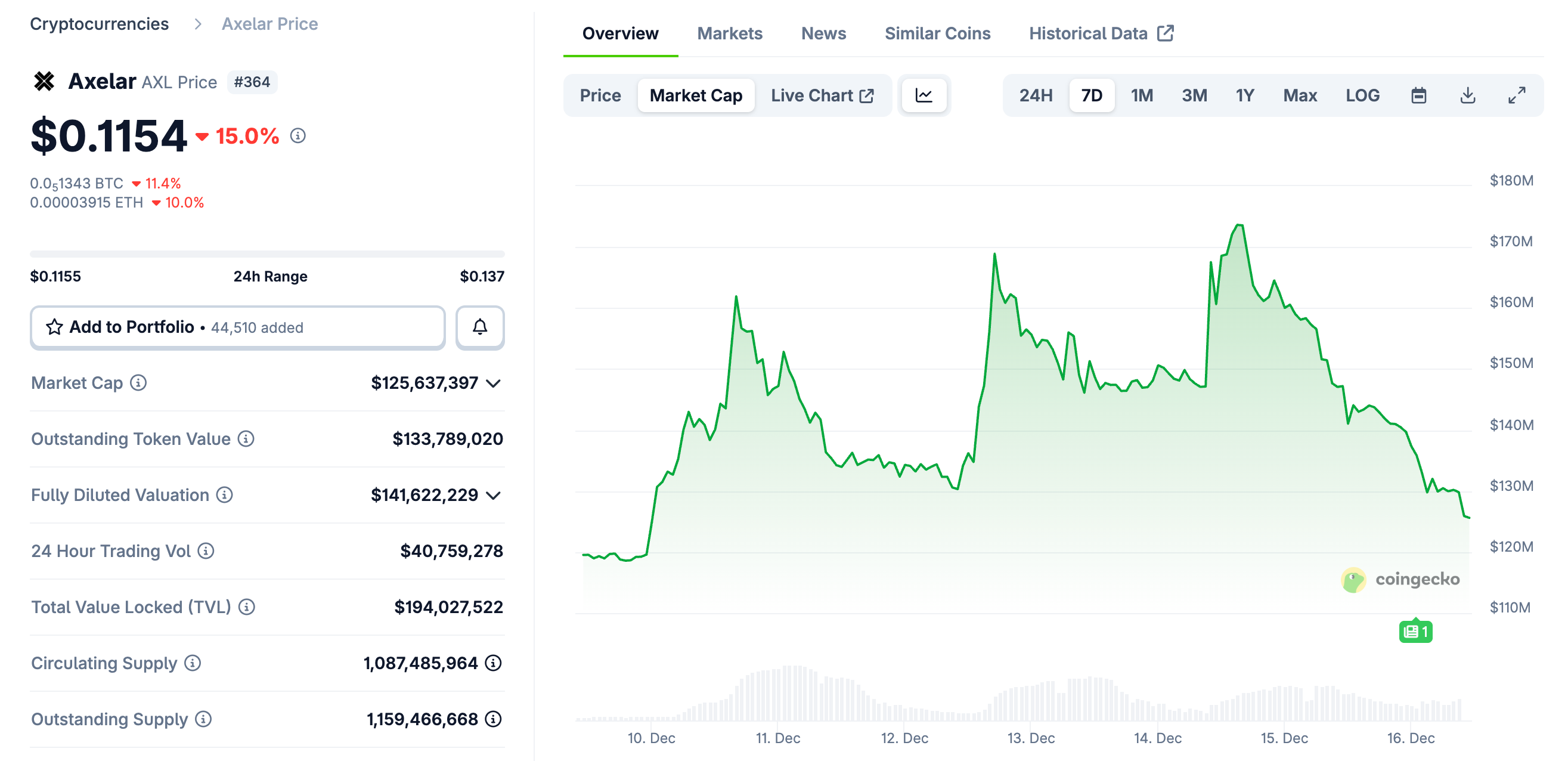
Affected by this sudden news, AXL experienced a sharp short-term drop, trading at around $0.115 as of 10:00 AM today, marking a 24-hour decline of 15%.
Simultaneously, the unique "take the team, not the token" nature of the acquisition and the ensuing debate over "equity vs. token" issues have sparked extensive discussion within the community, with supporters and opponents of this acquisition model arguing their respective points.

Opposing Views: De facto Rug Pull, Circle's Misstep, Only Token Holders Get Hurt......

The core of the opposition consists of some VCs, which is understandable — "I invested real money in the project's token, holding a bunch of tokens. Now you've taken the working team away, what use are these tokens to me?"

Moonrock Capital founder Simon Dedic commented on this: "Another acquisition, another rug pull. Circle acquires Axelar but explicitly excludes the Foundation and the AXL token. This is practically criminal. Even if not illegal, it violates ethics. If you are a founder wanting to issue a token: either treat it like equity, or get lost."

The Block co-founder and 6MV founder Mike Dudas commented: "For everyone thinking this is a token vs. equity issue, let me be clear, this is entirely Circle's doing. There are rumors that Circle's VP of Corporate Development once told an Axelar co-founder 'I don't care about your investors,' and 'bought' the CEO and IP out from under the investors without paying them any consideration, even though this IP and team are crucial for Arc's launch."

<2>Lombard Finance founder posted a chart of AXL's price movement and predicted: "Axelar's core team has been bought by Circle, AXL might be worthless now. It's been over three years since the token was issued, the team's equity has long been fully vested. But this outcome feels very uncomfortable: the team and/or investors sell tokens for profit, while token holders can only pin their hopes on a distant dream."

ChainLink community figurehead Zach Rynes stated: "This once again the token vs. equity conflict of interest plaguing the crypto industry. The development team behind the protocol gets successfully acquired, while the token holders who funded that team get nothing. So-called continued independent operation under community governance is no different than the development team abandoning its users for better prospects. If we want to attract real capital, this is the primary issue the industry urgently needs to solve."

SOAR Ecosystem Lead Nicholas Wenzel stated: "Axelar token is going to zero, thanks for playing. Yet another acquisition where token holders get nothing and equity holders get paid."

Supporting Views: Normal Market Behavior, Tokens Are Naturally at the Bottom of the Capital Stack

If the opposition focuses more on the unfair treatment of token holders, the supporters focus more on the rules of financing and M&A markets.

Arca Chief Investment Officer Jeff Dorman believes Circle's approach is not problematic and explained at length the capital structure of corporate financing and the naturally disadvantaged position of tokens.

Companies raise capital through different tiers of the capital structure, and these tiers themselves have a clear order of priority—some tiers are inherently senior to others — Secured Debt > Unsecured Senior Debt > Subordinated Debt > Preferred Stock > Common Stock > Tokens.

History is full of examples where gains for one type of investor come at the expense of another.

  • In bankruptcies, creditors win at the expense of equity investors;
  • In Leveraged Buyouts (LBOs), equity holders often profit at the expense of creditors;
  • In take-unders, creditors are usually prioritized over equity holders;
  • In strategic acquisitions, usually both creditors and equity holders benefit (but not always);
  • And tokens are often at the very bottom of the capital stack......

This doesn't mean tokens have no value, nor does it mean tokens necessarily need some form of "protection," but the market needs to recognize the reality: when someone acquires a company whose value is low and whose issued token is also nearly worthless, token holders don't magically receive a dividend. In such cases, gains for equity often come at the expense of the token.

Electric Capital co-founder Avichal Garg also commented: "This is normal. If all future value is created by the team, no company will want to pay returns to investors."

Core Contradiction: What Exactly Is a Token?

Surrounding the "take the team, not the token" acquisition storm involving Axelar and Circle, both sides of the debate seem to have their points.

The anger of the opposition is real: Token holders bore the risk when the project was at its most difficult, needing liquidity and narrative support the most, yet were completely excluded at the critical moment of value realization. From the result, the core team and intellectual property achieved value realization, while the token was left in the vacuum narrative of "community governance." The market voted most directly with the price, which is indeed deeply frustrating for all who believed in the token's value.

The judgment of the supporters is also reasonable in a practical sense: From a strict capital structure perspective, tokens are neither debt nor equity and naturally lack priority in the context of M&A and liquidation. Circle did not violate existing commercial rules; it just冷静地 chose the assets most valuable to itself.

The true core of the contradiction is not whether Circle acted morally, but lies in a question the industry has long deliberately avoided: What exactly is a token in the legal and economic structure?

When prospects are bright, tokens are tacitly assumed to be "quasi-equity," imbued with the imagination of a claim on future success; but in practical scenarios like acquisitions, bankruptcy, and liquidation, they are quickly reduced to their original form of a "rights-less instrument." This narrative equity-like treatment combined with structural subordination is the root cause of recurring conflicts.

The Axelar acquisition may not be the last similar controversy, but hopefully it can serve as an opportunity for the industry to further contemplate the positioning and meaning of tokens — Tokens do not inherently possess rights; only institutionalized, structured rights are acknowledged at critical moments. The specific form of implementation still requires all practitioners to explore and practice together.

Related Questions

QWhat was the main controversy surrounding Circle's acquisition of Axelar's development team?

AThe controversy centered on Circle acquiring only the core development team and intellectual property of Axelar's Interop Labs, while explicitly excluding the Axelar Network, its foundation, and the AXL token from the deal, leaving the token and project to operate independently under community governance.

QHow did the price of AXL token react to the news of the acquisition?

AThe AXL token price experienced a sharp decline, dropping 15% in 24 hours following the announcement, trading at approximately $0.115.

QWhat was a key argument from critics (the opposition) of this acquisition model?

ACritics argued that the acquisition was effectively a 'rug pull,' where the core team and IP were sold for the benefit of equity holders (like VCs and the team), while token holders who funded the project's early stages were left with a potentially worthless asset and received no compensation.

QWhat was the core argument from supporters justifying Circle's actions?

ASupporters argued it was a normal market behavior, explaining that tokens naturally sit at the very bottom of the capital structure (below secured debt, unsecured debt, and equity) in corporate finance. In acquisitions, gains for one class of investor (equity) often come at the expense of another (token holders), and Circle was simply acquiring the most valuable assets under existing commercial rules.

QWhat fundamental industry problem did this acquisition controversy highlight according to the article?

AThe controversy highlighted the fundamental ambiguity over what a token represents legally and economically. Tokens are often narratively treated as 'quasi-equity' promising future value, yet in real-world scenarios like acquisitions or bankruptcies, they are structurally at the bottom with no formal rights, creating a recurring conflict between narrative expectations and structural reality.

Related Reads

Facing Losses: The Trader's Path to Nirvana

Facing Loss: A Trader's Path to Rebirth This article addresses skilled traders who have recently suffered significant losses after a period of profitability, not those who are consistently unprofitable. A major loss can feel like the myth of Sisyphus, endlessly pushing a boulder up a hill only to watch it roll back down. Trading offers no safety nets; one bad decision can undo years of work. Typical reactions are extreme: some double down with aggressive, high-risk bets (a Martingale strategy), a dangerous habit that can lead to ruin. Others, often comfortable financially, simply quit, claiming the market has changed. The core issue is usually a failure of risk management. The math is simple, but the execution—sticking to rules under emotional duress, ego, and pressure—is incredibly difficult. The market ruthlessly exposes this disconnect. To recover, one must first accept that the loss was not bad luck but the result of a flaw in their process. This flaw must be identified and fixed. Crucially, traders must accept their new net worth and avoid the dangerous obsession of "making the money back." The goal is simply to be profitable again, not to reclaim a past high. View the loss as tuition paid to the market for a vital lesson. Identify the specific cause—often oversized positions, a lack of stop-losses, or failure to execute them. Implement strict, structured rules around risk to prevent future disasters. Allow time to grieve the loss, but channel the pain into action. Trauma must be converted into disciplined processes, or it will repeat. Like Napoleon after a defeat, the priority is to rebuild infrastructure and fortify weaknesses to fight another day. There is no need for revenge or self-pity. Approach the situation like a machine: diagnose the error, repair the system, and ensure it never happens again. Each survived failure becomes a moat in your trading strategy, hard-earned wisdom that others gain only through experience. Such failures forge a trader. Be grateful for the painful lesson, allow yourself to feel it, and use the anguish as fuel to ensure it is the last of its kind. Mastering this turns the inevitable wealth compounder in your favor. Good luck.

深潮14m ago

Facing Losses: The Trader's Path to Nirvana

深潮14m ago

Bitcoin's 'Strict Headmaster' Arrives? If He Takes the Helm at the Fed, the Crypto Party Could End Abruptly

The article discusses the potential implications of Kevin Warsh, a former Federal Reserve governor and Wall Street insider, becoming the next Fed Chair. Unlike other candidates like Kevin Hassett, who is seen as favoring lower interest rates and easier monetary policy, Warsh represents a more disciplined approach. Having worked at Morgan Stanley and experienced the 2008 financial crisis firsthand, Warsh is highly sensitive to systemic risks and liquidity issues. Warsh’s policy stance combines aggressive quantitative tightening (QT) with moderate interest rate cuts. He aims to control inflation by reducing the money supply and restoring the dollar’s credibility, while also easing corporate financing costs. This approach could challenge risk assets like cryptocurrencies, which have thrived in an era of abundant liquidity. If appointed, Warsh could bring stricter regulation to crypto, particularly stablecoins, potentially requiring full cash or short-term debt reserves. He opposes a retail central bank digital currency (CBDC) on privacy grounds but supports a wholesale CBDC for interbank settlements. While his policies may pressure crypto in the short term, they could also foster more institutional adoption and real-world asset (RWA) integration in the long run. However, the article notes that political pressures—especially from a Trump administration seeking lower rates and economic growth—could ultimately influence Warsh’s decisions, regardless of his personal beliefs.

Odaily星球日报21m ago

Bitcoin's 'Strict Headmaster' Arrives? If He Takes the Helm at the Fed, the Crypto Party Could End Abruptly

Odaily星球日报21m ago

Ethereum Completes Another Key Technical Advancement, Can It Achieve a Leap Forward by 2026?

The Ethereum Foundation (EF) has announced a major technical breakthrough in zkEVM development, achieving a dramatic reduction in block proof generation time—from 16 minutes to just 16 seconds—with a 45-fold decrease in cost. Certain zkVMs can now prove 99% of mainnet blocks in under 10 seconds on target hardware. However, EF emphasizes that raw speed is meaningless without proven security. Several mathematical conjectures underlying popular STARK-based zkEVMs have recently been disproven, reducing their security guarantees. The core focus has now shifted from throughput to provable safety, with L1 zkEVMs required to meet a 128-bit security standard to prevent risks like token forgery or state corruption. EF released a three-phase roadmap aiming for full compliance by December 2026: 1. By end-February 2026, all zkEVM teams must integrate with EF’s soundcalc security tool. 2. By end-May, achieve intermediate goals like 100-bit provable security. 3. By end-December, reach 128-bit provable security with formal verification of recursive proof systems. Key technologies like WHIR and JaggedPCS are being deployed to improve efficiency. Challenges remain, including on-chain implementation, dynamic security parameter adjustments, and uneven progress among teams. Once achieved, secure zkEVMs could allow Ethereum to increase gas limits safely, enhance L1 capacity, and blur the lines between L1 and L2 execution. The race for reliability is now the central theme for Ethereum in 2026.

marsbit31m ago

Ethereum Completes Another Key Technical Advancement, Can It Achieve a Leap Forward by 2026?

marsbit31m ago

Trading

Spot
Futures

Discussions

Welcome to the HTX Community. Here, you can stay informed about the latest platform developments and gain access to professional market insights. Users' opinions on the price of S (S) are presented below.

活动图片