Solana Explosive Growth Pushes Its Monthly Perps Volume Beyond Prior Records

bitcoinistPublished on 2026-06-04Last updated on 2026-06-04

Abstract

Despite bearish market conditions and price volatility, Solana is demonstrating significant strength in its derivatives market. The network's monthly perpetual futures volume has surged to a new record, exceeding $76.7 billion in May 2026—a 34% increase from the previous high. This growth reflects heightened speculative activity and trader engagement. Analysts note that perpetual contracts are becoming crucial financial primitives, with Solana positioning itself as a network for genuine on-chain price discovery and execution. Concurrently, Solana is experiencing a massive increase in stablecoin activity, processing over $79.9 billion in stablecoin volume in one week, underscoring its role as a major hub for on-chain liquidity and transactions.

In the face of heightened bearish performance and volatility, Solana is showing notable strength in the derivatives market. While SOL’s price has fallen sharply lately, bullish momentum is returning, and the monthly perpetual futures volume is experiencing one of its most significant growths ever.

Monthly Perps Volume on Solana Surges Past Previous Peak

Solana is experiencing sharp growth in some crucial areas even while the altcoin has fallen strongly, with its price retesting the $75 support level. In areas such as the derivatives market, SOL has reached a new landmark, breaking past previous record levels in monthly perpetual futures volume.

David Alexander, a crypto pundit, reported that SOL has shattered its previous monthly perpetual futures volume record by processing over $76.7 billion in May 2026 alone. This figure represents approximately 34% increase above the previous high of $57 billion set in November 2025.

The spike indicates a significant uptick in speculative activity and trader engagement throughout the Solana ecosystem, highlighting the network’s expanding impact on the cryptocurrency trading space. After this notable growth, the perps volume is now showing a 97% rise in month-over-month.
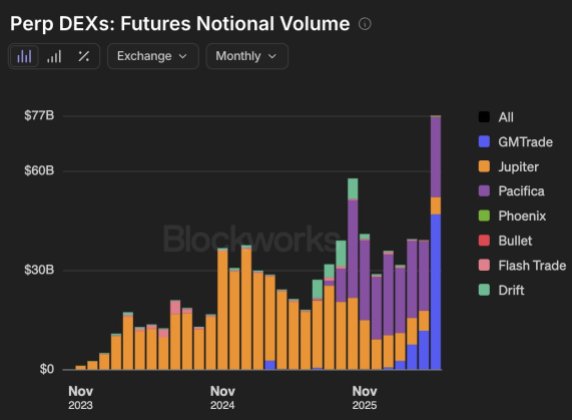
Source: Chart from Alexander on X

A rise to a new high in this metric is typically seen as an indication of heightened market interest, more liquidity, and more active participation from institutional and retail players. “Perhaps more interestingly, is what’s being built underneath,” Alexander stated. As the market evolves, perps are quietly becoming one of the most important financial primitives, both within the on-chain economy and extending into the legacy financial system.

Currently, the battle for dominance has become more intense than ever before. Meanwhile, Solana is portraying itself as the only network with actual price discovery powered by two-sided flow and 100% on-chain execution, as opposed to off-chain or synthetic matching.

This implies that each order, oracle update, match, cancellation, and settlement occurs on-chain. However, SOL perps in the next generation are resolutely designed to route revenue back to the network at the protocol level from launch.

A Massive Surge In Stablecoin Activity On The SOL Network

The Solana network is receiving fresh attention due to a significant increase in stablecoin activity, which highlights its expanding role as a hub for on-chain liquidity and digital finance transactions. Zensei, a market researcher, stated that the network’s stablecoin activity continues to operate at a scale most networks can only dream of.

In a one-week time frame, the SOL network processed over $79.9 billion in stablecoin transaction volume. Billions of dollars are seen being moved within the network every single day, indicating robust network health and economic participation. “When people choose to move money on-chain, the numbers keep showing they choose Solana,” Zensei added.

Users increasingly turning to SOL for payments, trading, and Decentralized Finance (DeFi) points to rising interest and demand for fast and low-cost transfers, which the network seems to offer.

SOL trading at $75 on the 1D chart | Source: SOLUSDT on Tradingview.com

Related Questions

QWhat new record did Solana's monthly perpetual futures volume reach in May 2026, and by what percentage did it increase over the previous record?

AIn May 2026, Solana's monthly perpetual futures volume reached over $76.7 billion, representing a 34% increase over the previous high of $57 billion set in November 2025.

QAccording to David Alexander, what do rising perps volume figures typically indicate for the market?

AAccording to David Alexander, a rise to a new high in perpetual futures volume is typically seen as an indication of heightened market interest, more liquidity, and more active participation from both institutional and retail players.

QWhat key feature does the article say distinguishes Solana's price discovery in the perps market?

AThe article states that Solana portrays itself as the only network with actual price discovery powered by two-sided flow and 100% on-chain execution, meaning each order, match, and settlement occurs on-chain, unlike off-chain or synthetic matching systems.

QHow much stablecoin transaction volume did the Solana network process in a one-week period, according to the researcher Zensei?

AAccording to researcher Zensei, the Solana network processed over $79.9 billion in stablecoin transaction volume in a one-week time frame.

QDespite a recent price decline, what price support level was Solana (SOL) retesting at the time of the article?

AAt the time of the article, Solana's price was retesting the $75 support level.

Related Reads

Both Suffer Massive Losses Exceeding $90 Billion, Which Is in Greater Peril: Strategy or Bitmine?

Facing massive paper losses exceeding $90 billion each amidst a sharp market downturn, "Digital Asset Treasury" (DAT) giants Strategy and Bitmine find themselves in a precarious position, but with different underlying risks. Strategy, heavily invested in Bitcoin (BTC), faces significant financial strain. Its strategy relies heavily on debt, including convertible notes and preferred stock (STRC) requiring substantial dividend payments. With its cash reserves dwindling and BTC offering no staking yield for cash flow, Strategy's high leverage makes it vulnerable. A continued price decline could force asset sales to meet obligations, potentially creating a negative feedback loop. Its market value has already fallen sharply. In contrast, Bitmine, an Ethereum (ETH) holder, appears on firmer financial ground. It primarily funds its purchases through equity offerings (like ATM programs), avoiding debt pressure. It also generates income by staking a large portion of its ETH holdings. While not immune to market drops and shareholder dilution concerns, Bitmine maintains more flexibility, recently announcing a new preferred share offering to raise further capital. The core divergence lies in their financing: Bitmine uses equity (investor money), while Strategy uses debt (borrowed money). Consequently, Bitmine currently faces less immediate liquidity pressure than Strategy, which must navigate the dual challenge of servicing debt/dividends and a declining core asset (BTC) price.

marsbitHá 5m

Both Suffer Massive Losses Exceeding $90 Billion, Which Is in Greater Peril: Strategy or Bitmine?

marsbitHá 5m

Where the AI Bubble Really Is: Which Layer of Players Are Naked

AI Bubble: Where It Really Is and Who's Swimming Naked This analysis dissects the AI industry not as a single entity but as a five-layer pyramid, arguing that bubbles are concentrated in specific tiers, not uniformly distributed. **Key Distinction from the 2000 Dot-com Bubble:** Unlike 2000, where companies had stock prices before revenue, today's leading AI players have massive, contract-backed revenue driving their valuations. Core infrastructure demand is real, with every GPU running at full capacity for paying customers. **The Five-Layer Pyramid & Bubble Assessment:** * **L0 (Fab/Manufacturing) & Top L4 (Leading AI Apps): NO BUBBLE.** Companies like TSMC, NVIDIA, major cloud providers (Microsoft, Google, Meta, Amazon), and top AI labs have real revenues and orders. Supply is tightly constrained by TSMC's disciplined capacity control and physical limits like power/land for data centers, preventing a supply glut. * **L1 (Memory): BATTLEGROUND.** Sky-high HBM margins could signal a new structural cycle or a classic "boom before bust." The oligopoly of three major players may enforce supply discipline, making this a high-stakes bet. * **L2 (Interconnect/Optical Modules): BUBBLE TERRITORY.** Companies like Lumentum and AAOI have seen stock surges (4-10x) far outpacing revenue growth. This hardware segment has lower physical barriers to expansion than fabs, allowing speculation. It mirrors the 2000 bubble's epicenter—optics. * **L3 (Infrastructure/"GPU Landlords"): VULNERABLE.** GPU leasing companies profit from the current compute shortage but own no long-term moat. Their business model relies on a temporary bottleneck that will ease as big tech expands and new tech (e.g., potential space-based data centers) emerges. * **L4 Long Tail (VC-backed Startups): STRONG BUBBLE SIGNALS.** VC funding concentration in AI is twice that of the 1999 peak. Many startups with little revenue use the valuation logic of successful giants to justify their own, creating high risk of a "valuation crunch" when funding dries up. **Critical Risks to Monitor:** 1. **GPU Depreciation & Accounting:** Companies extending the assumed useful life of GPUs artificially boost profits. The true economic life depends on future generational leaps from NVIDIA. 2. **"GPU Credit" & Off-Balance-Sheet Leverage:** Emerging structures where shell companies borrow to buy GPUs and lease them out (with chipmakers sometimes investing) move debt off major balance sheets. This echoes the "vendor financing" of 2000 and the securitization risks of 2008, though currently small-scale. 3. **TSMC Abandoning Caution:** If the primary supply bottleneck (TSMC's conservative capacity planning) breaks, runaway supply could trigger a bust. 4. **Algorithmic Efficiency Breakthrough:** A major leap in software efficiency could drastically reduce the need for raw compute hardware, undermining the investment thesis. **Conclusion:** The AI boom is expensive and has frothy areas, but its core is underpinned by real demand and physical supply constraints. The bubble risk is layered: most present in optical components, GPU leasing, and the long-tail startup ecosystem, while the foundational chip manufacturing and leading application layers remain relatively solid—for now.

marsbitHá 17m

Where the AI Bubble Really Is: Which Layer of Players Are Naked

marsbitHá 17m

Standing in the Light: A Comprehensive Guide to the Optical Module and CPO Supply Chain

"Standing in the Light: Understanding the Optical Module and CPO Industry Chain" This article analyzes the critical role of optical communication technology, specifically optical modules and Co-Packaged Optics (CPO), as the "nervous system" for modern AI data centers. With exponential growth in AI computational demands (e.g., NVIDIA's Vera Rubin architecture), traditional electrical interconnects using copper cables face severe bottlenecks in bandwidth, power consumption, and signal integrity over distance. The core function of an optical module is to act as a "translator," converting electrical signals from chips into optical signals for transmission over fiber (and vice-versa). Key internal components include lasers, modulators, photodetectors, drivers, and DSP chips. The industry is currently transitioning from 800G to 1.6T modules. However, the future lies in CPO. This next-generation technology integrates the optical engine directly with the switch ASIC/XPU on the same package substrate, drastically reducing power consumption (by ~3.5x according to NVIDIA), overcoming bandwidth density limits, and minimizing signal attenuation compared to traditional pluggable modules. Key challenges for CPO include advanced packaging capacity (dominated by TSMC), thermal management, repairability, and standardization. The article details the broader technology landscape, including Near-Packaged Optics (NPO, a pragmatic intermediate step), Linear-drive Pluggable Optics (LPO), Optical I/O (OIO for chip-level integration), and Optical Circuit Switches (OCS). A comprehensive CPO industry chain is mapped, highlighting shifting power dynamics: * **Architecture Definers:** NVIDIA, Broadcom, and Marvell now hold greater influence. * **Advanced Packaging & Manufacturing:** TSMC is central; Fabrinet is a key EMS player. * **Lasers ("The Heart"):** A strategic bottleneck. EML lasers are led by Lumentum and Coherent (both receiving major NVIDIA investments). CW lasers, favored for CPO/silicon photonics, see strong Chinese players like Source Photonics and Sicoya. * **Silicon Photonics Chips:** The mainstream path for CPO engines, with key players like Broadcom, Intel, Marvell, and China's Accelink. * **Fiber Connectivity Components:** A major new, high-growth market created by CPO, including Fiber Array Units (FAU), Polarization-Maintaining Fiber (PMF), and MPO connectors. Companies like Tianfu Communication and US Conec are leaders. * **Fiber & Cable:** Experiencing a super-cycle (e.g., Corning, Yangtze Optical Fiber). * **PCB/Substrates:** Requiring advanced materials (e.g., Shengyi Tech). * **DSP & SerDes:** Functions are integrated into switch ASICs in the CPO era (e.g., Broadcom, Astera Labs). * **Optical Module Makers:** Transitioning from standalone module suppliers to providers of optical engines and NPO/LPO solutions while riding the current pluggable boom (e.g., Zhongji Innolight, Eoptolink). The investment timeline is segmented: Short-term (2026-2027) features the "last feast" for pluggable modules and CPO's initial rollout. Medium-term (2027-2029) will see CPO expand and NPO peak. Long-term (2029-2032+) involves CPO/OIO penetration into intra-rack scaling. In conclusion, optical interconnects are fundamental to AI infrastructure. The competitive landscape sees US firms leading in architecture and high-end chips, TSMC in advanced packaging, and Chinese firms holding strong positions in modules, connectivity components, CW lasers, and fiber/cable. The future belongs to companies that can navigate the technological shift from "selling shovels" (modules) to "building highways" (CPO/OIO infrastructure).

marsbitHá 27m

Standing in the Light: A Comprehensive Guide to the Optical Module and CPO Supply Chain

marsbitHá 27m

Trading

Spot
Futures

Hot Articles

Discussions

Welcome to the HTX Community. Here, you can stay informed about the latest platform developments and gain access to professional market insights. Users' opinions on the price of SOL (SOL) are presented below.

活动图片