XRP Ledger DEX Metrics Flash Strong Growth As Activity Touches New Key Levels

bitcoinistPublished on 2026-01-31Last updated on 2026-01-31

Abstract

The XRP Ledger's decentralized exchange (DEX) activity has surged to a 13-month high, with its 14-day moving average of transactions reaching approximately 1.014 million, breaking previous records. This growth reflects sustained user engagement and increased liquidity, signaling deeper adoption beyond speculative spikes. The milestone coincides with the rollout of the new Lending Protocol (XLS-66), which introduces institutional-grade credit capabilities to the network, including fixed-term, fixed-rate, and uncollateralized loans held in risk-isolated vaults. The protocol has already gained institutional support, with companies like Evernorth backing it to transition a $100 billion market into a yield-bearing ecosystem, further establishing the XRP Ledger as a growing hub for decentralized finance.

Even years after its inception, the XRP Ledger, one of the leading networks in the crypto space, continues to attract robust adoption and real-world usage. With thousands of transactions being conducted on the leading network’s DEX on a daily basis, it has now reached a historical level that marks its growing role in decentralized trading.

Decentralized Trading On XRP Ledger Accelerates

XRP is experiencing heightened interest not just in buying activity from traders; the XRP Ledger has been seeing significant usage over the past few weeks. While adoption has increased toward the network, the Ledger’s Decentralized Exchange (DEX) activity is breaking past prior highs.

Xaif Crypto, a market expert and investor on the X platform, reported that the Ledger DEX activity has surged to new levels. Specifically, data shows that the activity recently reached a 13-month high, signaling a sharp uptick in on-chain trading across the network.

As more liquidity and transactions move over XRPL’s native DEX infrastructure, the increase is indicative of increasing user involvement. Sustained growth in DEX activity frequently indicates deeper adoption and expanding use cases, in contrast to brief spikes caused solely by speculation.

According to the chart shared by the expert, the number of transactions on the 14-day MA rose to approximately 1.014 million, breaking the ceiling that held throughout all of 2025. With this level of DEX transactions, the XRP Ledger is becoming a more active center for decentralized trade within the larger cryptocurrency ecosystem.
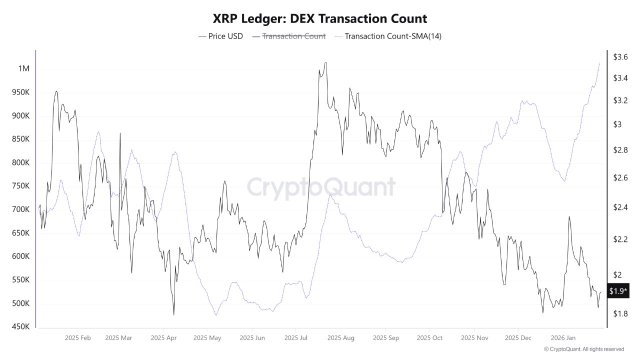
Source: Chart from Xaif Crypto on X

Xaif Crypto stated that this massive transaction count is not just a mere spike; it signals sustained momentum for the Ledger. Currently, the network is witnessing a fresh wave of liquidity and real user engagement. As a result, the expert declares that the Ledger is heating up in 2026.

This milestone comes as the XRP Ledger rolls out a new Lending Protocol (XLS-66), which is attracting institutional-grade credit to the network. With the new Lending Protocol, the Ledger is now evolving into a full financial layer with Rippled 3.1.0.

The protocol includes the ability to create loans on the Ledger, with loan brokers being able to generate fixed-term and fixed-rate, uncollateralized loans. These loans are predictable for professional use.

In addition, these loans are held in a Single Asset Vault, allowing risk-isolated liquidity. Another feature is the off-chain underwriting for uncollateralized options. It boasts native efficiency, which offers low-cost lending without a middleman or intermediaries. In the meantime, Decentralized Finance (DeFi) on the Ledger has just undergone a boost.

The Lending Protocol Gains Institutional Support

Following its historical launch a few days ago, the new XRP Lending Protocol is now experiencing significant support from institutional-level investors. One of the earliest companies to interact with the new protocol is Evernorth, a leading public treasury company.

According to BankXRP, the company is backing the native lending protocol to help transition a $100 billion market cap into a productive, yield-bearing ecosystem. These kinds of moves are an indication that the future of institutional DeFi is becoming native-driven.

XRP trading at $1.75 on the 1D chart | Source: XRPUSDT on Tradingview.com

Related Questions

QWhat key milestone did the XRP Ledger DEX recently achieve according to the article?

AThe XRP Ledger DEX activity recently reached a 13-month high, with the number of transactions on the 14-day moving average rising to approximately 1.014 million, breaking the ceiling that held throughout all of 2025.

QWho reported the surge in XRP Ledger DEX activity and on which platform?

AThe surge was reported by Xaif Crypto, a market expert and investor, on the X platform.

QWhat major new protocol has the XRP Ledger recently rolled out that is attracting institutional interest?

AThe XRP Ledger has rolled out a new Lending Protocol (XLS-66), which is attracting institutional-grade credit to the network.

QWhat is one of the key features of the new XRP Lending Protocol mentioned in the article?

AOne key feature is the ability to create fixed-term and fixed-rate, uncollateralized loans that are held in a Single Asset Vault, allowing for risk-isolated liquidity.

QWhich company was mentioned as one of the earliest institutional supporters of the new XRP Lending Protocol?

AEvernorth, a leading public treasury company, was one of the earliest companies to interact with and back the new XRP Lending Protocol.

Related Reads

Is Crypto Over? Don't Give Up, Liquidity Relief Is Coming

The article "Is Crypto Over? Don't Give Up, Liquidity is Coming" by Raoul Pal addresses the current downturn in the crypto market, arguing it is not a sign of the industry's demise but a temporary liquidity crisis. Pal refutes the narrative that crypto has permanently decoupled from other assets by showing that Bitcoin's price chart is nearly identical to that of the SaaS index, indicating a shared, external factor: a shortage of U.S. dollar liquidity. He explains this was caused by a combination of events, including the draining of the Reverse Repo facility, the rebuilding of the Treasury General Account (TGA) without monetary offset, and government shutdowns. This liquidity drain negatively impacted risk assets like crypto and tech stocks, while gold absorbed the marginal liquidity. The key takeaway is that this period of illiquidity is ending. The impending resolution of the U.S. government shutdown is seen as the final obstacle. Once cleared, a significant injection of liquidity is expected from sources like the easing of the SLR rule, TGA drawdowns, fiscal stimulus, and eventual rate cuts. Pal, alongside analysis from Stanley Druckenmiller, suggests the new Fed leadership under a potential Warsh chairmanship would be focused on cutting rates to keep the economy hot, aligning with a pro-growth strategy from the administration. The author admits a mistake in not prioritizing U.S. liquidity as the dominant short-term driver over global liquidity but remains highly bullish on the long-term cycle into 2026. The core advice for investors is patience, emphasizing that in a full cycle, time is more important than price. The message is clear: the liquidity cavalry is on its way.

marsbit32m ago

Is Crypto Over? Don't Give Up, Liquidity Relief Is Coming

marsbit32m ago

Is Crypto Over? Don't Give Up, Liquidity Relief Is Coming

The article "False Narratives....and Other Thoughts" by Raoul Pal addresses the current downturn in the crypto market, arguing against the mainstream narrative that the crypto cycle is over. Pal explains that the recent price decline in Bitcoin and other cryptocurrencies is not an isolated event but is correlated with a similar drop in SaaS stocks, as shown by comparative charts. He identifies the root cause as a temporary liquidity squeeze in the U.S. financial system, exacerbated by government shutdowns, TGA (Treasury General Account) rebuilding without monetary offset, and gold absorbing marginal liquidity that would otherwise support risk assets like crypto. Pal emphasizes that this liquidity crunch is temporary. He anticipates a resolution to the government shutdown soon, which will remove the last major obstacle to liquidity recovery. Following this, he expects a return of liquidity through measures such as eSLR adjustments, TGA drawdowns, fiscal stimulus, and eventual rate cuts. He advises investors to be patient, stressing that in a full market cycle, time is more critical than price movements. The article also corrects a misperception about potential Fed Chair Kevin Warsh, arguing he is not a hawk and would likely support rate cuts aligned with strategies to boost economic growth. Despite current market conditions, Pal remains highly optimistic about the crypto market's prospects through 2026, driven by anticipated pro-growth policies.

Odaily星球日报41m ago

Is Crypto Over? Don't Give Up, Liquidity Relief Is Coming

Odaily星球日报41m ago

Old Case Resurfaces: The 1011 Crash Sparks a Mixed Battle of Public Opinion Between Exchanges and Ecosystems

"Old Case Resurfaces: The 1011 Crash Sparks a Public Opinion Battle Between Exchanges and Ecosystems" Over the weekend, a wave of criticism targeting Binance reignited on X (formerly Twitter), centered on revisiting the "1011 Event" from October 11, 2023. The controversy was sparked by ARK Invest CEO Cathie Wood, who suggested in an interview that the crypto market's recent stagnation was an aftershock of a $28 billion leverage liquidation event caused by a system glitch on Binance. The 1011 Event was a major market crash where the global crypto market lost over $500 billion in value, with leverage liquidations surpassing $19 billion. Critics point to a liquidity anomaly on Binance during the crash, which triggered its Auto-Deleveraging (ADL) mechanism and caused massive, cascading liquidations. The exchange's high-yield USDe promotion was also cited as a contributing risk factor. Binance later paid approximately $283 million in compensation to affected users but maintained the sell-off was driven by broader market conditions. The criticism has evolved into a broader industry debate. A key figure in the accusatory camp is Leonidas, a founder in the Bitcoin Ordinals ecosystem, who has long criticized Binance's listing practices, alleging the exchange demands high token allocation fees from projects. More significantly, OKX founder Star (Xu Mingxing) entered the fray, arguing the 1011 crash fundamentally altered the market's microstructure. He claimed Binance's USDe promotion, which offered 12% APY and was treated as collateral, introduced massive systemic risk akin to a "tokenized hedge fund," not a stablecoin. The conflict also revealed underlying public chain competition. CZ unfollowed Solana co-founder Anatoly Yakovenko (Toly) after he shared Xu's critical post, hinting at the rivalry between Binance's BSC chain and Solana for meme coin liquidity. In Binance's defense, some analysts offered more neutral perspectives. Trader Benson and Dragonfly's Haseeb Qureshi argued that while Binance had some responsibility, the "USDe caused the crash" narrative doesn't align with the timeline, as the market bottomed before USDe depegged on Binance. They suggested a confluence of factors—including Trump's tariff comments, API issues preventing market makers from hedging, and a lack of circuit breakers—led to the crash. Amid the FUD, Binance announced it would convert the assets in its $1 billion SAFU insurance fund from stablecoins to Bitcoin. The article concludes that the intense scrutiny on Binance stems from its dominant size, meaning any structural industry problem will manifest there first. The core of the debate is not just assigning blame for one event, but whether the leading exchange will assume a higher responsibility for market stability.

marsbit52m ago

Old Case Resurfaces: The 1011 Crash Sparks a Mixed Battle of Public Opinion Between Exchanges and Ecosystems

marsbit52m ago

Trading

Spot
Futures

Hot Articles

T Nasıl Satın Alınır

HTX.com’a hoş geldiniz! Threshold Network Token (T) satın alma işlemlerini basit ve kullanışlı bir hâle getirdik. Adım adım açıkladığımız rehberimizi takip ederek kripto yolculuğunuza başlayın. 1. Adım: HTX Hesabınızı OluşturunHTX'te ücretsiz bir hesap açmak için e-posta adresinizi veya telefon numaranızı kullanın. Sorunsuzca kaydolun ve tüm özelliklerin kilidini açın. Hesabımı Aç2. Adım: Kripto Satın Al Bölümüne Gidin ve Ödeme Yönteminizi SeçinKredi/Banka Kartı: Visa veya Mastercard'ınızı kullanarak anında Threshold Network Token (T) satın alın.Bakiye: Sorunsuz bir şekilde işlem yapmak için HTX hesap bakiyenizdeki fonları kullanın.Üçüncü Taraflar: Kullanımı kolaylaştırmak için Google Pay ve Apple Pay gibi popüler ödeme yöntemlerini ekledik.P2P: HTX'teki diğer kullanıcılarla doğrudan işlem yapın.Borsa Dışı (OTC): Yatırımcılar için kişiye özel hizmetler ve rekabetçi döviz kurları sunuyoruz.3. Adım: Threshold Network Token (T) Varlıklarınızı SaklayınThreshold Network Token (T) satın aldıktan sonra HTX hesabınızda saklayın. Alternatif olarak, blok zinciri transferi yoluyla başka bir yere gönderebilir veya diğer kripto para birimlerini takas etmek için kullanabilirsiniz.4. Adım: Threshold Network Token (T) Varlıklarınızla İşlem YapınHTX'in spot piyasasında Threshold Network Token (T) ile kolayca işlemler yapın.Hesabınıza erişin, işlem çiftinizi seçin, işlemlerinizi gerçekleştirin ve gerçek zamanlı olarak izleyin. Hem yeni başlayanlar hem de deneyimli yatırımcılar için kullanıcı dostu bir deneyim sunuyoruz.

176 Total ViewsPublished 2024.12.10Updated 2025.03.21

Discussions

Welcome to the HTX Community. Here, you can stay informed about the latest platform developments and gain access to professional market insights. Users' opinions on the price of T (T) are presented below.

活动图片