Ripple’s RLUSD Lands In Mastercard’s Stablecoin Settlement Expansion

bitcoinistPublished on 2026-06-04Last updated on 2026-06-04

Abstract

Mastercard is expanding its stablecoin settlement capabilities, adding Ripple's RLUSD alongside other regulated stablecoins like USDC and PYUSD. This move allows issuers and acquirers to settle card transactions using digital assets on various blockchains, including Ethereum, Solana, and the XRP Ledger. The enhancement introduces intraday, weekend, and holiday settlement options, aiming to provide more flexibility, especially for cross-border payments and treasury operations. Mastercard positions this as a network-level addition that complements existing processes, with initial support focused on the US and Latin America. Ripple views RLUSD's inclusion as validation for regulated stablecoins in institutional payment infrastructure, highlighting the growing demand for faster, always-on settlement.

Mastercard is moving deeper into stablecoin infrastructure, adding Ripple’s RLUSD to a broader settlement expansion that will allow issuers and acquirers to settle card transactions through regulated digital assets alongside traditional fiat rails.

The payments giant said Wednesday that it plans to expand its settlement capabilities with intraday, weekend and holiday settlement options, as well as on-chain card settlement using regulated stablecoins. The move is designed to give Mastercard partners more flexibility in how and when they settle transactions across its global payments network, with particular relevance for cross-border payments, treasury operations and payouts.

Ripple Scores Mastercard Settlement Role

For Ripple, the key development is the inclusion of RLUSD among the stablecoins Mastercard plans to support. According to the announcement, Mastercard will enable settlement using Circle’s USDC, Paxos-issued stablecoins including PYUSD, USDG and USDP, Ripple’s RLUSD and SoFi’s SoFiUSD. These assets will be supported across a range of blockchain networks, including Arbitrum, Base, Canton, Ethereum, Polygon, Solana, Tempo and the XRP Ledger.

The announcement places RLUSD inside one of the most closely watched institutional use cases for stablecoins: settlement. Rather than positioning stablecoins primarily as trading instruments or exchange liquidity tools, Mastercard is framing them as part of the back-end financial infrastructure that can support faster money movement between issuers, acquirers and merchants.

“The next phase of stablecoin adoption is about real-world utility, especially in settlement, where timing and liquidity matter most,” said Raj Dhamodharan, executive vice president for Blockchain and Digital Assets at Mastercard. “By introducing intraday and weekend on settlement options across our global network, we’re expanding how partners manage liquidity and operate in an always-on digital economy while maintaining the trust, resilience and safeguards they expect from Mastercard.”

Mastercard said the stablecoin settlement option will sit alongside existing processes, rather than replace them. The company described the expansion as a “network-level enhancement” intended to preserve existing security standards, fraud safeguards and dispute processes while adding digital asset-based settlement as another choice for partners.

Initial support is expected from ARQ, formerly known as DolarApp, CBW Bank, Cross River, Lead Bank and Nuvei, with early focus on the United States and Latin America. Mastercard said further expansion is planned through 2026, subject to regulation, with additional regions, partners and regulated stablecoins expected over time.

Ripple framed the inclusion of RLUSD as validation for regulated stablecoins built for institutional payment flows. Jack McDonald, Ripple’s senior vice president of stablecoins, said Mastercard’s move into on-chain settlement marks “a landmark validation that blockchain technology is ready for the world’s most critical payment infrastructure.”

“RLUSD’s inclusion in Mastercard’s global settlement network reflects growing demand for trusted, regulated stablecoins built for real-world financial use cases on public blockchains like the XRP Ledger,” McDonald added. “We’re excited to support the next evolution of faster, more flexible, always-on settlement.”

Other stablecoin issuers and banking partners echoed that view, focusing on liquidity management and the limits of traditional settlement windows. Circle’s chief commercial officer Kash Razzaghi said demand is growing for infrastructure that can operate beyond banking hours, while Cross River’s Luca Cosentino said stablecoins have emerged as “a powerful tool” for faster and more transparent settlement.

At press time, XRP traded at $1.24.
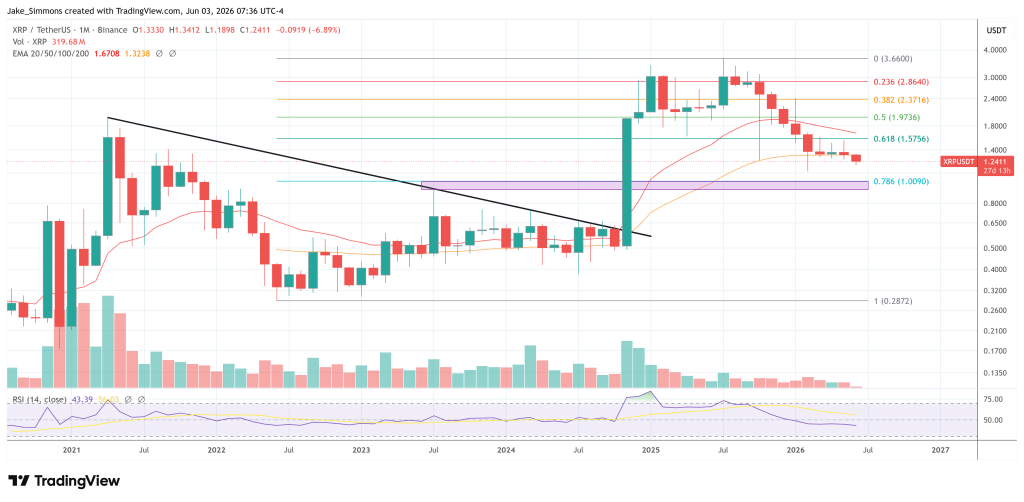
XRP falls below the 50-week EMA, 1-month chart | Source: XRPUSDT on TradingView.com

Related Questions

QWhat is the main announcement made by Mastercard in the article?

AMastercard is expanding its settlement capabilities to include on-chain settlement using regulated stablecoins, including Ripple's RLUSD, alongside traditional fiat methods. This will offer intraday, weekend, and holiday settlement options for its partners.

QWhich stablecoins are specifically mentioned as being supported by Mastercard's new settlement expansion?

AThe stablecoins mentioned are Circle's USDC, Paxos-issued stablecoins (PYUSD, USDG, USDP), Ripple's RLUSD, and SoFi's SoFiUSD.

QAccording to Raj Dhamodharan of Mastercard, what is the next phase of stablecoin adoption about?

ARaj Dhamodharan stated that the next phase of stablecoin adoption is about real-world utility, especially in settlement, where timing and liquidity matter most.

QHow does Mastercard describe the role of the new stablecoin settlement option in relation to its existing processes?

AMastercard said the stablecoin settlement option will sit alongside existing processes as a 'network-level enhancement,' adding it as another choice for partners rather than replacing current methods. It is intended to preserve existing security and fraud safeguards.

QWhat significance does Ripple attribute to RLUSD's inclusion in Mastercard's network, according to Jack McDonald?

AJack McDonald stated that RLUSD's inclusion reflects growing demand for trusted, regulated stablecoins built for real-world financial use cases. He called Mastercard's move a 'landmark validation' that blockchain technology is ready for critical payment infrastructure.

Related Reads

STRC Breaks Below $95: Why Does It Continue to Depeg? Is There Default Risk?

"STRC Falls Below $95: Why the Persistent Depegging and Is There Default Risk?" The article discusses the recent decline in the price of STRC, a perpetual preferred stock issued by Strategy (MSTR) designed to trade around a $100 par value. As of publication, STRC traded at $94.65, raising market concerns. STRC is described as a high-yield cash flow product, offering an 11.50% annual dividend paid monthly. Its "preferred" status grants it priority over common stock for dividends and in liquidation. Key reasons cited for the price depegging include: 1. **Bitcoin's Price Drop:** MSTR's assets are heavily tied to Bitcoin (BTC), which fell over 21% from its recent high, pressuring all Strategy-related products. 2. **Competitive Pressure:** Rival Strive Asset Management's similar product, SATA, offers daily dividends and has maintained its $100 par value with a ~13% yield. In response, Strategy has proposed changing STRC's dividend frequency from monthly to bi-weekly, pending shareholder vote. 3. **Technical Selling:** A break below $100 may have triggered algorithmic selling and stop-losses, exacerbating the decline. Regarding default risk, the analysis suggests it is currently low. Strategy founder Michael Saylor confirmed the June 2026 dividend rate remains at 11.50% with no cuts or suspensions. The company's massive reserve of 843,706 BTC provides a significant backstop for its obligations. Industry opinions are mixed. Some analysts view the BTC holdings as reliable support for dividends, while critics like Peter Schiff warn of potential dividend cuts leading to price crashes and lawsuits. Others highlight inflation risk and the company's ability to reduce dividends without a formal default. In summary, STRC's drop is attributed to BTC volatility, competition, and technical factors. While immediate default risk appears contained, the product faces challenges from market conditions and competitive dynamics.

marsbitHá 1h

STRC Breaks Below $95: Why Does It Continue to Depeg? Is There Default Risk?

marsbitHá 1h

AI Trading Cools, South Korean Stocks Plunge 1.8%, Spot Gold Rises 1%, Bitcoin Dives

A sell-off in AI-related stocks, triggered by Broadcom's disappointing earnings forecast, sent shockwaves through global markets. South Korea's KOSPI led Asia's decline, plunging 1.8% as the risks from concentrated chip stock gains and surging leveraged investments came to the fore. The tech-heavy Nasdaq 100 futures fell 0.5% following Broadcom's 14% after-hours plunge, which signaled a slower-than-expected transition to AI clients. This pullback extended Wall Street's weakness, halting the S&P 500's nine-day rally amid hawkish Fed signals and renewed Middle East tensions. South Korean authorities convened an emergency meeting, pledging "immediate measures" against market volatility and warning of record-high stock margin debt. The adjustment rippled across assets: Bitcoin fell to around $64,000, its lowest since February, while safe-haven gold rose 1% on bargain hunting. Oil prices dipped on Middle East ceasefire news. Market analysts noted the sell-off was driven by profit-taking after massive gains, particularly in chip stocks like Samsung and SK Hynix, which now dominate the KOSPI. Wall Street banks are divided on Korea's outlook, with Goldman Sachs raising its target while Citigroup and others warn of overvaluation and a potential bubble. Bridgewater's Ray Dalio noted that great technological shifts often create bubbles. Meanwhile, Fed officials' hints at potential future rate hikes added to the cautious mood ahead of key U.S. jobs data.

华尔街日报Há 2h

AI Trading Cools, South Korean Stocks Plunge 1.8%, Spot Gold Rises 1%, Bitcoin Dives

华尔街日报Há 2h

Trading

Spot
Futures

Hot Articles

Discussions

Welcome to the HTX Community. Here, you can stay informed about the latest platform developments and gain access to professional market insights. Users' opinions on the price of S (S) are presented below.

活动图片