Charity in Name, Family Gain in Reality: How the Trump Family Turns Philanthropy into Profit?

链捕手Опубліковано о 2026-06-17Востаннє оновлено о 2026-06-17

Анотація

Summary: The article examines how the Trump family, particularly Eric Trump, has allegedly leveraged charitable and business ventures for financial gain. It details the operations of Eric's children's cancer charity (now Curetivity), which, despite donating over $25 million to St. Jude, reportedly funneled at least $500,000 back to Trump-owned properties for event costs between 2011-2016. These transactions, often undisclosed, involved clear conflicts of interest with Trump Organization employees on the board. Following media scrutiny and a state investigation, the charity reformed but continued holding costly fundraisers at Trump venues. The piece draws parallels to Eric's role at cryptocurrency company American Bitcoin (ABTC), where he promoted unrealistic mining cost savings. Investigative reporting revealed most Bitcoin was acquired through share dilution, with actual costs far higher than claimed, contributing to a ~90% stock price drop and significant investor losses, while insiders like Eric retained substantial wealth. The pattern identified involves using misleading rhetoric, opaque accounting, and legal strategies to navigate controversies, often deflecting criticism as political attacks before resuming operations with minimal substantive change.

Author: Chloe, ChainCatcher

Last month, just hours before attending a state banquet with King Charles III, Eric Trump, the former president's second son, posted a five-paragraph defense of himself on X. The trigger was a controversy surrounding his involvement in a publicly-traded cryptocurrency company called "American Bitcoin," which he had been pitching to investors as capable of mining Bitcoin at roughly half the market price. A Forbes report had debunked that claim.

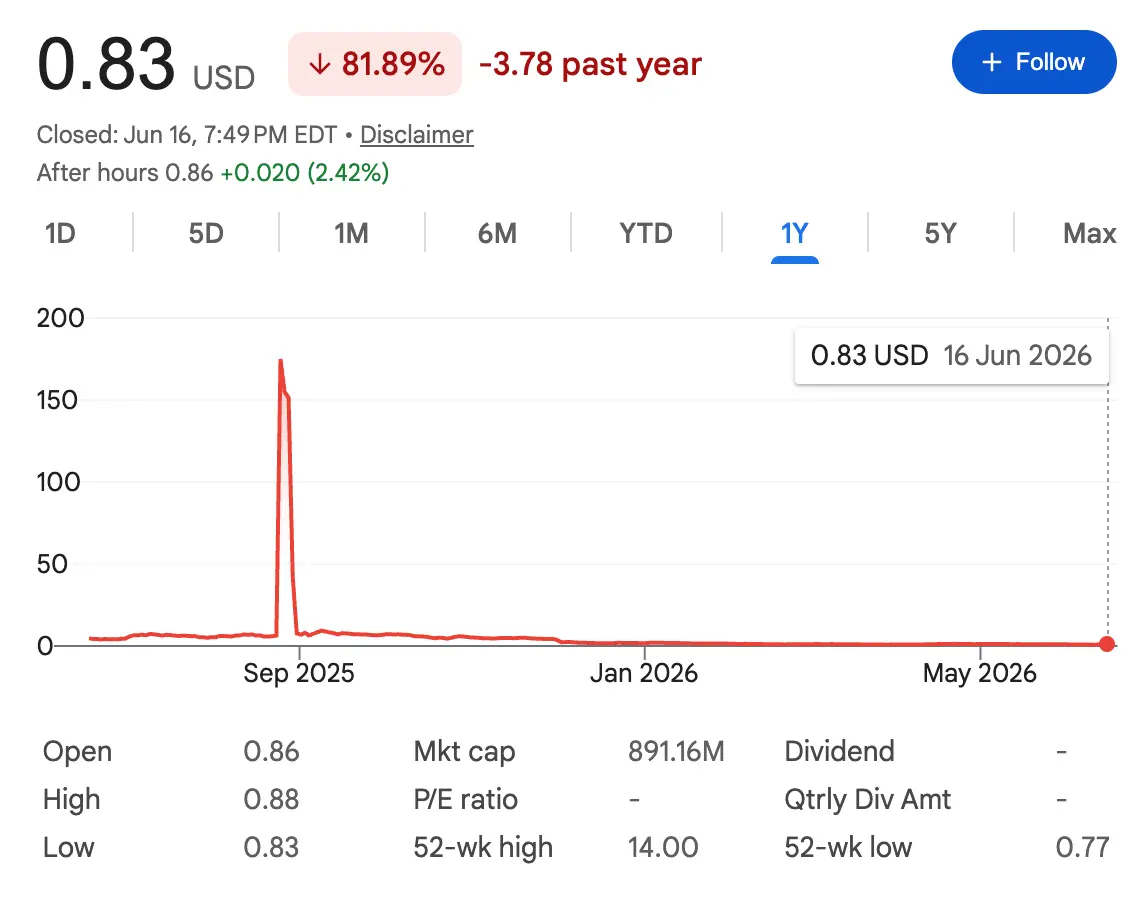
By June 17, 2026, the stock price of American Bitcoin (Nasdaq: ABTC) had fallen to about $0.83, a collapse of roughly 90% from its peak of around $175 at the end of last year and its $14 IPO price.
Then, Eric pivoted in his post to another matter weighing on him for nearly a decade: a 2017 Forbes investigation into his childhood cancer charity foundation. He wrote that the outside attacks were "insanity," as he was merely a young man "trying with all my heart to save dying children."

It is undeniable that he performed good deeds. Over the years, the foundation donated over $25 million to St. Jude Children's Research Hospital in Tennessee, operating with lean overhead, focused on fundraising while outsourcing the complex execution to others. However, its other side involves misleading rhetoric, sloppy accounting, a board entangled with interests, and unapologetic loyalty to Trump. The same playbook is now evident in the crypto industry.

The Trump Family's Habit of Emerging Unscathed from Scandals

Through Freedom of Information Act requests, Forbes obtained thousands of pages of documents revealing that between 2011 and 2016, his foundation directed at least $500,000 in charitable funds back to the family business through a series of transactions, most of which never appeared on tax filings.

These documents also explain why the Trump family consistently emerges unscathed. Their playbook is: first, mount a loud defense on television or social media; then, deploy lawyers to bury paper trails; next, adjust practices just enough to appease regulators and avoid punishment, without fundamentally changing; once the storm passes, re-emerge unabashedly as victims, asking the public for trust again—and there are always plenty willing to believe.

Eric's foundation has played this exact script from start to finish: nine years after the scandal, the renamed entity is still operating, with fundraising expanding annually, annual expenses exceeding $500,000, and events almost exclusively held at Trump-branded venues.

Blatant Conflicts of Interest, Extending Even to the White House

The foundation's origins were indeed well-intentioned. It began with Eric and his wealthy friends wanting to do good. The 2007 application to the IRS even stated: "Our family has three golf courses in New York and New Jersey available for use." The application also promised not to sign leases with any company controlled by its leadership. This held true for the first three years, with annual expenses around $50,000 and fundraising in the hundreds of thousands.

But starting in 2010, Trump Organization employees began joining the board. The following year, expenses surged to $142,000. Former club manager Ian Gillule pointed the finger directly at Trump himself in an interview: in the early days, the foundation used venues for free, and invoices often vanished. Trump was unhappy not with "helping for free," but with donating so much without leaving any paper trail or credit. He then ordered that everyone, including his own son, be charged.

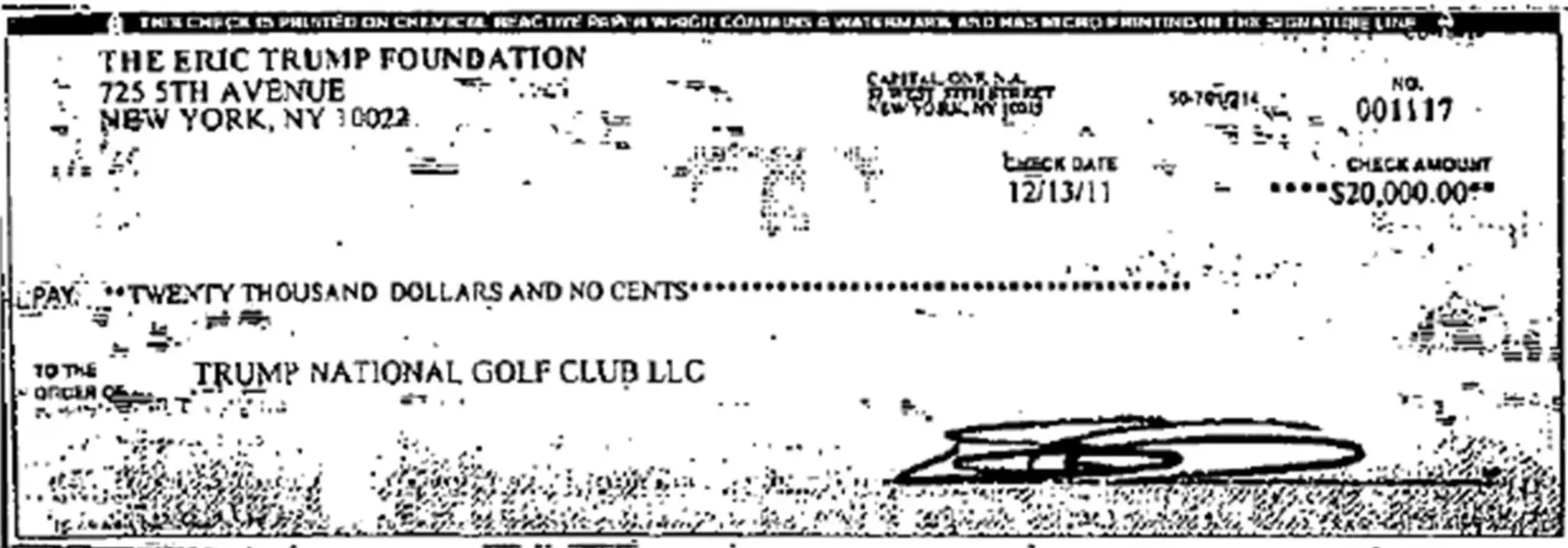
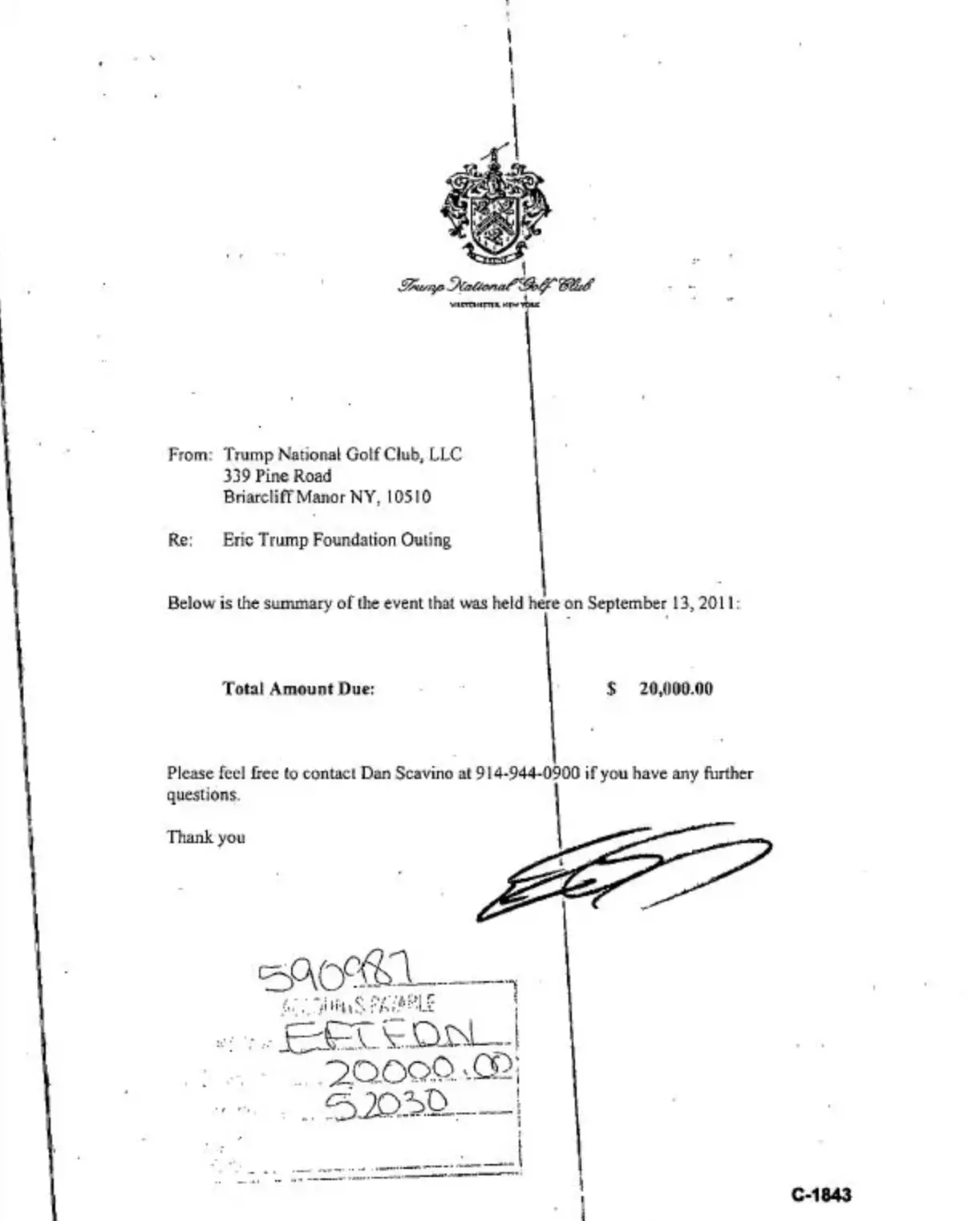
So, everyone got charged. After a 2011 event, Trump National Golf Club billed the foundation $20,000. The copy obtained by Forbes included a note: "If you have any questions, please call Dan Scavino." The conflict of interest was blatant: Dan Scavino, now White House Deputy Chief of Staff, was both the club's general manager and a foundation director at the time. The invoice also bore Eric's signature, though it's unclear in which capacity. Bills kept coming yearly: the club charged $100,000 in 2013, $99,000 in 2016, with Trump SoHo Hotel and Mar-a-Lago also taking a cut.
Toxic Candy Wrapped in Pretty Paper

"Dear Friends," Eric wrote in the 2014 fundraiser gala program, the foundation "boasts one of the lowest expense ratios in the world," insisting on using only Trump-owned venues, full-time volunteers, donated catering, and celebrity performers working pro bono, so that St. Jude received almost all proceeds.

But the books didn't match the rhetoric. The galas featured Hooters waitresses and mini Eric bobblehead dolls. Performers were mostly celebrities from "The Celebrity Apprentice." "They all performed for free," Eric claimed, yet checks he signed for performance fees totaled over $90,000. Auction items were "all donated," but the foundation spent at least $65,000 procuring them. In 2012, it even bought an item for $6,040 that sold for only $3,310. Transportation was another cost, with Sunny's alone charging over $35,000.

Furthermore, hundreds of thousands in donations flowed to other charities, several with closer ties to family interests than to childhood cancer; at least three also held fundraisers at Trump courses. In 2013, Eric even spent $1,600 of foundation funds to buy a decorative copper still and an antique bottle-washing machine near his family's winery. Of course, the foundation did donate large sums to St. Jude, increasing from $220,000 in 2007 to $2.9 million in 2016, the year of Trump's first election victory.

Eric as Victim, Feeling 'No Good Deed Goes Unpunished'

Politics soon thrust the foundation into the spotlight. In late 2016, Daily Beast and The Associated Press exposed its dealings with Trump clubs. The New York Times reported an investment manager bid nearly $60,000 at a fundraiser auction for a coffee with Ivanka Trump. The issues weren't just PR: under New York state and federal law, such related-party transactions required board votes, documentation, and disclosure on tax returns.

So Eric decided to restructure, distancing the foundation from the family: all Trump Organization employees left the board, including himself. He said his father's administration required avoiding "perception problems," and he would not personally fundraise until after his term. The foundation was renamed Curetivity, pledging all donations would go to St. Jude. Superficially, it seemed a return to its roots. But Eric remained unapologetic, telling Forbes a month after the board overhaul: "We use the best venues in the world 100% free, which is why our expense ratio is the lowest in history."

The day the article published, he appeared on Fox News, framing the scrutiny as a political witch hunt, casting himself as a victim. "I raised tens of millions of dollars, and what do I get in return? Hate."

Two days later, the Attorney General's office sent a letter requesting the books. The investigation took a toll: 2017 donations plummeted by over two-thirds, falling below $1 million, while administrative and legal costs soared from near zero to about $50,000 annually. By year-end, the AG's office wrote again, highlighting numerous issues: financial reports not conforming to accounting standards, ignoring related-party transaction rules, misleading marketing, and threatening to revoke its fundraising license.

Thereafter, the books became increasingly opaque. After Eric left the board, the occasional "related party transaction" label disappeared. The "rent/venue fees" line was often left blank. Fundraising expenses dropped from $384,000 in 2016 to $111,000 in 2017. By late 2018, when the AG's office indicated the investigation was shifting to compliance rather than enforcement, Eric re-emerged, returning to promotional materials and eventually being dubbed Curetivity's "founder." Fundraising expenses rebounded, hitting a new high of $392,000 in 2019. How much flowed back to the Trump Organization became unknowable under the murky accounting.

Today, fundraisers continue one after another at Trump-branded venues: $309,000 spent at Mar-a-Lago in 2020, with recent events held at Trump courses in North Carolina and Jupiter, Florida. If charges are similar to before, Curetivity alone could funnel around $200,000 annually into Trump's business empire, totaling over a million in two decades.

The Same Playbook Moved to Crypto

This playbook of "smooth talk, value flowing back to insiders" didn't stop at the charity foundation; it's now almost entirely replicated at American Bitcoin.

Previously, Eric packaged the company as a "money-printing machine," publicly claiming it could mine at a 53% discount to spot prices, with a cost per Bitcoin of about $57,000. It sounds strikingly similar to the foundation's "lowest expense ratio in the world." But just like the charity foundation, the books tell a different story.

The investigation was led by the same Forbes reporter, Dan Alexander, who exposed the foundation nine years ago. He found that about 70% of the company's Bitcoin wasn't mined; it was acquired by continuously issuing new shares and buying on the open market. Factoring in depreciation and SG&A, the all-in cost per coin neared $90,000, far above the $57,000 Eric claimed.

Now, the stock has crashed about 90% from its late-2025 peak of ~$175 and its $14 IPO price. Retail investors are estimated to have lost about $5 billion collectively. Financially, it's bleeding: a net loss of approximately $81.8 million in Q1 2026. Meanwhile, on the insider side, the view is completely different.

The founders originally acquired shares at near-zero cost. Even with the 90% stock drop, Eric's personal stake is still worth about $70 million; during the same period, his estimated net worth rose to around $300 million. The post-scandal script is also familiar. Facing质疑, Eric didn't directly address Forbes's calculated costs and dilution. Instead, he countered with impressive numbers like quarterly revenue growth and holdings exceeding 7,000 Bitcoins, lashing out on X that Forbes had become a political weapon and a disgrace to journalism.

Last September, Eric stood at the center of a party at the Westchester Country Club, hosting Curetivity's 19th fundraiser, surrounded by key business partners. Since his father's re-election, his estimated net worth has skyrocketed from around $40 million in 2024 to $300 million today.


Трендові криптовалюти

Пов'язані питання

QWhat were the main findings regarding the financial relationship between Eric Trump's charity foundation and the Trump Organization, according to the article?

AThe article states that through Freedom of Information Act requests, *Forbes* uncovered documents showing that between 2011 and 2016, Eric Trump's foundation diverted at least $500,000 in donations back to Trump family businesses through a series of transactions. These financial flows were largely absent from tax filings. The foundation paid substantial fees to Trump-owned venues like Trump National Golf Club, Trump SoHo hotel, and Mar-a-Lago for hosting its fundraising events.

QHow did Eric Trump respond to the *Forbes* investigation into his American Bitcoin company's mining cost claims?

AIn response to the *Forbes* article that challenged his claims about American Bitcoin's low mining costs, Eric Trump did not directly address the specific calculations regarding costs and share dilution. Instead, he defended the company by highlighting positive metrics like quarterly revenue growth and holdings of over 7,000 bitcoins. He also attacked *Forbes* on social media platform X, calling it a political weapon and a disgrace to journalism.

QWhat actions did the New York Attorney General's office take regarding Eric Trump's charity foundation, and what was the outcome?

AFollowing media reports, the New York Attorney General's office launched an investigation, requesting the foundation's books. The investigation identified several issues, including financial statements not conforming to accounting standards, disregard for rules on related-party transactions, and misleading marketing. The office threatened to revoke the foundation's fundraising license. By the end of 2018, the office informed the foundation that the inquiry was shifting towards compliance rather than enforcement action. Subsequently, Eric Trump returned to a prominent role in the renamed foundation, Curetivity.

QAccording to the article, what is the common pattern or 'playbook' used by the Trump family in handling controversies?

AThe article describes a recurring pattern: first, respond loudly on TV or social media to defend themselves. Then, use lawyers to bury paper records. Next, adjust practices just enough to appease regulators and avoid punishment, without changing the core behavior. Once the controversy subsides, they re-emerge portraying themselves as victims, asking for public trust again—a strategy that often finds a willing audience.

QHow does the article draw a parallel between Eric Trump's charity operations and his involvement in the cryptocurrency company American Bitcoin?

AThe article draws a parallel by stating that the playbook of 'pretty talk and value flowing back to the family' used in the charity foundation was almost copied verbatim into American Bitcoin. Similar to claiming the foundation had 'one of the lowest expense ratios in the world,' Eric Trump promoted the crypto company as a 'money-printing machine' that could mine bitcoin at a significant discount. In both cases, the article claims the actual account books did not match the rosy public claims, with hidden costs and benefits flowing to insiders.

Пов'язані матеріали

A Country That Has Been Mining Bitcoin for 8 Years Establishes Its Own Dedicated Crypto Bank

Bhutan, a small Himalayan nation known for prioritizing Gross National Happiness over GDP, has established a dedicated crypto bank after eight years of Bitcoin mining. The DK Bank, located in the Gelephu Mindfulness City (GMC) Special Administrative Region, aims to fill the persistent banking gap for the crypto industry. Unlike traditional banks that often reject crypto firms or only handle their fiat transactions, DK Bank offers integrated multi-currency accounts where users can manage both fiat currencies and stablecoins like USDT and USDC, alongside services such as Bitcoin-backed loans. The bank operates under a unique "one country, two systems" governance model in GMC, which is designed to become a financial hub for South Asia. Its regulatory framework is modeled on Singapore's common law and Abu Dhabi Global Market's (ADGM) rules, offering a fast-track licensing process for firms already licensed in those jurisdictions. DK Bank and GMC authorities emphasize stringent, real-time on-chain and off-chain transaction monitoring to mitigate risks associated with anonymity in crypto. This move is part of Bhutan's longer-term strategic pivot toward institutional crypto services—including mining, custody, and asset management—rather than retail-focused speculative tokens. Officials stress diversification within the blockchain ecosystem to hedge against volatility in assets like Bitcoin. The development of supporting infrastructure, including an international airport managed by Singapore's Changi operator, is ongoing, with completion targeted for 2029. The initiative represents Bhutan's attempt to position itself at the forefront of the shift of global financial services on-chain, leveraging its early experience and a stated ethos of orderly and mindful progress.

marsbit20 хв тому

A Country That Has Been Mining Bitcoin for 8 Years Establishes Its Own Dedicated Crypto Bank

marsbit20 хв тому

Market Trends in US Stocks (June 18): Walsh's Pivot Ignites Broad Sell-Off, SpaceX Suffers First Drop, Semiconductors Sole Safe Haven

**U.S. Market Trends (June 18): Wash Sparks Full-Scale Sell-off; SpaceX's First Drop, Semiconductors the Only Safe Haven** Markets plunged after the June FOMC meeting. The "dot plot" revealed a hawkish shift, with half the officials projecting at least one rate hike in 2024. New Fed Chair Wash, in his press conference, announced the abandonment of forward guidance, stating he "can't tell you what the next step will be." This policy uncertainty triggered a broad sell-off. All major indices fell over 1%, with the S&P 500 down 1.21%. The VIX volatility index jumped 12%. Treasury yields spiked, and the dollar surged to a two-month high, while gold erased its weekly gains. The sell-off was led by rate-sensitive sectors. Meta plunged over 5%, leading the Magnificent 7 lower. SpaceX closed down ~5%, marking its first decline since its IPO, as valuation pressure from higher rate expectations took hold. The sole market bright spot was semiconductors. The Philadelphia Semiconductor Index rose 1.38%, with Applied Materials, Lam Research, and Arm Holdings all posting significant gains. The narrative held that long-term AI computing demand remains intact, driving a rotation of funds from high-valuation software/internet stocks into infrastructure and equipment names. Retail sales data came in strong, and EIA crude inventories fell sharply, supporting the view of persistent inflation and limiting the Fed's scope for easing. Traders fully priced in a rate hike by October, with September seen as likely. In summary, Chair Wash's debut dismantled the market's traditional policy anchors, injecting new uncertainty. While the AI investment thesis provided pockets of resilience in semiconductors, the repricing of rate-sensitive, high-valuation technology stocks appears to have just begun under the new "hawkish reset" framework.

marsbit40 хв тому

Market Trends in US Stocks (June 18): Walsh's Pivot Ignites Broad Sell-Off, SpaceX Suffers First Drop, Semiconductors Sole Safe Haven

marsbit40 хв тому

3B Small Model's Programming Scores Rival Opus 4.5, Mysterious Model Sparks Heated Discussion, Turns Out to be Domestic

A 3B parameter dense reasoning model named VibeThinker-3B has gained significant attention for achieving performance comparable to leading models like Gemini 3 Pro, GPT-5 high, and Claude Opus 4.5 in verifiable reasoning tasks such as programming, mathematics, and STEM problem-solving, despite its significantly smaller size. Developed by Sina Weibo's team, the model is built upon Qwen2.5-Coder-3B. Its training employs an upgraded Spectrum-to-Signal pipeline, featuring a curriculum-based two-stage supervised fine-tuning (SFT), multi-domain reinforcement learning (RL) inspired by MGPO, offline self-distillation, and instruction RL to enhance controllability. A key innovation is the Claim-Level Reliability (CLR) assessment, a test-time scaling strategy that further boosts performance on math benchmarks. The model excels in specific, verifiable domains, scoring highly on tests like AIME26 (94.3/97.1 with CLR) and LiveCodeBench v6 (80.2 Pass@1). However, it performs less impressively in areas requiring broad general knowledge. The authors propose a "parameter compression coverage hypothesis," suggesting that verifiable reasoning abilities—reliant on multi-step logic and feedback—are highly compressible, while open-domain knowledge depends more on large-scale parameters. VibeThinker-3B demonstrates that small models, when specialized for tasks with clear verification signals, can reach frontier performance, offering a complementary research path to scaling model size. The model is publicly available for download and testing.

marsbit1 год тому

3B Small Model's Programming Scores Rival Opus 4.5, Mysterious Model Sparks Heated Discussion, Turns Out to be Domestic

marsbit1 год тому

Торгівля

Спот
Ф'ючерси

Популярні статті

Як купити GAIN

Ласкаво просимо до HTX.com! Ми зробили покупку GriffinAI (GAIN) простою та зручною. Дотримуйтесь нашої покрокової інструкції, щоб розпочати свою криптовалютну подорож.Крок 1: Створіть обліковий запис на HTXВикористовуйте свою електронну пошту або номер телефону, щоб зареєструвати обліковий запис на HTX безплатно. Пройдіть безпроблемну реєстрацію й отримайте доступ до всіх функцій.ЗареєструватисьКрок 2: Перейдіть до розділу Купити крипту і виберіть спосіб оплатиКредитна/дебетова картка: використовуйте вашу картку Visa або Mastercard, щоб миттєво купити GriffinAI (GAIN).Баланс: використовуйте кошти з балансу вашого рахунку HTX для безперешкодної торгівлі.Треті особи: ми додали популярні способи оплати, такі як Google Pay та Apple Pay, щоб підвищити зручність.P2P: Торгуйте безпосередньо з іншими користувачами на HTX.Позабіржова торгівля (OTC): ми пропонуємо індивідуальні послуги та конкурентні обмінні курси для трейдерів.Крок 3: Зберігайте свої GriffinAI (GAIN)Після придбання GriffinAI (GAIN) збережіть його у своєму обліковому записі на HTX. Крім того, ви можете відправити його в інше місце за допомогою блокчейн-переказу або використовувати його для торгівлі іншими криптовалютами.Крок 4: Торгівля GriffinAI (GAIN)Легко торгуйте GriffinAI (GAIN) на спотовому ринку HTX. Просто увійдіть до свого облікового запису, виберіть торгову пару, укладайте угоди та спостерігайте за ними в режимі реального часу. Ми пропонуємо зручний досвід як для початківців, так і для досвідчених трейдерів.

438 переглядів усьогоОпубліковано 2025.09.24Оновлено 2026.06.02

Як купити GAIN

Обговорення

Ласкаво просимо до спільноти HTX. Тут ви можете бути в курсі останніх подій розвитку платформи та отримати доступ до професійної ринкової інформації. Нижче представлені думки користувачів щодо ціни GAIN (GAIN).

活动图片