Polkadot jumps 11% after channel breakout – Can DOT breach $1.686?

ambcryptoPublished on 2026-03-16Last updated on 2026-03-16

Abstract

Polkadot (DOT) surged over 11% in 24 hours, accompanied by a 78% increase in trading volume, signaling renewed buyer interest. The price broke out of a prolonged descending channel, reaching toward the $1.686 resistance level—a key barrier that could determine the next directional move. Technical indicators strengthened, with the RSI climbing to 57.51, indicating bullish momentum. Market data revealed aggressive buy-dominant order flow and strong accumulation pressure in spot markets. Additionally, top Binance traders showed a long-biased stance, with 61.66% holding long positions. A sustained break above $1.686 could open a path toward the $2.000 resistance zone.

Polkadot has surged over 11% in 24 hours as trading volume jumped nearly 78%, signaling renewed market activity as buyers returned aggressively to the DOT market.

Rising participation has accompanied the move toward the $1.59 region, suggesting that traders have stepped back into the market after weeks of subdued activity.

Increased liquidity has strengthened short-term price dynamics while expanding volatility across spot markets.

As a result, Polkadot [DOT] traded closer to an important resistance barrier that could influence the next directional move.

Descending channel breakout reshapes DOT structure

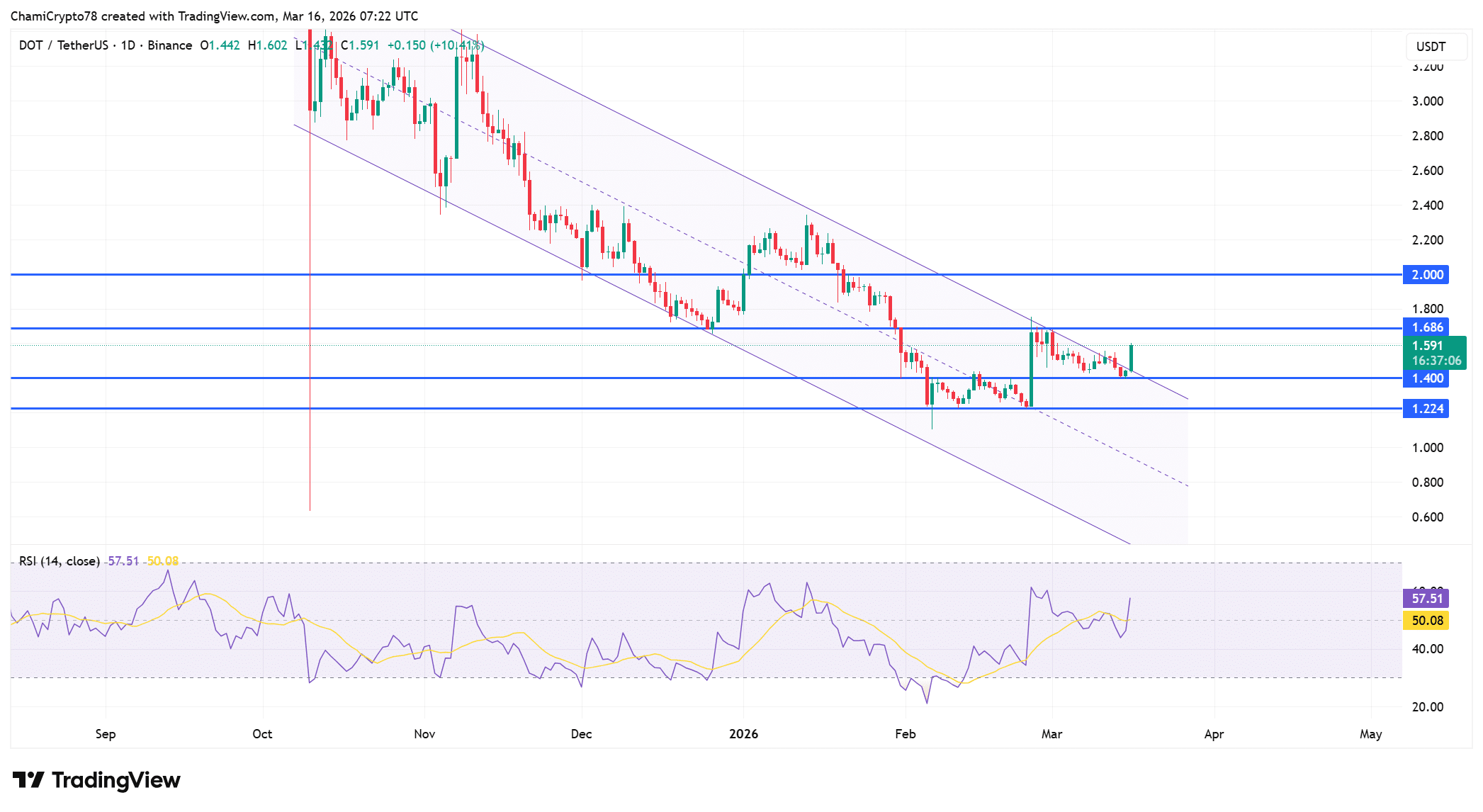
Price action reflected a notable structural shift after DOT had broken above a prolonged descending channel.

The breakout has followed the sharp rally that pushed the price toward the $1.686 resistance zone, placing the asset near a technical inflection point.

Earlier price compression inside the channel had restricted recovery attempts for months.

However, the recent surge has lifted the price above that declining boundary, signaling that bearish control has weakened considerably.

Technical indicators now reflect strengthening buyer activity as the RSI has climbed to 57.51, clearly above the 50 neutral threshold.

This shift suggests that demand has strengthened steadily following earlier weakness during the prolonged downtrend.

As buyers regained control of short-term price swings, the indicator has gradually advanced into bullish territory.

Meanwhile, DOT continued trading near $1.591, which places it between the $1.400 support level and the $1.686 resistance barrier.

Buyers have defended the lower zone repeatedly during recent sessions.

As a result, the breakout structure now attracts attention because a sustained push above $1.686 could open the path toward the $2.000 resistance region.
Source: TradingView

Buy-dominant order flow strengthens DOT demand

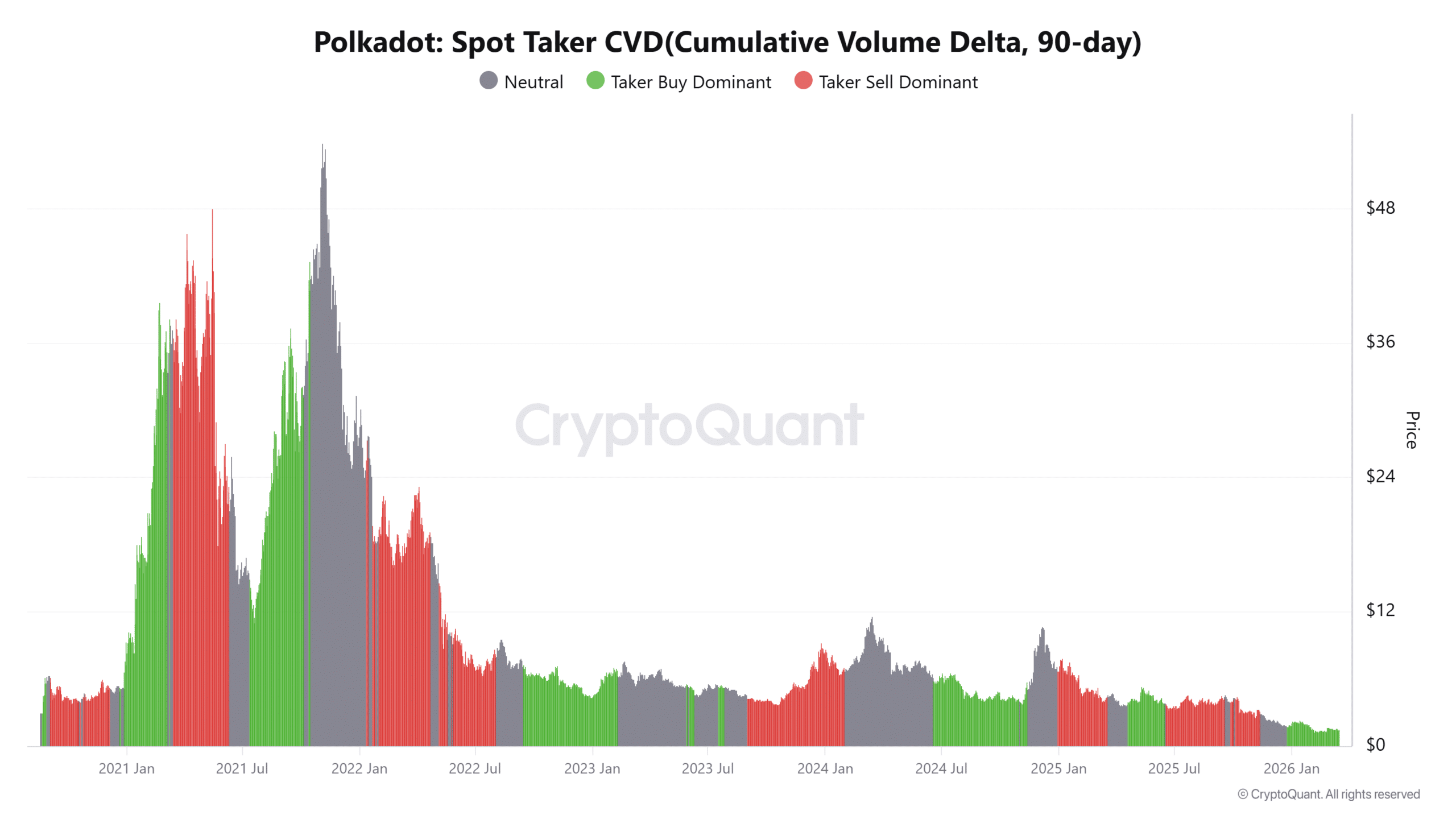
Market activity across spot exchanges now reflects strong buyer aggression as Spot Taker CVD has shifted into buy-dominant territory.

This metric tracks the cumulative difference between aggressive buy orders and sell orders, providing insight into trader conviction.

Recent readings suggest that market participants have increasingly executed buy orders at market prices rather than waiting for passive liquidity.

Such behavior often reflects stronger directional conviction among traders. In DOT’s case, this buyer-led order flow has emerged alongside rising trading activity and the recent price breakout.

As aggressive demand continues driving transactions, traders increasingly interpret the data as a signal that accumulation pressure has strengthened across spot markets.
Source: CryptoQuant

Top Binance traders lean heavily long on DOT

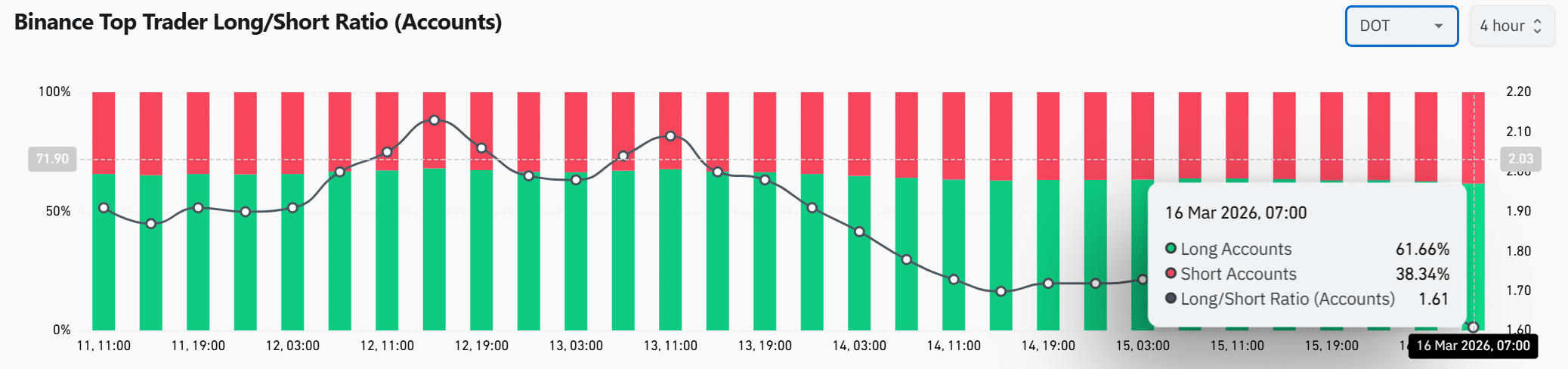
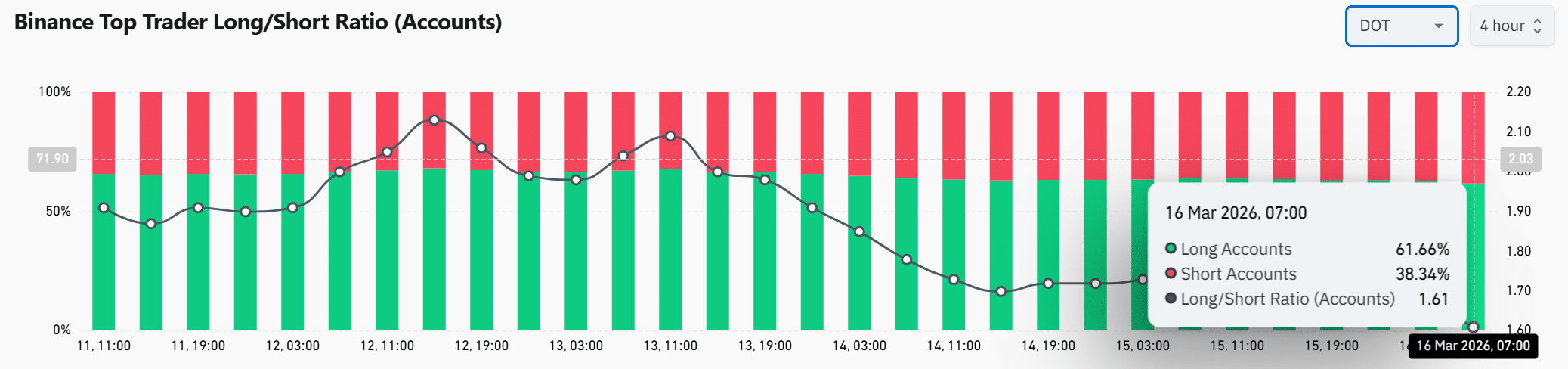
Data from CoinGlass on Binance Top Trader Long/Short Ratio showed that 61.66% of accounts held long positions at press time, while 38.34% maintain short exposure, resulting in a long/short ratio of 1.61.

This distribution indicates that experienced traders have largely positioned themselves for further upside.

Earlier sessions showed fluctuating positioning among top traders. However, recent readings show that long exposure has remained dominant while price attempted recovery.

This alignment between derivatives positioning and strengthening spot demand often signals growing conviction among market participants as they anticipate continued upside pressure.
Source: CoinGlass

Polkadot has strengthened significantly as the price surged above its descending channel while buyers expanded trading activity and aggressive order flow.

Technical indicators and derivatives positioning now support improving sentiment. However, the $1.686 resistance remains the next critical barrier.

A decisive break above that level could drive DOT toward the $2.000 zone as buyer conviction continues strengthening across the market.


Final Summary

  • Polkadot [DOT] jumped over 11% in 24 hours, with trading volume rising nearly 78%.
  • DOT broke above a prolonged descending channel, indicating weakening bearish control after months of price compression.


Related Questions

QWhat was the percentage increase in Polkadot's price and trading volume over 24 hours?

APolkadot's price surged over 11% and its trading volume jumped nearly 78% in 24 hours.

QWhat key resistance level is DOT approaching after the breakout?

ADOT is approaching the key resistance level at $1.686 after the breakout.

QWhat does the RSI value of 57.51 indicate about the market sentiment for DOT?

AThe RSI value of 57.51, which is above the 50 neutral threshold, indicates strengthening buyer activity and a shift into bullish territory.

QWhat does the Spot Taker CVD metric reveal about current market behavior?

AThe Spot Taker CVD metric has shifted into buy-dominant territory, indicating that traders are aggressively executing buy orders at market prices, reflecting stronger directional conviction.

QWhat is the long/short ratio for top Binance traders regarding DOT, and what does it suggest?

AThe long/short ratio for top Binance traders is 1.61, with 61.66% holding long positions, indicating that experienced traders are largely positioned for further upside price movement.

Related Reads

Will Quantum Computing Kill Bitcoin and Mining? Is This Alarmist?

The article addresses the recurring concern that quantum computing could break Bitcoin's encryption and disrupt mining. It references a Google Quantum AI white paper from March 2026, which suggests that the resources needed for a quantum computer to crack Bitcoin’s elliptic curve digital signature algorithm (ECDSA) have been reduced by about 20 times. Under ideal conditions, such an attack could theoretically derive a private key from a public key in roughly 9 minutes using 500,000 physical qubits. However, the threat is not immediate. Current quantum processors, like Google’s Willow (105 qubits) or IBM’s Condor (~1,121 qubits), are far from the scale required. The risk primarily targets transaction signatures—especially during the brief window when a transaction is broadcast but not yet confirmed, or when public keys have been historically exposed. It is estimated there is only a 10% probability of a “quantum break” by 2032. The impact on mining is considered negligible. Research indicates that quantum mining would require astronomically high qubit counts and energy—far exceeding entire national grids—making it economically and physically infeasible. The broader solution lies in post-quantum cryptography (PQC). Standards like ML-DSA and SLH-DSA are being developed, and Bitcoin improvement proposals such as BIP 360 aim to reduce quantum vulnerability by modifying transaction structures to avoid exposing public keys. While quantum computing poses a future risk to all public-key encryption systems—not just Bitcoin—the cryptocurrency ecosystem has time to adapt. Upgrades and migration to quantum-resistant algorithms are underway, ensuring the network evolves ahead of the threat.

marsbit1h ago

Will Quantum Computing Kill Bitcoin and Mining? Is This Alarmist?

marsbit1h ago

5 Minutes to Make AI Your Second Brain

This article introduces a powerful personal knowledge management system combining Claude Code and Obsidian, designed to function as an "AI second brain." Unlike traditional RAG systems that perform temporary, one-off retrievals, this system enables AI to continuously build and maintain an evolving knowledge wiki. The architecture consists of three layers: a raw data layer (notes, articles, transcripts), an AI-maintained structured knowledge base that builds cross-references, and a schema layer that governs organization and system logic. Core operations are Ingest (bringing in external information), Query (instant knowledge access), and Lint (checking consistency and fixing issues). The system's power lies in creating a "compound interest" effect for knowledge: it reduces cognitive load by offloading the tasks of connecting, organizing, and understanding information to AI, while simultaneously improving the accuracy and contextual consistency of the AI's outputs. The setup process is quick, requiring users to download Obsidian, create a vault (knowledge repository), configure Claude Code to access that vault, and apply a specific system prompt. Advanced tips include using a browser extension to easily add web content, maintaining separate vaults for work and personal life, and utilizing the "Orphans" feature to identify unlinked ideas. The main drawbacks are the need for visual thinking, a commitment to ongoing maintenance, and local storage usage. Ultimately, the system transforms scattered information into a reusable, interconnected network of knowledge.

marsbit3h ago

5 Minutes to Make AI Your Second Brain

marsbit3h ago

Trading

Spot
Futures

Hot Articles

How to Buy DOT

Welcome to HTX.com! We've made purchasing Polkadot (DOT) simple and convenient. Follow our step-by-step guide to embark on your crypto journey.Step 1: Create Your HTX AccountUse your email or phone number to sign up for a free account on HTX. Experience a hassle-free registration journey and unlock all features.Get My AccountStep 2: Go to Buy Crypto and Choose Your Payment MethodCredit/Debit Card: Use your Visa or Mastercard to buy Polkadot (DOT) instantly.Balance: Use funds from your HTX account balance to trade seamlessly.Third Parties: We've added popular payment methods such as Google Pay and Apple Pay to enhance convenience.P2P: Trade directly with other users on HTX.Over-the-Counter (OTC): We offer tailor-made services and competitive exchange rates for traders.Step 3: Store Your Polkadot (DOT)After purchasing your Polkadot (DOT), store it in your HTX account. Alternatively, you can send it elsewhere via blockchain transfer or use it to trade other cryptocurrencies.Step 4: Trade Polkadot (DOT)Easily trade Polkadot (DOT) on HTX's spot market. Simply access your account, select your trading pair, execute your trades, and monitor in real-time. We offer a user-friendly experience for both beginners and seasoned traders.

4.7k Total ViewsPublished 2024.03.29Updated 2026.01.28

How to Buy DOT

Discussions

Welcome to the HTX Community. Here, you can stay informed about the latest platform developments and gain access to professional market insights. Users' opinions on the price of DOT (DOT) are presented below.

活动图片