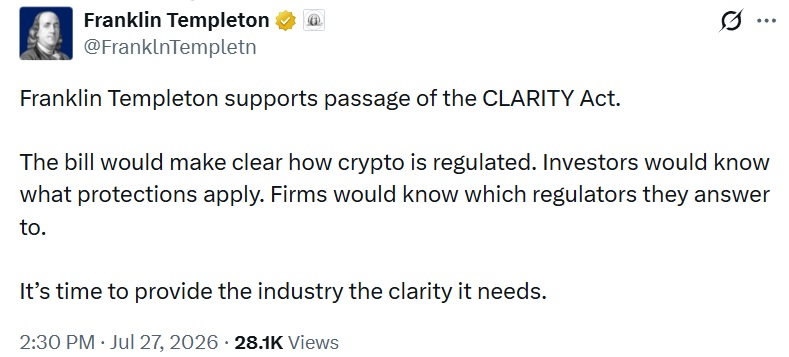
Financial giant Franklin Templeton, a subsidiary of Franklin Resources Inc. (NYSE: BEN), announced its support for the CLARITY Act on July 27 after reporting assets under management of $1.79 trillion as of June 30.
The company stated that the CLARITY Act would establish clearer rules for digital assets, helping investors better understand the protections available to them and providing companies with greater certainty about which federal regulatory bodies oversee their activities. Franklin Templeton added that this law would provide the regulatory clarity the crypto industry has long sought.
With this support, Franklin Templeton joins a number of companies such as the world's largest asset manager Blackrock Inc. (NYSE: BLK), investment giant Fidelity Investments, and global investment banking leader Goldman Sachs Group Inc. (NYSE: GS), all of which have publicly voiced their support for the CLARITY Act.
Financial Giants Urge Congress to Adopt Clearer Cryptocurrency Rules
Blackrock Senior Managing Director and Global Head of Market Development Samara Cohen characterized the bill as an important step toward creating a regulatory framework for digital assets that fosters innovation while maintaining transparency, market capital resilience, and investor protection, detailing Blackrock's rationale for supporting the legislation.
Fidelity Investments, which manages approximately $7.1 trillion in assets, also urged senators to approve the bill, arguing that a single national regulatory framework would encourage responsible innovation while providing greater certainty for investors and market participants as part of its call to advance the Senate bill.
Major Wall Street banks are also among the bill's supporters. Goldman Sachs CEO David Solomon endorsed the proposal, highlighting the banking sector's growing interest in tokenization, digital asset custody, trading, and blockchain-based financial services, as per his public statement in support of the proposal.
Charles Schwab Corp. (NYSE: SCHW), one of the nation's largest brokerage firms, also characterized the measure as a catalyst for broader adoption of digital assets by financial institutions and retail investors, while outlining its vision for the future of the industry.
Updated CLARITY Bill Defines Federal Oversight Mechanisms
On July 22, Republican senators unveiled an updated text of the CLARITY Act, reflecting the collaborative work of the Senate Banking Committee and the Senate Committee on Agriculture, as lawmakers sought to secure broader support.
According to the bill's official section-by-section summary, the proposal allocates responsibilities between the U.S. Securities and Exchange Commission (SEC) and the Commodity Futures Trading Commission (CFTC).
This regulatory framework defines how securities and digital commodities will be regulated, establishing registration standards, customer protection measures, disclosure obligations, and preserving anti-fraud authority.
end-content