IBIT Options Metrics Live on Glassnode

insights.glassnode2026-06-03 tarihinde yayınlandı2026-06-03 tarihinde güncellendi

Özet

Glassnode has expanded its options analytics to include BlackRock's iShares Bitcoin Trust ETF (IBIT), the largest US spot Bitcoin ETF. This move brings institutional-grade volatility intelligence to a key regulated Bitcoin instrument, reflecting Bitcoin's integration into traditional finance. IBIT options, with over $27.6B in open interest, now rival crypto-native venues like Deribit, offering a crucial lens into institutional positioning and risk appetite. The new suite provides 40+ metrics, including open interest, volume, max pain, ATM implied volatility, and proprietary skew analytics like the IBIT Skew Index. A core application is comparing IBIT data with platforms like Deribit to identify divergences between traditional finance and crypto-native market sentiment. For instance, recent data showed IBIT options exhibited a more defensive, put-skewed stance compared to Deribit at the 1-month tenor. These tools enable professionals to measure TradFi Bitcoin sentiment, monitor hedging pressure, and track volatility risk across tenors. The growth of IBIT options signals Bitcoin's maturation, allowing the pricing of volatility and complex risk views within a regulated framework. Glassnode's coverage provides real-time analytics for this evolving market structure.

For most of its history, Bitcoin price discovery was dominated by spot exchanges, offshore perpetual futures, and crypto-native derivatives venues. That is no longer the full story.

Since the approval of U.S. spot Bitcoin ETFs in 2024, Bitcoin has increasingly moved into traditional financial rails, where advisors, asset managers, hedge funds, banks, and structured product desks can access exposure through familiar instruments.

This progression is not accidental. Equity markets, FX, commodities, rates, every mature financial market has progressed along this path: spot markets first, followed by futures, and ultimately options. Options are the last layer to scale because they require the deepest liquidity, the most sophisticated risk management, and the broadest base of end-users (hedgers, overwriters, dealers, vol arbs). When options open interest rivals or exceeds futures notional, the asset has graduated.

At Glassnode, we've now expanded our options coverage to IBIT, bringing the same institutional-grade volatility intelligence used across crypto-native options markets to the largest U.S. spot Bitcoin ETF.

View the new metrics in Glassnode Studio. Available to all Professional plan users.

Explore IBIT metrics

Understanding IBIT Options

The approval of U.S. spot Bitcoin ETFs in 2024 was a watershed moment for crypto markets. Reuters described the decision as a major step for crypto’s mainstream acceptance, giving investors a regulated ETF wrapper for Bitcoin exposure. Since then, professional investors have increasingly used ETFs as the access layer for Bitcoin. BlackRock’s iShares Bitcoin Trust ETF, IBIT, has become the largest and most liquid U.S. spot Bitcoin ETF. As of April 29, 2026, IBIT reported more than $61.1B in net assets and a 30-day average daily volume above 41M shares.

Options are the next logical step.

Once an asset reaches sufficient scale in spot markets, participants require tools to hedge exposure, monetize volatility, structure positions, and express views across different time horizons. That is exactly what IBIT options enable.

  • For asset managers, IBIT options can support hedging and portfolio overlays.
  • For volatility traders, they create a listed U.S. market for Bitcoin-linked implied volatility.
  • For structured-product desks, they provide inputs for payoff construction.
  • For analysts, they offer a new source of information about institutional positioning and risk appetite.

Recent market data illustrates how quickly this market is maturing. IBIT options open interest was reported at around $27.6B, briefly surpassing Deribit’s Bitcoin options open interest of around $26.9B — a major milestone for U.S.-listed, regulated Bitcoin derivatives.
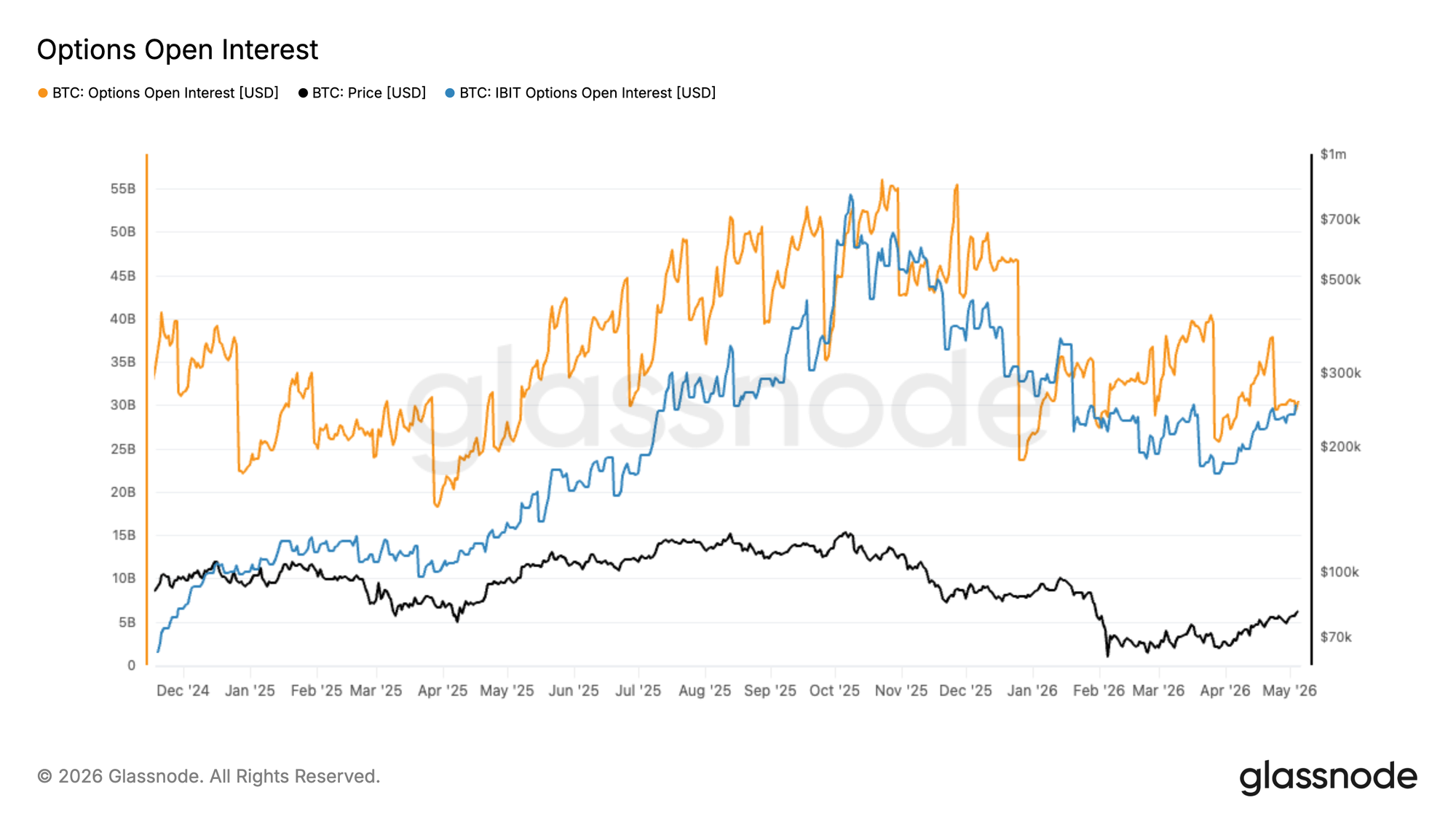
Why IBIT Options Matter

Options markets are where investors express more complex views than simple spot buying or selling. They reveal how participants price upside, downside, tail risk, volatility, and event risk.

In traditional markets, options are essential for understanding positioning and sentiment across equities, indices, rates, and commodities. As Bitcoin becomes more integrated into global portfolios, its options market is becoming equally important. Thus, IBIT options are particularly relevant for digital asset market analysis because they sit at the intersection of two worlds:

  • The Bitcoin market, where volatility, leverage, and directional positioning have historically been shaped by crypto-native exchanges.
  • The traditional ETF market, where regulated brokerage access, advisor platforms, structured products, and institutional risk frameworks play a larger role.

That makes IBIT options a powerful lens into how traditional finance is adopting Bitcoin — not only as a spot allocation, but also as a tradable, hedgeable, and volatility-sensitive asset.

IBIT vs Deribit: Two Different Views of the Bitcoin Market

One of the most important use cases is comparing IBIT options with crypto-native options venues such as Deribit.

Deribit remains a core liquidity venue for Bitcoin and Ethereum options. Deribit BTC options volume regularly exceeds 20,000 contracts, representing more than $2B in daily notional volume. But IBIT options represent a different flow profile.

Deribit is more crypto-native, global, and offshore. IBIT is U.S.-listed, ETF-based, and embedded in traditional brokerage and institutional workflows.

A divergence between IBIT and Deribit implied volatility can indicate that traditional finance and crypto-native markets are pricing Bitcoin risk differently. A richer call wing in IBIT may reflect stronger ETF-linked demand for upside exposure. A stronger put wing may indicate hedging pressure from ETF holders. Differences in term structure may indicate that TradFi participants are pricing event risk differently from crypto-native traders. The analytical value comes from comparing both markets directly.

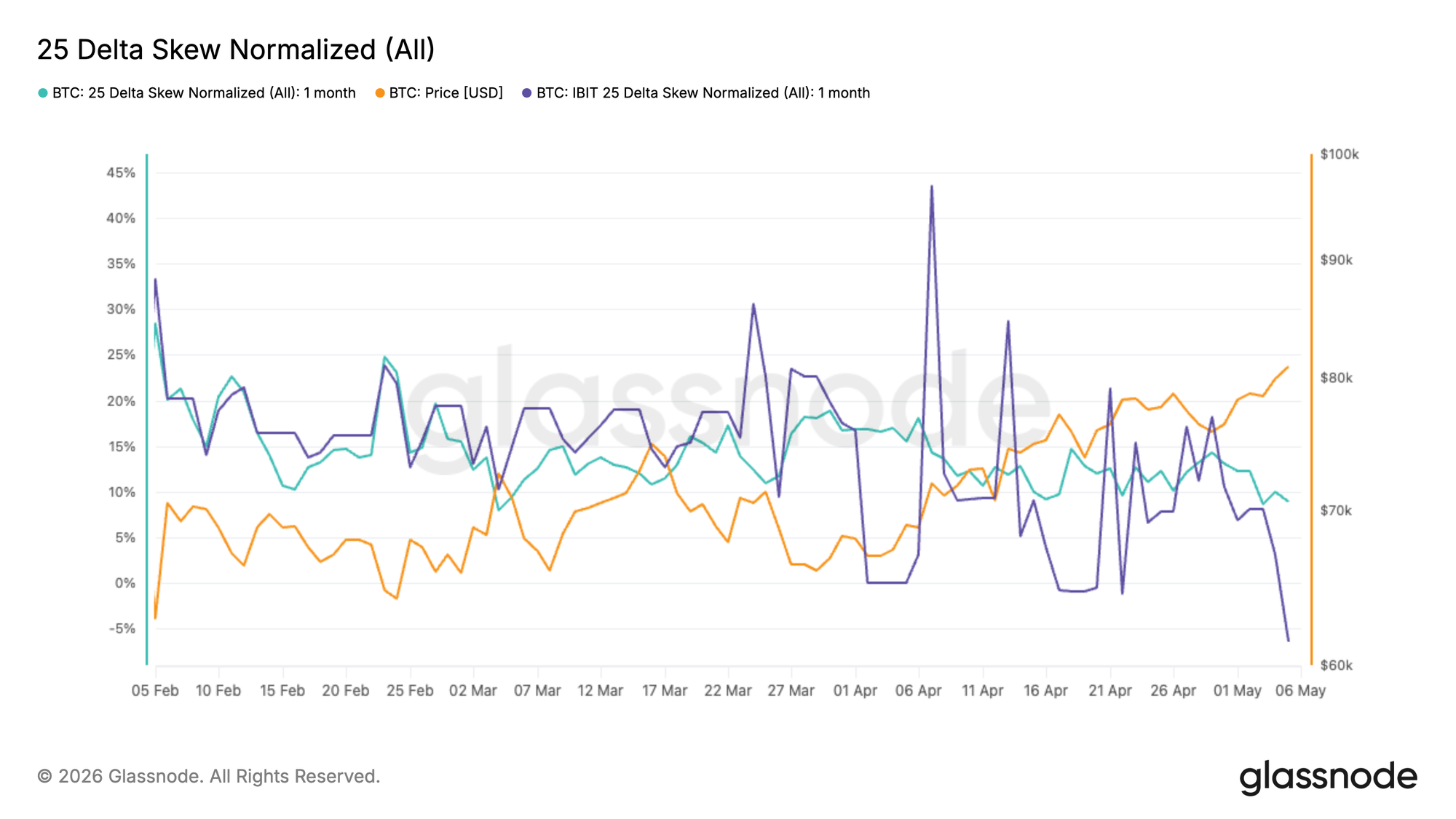
For example, as of May 5, Bitcoin options markets were pricing 1-month risk differently across venues. Deribit’s 1-month 25-delta skew remained modestly call-biased, while IBIT’s comparable skew stayed materially more put-skewed, leaving an approximately 15 percentage-point gap on the same underlying BTC exposure.

This suggests a meaningful venue-level divergence at the 1-month tenor, with IBIT and Deribit reflecting different risk-pricing dynamics across a more institutional ETF options market and a more crypto-native venue.
View live chart

In this context, ETF-linked options investors appear to be assigning a higher premium to short-term downside protection, while crypto-native options markets remain comparatively less defensive.

Glassnode's IBIT Options Metrics and Analytics

We've extended our options analytics framework to IBIT, bringing users the same institutional-grade intelligence used across crypto-native options markets to the largest U.S. spot Bitcoin ETF.

Core IBIT Options Metrics

This first release of 40+ metrics provides the foundation: open interest, volume, max pain, and interpolated IV.

Open Interest, Volume & Max Pain

  • IBIT Options Open Interest: Total OI across all IBIT option contracts. The single most important gauge of institutional engagement on the ETF.
  • IBIT Options Open Interest by Maturity: Distribution of call and put OI across expiration dates. Directly comparable against Deribit's term structure to spot tenor dispersion.
  • IBIT Options Volume: 24h rolling trading volume.
  • IBIT Options Volume Put/Call Ratio: Classic sentiment indicator. Read alongside Deribit's P/C ratio to separate institutional positioning from retail/native flow.
  • IBIT Options Max Pain: Strike where expiring options would cause maximum loss to holders. Useful for anticipating pinning behavior near monthly expiries.
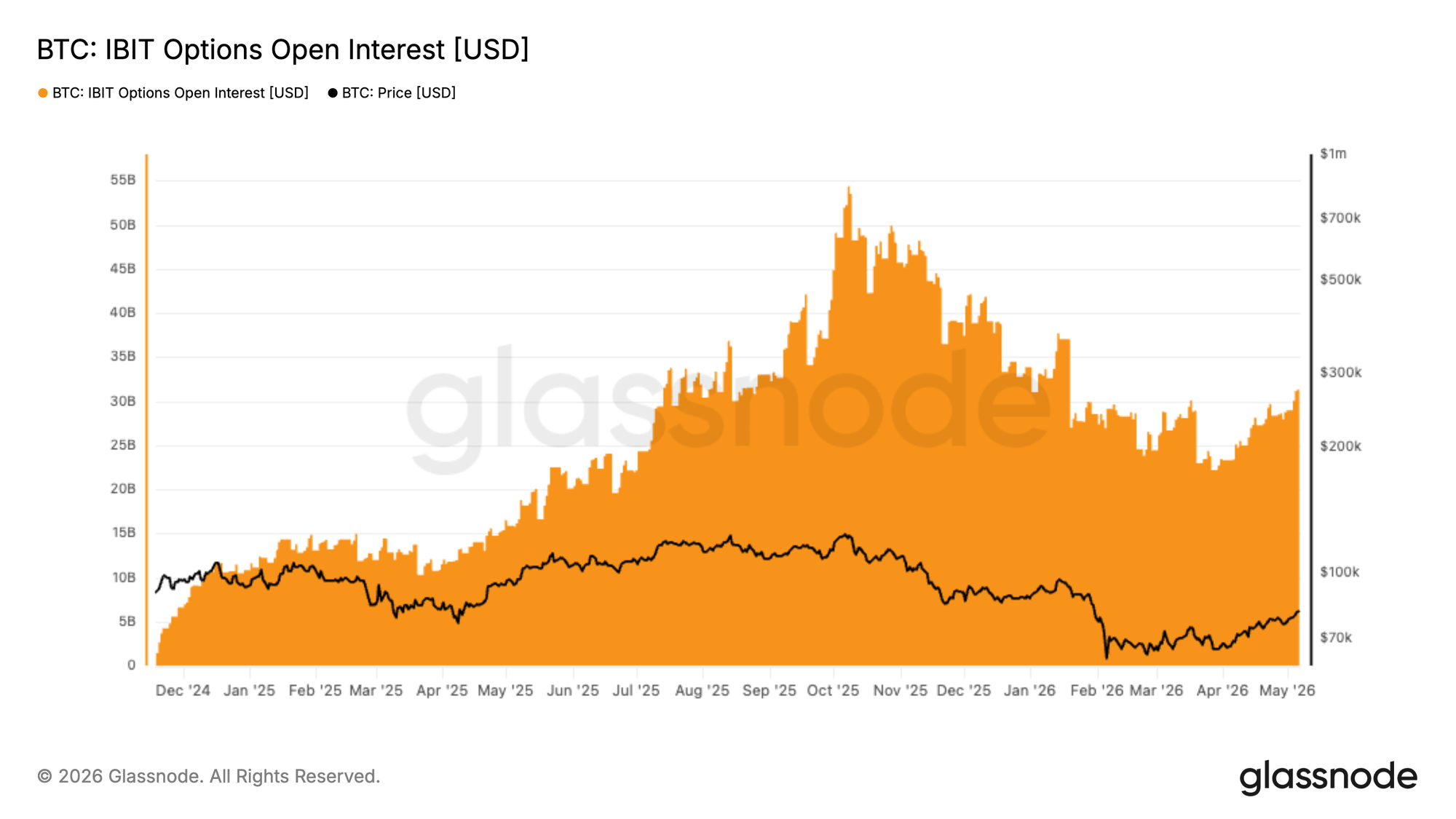
View live chart

IBIT Options ATM Implied Volatility

The new IBIT Options ATM Implied Volatility metrics provide a normalized view of how the U.S. ETF options market is pricing Bitcoin volatility across the term structure.

By tracking ATM IV across 1-week, 1-month, 3-month, and 6-month tenors, users can monitor how volatility expectations evolve through time — from short-term event risk to longer-term macro and positioning regimes. Rising ATM IV often reflects greater uncertainty, higher demand for optionality, or deteriorating sentiment, while falling ATM IV can point to calmer market conditions and reduced demand for protection.
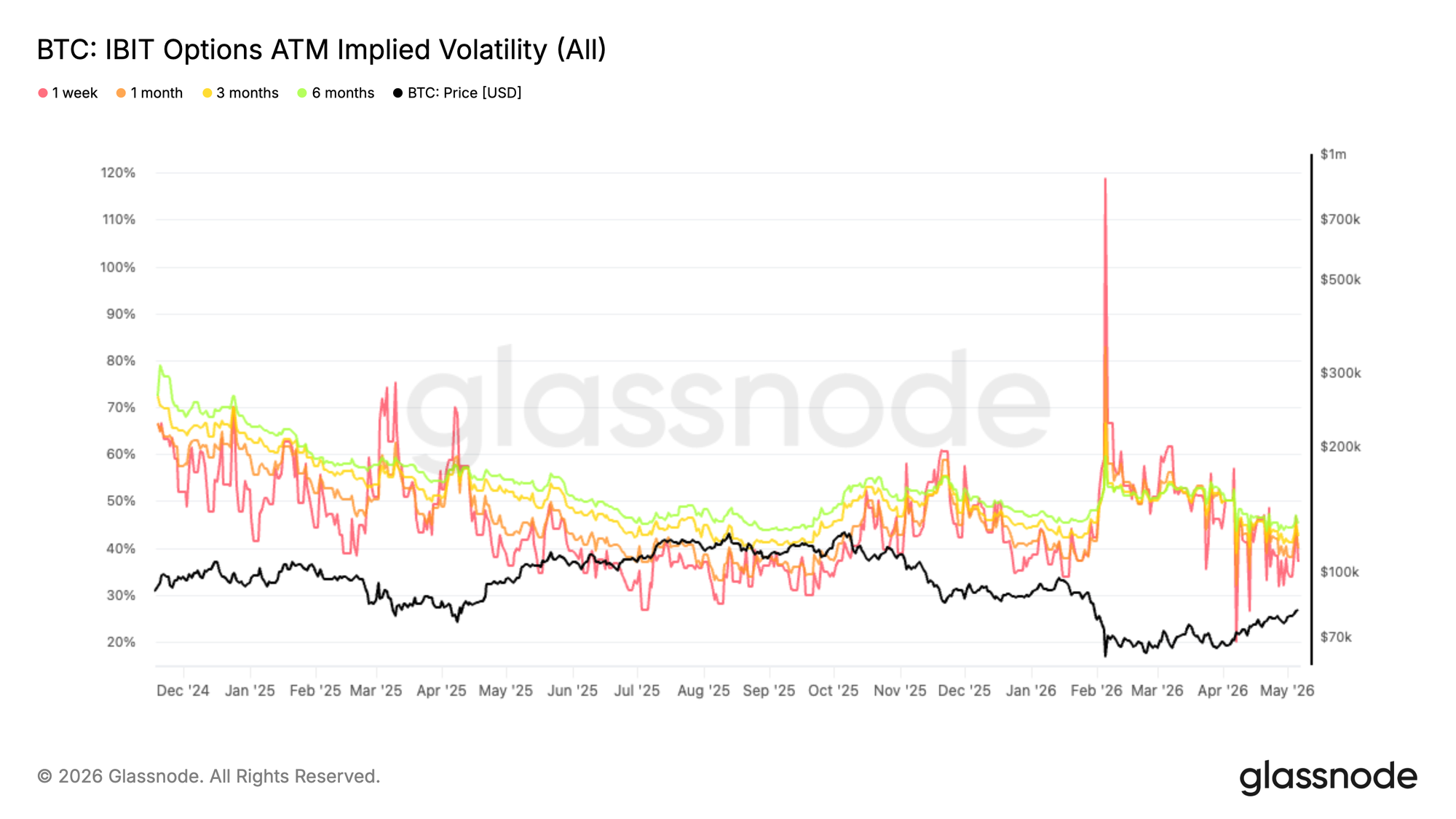
View live chart

Interpolated Implied Volatility by Delta

Smooth, model-interpolated IV at fixed deltas — no more jagged strike-listing artifacts.

  • IBIT Call IV / Put IV at Delta 5, 10, 15, 20, 25, 50

This grid lets you zoom into specific risk zones — crash insurance at 10D puts, squeeze tails at 5D calls, the core smile around 50D — and compare cleanly across time and against Deribit's BTC IV grid.

IBIT Options Skew Metrics

The newest layer delivers proprietary skew analytics, following the same architecture we use for our Glassnode Skew Index across BTC, ETH, SOL, XRP, now applied to IBIT.

IBIT Skew Index & Components:

  • IBIT Skew Index — Single measure of option-market asymmetry, integrating prices across broader sections of the volatility surface (not just two points like classical 25-delta skew). Positive = upside-focused IV dominates. Negative = downside hedging dominates.
  • IBIT Skew Ratio — Ratio of upside to downside IV. Above 1: upside premium. Below 1: downside premium.
  • IBIT Upside Implied Volatility — Upside-focused IV from OTM calls, integrated across strikes and time-weighted to fixed tenors.
  • IBIT Downside Implied Volatility — Downside-focused IV from OTM puts, same construction.

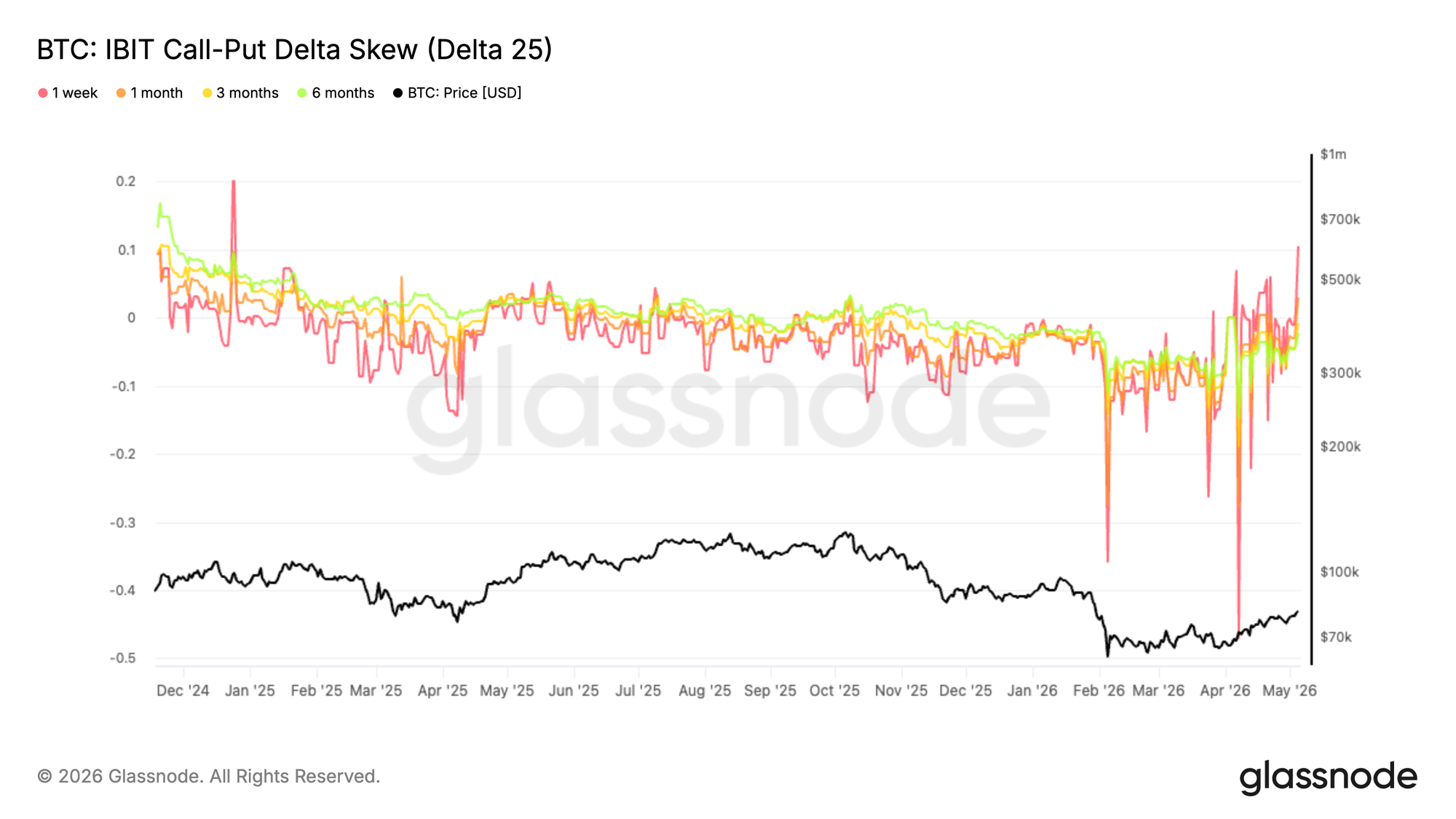
IBIT Call–Put Delta Skew (unnormalized, by tenor)

Time series of model-interpolated call–put IV skew — call IV minus put IV at each target delta, expressed directly in IV points.

  • Delta 5, 10, 15, 20, 25
View live metric

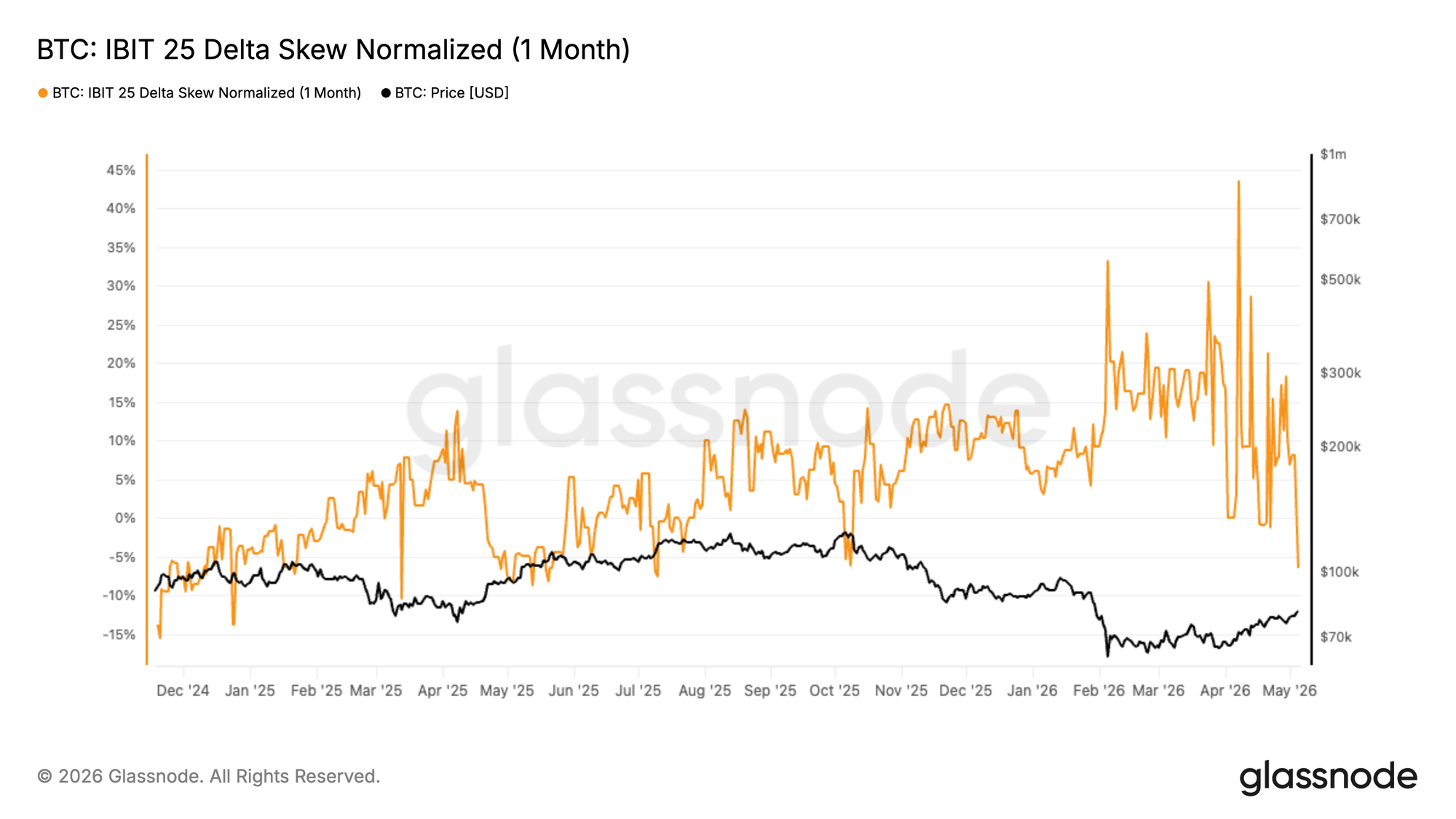
IBIT 25-Delta Skew Normalized (by tenor)

The classical 25-delta skew (25-delta put IV minus 25-delta call IV), normalized by ATM IV — making readings comparable across volatility regimes.

  • 1 Week, 1 Month
View live metric

IBIT Implied Volatility Heatmaps

Visual surfaces for the IBIT volatility structure:

IBIT Implied Volatility Heatmap (by Delta) — Heatmaps of model-interpolated IV across option delta at fixed tenors. Vertical axis = delta (positive for calls, negative for puts).

  • 1 Week, 1 Month, 3 Months, 6 Months

IBIT Implied Volatility Moneyness Heatmap — IV across moneyness buckets at a fixed tenor, from deep OTM puts to deep OTM calls.

  • 1 Month, 3 Months, 6 Months

The heatmaps make skew asymmetries, tail-risk pricing, and term-structure dislocations visible at a glance, where individual time series can require triangulation.
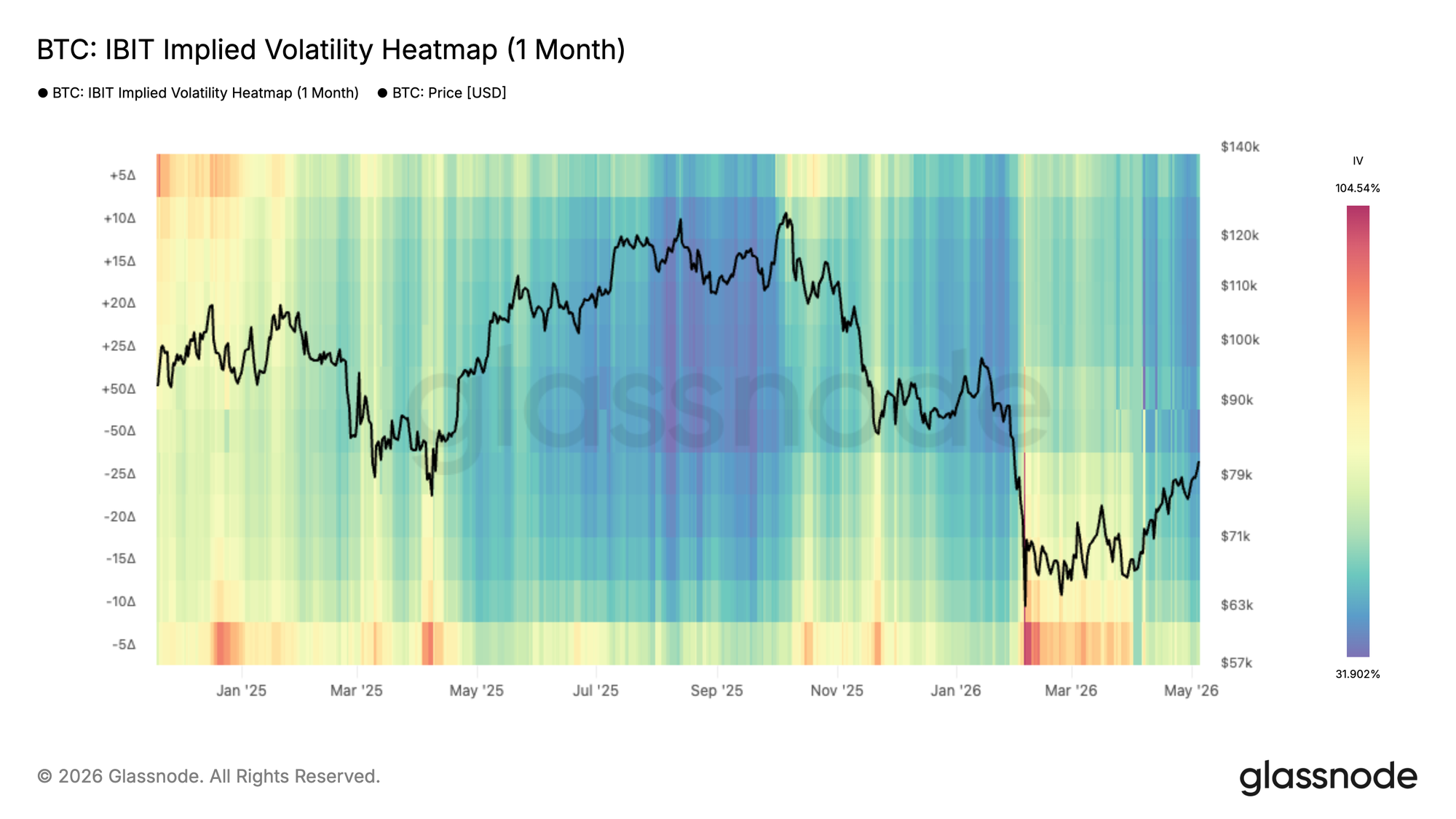
View live metric

Applications of IBIT Options Data

IBIT options data can be used across several workflows.

  1. Measure TradFi Bitcoin Sentiment

IBIT options provide a direct view into how ETF-linked participants are pricing Bitcoin risk. Call demand, put demand, skew, and term structure can reveal whether the market is positioning for upside, hedging downside, or pricing near-term event risk.

  1. Compare Institutional and Crypto-Native Views

By comparing IBIT metrics with Deribit metrics, clients can identify differences between traditional-market and crypto-native pricing. For example:

  • Is IBIT skew more bullish or more defensive than Deribit?
  • Are IBIT options pricing higher or lower volatility for the same tenor?
  • Is upside demand stronger in ETF markets than offshore crypto venues?
  • Are ETF investors hedging drawdowns more aggressively than crypto-native traders?

These divergences can become actionable research signals.

  1. Monitor Hedging Pressure

Put/call ratios, downside IV, and normalized skew can help identify when ETF holders may be using options defensively. This is especially useful around macro events, ETF flow reversals, large expiries, and Bitcoin drawdowns.

  1. Track Volatility Risk Across Tenors

The term structure of IBIT implied volatility shows how the market prices short-term versus long-term uncertainty. A steep front-end can indicate event risk. A richer back-end can indicate structural demand for longer-dated exposure.

The Takeaway

IBIT options are a sign that Bitcoin is moving further into mature institutional market structure.

  • Spot ETFs made Bitcoin easier to hold.
  • Futures made it easier to hedge directionally.
  • Options make it possible to price volatility, skew, convexity, and risk across time.

As IBIT options continue to grow, they are likely to become one of the most important signals for Bitcoin sentiment and institutional positioning. Glassnode’s IBIT options suite gives clients the tools to track that shift in real time.

Options data is a major focus for Glassnode's product development. Every quarter, we are scaling our coverage with new metrics that extend the depth of our volatility tooling, broaden analytical use cases, and give professionals a more complete view of positioning and risk across the digital assets market.


  • Follow us on X for timely market updates and analysis
  • Join our Telegram channel for regular market insights
  • For on-chain metrics, dashboards, and alerts, visit Glassnode Studio

Disclaimer: This report is for informational and educational purposes only. The analysis represents a limited case study with significant constraints and should not be interpreted as investment advice or definitive trading signals. Past performance patterns do not guarantee future results. Always conduct thorough due diligence and consider multiple factors before making investment decisions.


İlgili Sorular

QWhat is the main significance of the recent addition of IBIT options metrics to the Glassnode platform?

AThe main significance is that Glassnode has extended its institutional-grade options analytics framework to cover IBIT, the largest U.S. spot Bitcoin ETF. This provides professionals with tools to track and compare how traditional finance (TradFi) is pricing Bitcoin volatility, risk, and sentiment through a regulated ETF options market, alongside existing crypto-native data from venues like Deribit.

QAccording to the article, why are IBIT options considered a crucial milestone for Bitcoin's market maturity?

AIBIT options are a crucial milestone because they represent the final layer in the progression of a mature financial market (spot -> futures -> options). Options scaling requires deep liquidity and sophisticated risk management. When IBIT's options open interest briefly surpassed that of Deribit, it signaled Bitcoin's graduation into a market where traditional institutions can engage with complex risk management tools, indicating mainstream acceptance and integration into global portfolios.

QWhat key analytical value is highlighted by comparing IBIT options data with Deribit's Bitcoin options data?

AComparing IBIT and Deribit data allows analysts to identify divergences in how traditional finance and crypto-native markets are pricing Bitcoin risk. For example, differences in implied volatility skew (like IBIT showing stronger put-skew vs. Deribit's call-bias) can reveal whether ETF-linked institutional investors are more defensively positioned or have different views on event risk compared to crypto-native traders, providing actionable research signals.

QName three of the core IBIT options metrics provided by Glassnode's new suite.

AThree core metrics are: 1) IBIT Options Open Interest (total across all contracts), 2) IBIT Options Volume Put/Call Ratio (a classic sentiment indicator), and 3) IBIT Options ATM (At-The-Money) Implied Volatility (pricing of volatility across different tenors like 1-week, 1-month).

QHow does the article suggest IBIT options data can be applied to monitor institutional hedging pressure?

AThe article suggests that metrics like the Put/Call Ratio, Downside Implied Volatility, and normalized Skew Index can help identify when ETF holders are using options defensively. Monitoring these indicators is especially useful around macro events, ETF flow reversals, large option expiries, and during Bitcoin price drawdowns to gauge institutional hedging activity.

İlgili Okumalar

A Nation Blocks Chips, a Giant Buys a Nuclear Power Plant: Why It's Time to Seriously Consider DeAI

**Title: Great Powers Blockade Chips, Giants Buy Nuclear Plants: Why It's Time to Seriously Consider DeAI** In May 2026, the US closed loopholes for Chinese firms to acquire advanced NVIDIA chips via overseas subsidiaries. That same month, Kenya halted a $1B geothermal data center project involving Microsoft, fearing its immense energy consumption. Meanwhile, Huawei announced mass production of its Ascend AI chip. These disparate events underscore a new reality: the competition for computing power ("compute") has escalated beyond the tech industry, becoming a geopolitical and infrastructural battleground. A new era of oligopoly is forming, with control over the AI stack—from GPU chips (NVIDIA) and cloud platforms (AWS, Azure, Google Cloud) to foundational models (OpenAI, Anthropic)—concentrating in a few Western "AI Octopus" corporations. This centralization creates systemic risks: pricing power and platform lock-in for users, infrastructure fragility, and a widening "compute divide" that threatens to marginalize nations without independent AI capacity. An "AI Iron Curtain" is deepening through export controls. In response, some nations like Saudi Arabia and the UAE are investing heavily to buy compute power, aiming to transition from oil to AI economies. The EU seeks to triple its compute capacity by 2030 to reduce dependency. However, the spending gap is vast, with four US tech giants alone planning ~$750B in AI capex for 2026. The race is increasingly constrained by energy, with AI tasks consuming up to 1000x more power than web searches, pushing firms to even acquire nuclear plants. This landscape is fueling interest in Decentralized AI (DeAI). It proposes a third way: using open protocols to coordinate a global network of idle GPUs, independent developers, and data centers, creating an AI infrastructure without a single controlling entity. Leveraging blockchain and cryptographic verification, DeAI aims to break market concentration, disperse energy demands, reduce geopolitical dependencies, and enhance transparency. While still nascent in performance and stability, DeAI's core promise is not immediate superiority but providing a crucial alternative architecture to resist monopoly, censorship, and centralized power. As specialized AI hardware costs fall and open-source models flourish, the window to build this foundation is open. The very existence of such competition serves as a vital check against the inevitable abuse of concentrated power.

marsbit40 dk önce

A Nation Blocks Chips, a Giant Buys a Nuclear Power Plant: Why It's Time to Seriously Consider DeAI

marsbit40 dk önce

Outpoll Review: A Prediction Market Platform Built for Active Traders

Outpoll Review: A Prediction Market Platform Built for Active Traders In recent years, prediction markets have grown from a niche sector to a mainstream arena, attracting billions in trading volume and institutional capital. However, the user experience and tools for traders have not kept pace. Outpoll, a new global prediction market platform, aims to fill this gap by providing enhanced trading infrastructure for active and professional traders. Built on standard prediction market principles, Outpoll allows users to trade on the outcome of specific events. It uses fully collateralized contracts with USDC settlement, charges a competitive 0.1% fee per trade, and provides clear settlement rules upfront to minimize disputes. A key focus for Outpoll is its professional-grade trading tools. The platform supports limit and market orders, as well as take-profit and stop-loss orders for open positions—features uncommon in prediction markets. For automated trading, Outpoll offers comprehensive REST and WebSocket APIs, enabling portfolio management, price arbitrage, and integration with existing tools. The platform also features a creator-led market model, where approved experts and community leaders can create and manage markets for niche topics under platform supervision. Its integrated interface combines news feeds directly with trading functions, allowing users to monitor events and manage positions seamlessly. Outpoll launched with a native Android app (available on Google Play) and plans an iOS version later this year. In summary, Outpoll distinguishes itself with trader-focused tools, practical APIs, transparent and collateralized markets, integrated news, and an expanding creator program. For active traders, its advanced order types and API access alone make it a platform worth watching. Outpoll is now globally accessible via outpoll.com and Google Play.

marsbit49 dk önce

Outpoll Review: A Prediction Market Platform Built for Active Traders

marsbit49 dk önce

Bitwise: Crypto Becomes a Contrarian Investment, Three Logics to Understand the Current Market

**Summary** Matt Hougan, Bitwise's CIO, analyzes the current crypto market through three key lenses, arguing it has shifted from a momentum-driven to a contrarian investment. **1) Crypto Becomes a Contrarian Play:** The market is weak, with major assets like Bitcoin and Ethereum down significantly. Capital has moved to hot sectors like AI, leaving crypto as an "unloved" asset class. This transforms crypto investing from trend-following to a test of patience and fundamental analysis. Investors now favor projects with solid fundamentals (e.g., Hyperliquid) over speculative ones. **2) Regulatory Overhang:** The uncertain fate of the U.S. CLARITY Act, a major crypto regulatory framework, is a key headwind. With its passage in 2024 seen as far from guaranteed (estimates range from 30-55%), institutional capital remains on the sidelines, choosing less risky alternatives like AI stocks. The market needs clarity—whether the bill passes or fails—more than any specific outcome to move decisively. **3) Capital Rotates to New Fundamentals:** This cycle differs from past bear markets where money fled to Bitcoin. Now, capital seeks smaller assets with strong use cases. While major cryptos fell in May 2024, tokens like Hyperliquid (+72%), Zcash (+50%), and XLM (+44%) rallied on their specific fundamentals. This rotation confirms the new contrarian, fundamentals-driven logic and signals the bear market may be in its later stages. **Conclusion:** Short-term pressure persists due to regulatory uncertainty and competition from AI narratives. Investing in crypto now requires a contrarian mindset—acting against the crowd and focusing on fundamental value. Patience and targeting high-quality projects based on their merits are essential for capturing long-term gains.

marsbit1 saat önce

Bitwise: Crypto Becomes a Contrarian Investment, Three Logics to Understand the Current Market

marsbit1 saat önce

ChatGPT Might Be Disappearing Soon

OpenAI announced at its "Intelligence at Work" event that its coding assistant, Codex, will be fully integrated into the ChatGPT app within weeks. This move marks a strategic shift from a conversational AI (Chat) towards a unified "agentic" platform capable of execution. Codex, originally launched to compete with Anthropic's Claude Code, has grown rapidly to 5 million weekly active users, with 20% being non-developers like analysts and designers. Its enterprise revenue now constitutes 40% of OpenAI's total. The integration is the first step in creating a super-app combining ChatGPT (interface), Codex (execution engine), and the Atlas browser (web access). OpenAI also unveiled new Codex features: specialized Agent plugins for six professional roles, an "Annotations" tool for direct document editing, and a "Sites" function to turn work into shareable web apps. Internally, this reflects a power shift; the Codex team now leads core product strategy. While the ChatGPT brand remains for its vast user base, the platform's future is focused on autonomous agents that perform tasks, not just chat. The article notes that competition with Claude Code pushed OpenAI's development, with Codex competing on cost-effectiveness and accessibility rather than raw coding quality. It concludes that the essence of "ChatGPT" is evolving from a chatbot into an AI agent platform, with the name potentially becoming a legacy symbol of its original function.

marsbit1 saat önce

ChatGPT Might Be Disappearing Soon

marsbit1 saat önce

İşlemler

Spot
Futures
活动图片