Metrics Ventures Market Watch: The Brewing Storm

marsbitPubblicato 2026-05-26Pubblicato ultima volta 2026-05-26

Introduzione

In the past month, the market has been actively trading contrasting expectations, balancing global supply chain disruptions fueling re-inflation against both actual and anticipated (Walsh) interest rate hikes. This volatility has impacted commodities and most equities, though tech has temporarily benefited from concentrated short-term liquidity. Fundamentally, as previously analyzed regarding the Strait of Hormuz situation, the US faces deep-seated balance sheet issues beyond what any single Fed chair can resolve. Hypotheses around a figure like Walsh could only materialize if AI fundamentally reshapes production relations. Until then, most non-AI-leading nations (effectively all except the US and China) risk fiscal and monetary policy collapse, rendering the identity of the Fed chair ultimately irrelevant. For crypto assets, there is currently no clear role in these dominant narratives. The market remains strongly capped by the 200-day moving average. While trends may shift from "anything but AI" to "anything but mines," this phase is dominated by the silicon vs. carbon (AI vs. traditional) dichotomy, leaving little room for crypto—though its time will come. **Market Overview & Commentary** The crypto market lacks significant catalysts beyond hype, plagued by low volume and scarce innovation, with clear technical resistance. Currently, crypto struggles for attention as global focus lies elsewhere. Assets like gold, oil, and grains are more direct hedges against supply-cha...

1/ Over the past month, the market has been fervently trading expectations, on the one hand betting on re-inflation from damaged global supply chains, and on the other hand trading rate hikes, whether based on factual developments or on expectations surrounding Vice Chair for Supervision nominee Wash. These two forces are like fire and ice, causing commodities and most equity assets to fluctuate constantly. However, technology, which is actually impacted by both, still benefits from the concentration of short-term liquidity.

2/ On a factual level, as we previously analyzed regarding the Strait of Hormuz situation, the chronic issues with the US's bloated balance sheet have exceeded the scope of what any single Federal Reserve Chair can resolve. All of Wash's hypothetical scenarios could only become reality when AI fundamentally alters social production relations. Until that day arrives, the majority of non-AI-leading nations worldwide (almost all except China and the US) will be the first to fall into a collapse of fiscal and monetary policies. By then, who sits as the Fed Chair will no longer be of great importance.

3/ From a trading perspective, crypto assets currently see little possibility within all the narratives mentioned above. We also observe that the 200-day moving average continues to strongly suppress the price trends of these assets. Even if the "anything but AI" sentiment spreads to "anything but mines," it's unlikely to change this situation. In this current phase of silicon-based versus carbon-based competition, there is no stage for crypto, but there certainly will be in the future. Rest assured.

Review and Commentary on Overall Market Conditions and Trends

Aside from hype, there isn't much noteworthy to discuss in the crypto market. The lackluster trading volume and scarcity of innovation are old news, and technical resistance is very evident. In fact, crypto assets could potentially be good tools for hedging against global liquidity risks. At this moment, it's difficult for any major market focus to directly link to crypto. Meanwhile, inflation/stagflation caused by supply chain damage clearly has more definitive large-capacity investment targets like gold and other metals, petrochemicals, and food. Looking at token distribution, Bitcoin also needs more time to consolidate and absorb selling pressure. The development of this variable is crucial. We expect this correction to persist until at least Q4 2026.

Looking ahead, we believe three events will successively become the dominant drivers of future market volatility:

1. In the short term, the market will highly focus on whether Wash will repeat the missteps of Besant or Musk, turning his stance into the next "333" plan.

2. The market is significantly underestimating the severity of substantial damage to a large number of global supply chains and the time needed for future repair. In the medium term, the market will eventually realize that local resource shortages and price volatility will far exceed initial expectations, similar to the situation during the pandemic.

3. Nations like the UK and Japan, which represent "AI non-beneficiaries + inflation first to fall," will successively face severe fiscal and monetary policy crises. We should hope that AI substitution does not occur too rapidly; otherwise, the existing credit system and national welfare fiscal systems could collapse swiftly.

One day, the market may understand that the bursting of the AI bubble could trigger a contagious credit crisis for some sovereign nations. The monetary and fiscal responses at that time might be the ultimate ignition for Bitcoin's final major bull run.


Domande pertinenti

QAccording to the article, what are the two opposing forces causing volatility in commodity and equity markets over the past month?

AThe article states that markets have been trading on two opposing expectations: the re-inflation due to damaged global supply chains, and interest rate hikes, whether they are actual hikes or expectations stemming from Warsh. These two forces, likened to ice and fire, are causing significant volatility.

QWhat does the article suggest is the primary narrative or factor benefiting from current short-term liquidity concentration, despite the broader market volatility?

AThe article indicates that technology, specifically AI-related sectors, is benefiting from the concentration of short-term liquidity, even as it is simultaneously impacted by the opposing forces of supply-chain-driven re-inflation and interest rate hike expectations.

QWhat condition does the article claim must be met for all of Warsh's monetary policy assumptions to hold true, and what are the predicted consequences for most non-AI leading nations before that point?

AThe article claims that all of Warsh's assumptions can only hold true when AI fundamentally changes societal production relations. Before that day arrives, the majority of non-AI leading nations (almost all except China and the US) are predicted to fall into a collapse of fiscal and monetary policies.

QWhat is the article's main assessment of the current state of the cryptocurrency market in relation to broader global economic narratives?

AThe article's main assessment is that cryptocurrency assets currently see little possibility within the dominant global economic narratives. It notes low trading volume, a lack of innovation, clear technical resistance (like the 200-day moving average), and that market attention is focused elsewhere, such as on commodities like gold, oil, and grain as inflation hedges.

QWhat does the article identify as the potential catalyst for a future major bull run in Bitcoin?

AThe article suggests that a future contagion of sovereign credit crises, potentially triggered by an AI bubble burst, and the subsequent monetary and fiscal policy responses from governments could serve as the ultimate ignition for Bitcoin's next major bull run.

Letture associate

China's AI Fronts: From Yan'an to Midway

This article analyzes the competitive landscape of China's AI industry through a dual-front war analogy: the "Eastern Front" of business model competition and the "Western Front" of global strategic positioning. **The Eastern Front: The Scramble for Supply Lines and Monetization** The "Eastern Front" examines the contrasting strategies of three Chinese tech giants—Tencent, Alibaba, and ByteDance—in the face of AI's high marginal costs. Tencent integrates AI as a catalyst within its existing ecosystems (advertising, gaming, cloud) for monetization, prioritizing high-value scenarios over user growth. Alibaba bets on a full-stack, self-developed approach from chips to applications, aiming to control costs and ecosystem, though this requires immense patience and resources. ByteDance, with Doubao as its flagship, pursues a traditional traffic-driven, "super app" strategy but faces severe monetization challenges as its massive user base incurs unsustainable operational costs. The central challenge for all is building a reliable "supply line" (sustainable funding/profit) and achieving efficient monetization, moving beyond being mere "token factories." **The Western Front: "Preserving Land" vs. "Preserving People"** The "Western Front" frames a global strategic divergence. The U.S. model ("preserving land") focuses on closed-source, high-premium models (e.g., Anthropic) targeting lucrative enterprise markets. China's strategy ("preserving people") leverages open-source models (e.g., Alibaba's Qwen, DeepSeek) and extremely low pricing to attract global developers and capture long-tail markets, akin to a "surround the cities from the countryside" approach. The goal is to make Chinese models the default infrastructure, locking in future ecosystem value. However, the critical test is whether this open-source ecosystem can achieve a commercial闭环, converting developer adoption into tangible revenue (e.g., via cloud services), and bridging the monetization gap with Western models that charge for value, not just tokens. **Conclusion: The Long March from Factory to Brand** The article concludes that China's AI industry possesses technology, users, and scenarios but must integrate them to create and capture value. Its ultimate success depends on navigating both fronts: companies must establish sustainable monetization on the Eastern Front, while the industry's Western strategy must evolve from simply "preserving people" (developer adoption) to truly "preserving both people and land" — transforming open-source ecosystem dominance into commercial success and premium brand value. This journey from being a "token factory" to a "value highland" will require strategic patience and the ability to outlast competitors in a prolonged contest.

marsbit24 min fa

China's AI Fronts: From Yan'an to Midway

marsbit24 min fa

A History of Technological Evolution Powered by Electricity: Aluminum, Bitcoin, and AI

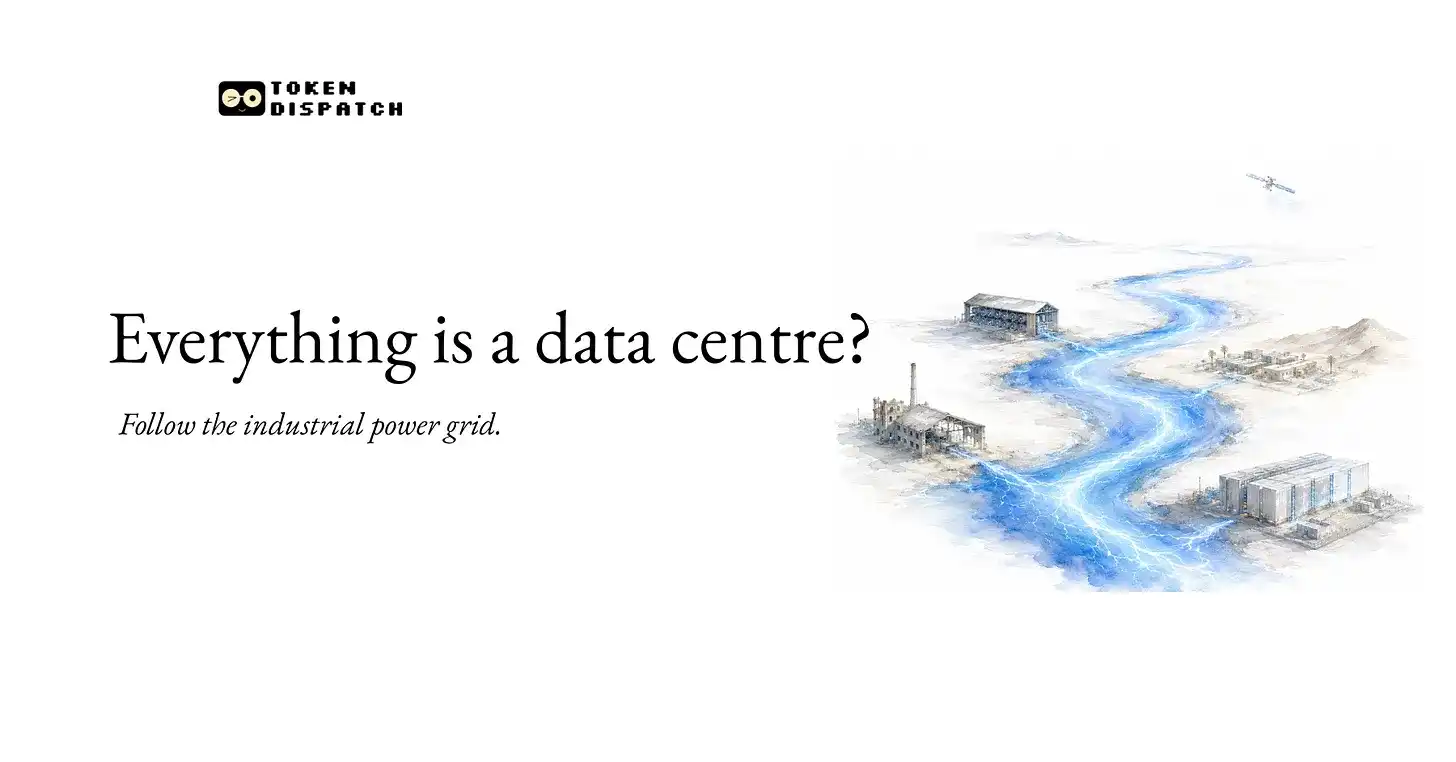
The journey from the Rockdale aluminum smelter in Texas to space-based data centers illustrates a core economic principle: whoever controls the cheapest electricity dictates the use of computing power. The evolution is clear. Old industrial sites with pre-existing, high-capacity power grids are being repurposed. In Rockdale, a former Alcoa plant now houses vast Bitcoin mining rigs, which are increasingly being replaced by AMD chips for AI training. The logic is purely financial: while smelting aluminum yields $0.17–0.27 per kWh and Bitcoin mining $0.05–0.11, AI inference on H100 GPUs generates $1.27–3.67 per kWh. Recent deals confirm the rush for power infrastructure. Riot Platforms leases space to AMD; TeraWulf bought an old Kentucky aluminum plant for its grid; NYDIG secured a New York site for its cheap hydropower to mine Bitcoin. As AI giants like Anthropic, Microsoft, Google, and Amazon aggressively expand, they now directly compete with crypto miners for the same industrial power resources, often outbidding them. This has led to a decline in Bitcoin's global hash rate and a wave of miner conversions to AI data centers. This "digital resource curse" extends globally. Gulf nations, long offering subsidized power to attract heavy industry like aluminum, are now pivoting to become AI and cloud computing hubs—exporting computational power instead of physical commodities. Similarly, Bhutan halted its sovereign Bitcoin mining to sell hydropower directly to India for a steadier return. The frontier is space. Projects like Starcloud plan orbital solar-powered data centers, leveraging constant sunlight and natural cooling, with Bitcoin mining as a secondary use for surplus power. Even consumer brands are transforming; Allbirds shifted from footwear to AI infrastructure, causing its stock to surge. Meanwhile, crypto projects like Bittensor, Render, and Akash propose a decentralized alternative, creating markets to aggregate distributed, idle computing resources from individual hardware. The underlying infrastructure—the power grid—remains constant. As profit margins shift, the facilities built upon it will continue to evolve, from aluminum to Bitcoin to AI and beyond, always chasing the highest yield per kilowatt-hour, whether in Texas, Abu Dhabi, or low Earth orbit.

marsbit34 min fa

A History of Technological Evolution Powered by Electricity: Aluminum, Bitcoin, and AI

marsbit34 min fa

Conquering is easy, governing is hard: Polymarket must bow to regulations to plant its flag globally

Polymarket, a decentralized prediction market platform, faces significant regulatory hurdles in its global expansion. Its "permissionless" model, which bypasses traditional identity and financial controls, has led to widespread crackdowns. India recently blocked the site, categorizing it as illegal online gambling under new 2025 laws. Brazil also banned it and similar platforms, though it simultaneously authorized a regulated, investor-only version on its national exchange. Across Europe, countries like France, Portugal, and the Netherlands are enforcing bans based on existing gambling and financial regulations. To enter key markets, Polymarket is adopting a pragmatic, compliant approach. In the U.S., it paid a $1.12 million fine, acquired a CFTC-licensed exchange, and now operates a regulated, KYC-mandatory platform for American users. It also secured a major investment from Intercontinental Exchange (ICE), which will distribute its prediction data to institutional investors. In Japan, where gambling laws are strict, Polymarket has begun a long-term lobbying effort, aiming for legalization by 2030 through building institutional partnerships and community presence. Despite these challenges, the prediction market industry is booming, with global volume projected to surge from $51 billion to potentially $1 trillion by 2030. Polymarket's core dilemma remains: adapting its decentralized, anonymous model to fit within sovereign regulatory frameworks focused on licensing, consumer protection, and anti-money laundering rules. Its survival in each market depends on navigating this complex political and legal landscape.

marsbit36 min fa

Conquering is easy, governing is hard: Polymarket must bow to regulations to plant its flag globally

marsbit36 min fa

It's Easier to Conquer than to Govern: Polymarket Must Bend to Every Rule to Plant Its Flag Globally

Polymarket, a decentralized prediction market platform, is facing significant regulatory hurdles as it expands globally, illustrating the tension between permissionless, crypto-native platforms and national legal frameworks. The platform, which allows users to bet on event outcomes, was recently blocked in India under new online gambling laws and faces similar outright bans in Brazil and Ukraine, the latter citing moral objections to wagering on active war events. In Europe, countries like France, the Netherlands, and the UK are restricting access by enforcing existing gambling and financial derivatives regulations, forcing Polymarket to geo-block users or operate in view-only modes. To navigate this complex landscape, Polymarket is adopting a market-by-market, compliant strategy. In the U.S., it paid a $1.4 million CFTC fine, acquired a licensed exchange (QCEX) for $112 million, and now operates a regulated U.S. entity with strict KYC, abandoning anonymity. It also secured a major investment from Intercontinental Exchange (ICE), which will distribute its prediction data to institutional investors. In Japan, a high-potential market, it has begun a long-term lobbying effort aiming for legalization by 2030, acknowledging the country's strict anti-gambling laws and slow regulatory processes. The article concludes that while the global prediction market is growing rapidly—projected to reach $2.4 trillion by 2030—Polymarket's core challenge is transforming its decentralized model to fit sovereign regulatory systems built on licensing, consumer protection, and anti-money laundering rules. Its survival depends on proving its legitimacy in each jurisdiction.

链捕手41 min fa

It's Easier to Conquer than to Govern: Polymarket Must Bend to Every Rule to Plant Its Flag Globally

链捕手41 min fa

Trading

Spot
Futures

Articoli Popolari

Come comprare T

Benvenuto in HTX.com! Abbiamo reso l'acquisto di Threshold Network Token (T) semplice e conveniente. Segui la nostra guida passo passo per intraprendere il tuo viaggio nel mondo delle criptovalute.Step 1: Crea il tuo Account HTXUsa la tua email o numero di telefono per registrarti il tuo account gratuito su HTX. Vivi un'esperienza facile e sblocca tutte le funzionalità,Crea il mio accountStep 2: Vai in Acquista crypto e seleziona il tuo metodo di pagamentoCarta di credito/debito: utilizza la tua Visa o Mastercard per acquistare immediatamente Threshold Network TokenT.Bilancio: Usa i fondi dal bilancio del tuo account HTX per fare trading senza problemi.Terze parti: abbiamo aggiunto metodi di pagamento molto utilizzati come Google Pay e Apple Pay per maggiore comodità.P2P: Fai trading direttamente con altri utenti HTX.Over-the-Counter (OTC): Offriamo servizi su misura e tassi di cambio competitivi per i trader.Step 3: Conserva Threshold Network Token (T)Dopo aver acquistato Threshold Network Token (T), conserva nel tuo account HTX. In alternativa, puoi inviare tramite trasferimento blockchain o scambiare per altre criptovalute.Step 4: Scambia Threshold Network Token (T)Scambia facilmente Threshold Network Token (T) nel mercato spot di HTX. Accedi al tuo account, seleziona la tua coppia di trading, esegui le tue operazioni e monitora in tempo reale. Offriamo un'esperienza user-friendly sia per chi ha appena iniziato che per i trader più esperti.

379 Totale visualizzazioniPubblicato il 2024.12.10Aggiornato il 2025.03.21

Come comprare T

Discussioni

Benvenuto nella Community HTX. Qui puoi rimanere informato sugli ultimi sviluppi della piattaforma e accedere ad approfondimenti esperti sul mercato. Le opinioni degli utenti sul prezzo di T T sono presentate come di seguito.

活动图片