18 Months, Over 50x Surge: KIOXIA's Epic Comeback

marsbitОпубліковано о 2026-06-23Востаннє оновлено о 2026-06-23

Анотація

KIOXIA, a NAND flash memory giant, staged a dramatic comeback driven by AI demand. After a period of significant losses, a failed merger, and missed HBM opportunities, its 2024 IPO began modestly. However, fueled by explosive demand for AI data storage, its stock price skyrocketed over 50 times within 18 months, making it Japan's most valuable company, surpassing Toyota. Its Q1 FY2026 profit guidance soared 30-fold year-over-year, with 2026 NAND capacity already sold out. Key to its success is its 3D NAND technology, BiCS FLASH. As the inventor of NAND, KIOXIA advanced its technology through generations, reaching over 200 layers by 2023. Key innovations include CBA (CMOS directly Bonded to Array), which separately manufactures control circuits and memory arrays for better performance, and OPS (On Pitch Select Gate) to increase density. The company is now developing high-capacity packages like an 8TB solution stacking 32 dies. Looking beyond NAND, KIOXIA is exploring 3D DRAM with its OCTRAM technology, using oxide semiconductor transistors for ultra-low leakage to reduce power consumption. This fundamental research differs from HBM and represents a long-term bet to extend its 3D expertise from NAND into future DRAM architectures. KIOXIA's story highlights how technological assets and shifting market cycles can rapidly transform a company's fortunes. While questions remain about sustaining growth beyond the current AI boom, its resurgence demonstrates that in semiconductors,...

Author: Du Qin DQ

Previously, we have deeply analyzed this flash memory giant's regrettable trough period in another article: burdened by the past glory of Toshiba Memory but 'born at the wrong time'; cold-shouldered by the capital markets, leading to a last-minute IPO setback; suffering consecutive huge losses in an industry downturn, and unfortunately missing out on the enormous opportunity of HBM, with even its attempt to seek refuge through a merger with Western Digital falling through... At that time, KIOXIA seemed to have become a 'hot potato' in the eyes of outsiders amid the semiconductor industry reshuffle.

However, just over a year later, KIOXIA staged a comeback that can be described as epic. Driven by the frenzy of AI large models, the market logic for storage underwent a fundamental shift. KIOXIA not only successfully reversed its fortunes but also achieved a dual explosion in both capital markets and technology.
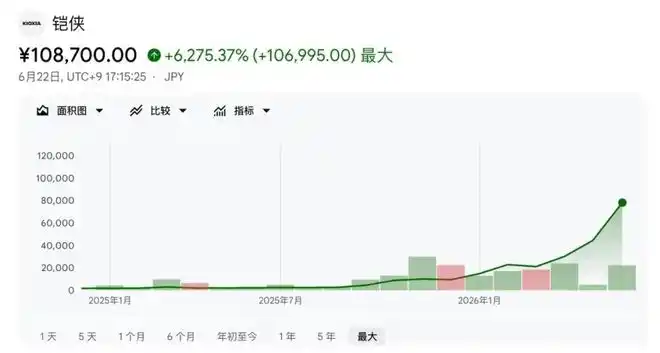
KIOXIA's stock price trend since listing

The Super Myth in the Capital Markets

KIOXIA successfully listed on the Tokyo Stock Exchange at the end of 2024, with its initial market capitalization hovering around only 800 billion yen (approximately $50 billion). However, with the comprehensive explosion of AI storage demand, KIOXIA performed an epic reversal in the 18 months following its listing: its stock price skyrocketed over 50 times within 18 months, rising 8-fold in 2026 alone.

Currently, KIOXIA's market capitalization has exceeded 51 trillion yen (approximately 481 trillion Korean won), repeatedly surpassing Toyota Motor, the symbol of Japanese manufacturing, to become the highest-valued company on the Japanese stock market.

According to KIOXIA's Q1 FY2026 (April–June) earnings forecast, its quarterly operating profit is expected to reach as high as 1.3 trillion yen (approximately $81 billion), a staggering increase of nearly 30 times year-over-year; the quarterly net profit guidance is 869 billion yen, a 48-fold increase year-over-year. The performance of a single quarter surpassed the full-year net profit forecast for FY2025.

As major customers scrambled to sign long-term supply contracts, KIOXIA's 2026 NAND capacity has been completely sold out, and the supply-demand imbalance is expected to persist until 2027. The market anticipates KIOXIA's operating profit margin this year to exceed 60%, setting a record for the highest profitability level in the global memory industry. Furthermore, with market expectations for shareholders to receive returns such as stock splits and dividends, its target stock price is hoped to rise to 200,000 yen.

This wave of soaring value has delivered investment returns beyond imagination to parent company Bain Capital, which held on during the downturn, and indirect major shareholder SK Hynix.

According to the Financial Times, the AI boom has made Bain's 2018 acquisition of Toshiba Memory (now KIOXIA) one of the most profitable private equity deals in history. Bain Capital has realized profits by selling most of its shares, with returns exceeding $150 billion, a near 20x return on investment. Its flagship private equity fund is estimated to have gained over $8 billion in profit.

SK Hynix invested a total of 395 billion yen (approximately 3.9 trillion Korean won at the time) in Toshiba Memory in 2018 through a consortium involving Korea, the US, and Japan, among other forms. Currently, this consortium still holds an 18% stake in KIOXIA. With the surge in KIOXIA's stock price, SK Hynix has seen enormous paper gains, and the market expects the consortium's eventual total profit to far exceed $70 billion.

The former 'hot potato' instantly transformed into a 'super ATM'.

In the past, the benefits of artificial intelligence were mainly concentrated in GPU and HBM companies like NVIDIA and SK Hynix. HBM was the star on the AI training side, while NAND became a scarce resource in AI inference, model storage, data lakes, enterprise SSDs, and nearline storage. The market expects KIOXIA's net profit for FY2027 to reach 2.8389 trillion yen, a 5.1-fold increase compared to the previous year.

3D NAND, The Foundation of KIOXIA's Existence

KIOXIA invented NAND flash memory over 35 years ago. In 2007, KIOXIA introduced BiCS FLASH 3D flash memory, a 3D flash memory technology system centered around vertical stacking, lateral scaling, wafer bonding, select gate optimization, and advanced packaging.

The basic idea of 3D NAND is: unlike 2D NAND, which only shrinks cells on a plane, it stacks memory cells vertically like building a skyscraper. KIOXIA's explanation is vivid: originally it was one floor with limited land area; 3D NAND is equivalent to turning a one-story building into a multi-story apartment, accommodating more 'residents' on the same area.

The core of BiCS FLASH is its batch processing technology. Its general process logic is: first, alternately stack plate-like electrodes and insulating layers; then drill a large number of holes along the vertical direction in one go; next, fill the holes with charge storage films and pillar-like electrodes; the intersection of the plate-like electrode and pillar-like electrode forms a memory cell. This shows that KIOXIA's BiCS FLASH is not the traditional 'create memory cells separately for each added layer,' but rather stacks the structure first, then forms memory cells by 'punching and plugging' through multiple layers at once. Therefore, when the number of layers increases, the manufacturing cost does not rise completely linearly, improving the economic viability of continued stacking for 3D NAND.

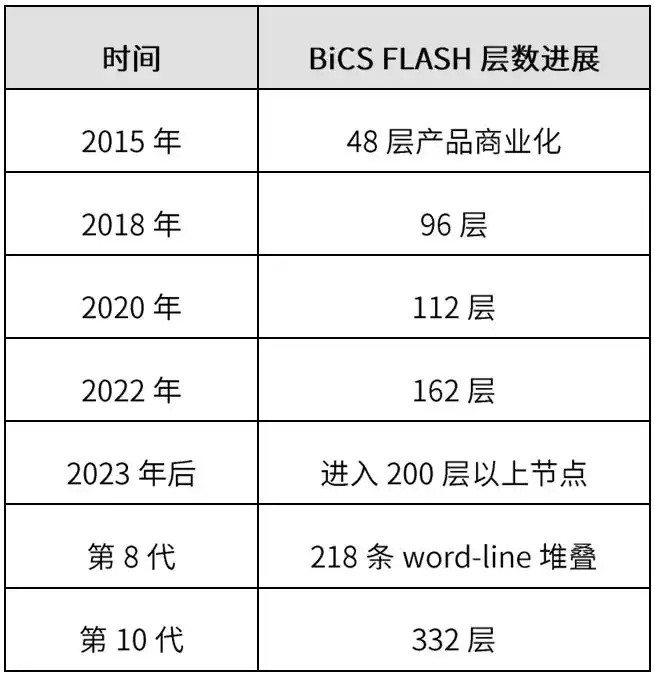
KIOXIA's officially disclosed commercialization timeline for BiCS FLASH is roughly as follows: BiCS FLASH products achieved commercialization with 48 layers in 2015, then progressed to 96 layers, 112 layers, 162 layers; as of March 2023, stacking of over 200 layers has been achieved.

Among these, the 8th-generation BiCS FLASH is a key milestone. KIOXIA states that the 8th-generation product uses 218 word-line stacks, achieves a storage density of 18.3Gb/mm² for the 1Tb TLC product, and supports a 3.2Gbps external data transfer speed, 40μs read time, and 205MB/s programming throughput.

KIOXIA's 8th-generation BiCS FLASH not only jumped from 162 layers to 218 layers but also introduced two key technologies:

CBA (CMOS directly Bonded to Array): CBA can be understood as manufacturing the peripheral CMOS control circuit and the memory array separately, followed by wafer bonding. In the past, CMOS circuits and the memory array were manufactured on the same wafer. However, the optimal process conditions for both are not identical: the memory array may require processes better suited for charge storage and stacked structures, while CMOS circuits focus more on logic control, electrical performance, and speed. Manufacturing them on the same wafer forces compromises.

CBA's approach is: manufacture the CMOS wafer separately, manufacture the memory array wafer separately, optimize the processes for each independently, and finally bond them together with high precision. The benefits are: improved bit density, increased NAND I/O speed, allowing the memory array to use high-temperature processes previously limited by CMOS constraints, and reduced electrical interference between adjacent memory cells.

OPS (On Pitch Select Gate): OPS solves the problem of wasted space within the memory array. In traditional structures, there exist 'dummy' areas between memory cells that are not used for data storage. These areas do not directly contribute to capacity but occupy area. KIOXIA's OPS technology, by rearranging select gates and insulating isolation structures, reduces or eliminates these ineffective areas, allowing more effective memory cells to be placed in the same area. KIOXIA's official explanation states that OPS removes unnecessary dummy regions, enabling more actual memory cells to be placed in the same space, significantly improving storage density.
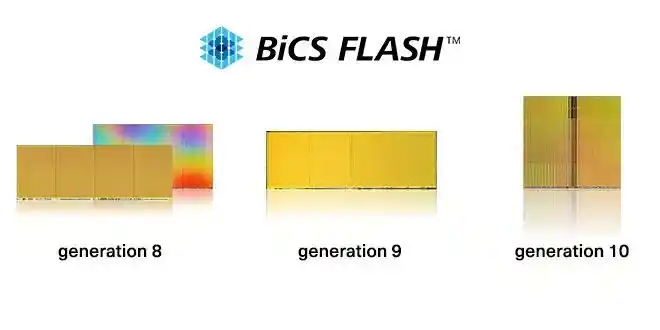
The 9th-generation BiCS FLASH primarily targets 512Gb and 1Tb TLC products, positioned to support applications in the mid-to-low capacity range that require high performance and low power consumption. It continues to use CBA and OPS technologies to improve production efficiency and provide more advanced flash memory solutions. The 9th generation does not follow the route of increasing layer count but emphasizes the balance between performance, power consumption, cost, and production efficiency.

The 10th-generation BiCS FLASH clearly leans more towards future high-capacity, high-performance demands. KIOXIA states that the 10th-generation product uses the same CMOS technology as the 9th generation while increasing the number of memory layers to 332, approximately 1.5 times that of the 8th generation, to enhance bit density and power efficiency.
Beyond front-end manufacturing processes, KIOXIA is also advancing back-end packaging capabilities. Official materials mention that KIOXIA developed a single-package 8TB flash memory, achieved by stacking 32 flash memory dies, each 2Tb, within one package. This relies on advanced back-end processes like wafer thinning, material design, and wire bonding. This 32-die stacking can assemble 32 pieces of 2Tb dies into a package with a height under 2mm, forming an 8TB flash memory solution.

From 3D NAND to 3D DRAM, KIOXIA's New Gambit

KIOXIA is also deploying a secret weapon to break through the single-product-line barrier of being a 'pure NAND vendor.' Why is KIOXIA venturing into 3D DRAM? This is because DRAM has also reached a planar scaling bottleneck similar to what NAND faced. As an established player in 3D NAND, KIOXIA also possesses process-validated advantages.

Continued scaling of traditional DRAM encounters several challenges: storage capacitors become increasingly difficult to shrink, access transistor leakage increases, data retention time shortens, refresh frequency rises, and higher capacity leads to higher refresh power consumption. Imec also mentioned in a technology review that the traditional DRAM 1T1C structure faces scaling, cost, and power efficiency challenges, especially as large capacitors limit the 3D integration path, and smaller transistors lead to more pronounced leakage paths, causing increased refresh power consumption.

In December 2024, KIOXIA announced the development of OCTRAM (Oxide-Semiconductor Channel Transistor DRAM) technology, a new 4F² DRAM composed of oxide semiconductor transistors, offering both high on-current and ultra-low off-current. This achievement was jointly developed by KIOXIA and Nanya Technology and presented at the 2024 IEEE IEDM.
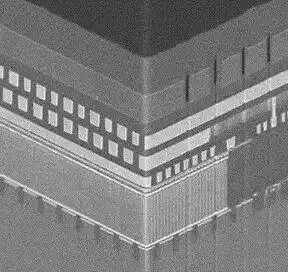
Panoramic view of OCTRAM (Source: KIOXIA, same below)

Traditional DRAM cells are generally 1T1C, meaning one access transistor plus one capacitor. Its problem is: as the cell continues to shrink, the capacitor becomes harder to make, and transistor leakage also increases refresh power consumption. KIOXIA's OCTRAM attempts to reduce leakage through InGaZnO transistors and push the cell structure towards higher density.
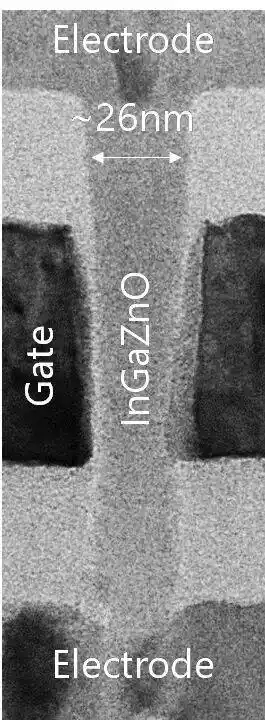
Cross-sectional TEM image of the InGaZnO vertical transistor

Due to its large bandgap and high electron mobility, InGaZnO transistors can theoretically achieve both ultra-low leakage and high on-current. KIOXIA, by optimizing contact electrode materials and spacer thickness, experimentally achieved over 15μA on-current while also realizing ultra-low leakage current below 10⁻¹⁸ A (as shown in the figure below). A significant portion of DRAM power consumption comes from refresh. Lower leakage leads to longer data retention time, reducing refresh pressure. Therefore, the core value of OCTRAM is using low-leakage oxide semiconductor transistors to reduce DRAM refresh power consumption.
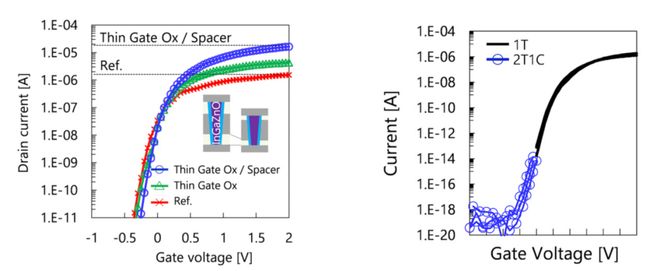
(a) On-current characteristics and (b) Off-current characteristics of the developed InGaZnO transistor

In September 2025, KIOXIA disclosed further reliability research on OCTRAM, focusing on TDDB lifetime issues of sub-25nm Gate-All-Around vertical InGaZnO transistors. TDDB stands for Time-Dependent Dielectric Breakdown. Simply put, it's whether the transistor's insulating layer gradually degrades and eventually fails under long-term electric field stress. KIOXIA stated they found lifetime degradation stems from two factors: intrinsic factors from scaling and extrinsic factors from the manufacturing process. By optimizing the process and reducing extrinsic degradation, KIOXIA achieved a projected TDDB lifetime exceeding 10 years.

In December 2025, KIOXIA announced progress closer to the core of 3D DRAM: developing oxide-semiconductor channel transistors capable of high stacking, having fabricated 8-layer horizontal transistor stacks with on-current exceeding 30μA and off-current below 1 aA, i.e., 10⁻¹⁸ A.

As of now, KIOXIA's 3D DRAM remains in the forefront R&D stage, not yet a commercial product.

KIOXIA is not a traditional DRAM giant, but its accumulated expertise in stacking processes, material integration, and array manufacturing from 3D NAND may give it an entry point in exploring next-generation 3D DRAM. Semiconductor Engineering also analyzed that KIOXIA's 3D DRAM path leverages mature oxide/nitride stacking capabilities from NAND to achieve lower-cost bit scaling, then uses IGZO to replace the channel to reduce thermal degradation issues.

However, one crucial point to emphasize is: KIOXIA's 3D DRAM is not HBM. HBM is packaging-level 3D; it stacks already manufactured DRAM dies to address high-bandwidth needs next to GPUs. KIOXIA's 3D DRAM is device/cell-level 3D; it aims to solve the problem of scaling the DRAM cell itself. Therefore, KIOXIA is not directly chasing HBM but is exploring a more fundamental 3D DRAM device path. If this path matures in the future, it may open a new technology branch for high-capacity, low-power working memory in the AI era.

Although 3D DRAM is still far from true commercialization. It currently resembles more of a future-facing technology ticket than an immediate revenue-contributing product line. But for KIOXIA, the significance of this ticket is not small. In the short term, KIOXIA can capitalize on the NAND recovery driven by AI; in the medium term, it advances high-layer BiCS FLASH; and in the long term, it bets on 3D DRAM, extending its 3D stacking capabilities from NAND to DRAM.

Conclusion

From massive losses and merger deadlock to the super myth of surpassing Toyota to become Japan's top-valued company in 2026, KIOXIA's rollercoaster trajectory is almost filled with the brutality and allure of the semiconductor memory industry. It was once cold-shouldered by capital markets for its single product line and missing the HBM wave, yet amid the tsunami of 'massive data flow' triggered by AI large models, it ushered in its own golden era by steadfastly adhering to NAND flash memory.

KIOXIA's comeback may not yet prove that Japanese semiconductors have truly revived. But at least it demonstrates one thing: in the semiconductor industry, a low point does not necessarily lead to exit. As long as technological assets remain, the realignment of cycles, capital, and demand can at any time bring a forgotten company back to the center of the table.

For KIOXIA, finding a long-term balance between fervent capital追捧 (pursuit) and the冷酷 (harsh) industry cycles moving forward will determine whether this lone sprout carrying the hopes of Japanese semiconductor revival is merely a fleeting flower in the AI supercycle or truly opens a new storage empire of its own.

*Disclaimer: This article was originally written by the author. The content represents the author's personal views. Semiconductor Industry Insights republishes it to convey a different perspective. This does not imply Semiconductor Industry Insights' agreement with or support for this view. If you have any objections, please contact Semiconductor Industry Insights.

Трендові криптовалюти

Пов'язані питання

QWhat triggered Kioxia's dramatic turnaround from a loss-making 'hot potato' to a stock market sensation in Japan?

AKioxia's dramatic turnaround was primarily triggered by the explosive demand for AI storage. The advent of large-scale AI models fundamentally shifted the market logic for memory. NAND flash, Kioxia's core product, became a scarce resource for AI inference, model storage, data lakes, enterprise SSDs, and nearline storage, leading to a supply shortage and surging profitability.

QWhat are the two key technologies (acronyms) introduced in Kioxia's 8th generation BiCS FLASH that significantly improved performance?

AThe two key technologies introduced in Kioxia's 8th generation BiCS FLASH are CBA (CMOS directly Bonded to Array) and OPS (On Pitch Select Gate). CBA improves density and speed by bonding separately optimized CMOS and array wafers, while OPS increases storage density by eliminating dummy areas within the memory array.

QWhat is the main technical advantage of Kioxia's OCTRAM (3D DRAM) technology over traditional DRAM?

AThe main technical advantage of Kioxia's OCTRAM technology is its use of InGaZnO (Oxide-Semiconductor) transistors, which offer extremely low leakage current (off-state current). This dramatically reduces refresh power consumption, a major challenge for traditional DRAM as it scales down, thereby enabling higher density and lower power 3D DRAM architectures.

QHow does Kioxia's approach to 3D DRAM (OCTRAM) fundamentally differ from High Bandwidth Memory (HBM)?

AKioxia's 3D DRAM (OCTRAM) is a device/cell-level 3D technology that aims to solve the fundamental scaling problems of the DRAM memory cell itself by stacking transistors vertically. In contrast, HBM is a package-level 3D technology that stacks pre-manufactured DRAM dies to achieve high bandwidth, primarily for GPU-adjacent memory. They address different layers of the memory hierarchy and scaling challenges.

QWhich major investors reaped enormous returns from Kioxia's stock surge, and what was the scale of one of their profits?

AThe major investors were Bain Capital (the parent company) and SK Hynix (an indirect major shareholder). Bain Capital's investment from the 2018 Toshiba Memory buyout became one of the most profitable private equity deals ever, with profits exceeding $15 billion and a return of nearly 20 times. The SK Hynix-led consortium is also expected to realize total profits far exceeding $70 billion.

Пов'язані матеріали

Rented Faith: How Much of the Bitcoin ETF Inflows Is Real Money?

"Rented Conviction: How Much of Bitcoin ETF Flows Is Real Money" The weekly inflows into Bitcoin ETFs are often interpreted as a gauge of institutional belief. However, a significant portion of this activity is driven by a hidden arbitrage trade, not directional conviction. The core mechanism is a cash-and-carry arbitrage: traders buy spot Bitcoin (often via ETFs) while simultaneously shorting CME futures to lock in the price difference, or "basis." This delta-neutral trade is essentially an interest rate play. In weekly data, about half the fluctuation in ETF flows can be explained by new short positions added by leveraged funds (hedge funds), with a correlation of 0.70. Bitcoin's price movement in a given week shows no statistical power in predicting these flows. While this arbitrage trade drives weekly *volatility*, it is not the main component of the cumulative *stock*. Of the total ~$55 billion in net ETF inflows, the current net arbitrage position is only about $1 billion. The remainder is steady, directional buying averaging ~$400 million per week, which constitutes the vast majority of the accumulated "mountain" over two years. Thus, ETF flow data overstates the *volatility* of conviction, not its *level*. This arbitrage trade has been unwinding for nearly two years. Leveraged fund short positions peaked at ~$14 billion in late 2024 and have since declined to ~$4.5 billion. When the basis compresses to unprofitable levels, ETF inflows and short positions retreat together. Recent outflows should not be mistaken for a loss of faith but rather the routine unwinding of this rate trade. For Ethereum ETFs, the pattern is weaker. Accounting for staking yield makes the basis often negative, so neither strong conviction buying nor robust arbitrage supports its flows. To interpret ETF flows correctly, monitor the CME basis versus T-bill rates and leveraged fund net shorts. They reveal how much of the next "demand" headline is real. The real, patient buy-and-hold demand is what constitutes the enduring bulk of ETF assets.

marsbit22 хв тому

Rented Faith: How Much of the Bitcoin ETF Inflows Is Real Money?

marsbit22 хв тому

Soaring Over Tenfold Within the Year: The Frenzy Over SK Hynix Leveraged Products

South China Morning Post The leveraged ETF tracking SK Hynix has surged over tenfold year-to-date, fueled by intense market speculation on the memory chip sector. By June 22, the value of the 'South Korea 2x Long SK Hynix ETF' listed in Hong Kong had skyrocketed by more than 1,061% since the start of the year, while its asset size exploded over twenty times from the end of last year. The rally is driven by AI-driven demand for high-bandwidth memory (HBM), with SK Hynix recently sampling its next-generation HBM4E product. However, industry professionals warn of significant risks. Leveraged ETFs magnify both gains and losses. During a recent market correction, while the underlying SK Hynix stock fell 19.1%, its double-leveraged ETF dropped nearly 38%. Korean regulators noted that such products could theoretically lose 60% in a single day. Additionally, these ETFs face risks like time decay in volatile markets, liquidity spirals during mass redemptions, and extreme price dislocations from market-making failures, as seen in early June when an ETF moved opposite to its underlying stock. The trading is predominantly driven by retail investors, with institutional capital largely absent due to the products' high volatility. Analysts caution that with the semiconductor sector at elevated valuations and facing geopolitical and supply chain uncertainties, leveraged ETFs pose a substantial threat of amplified losses for uninformed investors.

marsbit1 год тому

Soaring Over Tenfold Within the Year: The Frenzy Over SK Hynix Leveraged Products

marsbit1 год тому

Market Trends in U.S. Stocks (June 23): Peak at Listing? SpaceX Loses Over $800 Billion in Three Days, Tech Stocks Experience Severe Internal Divergence

Stock Market Trends (June 23): Did SpaceX Peak at IPO? The company loses over $800 billion in market value in three days as a sharp divergence unfolds within the tech sector. SpaceX's post-IPO decline of over 20%, falling below its first-day close, reflects a swift market repricing. The catalyst is a clear shift in narrative from "AI platform potential" to concerns over rising capital costs, as its $8.57 billion IPO and subsequent $20 billion debt offering are earmarked for acquisitions and refinancing existing bridge loans rather than de-leveraging. While high-valuation tech stocks like Google, Meta, Amazon, and Microsoft faced pressure, Micron surged nearly 7% to a record high following a strategic supply deal with Anthropic for HBM and memory, highlighting robust, tangible demand in AI infrastructure. The broader market saw funds rotate into more defensive industrial and financial names. Macro factors included a dip in oil prices to a three-month low on news of a US-Iran framework deal, though logistical hurdles for resuming full Strait of Hormuz shipments remain. Key events ahead include Nvidia's shareholder meeting, Micron's earnings, and the May PCE inflation data. The latter will be crucial in determining whether the sell-off in high-valuation growth stocks, which appears to have just begun, will persist.

marsbit1 год тому

Market Trends in U.S. Stocks (June 23): Peak at Listing? SpaceX Loses Over $800 Billion in Three Days, Tech Stocks Experience Severe Internal Divergence

marsbit1 год тому

Interview with MicroStrategy CEO: Beyond the 32 BTC Selling Stir, 6 Trillion AI Agents are the Ultimate Endgame for Bitcoin

Interview with Strategy CEO: Beyond the 32 BTC Sale, 6 Trillion AI Agents are Bitcoin's Ultimate Endgame Strategy CEO Phong Le discusses the recent sale of 32 BTC, clarifying it was a minor, strategic move to demonstrate operational liquidity and internal process robustness to creditors and rating agencies, not a reaction to market fears. He emphasizes Strategy's disciplined, data-driven decision-making framework involving its board and complex financial modeling, distancing the company from centralized "black box" operations seen elsewhere in crypto. Le outlines the company's resilience and long-term focus, citing the "doing nothing" strategy during the 2022 bear market as a testament to its conviction in Bitcoin's underlying value proposition for global sovereignty and freedom. He reveals that generative AI was instrumental in developing their Stretch (STRC) preferred stock product, cutting development time from years to months. The most visionary part of the discussion centers on Agentic AI. Le envisions a future with 6 trillion autonomous AI agents conducting commerce, particularly in off-world environments like Mars, which would naturally adopt decentralized crypto rails and seek yield-bearing assets like Bitcoin as a core store of value. Finally, Le addresses the STRC product, expressing confidence it will return to its $100 par value through reserve replenishment and the initiation of dividend payments, and dismisses concerns about competition with stablecoins. He concludes by affirming Strategy's philosophy of expanding Bitcoin access through all available means, from self-custody to ETFs, to onboard the next wave of users.

marsbit2 год тому

Interview with MicroStrategy CEO: Beyond the 32 BTC Selling Stir, 6 Trillion AI Agents are the Ultimate Endgame for Bitcoin

marsbit2 год тому

Торгівля

Спот
Ф'ючерси

Популярні статті

Що таке $S$

Розуміння SPERO: Комплексний огляд Вступ до SPERO Оскільки ландшафт інновацій продовжує еволюціонувати, виникнення технологій web3 та криптовалютних проектів відіграє ключову роль у формуванні цифрового майбутнього. Один з проектів, який привернув увагу в цій динамічній сфері, — це SPERO, позначений як SPERO,$$s$. Ця стаття має на меті зібрати та представити детальну інформацію про SPERO, щоб допомогти ентузіастам та інвесторам зрозуміти його основи, цілі та інновації в рамках web3 та крипто-сектору. Що таке SPERO,$$s$? SPERO,$$s$ — це унікальний проект у криптопросторі, який прагне використати принципи децентралізації та технології блокчейн для створення екосистеми, що сприяє залученню, корисності та фінансовій інклюзії. Проект розроблений для полегшення взаємодії між користувачами новими способами, надаючи їм інноваційні фінансові рішення та послуги. У своїй основі SPERO,$$s$ прагне надати можливості індивідам, забезпечуючи інструменти та платформи, які покращують користувацький досвід у криптовалютному просторі. Це включає в себе можливість більш гнучких методів транзакцій, сприяння ініціативам, що підтримуються спільнотою, та створення шляхів для фінансових можливостей через децентралізовані додатки (dApps). Основна концепція SPERO,$$s$ обертається навколо інклюзивності, прагнучи зменшити розриви в традиційній фінансовій системі, використовуючи переваги технології блокчейн. Хто є творцем SPERO,$$s$? Особистість творця SPERO,$$s$ залишається дещо невідомою, оскільки є обмежені публічно доступні ресурси, що надають детальну інформацію про його засновників. Ця відсутність прозорості може бути наслідком зобов'язання проекту до децентралізації — етики, яку багато проектів web3 поділяють, ставлячи колективні внески вище за індивідуальне визнання. Зосереджуючи обговорення навколо спільноти та її колективних цілей, SPERO,$$s$ втілює суть наділення без виділення конкретних осіб. Таким чином, розуміння етики та місії SPERO є більш важливим, ніж ідентифікація єдиного творця. Хто є інвесторами SPERO,$$s$? SPERO,$$s$ підтримується різноманітними інвесторами, починаючи від венчурних капіталістів до ангельських інвесторів, які прагнуть сприяти інноваціям у крипто-секторі. Зосередження цих інвесторів зазвичай узгоджується з місією SPERO — пріоритет надається проектам, які обіцяють технологічний прогрес у суспільстві, фінансову інклюзію та децентралізоване управління. Ці інвесторські фонди зазвичай зацікавлені в проектах, які не лише пропонують інноваційні продукти, але й позитивно впливають на спільноту блокчейн та її екосистеми. Підтримка з боку цих інвесторів підкріплює SPERO,$$s$ як значного конкурента в швидко змінюваній сфері крипто-проектів. Як працює SPERO,$$s$? SPERO,$$s$ використовує багатогранну структуру, яка відрізняє його від традиційних криптовалютних проектів. Ось деякі ключові особливості, які підкреслюють його унікальність та інноваційність: Децентралізоване управління: SPERO,$$s$ інтегрує моделі децентралізованого управління, надаючи користувачам можливість активно брати участь у процесах прийняття рішень щодо майбутнього проекту. Цей підхід сприяє відчуттю власності та відповідальності серед членів спільноти. Корисність токена: SPERO,$$s$ використовує свій власний криптовалютний токен, розроблений для виконання різних функцій в екосистемі. Ці токени дозволяють здійснювати транзакції, отримувати винагороди та полегшувати послуги, що пропонуються на платформі, підвищуючи загальну залученість та корисність. Шарова архітектура: Технічна архітектура SPERO,$$s$ підтримує модульність та масштабованість, що дозволяє безперешкодно інтегрувати додаткові функції та додатки в міру розвитку проекту. Ця адаптивність є надзвичайно важливою для збереження актуальності в постійно змінюваному крипто-ландшафті. Залучення спільноти: Проект підкреслює ініціативи, що підтримуються спільнотою, використовуючи механізми, які стимулюють співпрацю та зворотний зв'язок. Підтримуючи сильну спільноту, SPERO,$$s$ може краще задовольняти потреби користувачів та адаптуватися до ринкових тенденцій. Фокус на інклюзію: Пропонуючи низькі комісії за транзакції та зручні інтерфейси, SPERO,$$s$ прагне залучити різноманітну базу користувачів, включаючи осіб, які раніше не брали участі в крипто-просторі. Це зобов'язання до інклюзії узгоджується з його загальною місією наділення через доступність. Хронологія SPERO,$$s$ Розуміння історії проекту надає важливі уявлення про його розвиток та етапи. Нижче наведено пропоновану хронологію, що відображає значні події в еволюції SPERO,$$s$: Етап концептуалізації та ідеації: Початкові ідеї, що стали основою SPERO,$$s$, були сформовані, тісно пов'язані з принципами децентралізації та фокусом на спільноті в індустрії блокчейн. Запуск білого паперу проекту: Після концептуального етапу був випущений комплексний білий папір, що детально описує бачення, цілі та технологічну інфраструктуру SPERO,$$s$, щоб залучити інтерес та зворотний зв'язок від спільноти. Створення спільноти та ранні залучення: Активні зусилля були спрямовані на створення спільноти ранніх прихильників та потенційних інвесторів, що полегшило обговорення цілей проекту та отримання підтримки. Подія генерації токенів: SPERO,$$s$ провів подію генерації токенів (TGE) для розподілу своїх рідних токенів серед ранніх прихильників та встановлення початкової ліквідності в екосистемі. Запуск початкового dApp: Перший децентралізований додаток (dApp), пов'язаний з SPERO,$$s$, став доступним, дозволяючи користувачам взаємодіяти з основними функціями платформи. Постійний розвиток та партнерства: Безперервні оновлення та вдосконалення пропозицій проекту, включаючи стратегічні партнерства з іншими учасниками блокчейн-простору, сформували SPERO,$$s$ у конкурентоспроможного та еволюціонуючого гравця на крипто-ринку. Висновок SPERO,$$s$ є свідченням потенціалу web3 та криптовалют для революціонізації фінансових систем та наділення індивідів. Завдяки зобов'язанню до децентралізованого управління, залучення спільноти та інноваційно спроектованих функцій, він прокладає шлях до більш інклюзивного фінансового ландшафту. Як і з будь-якими інвестиціями в швидко змінюваному крипто-просторі, потенційним інвесторам та користувачам рекомендується ретельно досліджувати та обдумано взаємодіяти з поточними подіями в SPERO,$$s$. Проект демонструє інноваційний дух крипто-індустрії, запрошуючи до подальшого дослідження його численних можливостей. Хоча подорож SPERO,$$s$ ще триває, його основні принципи можуть справді вплинути на майбутнє того, як ми взаємодіємо з технологією, фінансами та один з одним у взаємопов'язаних цифрових екосистемах.

81 переглядів усьогоОпубліковано 2024.12.17Оновлено 2024.12.17

Що таке $S$

Що таке AGENT S

Агент S: Майбутнє автономної взаємодії в Web3 Вступ У постійно змінюваному ландшафті Web3 та криптовалюти інновації постійно переосмислюють, як люди взаємодіють з цифровими платформами. Один з таких новаторських проектів, Агент S, обіцяє революціонізувати взаємодію людини з комп'ютером через свою відкриту агентну структуру. Прокладаючи шлях для автономних взаємодій, Агент S прагне спростити складні завдання, пропонуючи трансформаційні застосування в штучному інтелекті (ШІ). Це детальне дослідження заглиблюється в складності проекту, його унікальні особливості та наслідки для сфери криптовалюти. Що таке Агент S? Агент S є революційною відкритою агентною структурою, спеціально розробленою для вирішення трьох основних викликів в автоматизації комп'ютерних завдань: Набуття специфічних знань у галузі: Структура інтелектуально навчається з різних зовнішніх джерел знань та внутрішнього досвіду. Цей подвійний підхід дозволяє їй створити багатий репозиторій специфічних знань у галузі, покращуючи її продуктивність у виконанні завдань. Планування на довгих горизонтах завдань: Агент S використовує планування з підкріпленням досвіду, стратегічний підхід, який полегшує ефективний розподіл та виконання складних завдань. Ця функція значно підвищує її здатність ефективно та результативно управляти кількома підзавданнями. Обробка динамічних, неоднорідних інтерфейсів: Проект представляє Інтерфейс Агент-Комп'ютер (ACI), інноваційне рішення, яке покращує взаємодію між агентами та користувачами. Використовуючи багатомодальні великі мовні моделі (MLLMs), Агент S може безперешкодно орієнтуватися та маніпулювати різноманітними графічними інтерфейсами користувача. Завдяки цим новаторським функціям Агент S надає надійну структуру, яка вирішує складнощі, пов'язані з автоматизацією людської взаємодії з машинами, прокладаючи шлях для численних застосувань у ШІ та за його межами. Хто є творцем Агент S? Хоча концепція Агент S є фундаментально новаторською, конкретна інформація про його творця залишається невідомою. Творець наразі невідомий, що підкреслює або початкову стадію проекту, або стратегічний вибір зберегти засновників у таємниці. Незважаючи на анонімність, акцент залишається на можливостях та потенціалі структури. Хто є інвесторами Агент S? Оскільки Агент S є відносно новим у криптографічній екосистемі, детальна інформація про його інвесторів та фінансових спонсорів не задокументована. Відсутність публічно доступних відомостей про інвестиційні фонди або організації, що підтримують проект, викликає питання щодо його фінансової структури та дорожньої карти розвитку. Розуміння підтримки є критично важливим для оцінки стійкості проекту та потенційного впливу на ринок. Як працює Агент S? В основі Агент S лежить передова технологія, яка дозволяє йому ефективно функціонувати в різних умовах. Його операційна модель побудована навколо кількох ключових функцій: Взаємодія з комп'ютером, подібна до людської: Структура пропонує розширене планування ШІ, прагнучи зробити взаємодії з комп'ютерами більш інтуїтивними. Імітуючи людську поведінку при виконанні завдань, вона обіцяє підвищити досвід користувачів. Наративна пам'ять: Використовується для використання високорівневого досвіду, Агент S використовує наративну пам'ять для відстеження історій завдань, тим самим покращуючи свої процеси прийняття рішень. Епізодична пам'ять: Ця функція надає користувачам покрокові інструкції, дозволяючи структурі пропонувати контекстуальну підтримку в міру виконання завдань. Підтримка OpenACI: Завдяки можливості працювати локально, Агент S дозволяє користувачам зберігати контроль над своїми взаємодіями та робочими процесами, узгоджуючи з децентралізованою етикою Web3. Легка інтеграція з зовнішніми API: Його універсальність і сумісність з різними платформами ШІ забезпечують те, що Агент S може безперешкодно вписатися в існуючі технологічні екосистеми, роблячи його привабливим вибором для розробників та організацій. Ці функціональні можливості колективно сприяють унікальному положенню Агент S у крипто-просторі, оскільки він автоматизує складні, багатоступеневі завдання з мінімальним втручанням людини. У міру розвитку проекту його потенційні застосування в Web3 можуть переосмислити, як відбуваються цифрові взаємодії. Хронологія Агент S Розробка та етапи Агент S можуть бути узагальнені в хронології, яка підкреслює його значні події: 27 вересня 2024 року: Концепція Агент S була представлена в комплексній науковій статті під назвою “Відкрита агентна структура, яка використовує комп'ютери як людина”, що демонструє основи проекту. 10 жовтня 2024 року: Наукова стаття була опублікована на arXiv, пропонуючи детальне дослідження структури та її оцінки продуктивності на основі бенчмарку OSWorld. 12 жовтня 2024 року: Було випущено відеопрезентацію, що надає візуальне уявлення про можливості та особливості Агент S, ще більше залучаючи потенційних користувачів та інвесторів. Ці маркери в хронології не лише ілюструють прогрес Агент S, але й вказують на його прихильність до прозорості та залучення громади. Ключові моменти про Агент S У міру розвитку структури Агент S кілька ключових характеристик виділяються, підкреслюючи її новаторський характер та потенціал: Інноваційна структура: Розроблена для забезпечення інтуїтивного використання комп'ютерів, подібного до людської взаємодії, Агент S пропонує новий підхід до автоматизації завдань. Автономна взаємодія: Здатність автономно взаємодіяти з комп'ютерами через GUI означає стрибок до більш інтелектуальних та ефективних обчислювальних рішень. Автоматизація складних завдань: Завдяки своїй надійній методології він може автоматизувати складні, багатоступеневі завдання, роблячи процеси швидшими та менш схильними до помилок. Безперервне вдосконалення: Механізми навчання дозволяють Агенту S покращуватися на основі минулого досвіду, постійно підвищуючи свою продуктивність та ефективність. Універсальність: Його адаптивність до різних операційних середовищ, таких як OSWorld та WindowsAgentArena, забезпечує його здатність служити широкому спектру застосувань. Оскільки Агент S займає своє місце в ландшафті Web3 та криптовалюти, його потенціал покращити можливості взаємодії та автоматизувати процеси означає значний прогрес у технологіях ШІ. Завдяки своїй інноваційній структурі Агент S є прикладом майбутнього цифрових взаємодій, обіцяючи більш безперешкодний та ефективний досвід для користувачів у різних галузях. Висновок Агент S представляє собою сміливий крок вперед у поєднанні ШІ та Web3, з можливістю переосмислити, як ми взаємодіємо з технологією. Хоча проект все ще на ранніх стадіях, можливості для його застосування є величезними та переконливими. Завдяки своїй комплексній структурі, що вирішує критичні виклики, Агент S прагне вивести автономні взаємодії на передній план цифрового досвіду. У міру того, як ми заглиблюємося в сфери криптовалюти та децентралізації, проекти, подібні до Агент S, безсумнівно, відіграватимуть ключову роль у формуванні майбутнього технологій та співпраці людини з комп'ютером.

706 переглядів усьогоОпубліковано 2025.01.14Оновлено 2025.01.14

Що таке AGENT S

Як купити S

Ласкаво просимо до HTX.com! Ми зробили покупку Sonic (S) простою та зручною. Дотримуйтесь нашої покрокової інструкції, щоб розпочати свою криптовалютну подорож.Крок 1: Створіть обліковий запис на HTXВикористовуйте свою електронну пошту або номер телефону, щоб зареєструвати обліковий запис на HTX безплатно. Пройдіть безпроблемну реєстрацію й отримайте доступ до всіх функцій.ЗареєструватисьКрок 2: Перейдіть до розділу Купити крипту і виберіть спосіб оплатиКредитна/дебетова картка: використовуйте вашу картку Visa або Mastercard, щоб миттєво купити Sonic (S).Баланс: використовуйте кошти з балансу вашого рахунку HTX для безперешкодної торгівлі.Треті особи: ми додали популярні способи оплати, такі як Google Pay та Apple Pay, щоб підвищити зручність.P2P: Торгуйте безпосередньо з іншими користувачами на HTX.Позабіржова торгівля (OTC): ми пропонуємо індивідуальні послуги та конкурентні обмінні курси для трейдерів.Крок 3: Зберігайте свої Sonic (S)Після придбання Sonic (S) збережіть його у своєму обліковому записі на HTX. Крім того, ви можете відправити його в інше місце за допомогою блокчейн-переказу або використовувати його для торгівлі іншими криптовалютами.Крок 4: Торгівля Sonic (S)Легко торгуйте Sonic (S) на спотовому ринку HTX. Просто увійдіть до свого облікового запису, виберіть торгову пару, укладайте угоди та спостерігайте за ними в режимі реального часу. Ми пропонуємо зручний досвід як для початківців, так і для досвідчених трейдерів.

1.6k переглядів усьогоОпубліковано 2025.01.15Оновлено 2026.06.02

Як купити S

Обговорення

Ласкаво просимо до спільноти HTX. Тут ви можете бути в курсі останніх подій розвитку платформи та отримати доступ до професійної ринкової інформації. Нижче представлені думки користувачів щодо ціни S (S).

活动图片