MEV trading returns to court in Pump.fun class-action lawsuit

cointelegraphОпубліковано о 2025-12-18Востаннє оновлено о 2025-12-18

Анотація

A US court has allowed new evidence to be incorporated into a class-action lawsuit against memecoin platform Pump.fun, MEV infrastructure firm Jito Labs, and the Solana Foundation. The amended complaint includes over 5,000 internal chat logs provided by a confidential informant, allegedly revealing coordinated discussions about an MEV scheme. The lawsuit, originally filed in July, accuses Pump.fun of misleading retail investors by marketing “fair” memecoin launches while allegedly colluding with validators to use maximal extractable value (MEV) techniques to front-run retail traders. Plaintiffs claim insiders received preferential access to tokens at low prices before dumping them on retail users. The case could set a significant US legal precedent regarding MEV, a complex and ethically debated practice in crypto. This development follows a recent mistrial in a separate MEV bot case, underscoring the legal system's challenges in adjudicating such technically intricate matters.

A US court is once again being asked to weigh in on maximal extractable value practices after a judge allowed new evidence to be added to a class-action lawsuit tied to a memecoin platform.

The judge granted a motion to amend and refile to include new evidence a class-action lawsuit against memecoin launch platform Pump.fun, the maximal extractable value (MEV) infrastructure company Jito Labs, the Solana Foundation, which is the nonprofit organization behind the Solana ecosystem, and others.

The motion said over 5,000 pieces of evidence in the form of internal chat logs were submitted by a “confidential informant” in September that were previously unavailable. The filing said:

“Plaintiffs assert that the logs contain contemporaneous discussions among Pump.fun, Solana Labs, Jito Labs, and others concerning the alleged scheme, and that they materially clarify the enterprise's management, coordination, and communications.”
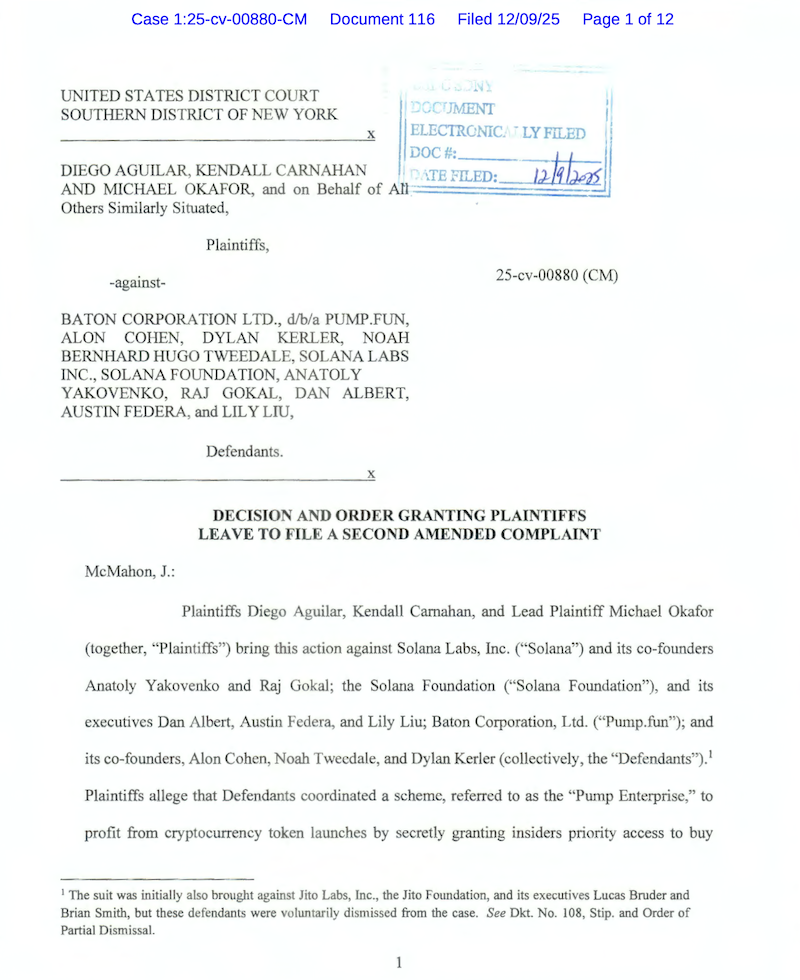
The first page of the motion to amend the case to include new evidence, which was granted. Source: Burwick Law

The lawsuit, originally filed in July, alleges that the Pump.fun platform deliberately misled retail investors by marketing memecoin launches as “fair,” but engaged in a scheme with Solana validators to front-run retail participants through maximal extractable value (MEV).

Maximal extractable value is a technique that involves reordering transactions within a block to maximize profit for MEV arbitrageurs and validators.

The plaintiffs allege that Pump.fun used MEV techniques to give insiders preferential access to new tokens at a low value, which were then pumped and dumped onto retail participants, who were used as exit liquidity by insiders.

Cointelegraph reached out to Burwick Law, the legal firm representing the plaintiffs, as well as Pump.fun, Jito Labs and the Solana Foundation, but did not receive any responses by the time of publication.
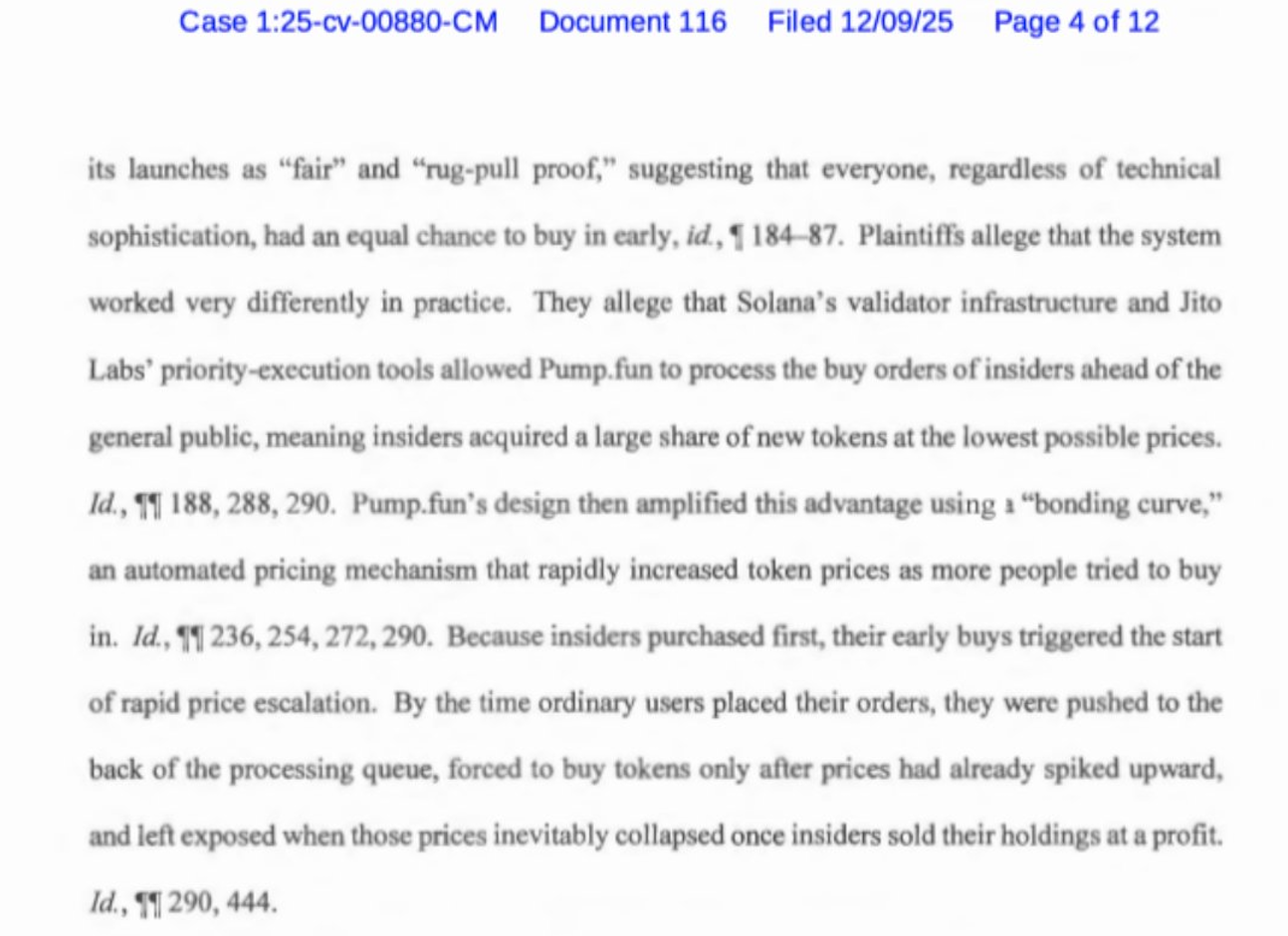
The allegations in the original lawsuit filing. Source: Burwick Law

The lawsuit could set a precedent for MEV cases in the United States, as the ethics of the practice continue to be debated within the crypto industry and legal bodies struggle to define proper regulations about the highly technical subject.

Related: Pump.fun co-founder denies $436M cash out, claims it was ‘treasury management’

The MEV bot trial leaves questions unanswered

Anton and James Peraire-Bueno, the brothers accused of using a MEV trading bot to make millions of dollars in profit, went to trial in November in the US.

Prosecutors argued that the brothers tricked victims out of their funds, but defense attorneys said that they were executing a legitimate trading strategy and did not do anything illegal.

The jury struggled to reach a verdict in the case, and several jurors requested additional information to clarify the complexities surrounding the technical specifics of blockchain technology.

The case ended in a mistrial after the jury was deadlocked and failed to reach a verdict, highlighting the complexity of adjudicating legal disputes surrounding the application of nascent financial technology.

Magazine: Meet the onchain crypto detectives fighting crime better than the cops


Пов'язані питання

QWhat is the main subject of the class-action lawsuit discussed in the article?

AThe class-action lawsuit is against memecoin launch platform Pump.fun, MEV infrastructure company Jito Labs, the Solana Foundation, and others. It alleges they engaged in a scheme using Maximal Extractable Value (MEV) to front-run retail investors, misleading them about the fairness of memecoin launches.

QWhat significant new evidence was added to the lawsuit, and how was it obtained?

AOver 5,000 pieces of evidence in the form of internal chat logs were submitted by a 'confidential informant' in September. The plaintiffs assert these logs contain contemporaneous discussions among the defendants that clarify the management, coordination, and communications of the alleged scheme.

QHow does the article describe the practice of Maximal Extractable Value (MEV)?

AMaximal Extractable Value (MEV) is described as a technique that involves reordering transactions within a block to maximize profit for MEV arbitrageurs and validators.

QWhat was the outcome of the recent trial involving the Peraire-Bueno brothers and an MEV trading bot?

AThe trial of Anton and James Peraire-Bueno ended in a mistrial after the jury was deadlocked and failed to reach a verdict, highlighting the complexity of adjudicating legal disputes involving this nascent financial technology.

QWhy is this lawsuit considered potentially precedent-setting according to the article?

AThe lawsuit could set a precedent for MEV cases in the United States as legal bodies struggle to define proper regulations for this highly technical subject, and the ethics of the practice continue to be debated within the crypto industry.

Пов'язані матеріали

Blockchain Has Finally Started to Sail into the Mainstream After 18 Years

Blockchain Finds Its True Path After 18 Years: Becoming the Financial Backbone for AI Agents and Autonomy This analysis explores a pivotal shift in the blockchain and crypto investment landscape, driven by the dominance of AI. Major venture capital firms, including Variant, Paradigm, Haun Ventures, and YZi Labs, are moving beyond pure "crypto" investment theses. They are expanding their focus to AI, robotics, and frontier tech, signaling that blockchain is no longer seen as a standalone sector but as an underlying infrastructure layer. The core argument is that blockchain's killer application may not be user-facing apps, but rather providing the economic rails for the coming wave of AI agents, autonomous robots, and automated systems. Key capabilities like self-custody wallets, programmable stablecoins for micropayments, on-chain identity, and verifiable smart contracts are positioned as essential for a future where machines conduct economic activity. The recent $1.4 billion investment by Tether (via its venture arm) in German robotics company NEURA Robotics exemplifies this, aiming to embed Tether's wallet tools directly into robots for autonomous transactions. While many "AI + Crypto" projects remain superficial, the article concludes that true value lies where crypto is a necessary component—enabling machine-to-machine payments, agent autonomy, verifiable data provenance, and open financial settlement for the AI era. For crypto venture capital, this convergence with AI represents both an adaptation to shifting capital flows and a potential path to unlocking the large-scale, non-speculative utility the industry has long sought.

marsbit13 хв тому

Blockchain Has Finally Started to Sail into the Mainstream After 18 Years

marsbit13 хв тому

Blockchain has finally begun sailing toward the main channel after 18 years

After 18 years of development, blockchain technology is beginning to move from a specialized niche into mainstream adoption, according to a recent industry analysis. The shift is reflected in the changing strategies of major crypto venture capital firms, which are expanding their focus beyond pure "digital ownership" towards broader themes like "autonomy." The report highlights that leading VC firms like Variant, Paradigm, Haun Ventures, and YZi Labs are broadening their investment mandates to include not only crypto but also artificial intelligence (AI), robotics, biotech, and other frontier technologies. This reflects a recognition that the isolated "crypto investment" narrative is losing appeal to limited partners (LPs) as capital and attention increasingly flow toward AI and other high-growth tech sectors. A key emerging thesis is that blockchain's most significant future application may not be as a consumer-facing product, but as the underlying economic and settlement infrastructure for the AI era. As AI agents and autonomous systems become more prevalent, they will require programmable, global, and low-cost payment networks (like stablecoins), verifiable digital identities, and secure wallets to manage transactions and assets on behalf of users. The investment by stablecoin issuer Tether into robotics company NEURA, with plans to integrate its wallet technology, is cited as a prime example of this convergence. However, the article cautions that simply labeling projects as "AI + Crypto" is insufficient. True value lies in integrations where blockchain technology is essential—such as enabling machine-to-machine micropayments, verifiable data provenance for AI, or transparent governance for autonomous organizations—rather than being a superficial marketing add-on. In conclusion, while AI currently dominates the tech narrative and capital flows, it may ultimately create the real-world, high-frequency demand that the crypto industry has long sought. For crypto VCs and projects, the path forward is to position blockchain not as a competing sector, but as a critical foundational layer powering autonomy and economic activity in an AI-driven future.

链捕手20 хв тому

Blockchain has finally begun sailing toward the main channel after 18 years

链捕手20 хв тому

Y Combinator Co-founder: How to Make a Billion Dollars?

The Y Combinator co-founder argues that becoming a billionaire by founding a successful startup is not only possible but demonstrably achievable without unfair or unethical practices. He disputes a politician's claim to the contrary, using the example of a founder whose company grew at 93% monthly solely through creating a product users loved and recommended. The core mechanism is exponential growth. A conservative 15% monthly growth rate compounds to a 4384x increase over five years, which can easily lead to billion-dollar valuations and founder wealth. The process depends on two key variables: the growth rate and the duration it can be sustained. A high growth rate stems from a great product that users naturally promote, while a long duration requires a large enough market. For aspiring founders, especially young ones, the simplest path is to build something they and their friends genuinely need. Young people's current needs often predict future mass-market trends. He advises against actively "searching" for ideas, as this tends to filter out unconventional but promising ones. Instead, inspiration should come from working on interesting projects with friends, as many iconic companies (e.g., Apple, Facebook) started this way. Ultimately, building a massively valuable startup is not about exploitation but empathy: deeply understanding a user group and building a product that significantly improves their lives. This, powered by exponential growth in a large market, is the legitimate path to immense wealth creation.

Foresight News22 хв тому

Y Combinator Co-founder: How to Make a Billion Dollars?

Foresight News22 хв тому

The 800V Voltage Standard Championed by Nvidia: Which Infrastructure Providers Stand to Benefit?

NVIDIA is actively promoting the 800VDC architecture as a key direction for its next-generation AI factories and high-power racks, particularly for the upcoming Rubin and Kyber platforms. The primary driver is the rapidly increasing power density of AI racks, with designs like GB200/GB300 NVL72 reaching 120-140kW and future systems potentially hitting 180-220kW. At such high power levels, traditional low-voltage power delivery becomes inefficient due to massive current, leading to significant copper use, cable bulk, heat, and power loss. The 800VDC standard aims to increase efficiency by transmitting power at higher voltage and lower current to the rack before stepping it down locally for GPUs. NVIDIA claims this can improve efficiency by up to 5%, reduce total cost of ownership (TCO) by up to 30%, and cut copper usage by approximately 45%. This shift redefines infrastructure roles, pushing power engineering to the forefront alongside GPU performance. Key beneficiaries and ecosystem partners highlighted include: 1. **Power Infrastructure Providers:** Companies like Vertiv, Schneider Electric, Delta Electronics (台达电), and Korean firms LS Electric and HD Hyundai Electric are involved in designing next-gen AI factory power distribution, rack power supplies, and backup systems. 2. **Power Semiconductors:** Suppliers of SiC/GaN devices, such as Infineon and STMicroelectronics, are better suited for high-voltage, high-efficiency conversion in this new architecture. 3. **Connectivity & Structure:** The focus shifts to high-reliability components like busbars, high-voltage connectors, and advanced PCBs that meet stricter insulation and safety requirements. 4. **Liquid Cooling & Rack ODM:** As power and heat density rise, liquid cooling becomes critical. Full-rack system integrators (e.g., Dell, Wiwynn, Wistron) must now demonstrate robust pre-delivery testing capabilities, including burn-in testing under full load, requiring significant power and cooling infrastructure in their factories. The transition is not immediate for all data centers but is targeted at high-density AI factories. NVIDIA’s 800VDC ecosystem is in a preparatory phase, with full-scale production expected to align with the 2027 launch of Kyber rack-scale systems. The investment thesis revolves around which companies can demonstrate proven product integration, customer validation, and reliable delivery of complete, high-power AI rack systems, making power, cooling, and testing capabilities new critical variables in the AI infrastructure value chain alongside GPUs.

marsbit43 хв тому

The 800V Voltage Standard Championed by Nvidia: Which Infrastructure Providers Stand to Benefit?

marsbit43 хв тому

Торгівля

Спот
Ф'ючерси

Популярні статті

Як купити PUMP

Ласкаво просимо до HTX.com! Ми зробили покупку Big Pump (PUMP) простою та зручною. Дотримуйтесь нашої покрокової інструкції, щоб розпочати свою криптовалютну подорож.Крок 1: Створіть обліковий запис на HTXВикористовуйте свою електронну пошту або номер телефону, щоб зареєструвати обліковий запис на HTX безплатно. Пройдіть безпроблемну реєстрацію й отримайте доступ до всіх функцій.ЗареєструватисьКрок 2: Перейдіть до розділу Купити крипту і виберіть спосіб оплатиКредитна/дебетова картка: використовуйте вашу картку Visa або Mastercard, щоб миттєво купити Big Pump (PUMP).Баланс: використовуйте кошти з балансу вашого рахунку HTX для безперешкодної торгівлі.Треті особи: ми додали популярні способи оплати, такі як Google Pay та Apple Pay, щоб підвищити зручність.P2P: Торгуйте безпосередньо з іншими користувачами на HTX.Позабіржова торгівля (OTC): ми пропонуємо індивідуальні послуги та конкурентні обмінні курси для трейдерів.Крок 3: Зберігайте свої Big Pump (PUMP)Після придбання Big Pump (PUMP) збережіть його у своєму обліковому записі на HTX. Крім того, ви можете відправити його в інше місце за допомогою блокчейн-переказу або використовувати його для торгівлі іншими криптовалютами.Крок 4: Торгівля Big Pump (PUMP)Легко торгуйте Big Pump (PUMP) на спотовому ринку HTX. Просто увійдіть до свого облікового запису, виберіть торгову пару, укладайте угоди та спостерігайте за ними в режимі реального часу. Ми пропонуємо зручний досвід як для початківців, так і для досвідчених трейдерів.

320 переглядів усьогоОпубліковано 2024.12.12Оновлено 2026.06.02

Як купити PUMP

Обговорення

Ласкаво просимо до спільноти HTX. Тут ви можете бути в курсі останніх подій розвитку платформи та отримати доступ до професійної ринкової інформації. Нижче представлені думки користувачів щодо ціни PUMP (PUMP).

活动图片