Hyperliquid, Wall Street's 24/7 Trading Convenience Store

marsbitPublished on 2026-06-04Last updated on 2026-06-04

Abstract

Hyperliquid: The 24/7 Trading "Convenience Store" for Wall Street Hyperliquid, a decentralized cryptocurrency exchange, has become a go-to platform for Wall Street traders seeking to trade around the clock, especially during traditional market closures. Founded by Jeff Yan, a former quantitative trader, after the FTX collapse, the platform emphasizes user self-custody of assets. It offers a wide range of perpetual contracts—leveraged derivatives with no expiry—on assets from Bitcoin and crude oil to the S&P 500 and even pre-IPO companies like SpaceX. A notable example involves a hedge fund trader who capitalized on geopolitical news over a weekend, securing a 243% return on oil derivatives before markets reopened. The platform, run by just 11 employees, generated approximately $800 million in revenue last year, and its native token HYPE has seen significant growth. Its rise highlights the merging of traditional finance and crypto. While U.S. users are currently restricted, recent CFTC rule changes could open access. The platform is known for its transparency, having processed $10 billion in liquidations during a market crash while competitors faltered. Regulators warn of the high risks and complexity of perpetual contracts for retail investors. Key to its appeal is a strong community culture, direct engagement with founders, and a simple interface. Despite rules against VPN use, it attracts global users with its permissionless approach. Hyperliquid plans to expand into pr...

By: Vicky Ge Huang, The Wall Street Journal

Compiled by: Luffy, Foresight News

One Saturday in February, when the phone of hedge fund commodity trader Vala Zeinali lit up with the news that President Trump had announced airstrikes against Iran, he immediately opened the Hyperliquid website.

As a decentralized crypto trading platform, Hyperliquid is open for business 24/7, all year round. Since the beginning of this year, it has become the go-to destination for short-term traders on Wall Street. During weekends when U.S. stock markets are closed, investors can open or close positions here in advance, locking in profits before the U.S. markets open.

Back in early 2026, anticipating that geopolitical conflict might erupt in the Middle East, Zeinali had deployed four-figure capital into crude oil derivatives. When the airstrike news hit and oil prices surged, he promptly closed his position on Hyperliquid, securing a hefty 243% return.

"I was particularly grateful at that moment," Zeinali said. "Typically, the oil price spike from such geopolitical news tends to retrace before the U.S. markets open on Monday. Luckily, I could exit in time, and most of my positions were successfully cashed out."

An increasing number of traditional finance and crypto traders are flocking to the platform, trading a diverse range of assets: Bitcoin, the S&P 500, crude oil, and even pre-IPO stars like SpaceX. The primary focus is on perpetual contracts, a type of derivative with no expiry date that trades around the clock and allows leveraged amplification of gains and losses.

Hyperliquid founder Jeff Yan, appearing at an event, stated that the platform's ultimate goal is to host all financial activities.

Hyperliquid was founded three years ago by Jeff Yan, a former quantitative trader at high-frequency trading firm Hudson River Trading. The FTX collapse inspired him: the crypto market desperately needed a high-performance trading system where users self-custody their assets.

"Self-custody isn't some abstract academic concept; it's a fundamental user need," Jeff Yan said in an interview. "After the FTX incident, more users should have prioritized this. The core essence is having assets in your own hands."

The company behind Hyperliquid has only 11 employees. According to Blockworks Research data, the platform and its associated blockchain generated approximately $800 million in revenue last year; the blockchain's native token, HYPE, has surged over 100% since its launch in late 2024, with a current market cap of around $16 billion.

Hyperliquid's rapid rise is a microcosm of the accelerating convergence between traditional finance and crypto markets. Perpetual contracts linked to U.S. stocks and commodities have firmly captured Wall Street's attention.

Recently, Eric Vishria, a general partner at venture capital firm Benchmark, shared an image on platform X showing a banker monitoring the price of perpetual futures linked to AI chipmaker Cerebras. Earlier this year, Trade [XYZ], a licensed partner of S&P Dow Jones Indices, launched an S&P 500 index perpetual product on Hyperliquid, which has also become one of the platform's popular contracts.

Significant capital is betting on the IPO prospects of unlisted companies. According to Hyperdash data, perpetual contracts for SpaceX have accumulated a trading volume of $280 million on Hyperliquid.

Currently, users within the U.S. cannot legally access the platform, but this may change. Last Friday, the U.S. Commodity Futures Trading Commission (CFTC) introduced a new regulatory framework allowing licensed domestic platforms to list perpetual contracts; it also approved Kalshi to launch a Bitcoin perpetual product, and U.S. Coinbase users can access its global perpetual contracts through an affiliated entity.

Perpetual contracts inherently carry high leverage and risk, magnifying both profits and losses. For example, on October 10th last year, when Trump suddenly announced 100% tariffs on China, the market crashed violently, with over $19 billion in leveraged positions liquidated across all markets. Hyperliquid alone accounted for $10 billion of that.

Jeff Yan stated that the actual industry-wide losses were far higher than $19 billion. Hyperliquid was singled out in statistics because its liquidation data is fully transparent, and its system remained fully operational during the extreme volatility, while several competing platforms suffered outages and were unable to function normally.

Benjamin Schiffrin, Director of Securities Policy at financial watchdog Better Markets, issued a warning: "Perpetual contracts are structurally complex; even seasoned finance professionals struggle to fully grasp them. The current level of risk disclosure to retail investors is severely inadequate. This combination harbors significant dangers."

Despite restrictions, traders from the U.S. and other prohibited regions still participate via VPNs. The key attraction lies in the platform's lack of mandatory identity verification, a stark contrast to the rigorous due diligence required by traditional brokerages. The platform's user agreement explicitly prohibits U.S. user participation and forbids using VPNs to circumvent restrictions.

Another major advantage retaining users is the simple and user-friendly interface, diverse trading offerings, and strong community atmosphere.

Geneva-based trader Pascal Lin joined in late 2023 and quickly became a power user. What impressed him most was the ability to give direct product feedback to founder Jeff Yan and the team via the Discord community.

"The sense of involvement is intense; it feels like you're building the product yourself," said Pascal, who also runs the proprietary trading desk at ARES Capital Management, primarily trading HYPE and crude oil perpetuals. He previously capitalized on a major oil bull run, riding prices from $67 per barrel to nearly $100.

His obsession with Hyperliquid is such that he even set up real-time price alerts on his Apple Watch, though he admits he wouldn't recommend ordinary traders to follow suit. "Waking up at any hour of the night, you can open the app with one tap to check HYPE's price."

He's not the only fervent user. The platform's unique community culture is central to its traffic. On platform X, users habitually tag Hyperliquid at the end of their posts, regardless of topic. Many users adopt the green-hoodie smiling cat Hypurr as their social avatar. Beyond the meme culture, third-party developers continuously build supporting ecosystem tools like market trackers and data dashboards.

Lawrence Wu, co-founder of Hyperdash, remarked: "I think the reason it has such a massive community is that it's trying to achieve crypto's original vision—a meritocratic, permissionless system. It's highly idealistic."

Jeff Yan stated that Hyperliquid's ultimate goal is to consolidate all financial activity. The next step for Hyperliquid is to venture into prediction markets and options trading. Its first set of contracts tracking Bitcoin prices, launched in early May, has already generated millions in trading volume.


Related Questions

QAccording to the article, why has Hyperliquid become the preferred platform for Wall Street traders in 2026?

AHyperliquid has become the preferred platform because it is a decentralized crypto trading platform that operates 24/7, 365 days a year. This allows investors to open or close positions on weekends when U.S. stock markets are closed, enabling them to lock in profits or hedge before the markets reopen.

QWhat was the key inspiration for Jeff Yan, the founder of Hyperliquid, to create the platform?

AJeff Yan was inspired to create Hyperliquid by the FTX collapse. This event highlighted the crypto market's need for a high-performance trading system where users could have self-custody of their assets, a core principle he views as a critical user demand.

QWhat significant advantage does Hyperliquid claim to have over its competitors during the market crash on October 10, 2025?

ADuring the market crash, Hyperliquid claims its system continued to function normally while several competing platforms went down. Additionally, its liquidation data is fully transparent, which is why its liquidation amount of $10 billion was distinctly reported amidst the total market liquidation of over $19 billion.

QWhat is one of the main regulatory concerns raised about perpetual contracts, as mentioned in the article?

AOne major regulatory concern is that perpetual contracts are structurally complex and difficult for even seasoned finance professionals to fully understand. The current risk disclosures for retail investors are deemed severely inadequate, creating a potentially dangerous combination.

QWhat are some key features, besides 24/7 trading, that contribute to Hyperliquid's strong user community and appeal?

AKey features contributing to its strong community include a simple and user-friendly interface, a wide variety of tradable assets, and a vibrant community culture. Users can directly interact with the founder and team on Discord, fostering a strong sense of participation. The community also actively uses memes like the 'Hypurr' cat and develops third-party tools, creating a unique ecosystem.

Related Reads

Blocked Its Own Treasure, WeChat AI Steps Up

Tencent's stock surged over 10% on June 2nd amid reports that WeChat, with 1.43 billion monthly users, is finalizing tests for a native AI Agent. The reported feature, accessible by swiping right from the main interface, allows users to issue commands in natural language. The AI then decomposes tasks and automatically calls upon relevant Mini Programs within WeChat to complete actions like ordering food, booking tickets, or making payments, creating a closed-loop service execution system. This strategic shift follows the internal conflict and subsequent "blocking" of Tencent's standalone AI app, Yuanbao, by WeChat for violating sharing rules during a 2026 Spring Festival promotion. The incident highlighted a lack of internal consensus and exposed the weakness of competing in the standalone AI assistant arena against rivals like ByteDance's Doubao (345M MAU) and Alibaba's Qianwen. The new WeChat AI Agent aims to leverage WeChat's unique assets—its massive user base, standardized Mini Program APIs, WeChat Pay, and identity system—to move from simple content generation to actual task execution. Analysts note this changes the competitive landscape from model benchmarks to which AI can connect to more real-world services. However, success depends on key variables: the capability of Tencent's underlying Hunyuan model, managing massive inference costs, and redesigning incentives for Mini Program developers whose traffic might be bypassed. The move is seen as an attempt to keep user service intent within WeChat's ecosystem as AI begins to redefine how users access services.

marsbitHá 20m

Blocked Its Own Treasure, WeChat AI Steps Up

marsbitHá 20m

ByteDance Adopts Arm CPUs, Jensen Huang: So Sad I Didn't Buy Arm

**Summary:** At Computex 2026, Arm CEO Rene Haas announced that ByteDance and Oracle have adopted Arm's self-designed Arm AGI data center CPU. The company expects significant revenue growth from this product, projecting $20 billion in demand for the 2027/2028 fiscal years. Haas noted that restricting AI-capable CPUs from the US to China is nearly impossible due to their widespread applications. Arm's stock has surged dramatically this year, notably rising 16% after NVIDIA's Arm-based Vera CPU and RTX Spark announcements. A highlight was the informal, humorous on-stage conversation between Haas and NVIDIA CEO Jensen Huang. Huang joked about NVIDIA's failed attempt to acquire Arm and playfully lamented selling his Arm shares. Both executives showed a clear sense of camaraderie and shared regret over the missed merger. Key technical topics were discussed: 1. **AI PC Design:** Huang explained NVIDIA's RTX Spark superchip (with a 20-core Arm CPU) is designed for future AI agents that will autonomously run and use tools on PCs, blending local and cloud processing. 2. **Agent vs. OS:** Huang emphasized the operating system remains crucial, as AI agents rely on its APIs and tools to function. 3. **Growth Constraints:** He identified the shift to "useful AI" that generates profitable tokens as a primary driver for immense, almost limitless, computational demand. Haas outlined Arm's strategy across PC and data centers. For PCs, Arm collaborates with partners like NVIDIA and MediaTek, offering its compute subsystem (CSS) for custom SoCs. In data centers, its Arm AGI CPU (built on TSMC's 3nm process) has gained major partners including OpenAI, Meta, and now ByteDance and Oracle. Arm presented a multi-year roadmap for its in-house CPU line. The article concludes that while GPUs dominated the AI training race, the explosion of AI agents is shifting significant focus to CPUs for inference, state management, and tool orchestration. The industry is trending towards vertical integration, with companies like cloud providers designing chips and chip/IP firms offering full solutions, all competing to deliver more efficient computing per watt.

marsbitHá 40m

ByteDance Adopts Arm CPUs, Jensen Huang: So Sad I Didn't Buy Arm

marsbitHá 40m

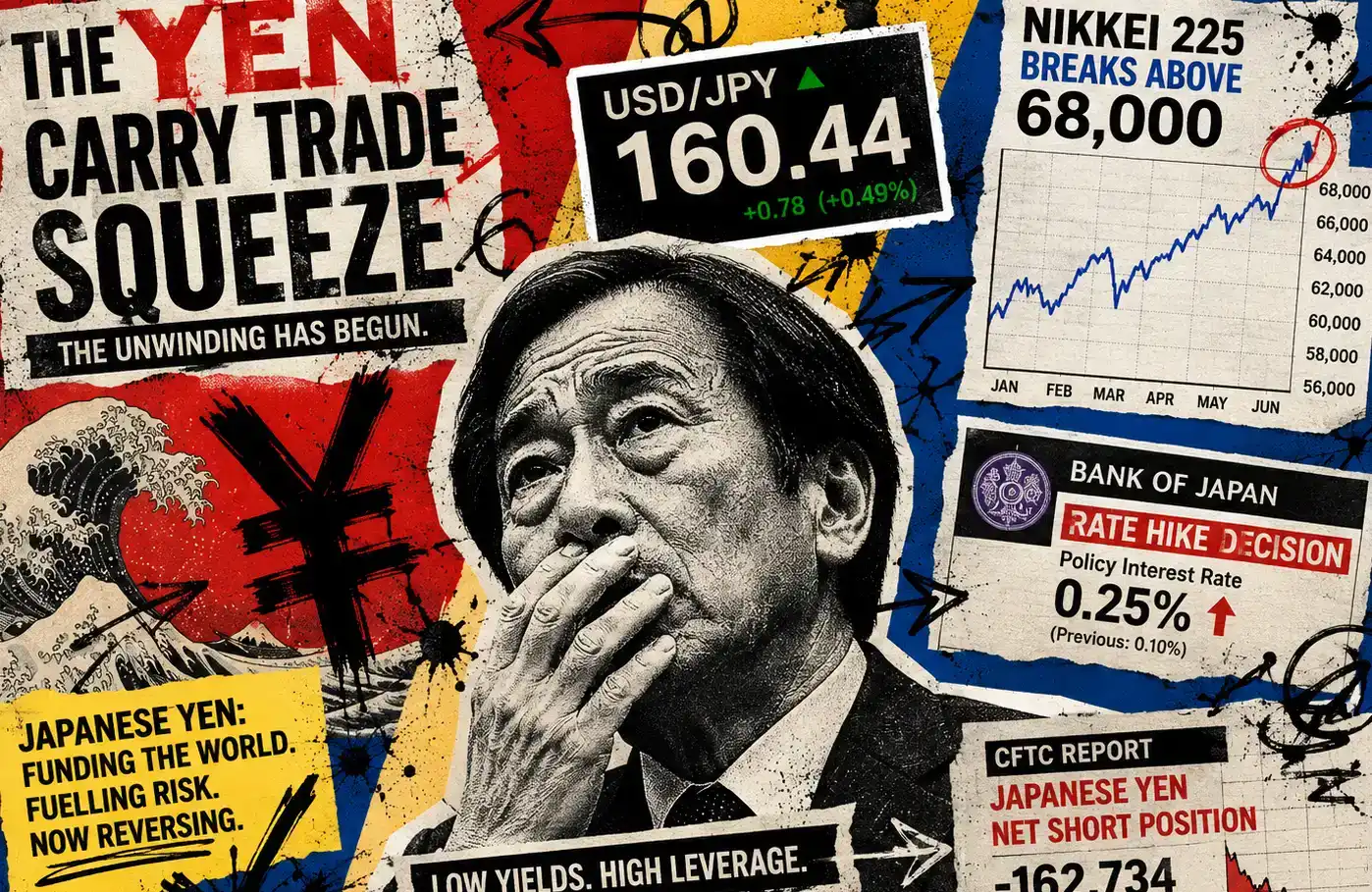
New Wall Street Play: Yen Shorts Still Adding, But Japan Stocks Don't Rely on Carry Trade Unwinding

On June 3rd, USD/JPY hit 160.44, its highest level since July 2024, while the Nikkei 225 surged past 68,000 points. Contrary to popular narratives of an imminent "carry trade unwind" akin to August 2024, data reveals a more complex picture. Speculative net short positions in yen futures have actually increased, reaching -114,667 contracts by late May, suggesting traders are doubling down rather than retreating. Meanwhile, Japan's Finance Ministry conducted its largest-ever single-round FX intervention (11.73 trillion yen) in April-May but failed to hold the 160 yen line. The Nikkei's rally is not driven by carry trade dynamics. Foreign investors are aggressively buying Japanese stocks, with net purchases in 2026 running nearly 16 times higher than 2025 levels. This inflow is concentrated in AI and semiconductor-related stocks like SoftBank and Socionext, fueled by positive sector outlooks, rather than being a flight from unwinding yen shorts. Furthermore, the Nikkei has continued climbing despite the Bank of Japan's (BOJ) rate hikes to 0.75%. This disconnect exists because the current equity boom is fueled by AI-driven foreign investment, not reliant on cheap yen funding. However, this relationship remains fragile. Should the BOJ hike rates further (e.g., to 1.0%) while dollar weakness increases carry trade costs, the trajectories of the yen and Japanese stocks could reconverge, potentially triggering volatility.

marsbitHá 44m

New Wall Street Play: Yen Shorts Still Adding, But Japan Stocks Don't Rely on Carry Trade Unwinding

marsbitHá 44m

Broadcom's Q3 Guidance Misses Expectations by $12 Billion, After-Hours Trading Plummets Over 13%, AI Narrative "Cooling"?

On June 3, Broadcom released record Q2 FY26 results with revenue of $22.19B, up 48% YoY, and AI chip sales of $10.8B, up 143%. Adjusted EPS of $2.44 beat estimates. However, its Q3 AI semiconductor revenue guidance of $16B, while up over 200% YoY, fell roughly $1.2B (7%) short of analyst consensus expectations of $17.2B. This miss, coupled with slightly weaker-than-expected software revenue, triggered a severe market reaction. CEO Hock Tan maintained the FY26 AI revenue outlook of over $100B but did not raise it, disappointing investors who had priced in more robust growth. The stock plummeted over 13% in after-hours trading, erasing roughly $270B in market cap. The sell-off extended to peers like Marvell. A key concern for markets, particularly for Chinese optical module suppliers, was Tan's comment that the contribution of AI networking (e.g., Ethernet switches, optical interconnect chips) to AI revenue, currently near 40%, is expected to normalize to around 30% over time, signaling a potential peak in growth for that segment. Despite the guidance shortfall, Tan reiterated that AI demand remains "insatiable" and reaffirmed the long-term target of exceeding $100B in AI revenue by FY27. The reaction highlights the heightened sensitivity and premium valuation placed on AI-exposed stocks, where anything less than stellar guidance can prompt significant profit-taking. The broader question is whether this represents a cooling AI narrative or a correction in overstretched valuations.

marsbitHá 44m

Broadcom's Q3 Guidance Misses Expectations by $12 Billion, After-Hours Trading Plummets Over 13%, AI Narrative "Cooling"?

marsbitHá 44m

Trading

Spot
Futures
活动图片