$7.8mln ETH deployed into DeFi – Is Ethereum Foundation setting the tone?

ambcryptoPublicado a 2026-03-19Actualizado a 2026-03-19

Resumen

The Ethereum Foundation has deployed 3,400 ETH (worth approximately $7.8 million) into DeFi protocol Morpho, signaling strong institutional confidence in Ethereum’s staking and lending ecosystem. This follows an earlier deposit of 2,400 ETH and $6 million in stablecoins in October 2025. The move is seen as a strategic effort to encourage broader DeFi adoption and strengthen Ethereum’s financial infrastructure. This activity coincides with growing institutional interest, including BlackRock’s Staked ETH ETF (ETHB) recording its largest inflow of 28,810 ETH ($67.18 million) and Grayscale’s Ethereum Mini Trust locking 76,800 ETH in under a week. Total Value Locked (TVL) in DeFi has surpassed $100 billion, with Ethereum dominating nearly 60% of the market. The upcoming CLARITY Act is expected to further accelerate institutional participation, positioning Ethereum’s DeFi as a key area for long-term investment and a hedge during market volatility. The Ethereum Foundation still holds over $400 million in ETH, underscoring its ongoing influence.

Staking yields are one of the main bridges connecting TradFi and DeFi.

Put simply, staking yields let traditional investors earn “predictable” returns while getting exposure to the decentralized ecosystem, similar to earning interest in banks. That’s why many in TradFi see the CLARITY Act as a real disruptor, as it could speed up DeFi adoption and reshape capital flows.

Ethereum [ETH], however, seems to be ahead of the curve.

The Ethereum Foundation recently deployed 3,400 ETH into Morpho, including 1,000 ETH into Morpho Vaults V2. Back in October 2025, they had already added 2,400 ETH plus about $6 million in stablecoins into Morpho Vaults V1.
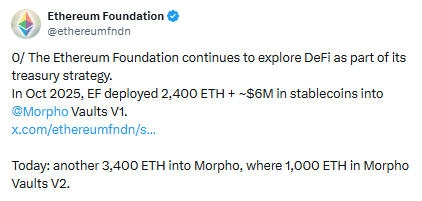
Source: X

From a strategic perspective, these moves carry real weight.

For instance, the Ethereum Foundation (a non-profit focused on network development) is showing that it’s actively putting capital to work in DeFi. By doing so, it signals confidence in Ethereum’s staking and lending ecosystem while also encouraging broader adoption across the network.

Notably, this strategy is playing out in real time.

On the 17th of March, the BlackRock Staked ETH ETF (ETHB) saw its largest inflow since inception, with a net flow of 28,810 ETH (about $67.18 million) and $0.3 billion in trading volume, highlighting growing institutional interest in Ethereum’s staking ecosystem.

And it doesn’t stop there.

Grayscale’s Ethereum Mini Trust has locked in 76,800 ETH in under a week alone. Technically, this shows that large ETH holders are allocating more and more capital into DeFi, with the Ethereum Foundation’s moves setting the pace.

Naturally, the question is: Does this give the network an edge as the CLARITY Act draws closer?

Ethereum treasuries deploy ETH, showing DeFi as a risk-off catalyst

Beyond network-level breakdowns, the DeFi sector is seeing unprecedented growth.

In fact, Total Value Locked (TVL) recently crossed $100 billion for the first time since February, demonstrating that staking continues to attract capital even in a broader risk-off environment.

Ethereum, which represents nearly 60% of the market, is clearly benefiting the most, making this trend a strong bullish signal for the network.

Against this backdrop, the CLARITY Act could become a meaningful catalyst for Ethereum, both technically and fundamentally. Backing this, the Ethereum Foundation is deploying millions into the financial infrastructure, showing that developers are laying the groundwork for broader DeFi adoption.


Source: Arkham

As the chart above shows, the Ethereum Foundation recently deposited $7.88 million of ETH to Steakhouse, a billion-dollar DeFi asset manager.

More importantly, the Foundation still holds over $400 million in ETH, highlighting its continued influence and strategic role in supporting the network’s growing market share.

According to AMBCrypto, this is just the start of a deeper trend.

As noted earlier, the CLARITY Act could act as a major catalyst, driving even greater institutional interest in Ethereum DeFi, with more ETH treasuries likely following BitMine’s playbook. Recent inflows into BlackRock’s ETHB only reinforce this momentum.

At the heart of it all, the Ethereum Foundation is clearly leading the way. Its recent “strategic” moves clearly signal the network’s direction, positioning Ethereum’s DeFi ecosystem as a key focus for long-term investors and a safety net during periods of intense volatility, supported by a 6% jump in ETH TVL so far this month.


Final Summary

  • Ethereum treasuries, including the Ethereum Foundation, are deploying hundreds of millions of ETH into DeFi protocols, signaling confidence and driving network growth.
  • Big inflows into BlackRock’s ETHB and Grayscale’s Ethereum Mini Trust show that traditional finance is increasingly participating in Ethereum staking, with the CLARITY Act likely acting as a catalyst.


Preguntas relacionadas

QWhat is the significance of the Ethereum Foundation deploying 3,400 ETH into Morpho, according to the article?

AThe deployment signals the Foundation's confidence in Ethereum's staking and lending ecosystem, actively putting capital to work in DeFi to encourage broader adoption and set a strategic tone for the network.

QHow does the article connect the CLARITY Act to the growth of Ethereum's DeFi ecosystem?

AThe CLARITY Act is seen as a potential major catalyst that could accelerate DeFi adoption and drive greater institutional interest in Ethereum, reshaping capital flows and providing regulatory clarity.

QWhat recent institutional developments highlight growing interest in Ethereum's staking ecosystem?

ABlackRock's Staked ETH ETF (ETHB) had its largest inflow with a net flow of 28,810 ETH (about $67.18 million), and Grayscale's Ethereum Mini Trust locked in 76,800 ETH in under a week, showing increased institutional participation.

QWhat does the Total Value Locked (TVL) crossing $100 billion indicate for the DeFi sector and Ethereum specifically?

AIt demonstrates that staking continues to attract capital even in a risk-off environment, with Ethereum benefiting the most as it represents nearly 60% of the market, making it a strong bullish signal for the network.

QHow much ETH does the Ethereum Foundation still hold, and what does this signify for its role in the ecosystem?

AThe Ethereum Foundation still holds over $400 million in ETH, highlighting its continued influence and strategic role in supporting the network's growth and market share through DeFi deployments.

Lecturas Relacionadas

What AI Services Are Crypto Companies Offering?

Crypto companies across various sectors—exchanges, security firms, payment infrastructure, and research platforms—are rapidly integrating AI-driven services. Unlike previous hype cycles, this wave is led by established players like Coinbase, Binance, and Bitget, who are motivated by both genuine utility and fear of missing out (FOMO) as AI transitions from concept to operational necessity. Key applications include: - **Research tools** (e.g., Surf AI) that aggregate fragmented on-chain and market data to provide accurate crypto-specific insights. - **Trading automation**, where exchanges enable users to execute strategies via natural language commands, lowering barriers for non-developers but potentially reducing platform loyalty. - **Security and auditing** (e.g., CertiK), using AI to enhance code review efficiency and post-audit monitoring, addressing historical limitations. - **Payment infrastructure** (e.g., Circle’s proposals), exploring AI-agent-compatible stablecoin payments for the emerging autonomous economy, though this remains nascent. While AI adoption is driven by competitive pressure and the need to retain users, gaps remain between feature launches and real-world usage. The focus is on distinguishing value-adding integrations from superficial implementations. The entry of mature firms signals AI’s strategic importance, ensuring crypto remains relevant in the AI evolution.

marsbitHace 4 min(s)

What AI Services Are Crypto Companies Offering?

marsbitHace 4 min(s)

People Laid Off by AI Won't Disappear; They Will Become the Creators of the Next Economy

The article argues that the real question surrounding AI is not whether it will cause unemployment, but what happens to the people displaced. AI is replacing not humans, but the standardized, replicable, and automatable parts of human work. This follows historical patterns where technological revolutions, from stone tools to computers, made old skills obsolete and dissolved old structures—but humanity adapted and reorganized. The author draws a parallel to China’s large-scale layoffs during state-owned enterprise reforms 30 years ago, which initially seemed catastrophic but eventually fueled the growth of a new private economy, new companies, and new types of jobs. Engineers, though among the first impacted, are also positioned to recover fastest. Their systemic understanding and proximity to new productive forces make them ideal candidates to adapt and create in the new economy. More importantly, AI is reshaping companies themselves—reducing organizational bloat, communication costs, and bureaucracy. This enables smaller, more agile teams and empowers strong creators who may have previously struggled with management rather than innovation. The core issue is not job loss, but self-definition: will individuals wait to be reassigned by the old system, or use new tools to reorganize production? AI accelerates differentiation—eliminating some jobs, shattering illusions for some, and offering others a chance to leap forward. The author’s view is that AI is dismantling an entire generation’s belief in stable career paths. Those laid off won’t vanish; instead, many will reinvent themselves—transitioning from employees in old systems to creators of the next economy. Every productivity revolution淘汰 (eliminates) not people, but those who refuse to rewrite themselves. The first to accept this and start building the new world will succeed.

marsbitHace 14 min(s)

People Laid Off by AI Won't Disappear; They Will Become the Creators of the Next Economy

marsbitHace 14 min(s)

Trading

Spot
Futuros
活动图片