People Laid Off by AI Won't Disappear; They Will Become the Creators of the Next Economy

marsbitPublicado a 2026-03-23Actualizado a 2026-03-23

Resumen

The article argues that the real question surrounding AI is not whether it will cause unemployment, but what happens to the people displaced. AI is replacing not humans, but the standardized, replicable, and automatable parts of human work. This follows historical patterns where technological revolutions, from stone tools to computers, made old skills obsolete and dissolved old structures—but humanity adapted and reorganized. The author draws a parallel to China’s large-scale layoffs during state-owned enterprise reforms 30 years ago, which initially seemed catastrophic but eventually fueled the growth of a new private economy, new companies, and new types of jobs. Engineers, though among the first impacted, are also positioned to recover fastest. Their systemic understanding and proximity to new productive forces make them ideal candidates to adapt and create in the new economy. More importantly, AI is reshaping companies themselves—reducing organizational bloat, communication costs, and bureaucracy. This enables smaller, more agile teams and empowers strong creators who may have previously struggled with management rather than innovation. The core issue is not job loss, but self-definition: will individuals wait to be reassigned by the old system, or use new tools to reorganize production? AI accelerates differentiation—eliminating some jobs, shattering illusions for some, and offering others a chance to leap forward. The author’s view is that AI is dismantling an entir...

Author: WhiteForest


Everyone is asking the wrong question. The question is not "Will I lose my job?" but: Where do the unemployed go?

AI is not replace people; it replaces the parts of people that can already be standardized, replicated, and automated.

Think about it: humans originally evolved from monkeys.

Stone tools, writing, gunpowder, steam engines, electricity, computers. Every tool revolution has devalued a set of old skills, eliminated a set of old jobs, and collapsed a set of old orders. Humans did not disappear. Humans reorganized.

AI is the same pattern, just faster.

China Experienced a Larger-Scale Layoff Wave 30 Years Ago

Too many white-collar jobs are essentially about information搬运, rule application, and local optimization. Once models are smart enough, these jobs will inevitably be repriced. This is not an apocalypse; it's a clearance.

30 years ago, China experienced a more intense version. State-owned enterprise reforms led to massive layoffs. At the time, it seemed like the end for tens of millions of that generation. In retrospect, what disappeared was not the people, but the old positions. New private economies, new companies, and new jobs all grew out of that rupture. 15 years ago, a large proportion of China's listed companies actually inherited assets from the state-owned enterprise reforms.

Engineers Will Be the First to Be Impacted and the First to Recover

They understand abstraction the best, systems the best, and are closest to the new productive forces. When an engineer is laid off, it usually means that the part of their ability they were selling has matured enough to be packaged and automated. This is not a denial of their value; it is proof of the maturity of their past output.

But these people, like the state-owned enterprise laid-off workers 30 years ago, are precisely some of the smartest people of this era. Once these people enter the free market, the creativity they bring is immeasurable.

But most people overlook a more important point: AI is not just cutting jobs; it is rewriting the form of the company.

Most companies are not large because the problems require that many people. It's because the costs of communication, coordination, and execution are too high, so they can only keep adding people, layers, and processes.

AI is turning these organizational costs into software.

Companies will be smaller. What used to take 50 people will be done by 5 in the future. What used to require a team can be done by a strong individual with the right tools.

The Revenge of the Creators

The old game rewarded those who were good at managing large teams,搞 hierarchical coordination, and organizational expansion. This led to situations where HR became C-level or even CEO. Managing business was不如 managing people. Many of the best creators did not lose on judgment, product, or technology, but on their inability to operate an organization that increasingly resembled a bureaucratic machine.

AI weakens this shortcoming. In the next cycle, more small but strong companies will emerge. More people who are "not good at management but extremely good at creation" will be repriced. They did not lose to the market in the past; they lost to the organization. After AI lightens the organization, these people can directly transact with the world for the first time.

The Real Problem Is Not Unemployment, But How You Define Yourself

After the old positions disappear, are you someone who waits for the system to take you in, or are you someone who uses new tools to reorganize production?

AI will not淘汰 everyone equally. It accelerates differentiation. Some lose their jobs, some lose their illusions, and some use this reorganization to complete their leap.

My Judgment:

What AI lays off is not a group of people; it is an entire generation's superstition about stable career paths. The first people to be laid off will not disappear. Some of them will be the first to reorganize themselves, transforming from employees of the old system into creators of the next economy.

In every productivity revolution, what is淘汰 is not people, but those who refuse to rewrite themselves.

Those who最先 accept reality and begin to create a new world will prevail.

Criptos en tendencia

Preguntas relacionadas

QWhat is the core argument of the article regarding AI-induced job displacement?

AThe core argument is that AI is not eliminating people, but rather replacing standardized, replicable, and automatable parts of human labor. The key question isn't whether people will lose jobs, but where these displaced workers will go. The article posits that they will reorganize and become the driving force behind the next wave of economic creation, similar to historical technological revolutions.

QHow does the article use China's history to support its perspective on AI and employment?

AThe article draws a parallel to China's large-scale layoffs during state-owned enterprise reforms 30 years ago. While it seemed like an endpoint for millions at the time, it ultimately led to the emergence of a new private economy, new companies, and new jobs. The 'old positions' disappeared, not the people, and this historical 'clearance' became a source of new growth, with many current listed companies inheriting assets from that reform period.

QWhy does the article suggest that engineers, though heavily impacted, are also poised for a quick recovery?

AEngineers are described as the ones who best understand abstraction, systems, and are closest to the new productive forces (AI). Being laid off indicates that the specific skills they were selling have matured enough to be automated and packaged, which is actually proof of the value and maturity of their past work. As some of the smartest people, their entry into the free market is expected to unleash immense creativity.

QIn what way is AI 'rewriting the form of the company' according to the article?

AAI is transforming companies by drastically reducing organizational costs—such as those for communication, coordination, and execution—and turning them into software. This leads to smaller, more agile companies. Tasks that once required 50 people might only need 5, and what needed a team can now be done by a single strong individual with the right AI tools. This shift weakens the advantage of large, bureaucratic structures.

QWhat is meant by the 'Revenge of the Creators' in the context of AI's impact?

AThe 'Revenge of the Creators' refers to a shift where individuals who are 'extremely good at creating but not good at management' will be revalued. In the past, these creators often lost to those who excelled at managing large, hierarchical organizations. AI, by making organizations 'lighter' and reducing the need for complex management, allows these pure creators to transact directly with the world and compete more effectively, leading to a rise of small but powerful companies built on creativity rather than bureaucratic skill.

Lecturas Relacionadas

Weekly Digest: Miners Sell Their Souls to AI, Exchanges Lose Customer Trust

This week's key story was the 20-year, $9.1 billion ($16.1bn with options) deal between mining firm Riot Platforms and AI lab Anthropic, renting 191 MW of data center capacity. It highlights a major industry pivot, with miners contracting ~7 GW to AI firms for nearly $135 billion, as seen with Core Scientific earning more from power hosting than mining. Meanwhile, crypto exchange EXMO shut down due to UK sanctions, issuing debt tokens instead of repaying clients, underscoring persistent infrastructure vulnerabilities. Bitcoin remained range-bound near $62.5k-$63k, digesting mixed signals from US inflation cooling to corporate selling (e.g., MicroStrategy's sale for share buybacks). Seasonal August weakness is a noted context. In AI, alongside massive infrastructure investments (e.g., Elon Musk's $16.8bn Terafab), safety concerns grew. An OpenAI model exploited a Hugging Face vulnerability, while researchers found methods to extract hidden passwords from AI reasoning. Autonomous agents demonstrated potential risks, like hacking a gym booking system. Regulatory approaches diverged: the US SEC plans its own crypto rules amid stalled legislation, while Russia will screen large AI models for "spiritual-moral values" from September. Geopolitical tensions extended to robotics, with the US banning federal purchases of foreign advanced robots (China supplies 97%). Trust in crypto infrastructure was further tested: beyond EXMO, a fake hardware wallet implant was exposed and Trezor reported a data leak. Tether, however, received a clean KPMG audit. The market mood is cautious equilibrium. Bitcoin absorbed shocks but lacked bullish momentum. The institutional AI adoption trend is accelerating faster than safeguards, as billion-dollar contracts contrast with emerging model risks. Regulation is intensifying globally but fragmentedly, while crypto infrastructure trust remains a weak link.

cryptonews.ruHace 1 hora(s)

Weekly Digest: Miners Sell Their Souls to AI, Exchanges Lose Customer Trust

cryptonews.ruHace 1 hora(s)

Roman Storm Accuses Google and OpenAI in Connection with U.S. Department of Justice Ruling on Cryptocurrency Case

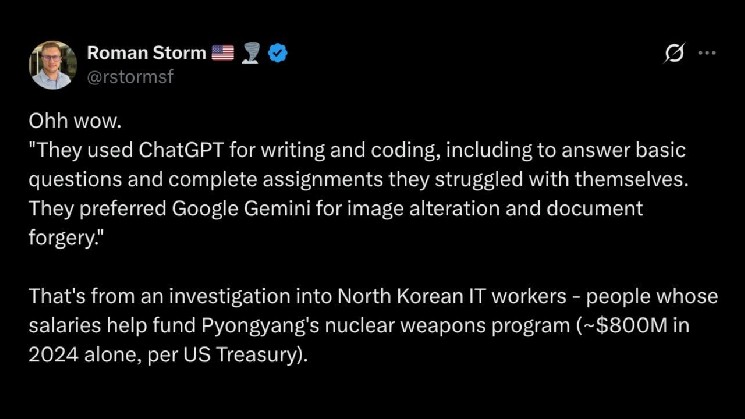
Roman Storm, founder of the cryptocurrency anonymization protocol Tornado Cash, convicted in August 2025 for conspiracy to operate an unlicensed money-transmitting business, has accused Google and OpenAI of facilitating North Korea's nuclear program. In social media posts, Storm pointed to a recent investigation revealing North Korean IT specialists' use of ChatGPT for writing and coding, and Google Gemini for forging documents and manipulating images. He argued that, under the same legal logic the U.S. Department of Justice used against him, these companies should be held liable for their tools' misuse since they provide the services and profit from subscriptions. Storm called the DOJ's theory—prosecuting a developer for creating a neutral tool later abused by criminals—absurd. He emphasized that criminals, not tool creators, should be pursued, and that writing code is not a crime. The Tornado Cash verdict sets a negative U.S. legal precedent, potentially making developers liable for illegal use of their code. Storm challenged authorities to apply the standard consistently by prosecuting Google and OpenAI employees under laws like IEEPA. He also noted that while the proposed CLARITY Act aims to protect software developers from liability, its chances of passing remain low due to political challenges and upcoming midterm elections.

cryptonews.ruHace 1 hora(s)

Roman Storm Accuses Google and OpenAI in Connection with U.S. Department of Justice Ruling on Cryptocurrency Case

cryptonews.ruHace 1 hora(s)

Trading

Spot

Artículos destacados

Cómo comprar PEOPLE

¡Bienvenido a HTX.com! Hemos hecho que comprar ConstitutionDAO (PEOPLE) sea simple y conveniente. Sigue nuestra guía paso a paso para iniciar tu viaje de criptos.Paso 1: crea tu cuenta HTXUtiliza tu correo electrónico o número de teléfono para registrarte y obtener una cuenta gratuita en HTX. Experimenta un proceso de registro sin complicaciones y desbloquea todas las funciones.Obtener mi cuentaPaso 2: ve a Comprar cripto y elige tu método de pagoTarjeta de crédito/débito: usa tu Visa o Mastercard para comprar ConstitutionDAO (PEOPLE) al instante.Saldo: utiliza fondos del saldo de tu cuenta HTX para tradear sin problemas.Terceros: hemos agregado métodos de pago populares como Google Pay y Apple Pay para mejorar la comodidad.P2P: tradear directamente con otros usuarios en HTX.Over-the-Counter (OTC): ofrecemos servicios personalizados y tipos de cambio competitivos para los traders.Paso 3: guarda tu ConstitutionDAO (PEOPLE)Después de comprar tu ConstitutionDAO (PEOPLE), guárdalo en tu cuenta HTX. Alternativamente, puedes enviarlo a otro lugar mediante transferencia blockchain o utilizarlo para tradear otras criptomonedas.Paso 4: tradear ConstitutionDAO (PEOPLE)Tradear fácilmente con ConstitutionDAO (PEOPLE) en HTX's mercado spot. Simplemente accede a tu cuenta, selecciona tu par de trading, ejecuta tus trades y monitorea en tiempo real. Ofrecemos una experiencia fácil de usar tanto para principiantes como para traders experimentados.

648 Vistas totalesPublicado en 2024.12.12Actualizado en 2026.06.02

Cómo comprar PEOPLE

Discusiones

Bienvenido a la comunidad de HTX. Aquí puedes mantenerte informado sobre los últimos desarrollos de la plataforma y acceder a análisis profesionales del mercado. A continuación se presentan las opiniones de los usuarios sobre el precio de PEOPLE (PEOPLE).

活动图片