Zcash Price Surge Enhances Its Advantage Over Bitcoin in Mining Revenue and AI High-Performance Computing

cryptonews.ruPublished on 2026-08-25Last updated on 2026-08-25

Abstract

According to analysis by The Energy Mag, Bitmain's Z15 Pro miner for Zcash cryptocurrency generated approximately $727.30 in gross revenue per megawatt-hour of electricity as of Monday, which is about 3.3 times higher than the estimated industry average for high-performance computing (HPC) at $222.73 per MWh. This marks a significant increase in the mining advantage of Zcash over HPC, from about $150 per MWh in late June to over $500 currently. The performance gap compared to Bitcoin mining hardware like the S23 Pro also widened substantially. The surge is driven primarily by a sharp price increase in Zcash (ZEC), which rose roughly 70% in seven days to trade around $890, setting what analysts consider a practical all-time high based on more liquid trading history. Bitcoin also saw gains of over 20%, rising above $77,000, but its mining revenue growth was far less pronounced than Zcash's. The broader cryptocurrency rally was initially fueled by the U.S. Treasury's decision to expand long-term bond purchases, which lowered yields and weakened the dollar, prompting investors to shift towards alternative assets like gold and cryptocurrencies. Regulatory developments, including former President Trump's push for the Clarity Act and outlined lighter rules for digital asset firms, provided additional momentum. A subsequent short squeeze, with over $4 billion in bearish crypto positions liquidated, further amplified upward pressure. Upcoming U.S. economic data and Federal Reserve ...

This article first appeared in The Energy Mag. You can read the original article here. The Energy Mag (formerly The Miner Mag) publishes news, data, and analysis focused on the intersection of energy, computing, and markets.

According to The Energy Mag's analysis as of Monday, the Bitmain Antminer Z15 Pro mining Zcash yields approximately $727.30 in gross revenue per megawatt-hour of electricity. This is roughly 3.3 times the industry's average revenue yield for High-Performance Computing (HPC), estimated at $222.73 per MWh.
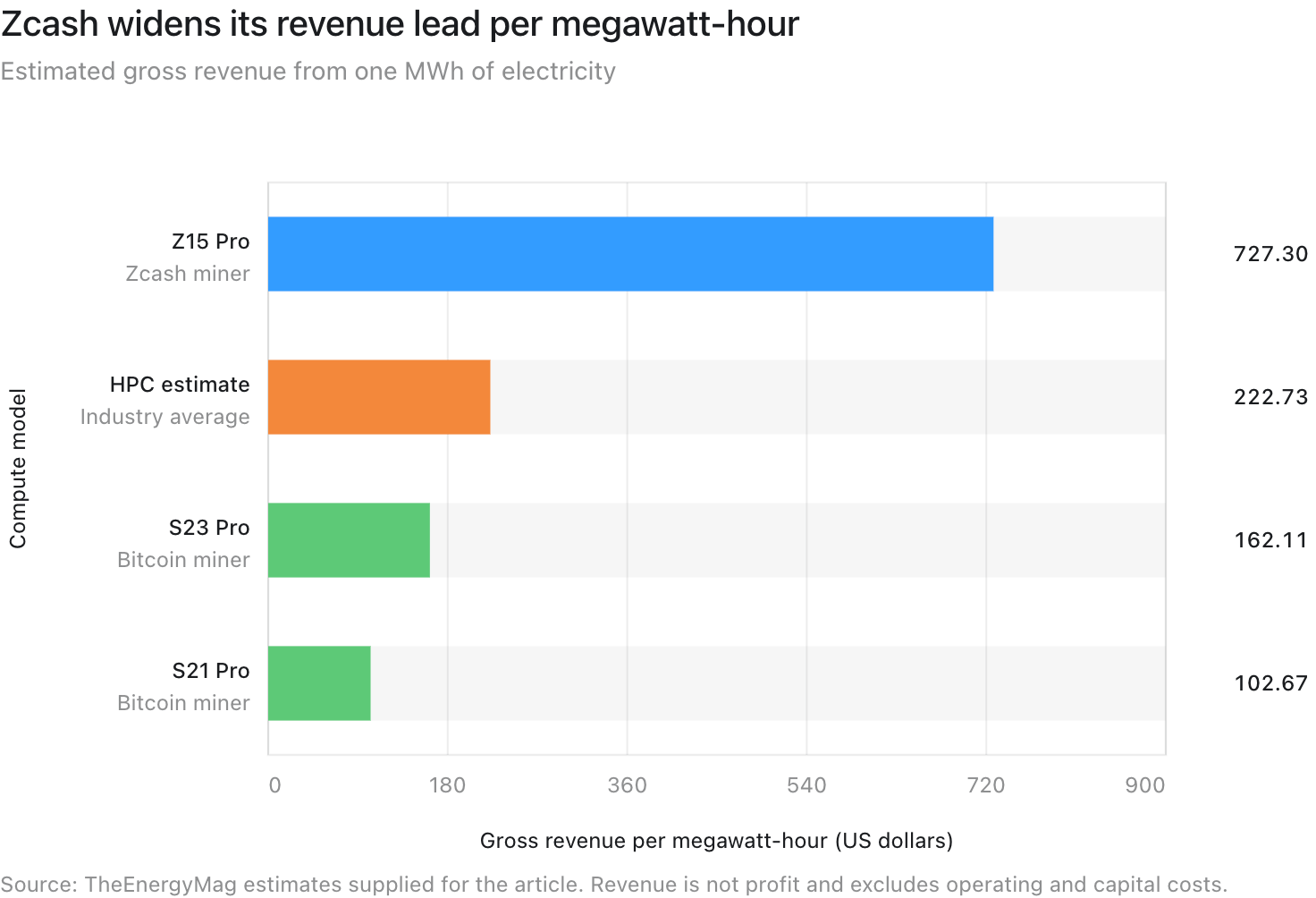
In a similar review by The Energy Mag published at the end of June, the Z15 Pro's revenue yield was estimated at $373 per MWh, compared to approximately $223 for HPC, $133 for the S23 Pro, and $84 for the S21 Pro. Zcash mining's advantage over the HPC benchmark at that time was about $150 per MWh. Since then, it has increased to over $500.

The gap between the Z15 Pro and the S23 Pro has more than doubled—from $240 to approximately $565 per MWh. The Z15 Pro's revenue is estimated to have grown by about 95%, while the S23 Pro's revenue increased by about 22%, and the HPC figure remained virtually unchanged.

This divergence reflects Zcash's superior performance. Over seven days, ZEC surged by approximately 70% and traded around $890 over the past week, surpassing the more sustainable market highs achieved after its launch in 2016.

This record comes with a caveat. Major price databases record anomalous trades from its launch week, ranging from about $3,200 to nearly $6,000, as Zcash's official all-time high. These prices were logged when only a negligible number of coins had been mined and available liquidity was extremely limited. Based on subsequent, more liquid trading history, the rise to around $890 represents a de facto all-time high, exceeding the peak levels reached during the 2017-2018 cryptocurrency cycle.

Bitcoin also rose more than 20% last week, breaking out of its roughly $62,000 to $67,000 range and climbing above $77,000 on Friday. This led to increased Bitcoin mining revenue, although the growth was significantly less than the growth in Zcash's economic activity.

The broader cryptocurrency rally began after the U.S. Treasury Department moved to expand purchases of long-term government bonds, leading to lower yields and a weaker dollar. Investors shifted focus to alternative assets, including gold and Bitcoin, amid concerns about inflation, federal debt, and the outlook for the U.S. currency.

Regulatory developments provided additional momentum. President Donald Trump used a White House cryptocurrency conference to pressure Congress to pass the Clarity Act, while regulators outlined further steps that could ease rules for companies handling digital assets.

The initial surge then accelerated into a "short squeeze." According to data from Coinglass, cited by the Associated Press, over $4 billion in cryptocurrency short positions were liquidated by Friday. Closing these positions required traders to buy back digital assets, intensifying upward pressure.

The next test will come from U.S. economic data and Federal Reserve actions. July personal consumption expenditures data, revised second-quarter GDP figures, and durable goods orders data are scheduled for Wednesday. Weekly jobless claims data will be released on Thursday.

On Friday, Fed Chairman Kevin Warsh will speak at the Jackson Hole symposium. A "hawkish" signal on inflation could lead to rising Treasury yields and a stronger dollar, partially reversing the liquidity-driven cryptocurrency rally. A more dovish stance could support further demand for risk and alternative assets.

end-content

Related Questions

QAccording to the article, how does the gross revenue of the Bitmain Antminer Z15 Pro mining Zcash compare to the industry average for HPC, and by what factor?

AAccording to the analysis, the Bitmain Antminer Z15 Pro generates approximately $727.30 in gross revenue per megawatt-hour of electricity, which is about 3.3 times the industry-average HPC revenue of $222.73 per MWh.

QWhat is the significant price milestone mentioned for ZEC (Zcash), and why does the article consider it a 'true historical high'?

AZEC traded around $890, a level exceeding its more sustainable post-launch highs. The article argues this is its 'true historical high' because the official all-time highs from its 2016 launch week (around $3,200 to nearly $6,000) occurred with extremely limited liquidity and a minuscule number of coins mined, making the recent $890 level a more meaningful peak.

QWhat two main factors are cited as catalysts for the broader cryptocurrency rally mentioned in the article?

AThe two main catalysts cited are: 1) The U.S. Treasury's decision to expand purchases of long-term government bonds, which lowered yields and weakened the dollar, prompting a shift to alternative assets. 2) Regulatory events, including pressure from former President Trump for crypto legislation and outlined measures by regulators to ease rules for digital asset firms.

QHow did the performance of Zcash's mining revenue compare to Bitcoin's mining revenue growth during the recent rally?

AWhile Bitcoin mining revenue also increased as Bitcoin's price rose over 20%, the growth in Zcash's mining economy was significantly greater. Revenue for the Z15 Pro miner increased by about 95%, compared to a roughly 22% increase for the S23 Pro Bitcoin miner.

QWhat upcoming event is highlighted as a potential test for the cryptocurrency market's rally, and what are the two possible outcomes suggested?

AFederal Reserve Chair Kevin Warsh's speech at the Jackson Hole symposium is highlighted as a potential test. A 'hawkish' signal on inflation could lead to higher Treasury yields and a stronger dollar, partially reversing the crypto rally. A more dovish stance could support further demand for risk and alternative assets.

Related Reads

Ilya Delivers, Huang Jen-Hsun Bets 50 Billion on SSI, First Model Suspected to Launch This Week

Ilya Sutskever's Safe Superintelligence (SSI) lab, backed by a rumored $5 billion investment from NVIDIA granting exclusive access to next-gen systems, may release its first groundbreaking model as early as this week. Industry insiders are hinting at a major breakthrough from a non-major player, with some claiming AI will be "utterly transformed." The model is speculated to fundamentally differ from current large language models like ChatGPT. Instead of relying on massive, static pre-training and ever-larger context windows, SSI's approach reportedly centers on **Test-Time Training (TTT)**. This would allow the model to **update its own internal weights in real-time** as it processes information, effectively "learning on the fly" and internalizing new knowledge like a human, rather than just referencing it from a large prompt. This aligns with Ilya Sutskever's long-stated vision of moving beyond the "pre-training" and "scaling" era. He envisions superintelligence not as a monolithic, pre-loaded database, but as an adaptive, "infinitely curious 15-year-old genius" capable of continual learning through interaction. SSI's strategy has been focused solely on this goal of "safe superintelligence" through efficient continual learning and alignment, explaining its prior silence. If successful, this model could disrupt the entire AI industry, challenging the current reliance on vast compute resources for training and the business models built around context windows. It suggests that core technological leaps, not just financial scale, remain decisive in the AI race.

marsbit10m ago

Ilya Delivers, Huang Jen-Hsun Bets 50 Billion on SSI, First Model Suspected to Launch This Week

marsbit10m ago

Demand Test: Bitcoin Whales Earn Record $1.2 Billion, Ethereum Holders Return to Profitability

In just three days after Bitcoin's price recovery, new Bitcoin whales have realized over $1.2 billion in profit, marking the largest profit-taking event for this cohort on record according to CryptoQuant. The peak occurred on August 20 with roughly $614 million, setting a daily record. Analysts note this selling pressure began after Bitcoin rose above the realized price of short-term whales, which was around $68,900. With Bitcoin trading near $77,700 on August 23, these whales were sitting on an average profit of about 12.8%. The market recovery allowed investors who were previously at breakeven or at a loss to lock in gains. CryptoQuant described the situation as a key test for Bitcoin demand; sustained prices above whale cost-basis with normalized profit-taking could signal strong new demand, while continued selling pressure could turn the rally into a mere break-even exit. Simultaneously, large Ethereum holders have also returned to an unrealized profit zone following its rally, as noted by CryptoQuant analyst Darkfost. Current profit levels, however, remain relatively low and are not seen as creating significant selling pressure. The Unrealized Profit/Loss Ratio for different whale cohorts stands at 0.075 (for 1k-10k ETH holders), 0.16 (10k-100k ETH), and 0.38 (over 100k ETH). This marks a significant improvement from June, when these whales were in substantial unrealized loss, with Ethereum having risen over 65% since then. The increased profitability is viewed as a positive sentiment signal for the Ethereum market.

cryptonews.ru22m ago

Demand Test: Bitcoin Whales Earn Record $1.2 Billion, Ethereum Holders Return to Profitability

cryptonews.ru22m ago

Kinetiq Team Announces Elysium L2 Network for Hyperliquid

On August 24, the liquid staking protocol Kinetiq announced Elysium, a new L2 network for the Hyperliquid ecosystem. It aims to increase HyperEVM's throughput and simplify the launch of spot markets, tokens, and DeFi applications. Elysium will use $HYPE for gas fees and plans direct integration with HyperCore's trading engine, giving apps access to its liquidity and orderbook data. Technical details and partners will be revealed later, with a launch date set for "soon." A primary reason for Elysium's development is to overcome HyperEVM's limitations, such as low throughput and rising fees during high load. Kinetiq claims the L2 will start with significantly higher block production and transaction speeds, later aiming to approach HyperCore's performance. This targets applications needing frequent state updates like high-frequency spot trading and AMMs, and will provide them deeper access to HyperCore orderbook data. The network also proposes to streamline the process of launching new assets within Hyperliquid, allowing a token to progress from AMM liquidity to HyperCore's spot orderbook and eventually to perp markets via HIP-3 in a unified flow. Regarding revenue, Kinetiq's model allocates 50% of sequencer fees to buy back and burn $KNTQ, 25% to developers using Elysium's block space, and 25% to the Kinetiq treasury. Elysium marks Kinetiq's expansion beyond its core liquid staking product, kHYPE.

cryptonews.ru24m ago

Kinetiq Team Announces Elysium L2 Network for Hyperliquid

cryptonews.ru24m ago

Trading

Spot
活动图片