Maelstrom’s Bitcoin Grants Hit 20 Months — 5 Developers, 4 Active, Here’s What They’ve Accomplished

bitcoinistPublished on 2026-06-10Last updated on 2026-06-10

Abstract

Maelstrom, the family office of BitMEX co-founder Arthur Hayes, has published the first annual report for its Bitcoin Grant Program. Over a 20-month period beginning in October 2024, the program has supported five developers, with four currently active. They are paid monthly in Bitcoin, with grants capped at $400,000 per developer annually. Two developers focus on Bitcoin Core: **Rkrux** is a prolific code reviewer, working on MuSig2 and wallet descriptor modernization. **Stratospher** focuses on critical consensus and peer-to-peer network code, fixing bugs that could cause network splits. Two others advance Bitcoin privacy: **Benalleng** develops Payjoin, a protocol that breaks common surveillance heuristics, with integrations in several wallets. **Macgyver** works on Silent Payments, enabling reusable static addresses without on-chain reuse, driving wallet adoption and standardization. The program funds only open-source Bitcoin protocol work with no commercial ties. The report highlights this model as a direct, transparent way for successful industry participants to fund the essential, unglamorous development underpinning Bitcoin's security and privacy.

Maelstrom, the family office of BitMEX co-founder Arthur Hayes, has published its first annual report for its Bitcoin Grant Program — revealing that four active developers have collectively advanced Bitcoin’s privacy, security, and codebase resilience across a 20-month program that began in October 2024, with five developers supported in total since inception.

The report, authored by Grant Program Administrator Jonathan Bier, covers the technical output of four currently active grantees — Rkrux, Stratospher, Benalleng, and Macgyver — two of whom work on Bitcoin Core directly and two of whom focus entirely on advancing Bitcoin’s privacy infrastructure. Grants are issued on 12-month contracts, paid monthly in Bitcoin, and can be stacked up to a cap of $400,000 per developer per year. The program is wholly funded by Maelstrom, per the report.

Bitcoin Core: The Unglamorous Work That Keeps The Network Safe

Two grantees are dedicated to Bitcoin Core — the software that runs the nodes securing the most valuable financial network ever built.

Rkrux, a grantee since October 2024, has become one of the project’s most prolific reviewers. In 2025 alone he made 1,155 review comments across more than 200 pull requests, ranking him the 11th most active commenter on the entire codebase, per a dashboard built by developer Niklas Gögge cited in the report. In the first five months of 2026 he added more than 400 additional PR comments.

His work spans MuSig2 — a protocol that makes multisignature transactions indistinguishable from single-signature transactions on-chain, simultaneously improving privacy and reducing fees — as well as the deprecation of legacy wallets in favor of modern descriptor-based wallets that improve interoperability across the ecosystem.

Stratospher, a grantee since November 2025, has focused on the areas where bugs carry the most catastrophic potential consequences — consensus-critical validation code and the peer-to-peer network. She discovered and fixed an undefined behavior bug in Bitcoin Core’s FindMostWorkChain function, contributed to the removal of the BLOCK_FAILED_CHILD flag, and worked on DLEQ cryptographic proofs in libsecp256k1 in relation to Silent Payments.

She also presented at the Africa Bitcoin Conference on two panels covering open source development and privacy. Her report notes directly that bugs in consensus code can cause nodes to disagree on the state of the network — a failure mode with no clean recovery path.
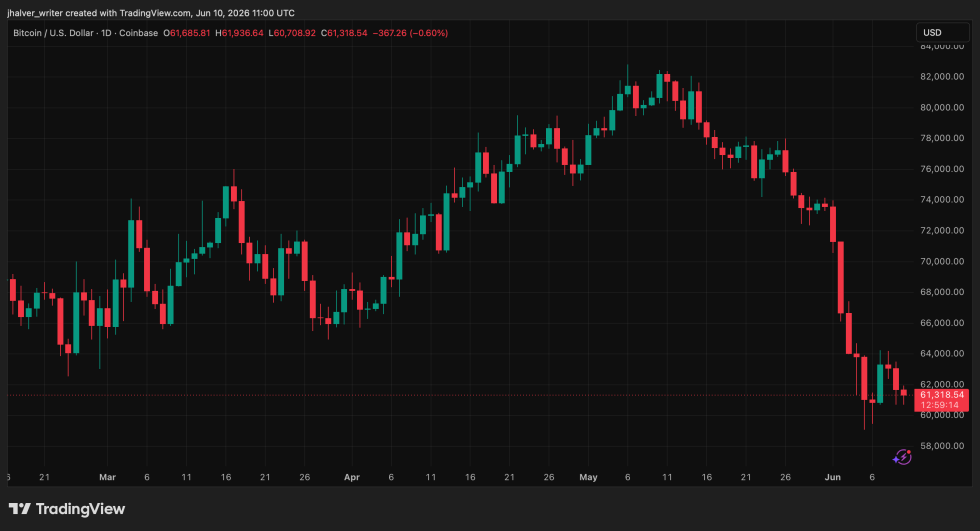
BTC's price trends to the downside on the daily chart. Source: BTCUSD on Tradingview

Privacy: The Infrastructure Bitcoin Still Needs

The other two grantees are wholly dedicated to Bitcoin privacy technologies — an area the report describes as central to Maelstrom’s philosophy.

Benalleng, funded since June 2025, works full time on Payjoin — a transaction protocol that allows both the sender and receiver to contribute inputs to a Bitcoin transaction, systematically breaking the surveillance heuristic that all inputs in a transaction belong to the same party. The Payjoin API has been integrated into Bull Bitcoin and Cake Wallet, with five or more additional wallet integrations currently in progress, per the report.

Bindings for Python, Javascript, Dart, and CSharp have been released to maximize developer accessibility. The report makes an argument that deserves attention: even minority adoption of Payjoin degrades chain surveillance capabilities for the entire network, including users who never use Payjoin themselves — a game-theoretic asymmetry Maelstrom considers one of Bitcoin’s most underappreciated privacy levers.

Macgyver, also funded since June 2025, is focused on Silent Payments — a protocol proposed by Ruben Somsen in 2022 that allows senders to make multiple payments to a recipient using a single static address, without ever reusing that address on-chain. Wallet adoption has progressed materially over the past 12 months: Blindbit-Desktop, Cake Wallet, and Dana Wallet now support both send and receive phases, while Sparrow Wallet and Nunchuk have added send support.

Bitcoin Core has draft implementations for both phases but they remain on hold pending a dependency on the Silent Payments module in libsecp256k1, per the report. Macgyver has formalized the Silent Payments roadmap, produced BIP-375 test vectors, proposed the first working BIP-375 hardware signer implementation for Coldcard, and organized monthly Silent Payments working group meetups.

What The Program Represents

Maelstrom’s grant framework is deliberately narrow — it funds open-source Bitcoin protocol work only, with no commercial strings attached and no token incentives involved. The review committee is two people: Arthur Hayes and Jonathan Bier. The funding comes from a single source.

And the work being done — reviewing consensus code, hardening P2P privacy, building transaction obfuscation tooling — is the kind of development that receives no headlines, generates no token price and yet underpins the security and privacy of a network that now holds hundreds of billions of dollars in value.

This development marks a pivotal moment for how the nascent sector’s most successful participants choose to give back. A family office that has profited substantially from Bitcoin’s appreciation deploying capital directly into the protocol’s open-source development stack — paid in Bitcoin, reviewed by peers, and published transparently — is a model the industry rarely produces and almost never documents this clearly.

Cover image from Grok, BTCUSD chart from Tradingview

Related Questions

QAccording to the article, what are the key focus areas of Maelstrom's Bitcoin Grant Program, and how many developers are currently active?

AThe Maelstrom Bitcoin Grant Program focuses on advancing Bitcoin's privacy, security, and codebase resilience. There are four currently active developers working in the program.

QWho are the two grantees working directly on Bitcoin Core, and what specific contributions did they make as highlighted in the report?

AThe two grantees working on Bitcoin Core are Rkrux and Stratospher. Rkrux is a prolific reviewer, making over 1,155 review comments in 2025 alone and working on MuSig2 and wallet deprecation. Stratospher focuses on consensus-critical validation and the peer-to-peer network, having fixed an undefined behavior bug and contributed to removing the BLOCK_FAILED_CHILD flag.

QWhat are the main privacy technologies being worked on by the other two grantees, Benalleng and Macgyver?

ABenalleng works full-time on the Payjoin transaction protocol to break surveillance heuristics. Macgyver focuses on the Silent Payments protocol, which allows multiple payments to a static address without on-chain reuse.

QHow is the Maelstrom grant program structured in terms of funding and administration?

AThe program issues 12-month contracts, pays monthly in Bitcoin up to a cap of $400,000 per developer per year. It is wholly funded by Maelstrom and administered by a two-person review committee consisting of Arthur Hayes and Jonathan Bier.

QWhy does the article consider the Payjoin protocol's adoption significant for Bitcoin's overall privacy, even if adopted by a minority of users?

AThe article argues that even minority adoption of Payjoin degrades chain surveillance capabilities for the entire network, benefiting users who never use Payjoin themselves. This creates a game-theoretic asymmetry that is considered one of Bitcoin's most underappreciated privacy levers.

Related Reads

CFTC Proposes New Rules for Prediction Markets, Redefining Which Events Can Be Listed and Who Can Participate

The U.S. Commodity Futures Trading Commission (CFTC) has proposed new rules to establish a clearer regulatory framework for prediction markets. The proposal aims to modify how "event contracts" are reviewed, creating a structured process to determine if contracts involving terrorism, assassination, war, or illegal activities violate the public interest. This moves away from a blanket ban toward a case-by-case assessment of whether a contract's subject matter is acceptable for financial trading. A key focus is distinguishing between predicting the impact of risks and predicting the occurrence of harm. The proposal suggests that many sports-based prediction markets—such as those on game outcomes, scores, or season standings—may be permissible as they can provide price discovery and meaningful information. However, markets on easily manipulated events like specific player injuries, referee calls, or outcomes of youth sports would face stricter scrutiny. The rules directly target insider trading and manipulation risks, highlighting cases where individuals with non-public information or the ability to influence an event's outcome could unfairly profit. This underscores a shift toward ensuring market fairness. The proposal does not end the regulatory debate, particularly with state gambling regulators who argue that sports prediction markets are essentially sports betting and should fall under state jurisdiction. Nonetheless, the CFTC's action signals a move toward formalizing prediction markets, pushing the industry from a phase of rapid, often unregulated expansion into a more institutionalized, rule-based environment that more closely resembles traditional financial markets.

marsbit7m ago

CFTC Proposes New Rules for Prediction Markets, Redefining Which Events Can Be Listed and Who Can Participate

marsbit7m ago

CFTC Proposes New Rules for Prediction Markets, Redefining Which Events and Who Can Participate

The U.S. Commodity Futures Trading Commission (CFTC) has proposed new rules to establish a regulatory framework for prediction markets, aiming to define which event contracts can be traded and who can participate. The 267-page proposal seeks to amend regulations to create a structured review process for "event contracts." The core goal is to determine whether contracts involving sensitive topics like terrorism, assassination, war, or illegal activities are contrary to the "public interest." The CFTC's approach is not an outright ban but a case-by-case assessment, focusing on whether a contract predicts harmful acts themselves or merely their commercial or risk-related impacts. The proposal suggests that most mainstream sports prediction markets—based on final scores, winners, or season outcomes—may be permissible as they provide price discovery and informational value. However, markets on easily manipulated granular events (e.g., player injuries, specific referee calls) or those encouraging harm/cheating would face stricter scrutiny. A primary regulatory target is insider trading and market manipulation, where individuals with non-public knowledge or influence over an event's outcome could unfairly profit. Recent alleged incidents involving military personnel, former politicians, and corporate insiders highlight this risk. The move clarifies federal oversight but does not end the debate. State regulators and gambling associations argue that many prediction markets, especially on sports, constitute gambling and should fall under state, not federal, jurisdiction. This sets up a potential conflict over regulatory authority. Overall, the CFTC's proposal signals a shift for prediction markets from rapid, less-regulated expansion toward a more institutionalized, rules-based model resembling traditional financial markets. Growth will increasingly depend on demonstrating market fairness, transparent settlement, and controlled risks.

Odaily星球日报16m ago

CFTC Proposes New Rules for Prediction Markets, Redefining Which Events and Who Can Participate

Odaily星球日报16m ago

Trading

Spot
Futures

Hot Articles

Discussions

Welcome to the HTX Community. Here, you can stay informed about the latest platform developments and gain access to professional market insights. Users' opinions on the price of S (S) are presented below.

活动图片