Platform Token Soars 15x in Half a Month, Pons Tops Robinhood Chain Charts for Both Token Launches and Trading

Odaily星球日报Pubblicato 2026-07-31Pubblicato ultima volta 2026-07-31

Introduzione

In just half a month, the Pons platform token (PONS) surged over 15x in value as Pons solidified its position as the leading token launch and trading platform on Robinhood Chain, capturing both the highest daily token creation volume and transaction volume. Following the exit of previous leader NOXA, competition initially favored Flap before Pons emerged dominant around mid-July. By July 26th, Pons accounted for 77.1% of total trading volume across all Robinhood Chain launchpads. Pons's success is attributed to its streamlined, one-transaction process for deploying a token contract and its corresponding Uniswap V3 liquidity pool simultaneously, eliminating the need for bonding curves or complex migrations. This simplicity, combined with low creation costs and immediate tradability, attracted significant creation activity and speculative trading. The meteoric rise of its native token, PONS, further fueled platform growth. A tokenomics model directing 80% of protocol fees to buy back and burn PONS created a reinforcing cycle: platform usage boosted PONS value, which in turn attracted more users. Looking ahead, Pons V2 aims to expand beyond meme tokens by integrating support for paying fees in stablecoins (USDG) and RWA assets, aligning with Robinhood Chain's broader focus on on-chain finance and stock tokens.

Original | Odaily Planet Daily (@OdailyChina)

Author | Asher (@Asher_ 0210)

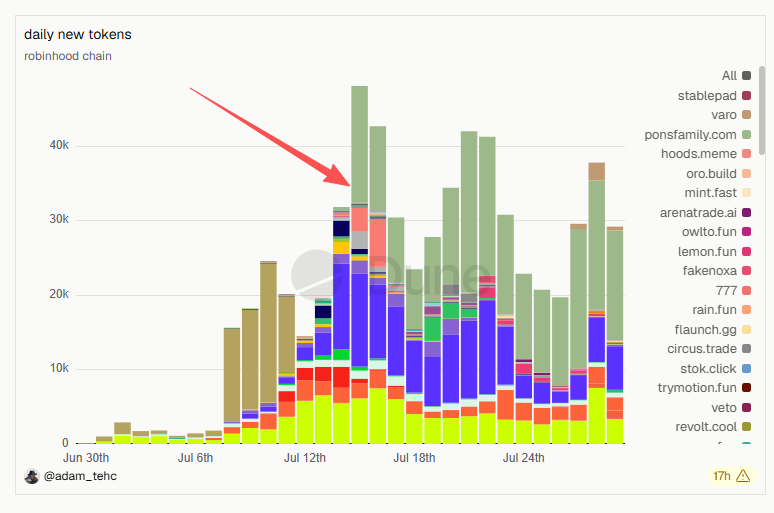
After NOXA ceased launching new tokens, the first to capture the Robinhood Chain token launch traffic was Flap. On July 14, Flap created over 11,000 tokens in a single day, accounting for more than 35% of the chain's token launches that day, with Bankr, Klik, and trench.today also taking a share of the traffic.

Two weeks later, the outcome of this free-for-all has become clearer.

Dune data shows that on July 15, Pons launched over 15,000 tokens in a single day, rising to the top spot among Robinhood Chain token launch platforms for the first time. Since then, Pons has maintained the lead in daily token launches, gradually widening the gap with Flap and other platforms.
In addition to the daily number of token launches, the trading volume of tokens on the Pons platform also began to grow rapidly from mid-July. On July 18, Pons' daily trading volume reached $40.7 million, surpassing NOXA's $37.4 million for the first time, and has remained in the top spot since. To date, the cumulative trading volume on the Pons platform has exceeded $1.5 billion.

On July 26 alone, Pons accounted for 77.1% of the total trading volume among Robinhood Chain token launch platforms, while the second-place NOXA accounted for only 6.6%. Pons is not only the platform with the most token launches but also commands the vast majority of trading volume on Robinhood Chain's token launch platforms.
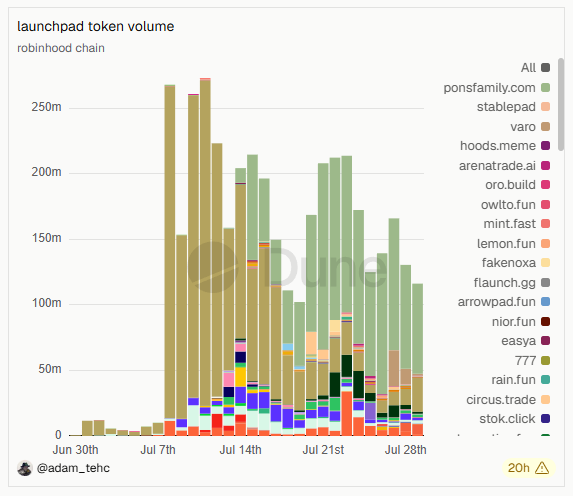
From Flap first capturing the demand after NOXA's exit to Pons overtaking in both launch volume and trading volume, a new leader among Robinhood Chain token launch platforms has emerged.

No Bonding Curve, No Migration: Pons Streamlines the Token Launch Process to the Minimum

Pons is a token launch and trading platform specifically built around Robinhood Chain, operated by Pons Labs, and is not an official Robinhood product. Users can create and trade tokens within the platform, with all operations completed via personal wallet signatures; Pons does not custody user assets.

Currently, the total supply of each new token on Pons is fixed at 1 billion, with a creation cost of only 0.0005 ETH. The platform charges a 1% fee on trades. Creators only need to fill in the token name, ticker, image, and social links to complete the launch.

Unlike the common bonding curve model seen on Pump.fun or Four.meme, the current version of Pons deploys the token contract and a Uniswap V3 liquidity pool in a single transaction, with liquidity locked immediately upon deployment. The token becomes tradable directly against WETH upon launch, eliminating the need to wait for a bonding curve to sell out or for a subsequent migration to an external DEX.

Once the paired WETH in the trading pool reaches the default threshold of 4.2 ETH, the token is marked as "graduated", but the original trading pool remains unchanged, and users continue buying and selling within the same pool. Pons also has a protection period for the first two blocks after a new token launches, limiting the buy amount and holding ratio per wallet to reduce the risk of a few addresses sweeping up tokens during the opening phase.

Pons' mechanism isn't overly complex or innovative; its advantage lies in being simple enough. Creators don't need to prepare initial liquidity or worry about post-bonding curve migration; traders can complete token discovery, buying, and selling all within the same platform.

In the early stages of Robinhood Chain's launch, low cost, fast launches, and instant trading were precisely what many projects and traders sought. By compressing the path from token creation to open trading into a single on-chain transaction, Pons laid the foundation for rapidly attracting launchers, bots, and short-term capital.

Surge of Over 15x: PONS Fuels Rising Platform Hype

The key factor enabling Pons to quickly distance itself from other platforms might be the explosive surge of its platform token, PONS, alongside its product and data growth.

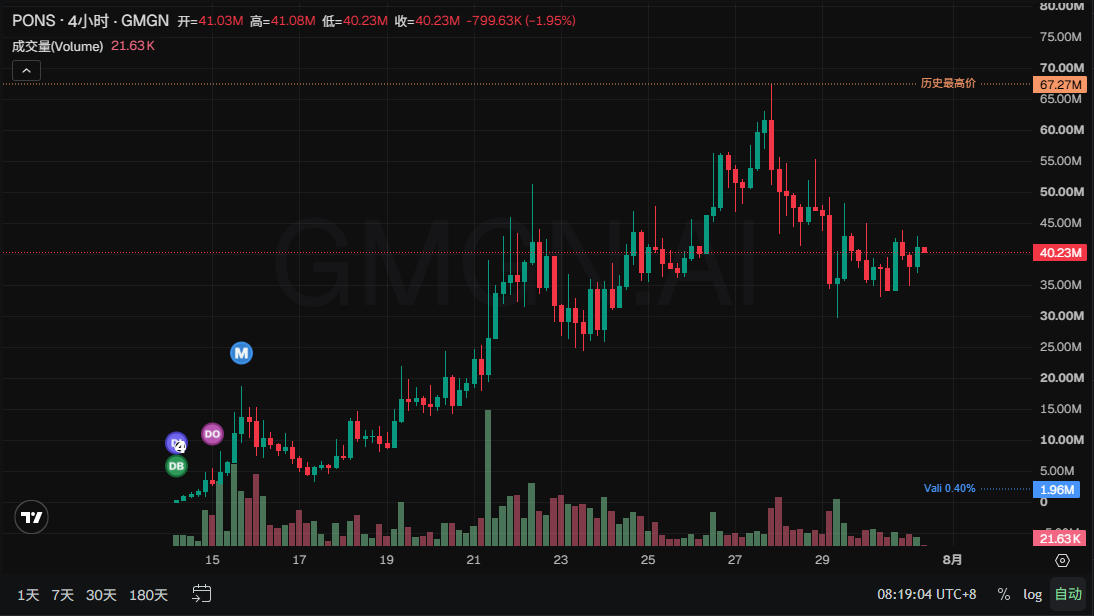
According to GMGN data, on July 16, the market cap of PONS was less than $5 million. It then rapidly increased, peaking at over $67 million at one point, representing a gain of more than 15 times during that period. The price has since retraced, with the current market cap around $40 million.
Currently, for tokens launched via Pons' new contract version, the trading fee is split 70% to the creator and 30% to the protocol (the old contract split 90%/10%). Of the protocol's share, 80% is used to market-buy and burn PONS, with the remaining 20% allocated to infrastructure and team operations. On July 28, the official announcement stated that 22% of the total PONS token supply had been burned.

Compared to launching tens of thousands of new tokens daily, PONS more easily becomes a unified target for the market to identify and trade the Pons narrative. As the PONS price continued to rise, more capital began paying attention to its underlying launch platform and entered Pons to seek new projects. The growth in platform trading volume, in turn, generated more fees and buyback funds, further strengthening PONS's price performance.

For Pons, PONS is not just a platform token; it has also become a crucial gateway for attracting new capital and users.

From Meme to RWA: The Positioning Upgrade of Pons V2

What truly distinguishes Robinhood Chain from other public chains are its stock tokens and on-chain finance. Pons' upcoming V2, currently in development, is beginning to extend in this direction. According to official disclosures, the platform will in the future support payment of trading fees to token creators and CTO operators in ETH, USDG, or RWA assets.
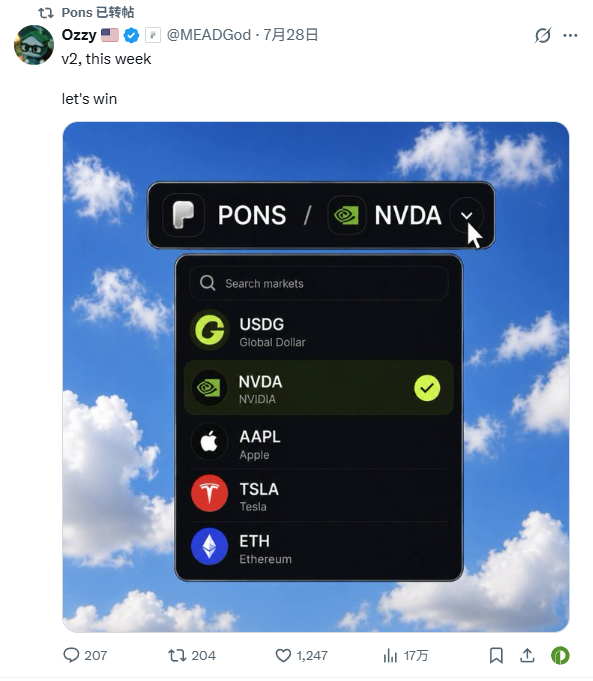
Pons initially gained a large user base and trading volume through Meme tokens launched on its platform. V2 now attempts to connect this launch mechanism with Robinhood Chain's stablecoins and RWA assets. For Pons, this signifies an evolution in its positioning from a simple token launch platform towards encompassing more asset types and revenue settlement scenarios.


Domande pertinenti

QWhat is the main reason for Pons's rapid rise to become the leading token launch and trading platform on Robinhood Chain, according to the article?

AAccording to the article, Pons's main advantage lies in its simplicity and efficiency. Unlike platforms that use a bonding curve, Pons deploys the token contract and a Uniswap V3 liquidity pool in a single transaction. This eliminates the need for creators to provide initial liquidity, removes the waiting period for a bonding curve to conclude, and avoids the need for a complex migration to an external DEX. This highly streamlined path from token creation to immediate trading attracted a large number of issuers and traders seeking low cost and speed on Robinhood Chain.

QWhat significant achievement did the PONS platform token accomplish, and what mechanism is designed to support its price?

AThe PONS platform token achieved a price surge of over 15 times, with its market capitalization rising from less than $5 million to briefly exceed $67 million. A key mechanism supporting its price is the platform's fee redistribution and buyback model. For tokens issued via the new contract, 1% of the trading fees are allocated, with 30% going to the protocol. Of this protocol revenue, 80% is used to buy back PONS tokens from the market and burn them, creating deflationary pressure. As of July 28th, 22% of the PONS total supply had been burned.

QHow does Pons differ from previous popular platforms like Pump.fun in its token launch mechanism?

APons differs significantly from platforms like Pump.fun, which typically use a bonding curve model. On Pons, the token contract and its Uniswap V3 trading pool are deployed simultaneously in one transaction, with liquidity locked immediately. This means trading begins directly against WETH without any bonding curve phase. There is no subsequent 'migration' step to move liquidity to a standard DEX, as the token is already trading on a full-featured AMM pool from the moment of creation.

QWhat are Pons's future plans for its V2 upgrade, as mentioned in the article?

APons's V2 plans involve expanding beyond meme tokens to integrate with Robinhood Chain's core offerings. The platform intends to allow token creators and CTO (presumably a feature for creators) operators to receive their share of trading fees not just in ETH, but also in USDG (likely a Robinhood Chain stablecoin) or RWA (Real World Asset) tokens. This shift aims to connect Pons's token issuance mechanism with Robinhood Chain's ecosystem of stablecoins and real-world assets.

QBased on the data presented, what was Pons's dominance in the Robinhood Chain token launch platform ecosystem by late July?

ABy late July, Pons had achieved significant dominance in both key metrics. On July 26th, it accounted for 77.1% of the total trading volume across all token launch platforms on Robinhood Chain. It had also consistently maintained the highest daily number of new token launches since overtaking Flap on July 15th. The article states that Pons had become the new leader, not just in issuance volume but also in capturing the vast majority of the trading activity on these platforms.

Letture associate

Base Claims Its Distribution Advantage Can Outlast Robinhood Chain's Initial Surge

Base, a layer-2 blockchain, argues that its established distribution network will outlast Robinhood Chain's initial popularity surge. While Robinhood Chain quickly attracted 230,000 daily active users and over $9 billion in DEX volume (primarily from meme coins) shortly after launch, its core feature of tokenized stocks saw minimal use. Base acknowledged shortcomings in focusing on social blockchain products and lagging in areas like perpetual contracts, predictions markets, and on-chain tokenized stocks—a move Robinhood got right. In response, Base highlights its nearly three-year head start in building infrastructure. It emphasizes its x402 payment protocol, which has processed 187.8 million agent payments, its $3.9 billion in stablecoin deposits (mostly USDC), and its integration with partners like Visa, Shopify, and JPMorgan for institutional and merchant settlements. Base contends these capabilities for corporate payments and stablecoin liquidity represent a more durable and defensible ecosystem than Robinhood's retail trading metrics. Coinbase plans to launch its own on-chain, share-backed tokenized stocks on Base, which would directly challenge Robinhood's key differentiating feature. Base's strategy bets that its deep-rooted distribution and institutional partnerships will prove harder to overcome than Robinhood's early, meme-driven volume, which may fade after the initial launch hype.

cryptonews.ru3 min fa

Base Claims Its Distribution Advantage Can Outlast Robinhood Chain's Initial Surge

cryptonews.ru3 min fa

The Turning Point of the AI Bull Market: Leverage Blow-ups, Overcapacity in Compute, Why This Macro Analyst is Fully Bearish

AI Bull Market Reaches Inflection Point: Analyst Turns Bearish Due to Leverage, Chinese Competition, and Overcapacity Fidenza Macro analyst Geo Chen explains his decision to sell all AI semiconductor and infrastructure holdings in June, offering a comprehensive bearish thesis. He argues the AI-driven bull market has peaked, citing several key factors. First, unsustainable buying pressure: a massive influx of "low-quality" capital from Korean retail investors using highly leveraged ETFs on stocks like SK Hynix created a parabolic, fragile rally. Recent liquidations have wiped out billions and impacted over a million accounts, removing a key market driver. Second, a competitive threat: the rapid rise of powerful, cost-effective open-source AI models from China, such as MoonShot AI's Kimi K3 and Alibaba's Qwen 3.8, is commoditizing intelligence. This undermines the pricing power and high-valuation financing prospects of closed-source leaders like OpenAI and Anthropic, potentially creating a "single point of failure" for the ecosystem. Third, an impending capacity glut: while AI compute and components are currently in shortage, Chen warns this is typical of a cycle top. Massive, committed capex from cloud providers will likely lead to a supply overhang within 1-2 years. Data shows token spending has already peaked and declined since June, while bond spreads for data center companies are widening, signaling rising credit risk. Chen also highlights broader macro headwinds: the protracted Iran conflict acts as a persistent stagflationary force, and the Federal Reserve under Chair Kevin Warsh is losing credibility in its inflation fight. Long-term Treasury yields breaking above 5.2% present a new challenge for equities. In summary, Chen believes the convergence of speculative excesses, competitive disruption, looming overcapacity, and adverse macroeconomic conditions marks a significant turning point for the AI investment theme.

marsbit18 min fa

The Turning Point of the AI Bull Market: Leverage Blow-ups, Overcapacity in Compute, Why This Macro Analyst is Fully Bearish

marsbit18 min fa

Trading

Spot
活动图片