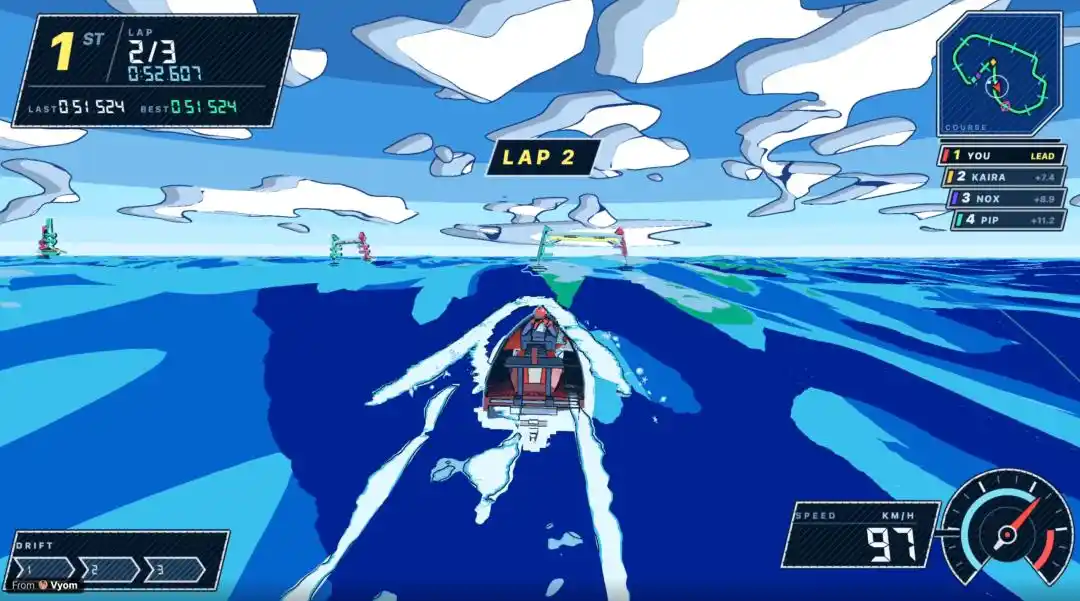
Opus 5 Burns 690M Tokens Making a Game; GPT-5.6 Replicates It for $5

marsbitPubblicato 2026-08-10Pubblicato ultima volta 2026-08-10

Introduzione

A user used a single, highly detailed 2000-word prompt with the Opus 5 model to generate a complete browser-based 3D jet ski racing game called "INK TIDE," spending $423 and consuming 6.9 billion tokens. The prompt acted as a comprehensive project brief, specifying technical constraints, visual style, and a multi-agent workflow to prevent "attention dilution" by dividing tasks like water simulation, physics, and AI among specialized sub-agents. The resulting game features cartoon-style graphics, a functional UI, and basic AI opponents. Subsequently, another user replicated a similar game using the GPT-5.6 Sol and GPT-5.6 Luna models within Codex, costing only approximately $5. While the $5 version captures the core racing concept and aesthetic, its visual fidelity and polish are notably less refined than the original Opus 5-generated demo. The comparison highlights that while AI can now produce technically functional games, the final quality and cost are heavily influenced by the model used, the detail of the human instruction, and the allocated budget.

"Just" 690 million tokens, $423, and one prompt are all it takes to create an American-style high-speed boat racing game that went viral.

And it's playable online; anyone can play it.

So says netizen Vyom.
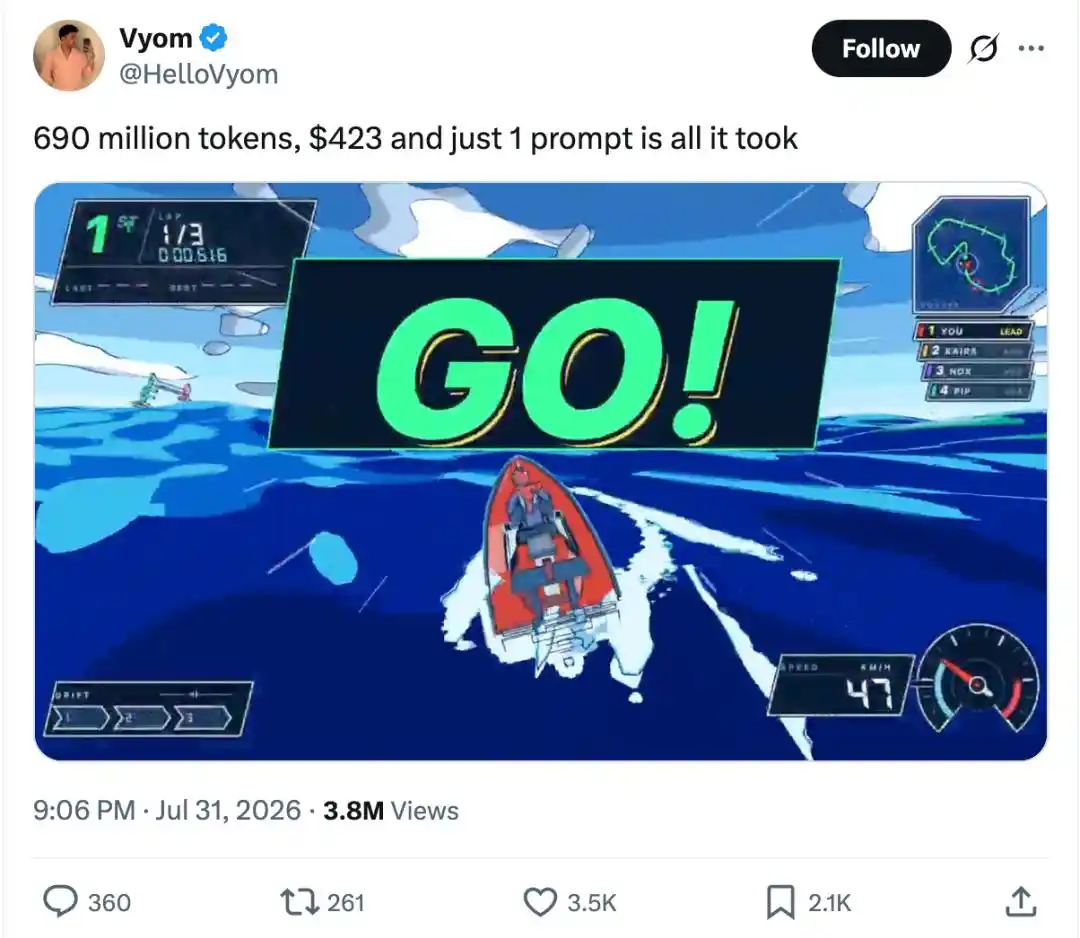
Taking a closer look, the game is quite impressive.

American cartoon style, retro arcade boat racing gameplay, complete with a countdown, lap counter, and ranking system.

Even the UI is fully designed with a unified, hardcore street racing dashboard aesthetic, and it feels pretty engaging to play.

This is the result of a single prompt, one-shot generation using Opus 5. Gotta say, Opus 5 has some skills.

But the celebration didn't last long. Another netizen replicated it using GPT-5.6 Sol on Codex.
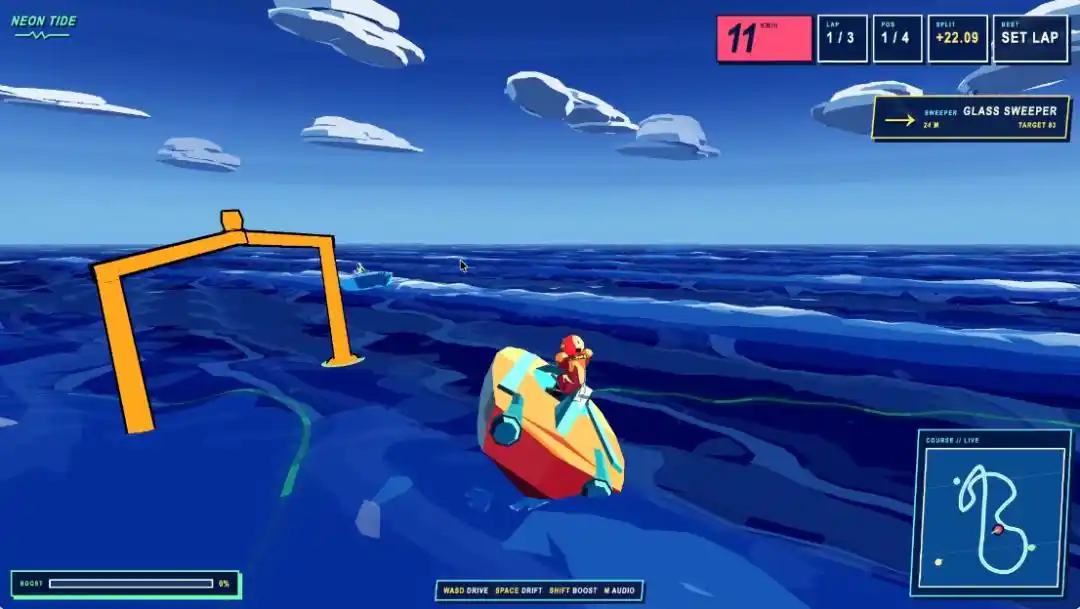
And it only cost $5!!!

Opus 5 + Single Prompt Creates a Water Racing Game

The water racing game created by netizen Vyom is called "INK TIDE".

I'll admit, I was fooled the moment I opened the game.

The visuals are in an American cartoon style. When controlling the boat, the pitch and roll of the hull feel very realistic.

The bottom right of the screen features a dashboard, while the top right shows a minimap and a real-time ranking board.

Charging and acceleration have clear visual effects. If you take a wrong turn or collide with an opponent's boat, there are clear on-screen prompts.

In short, it's bang-bang exciting.

The downside is that the three AI opponents are too weak; I easily came in first just by casually playing.
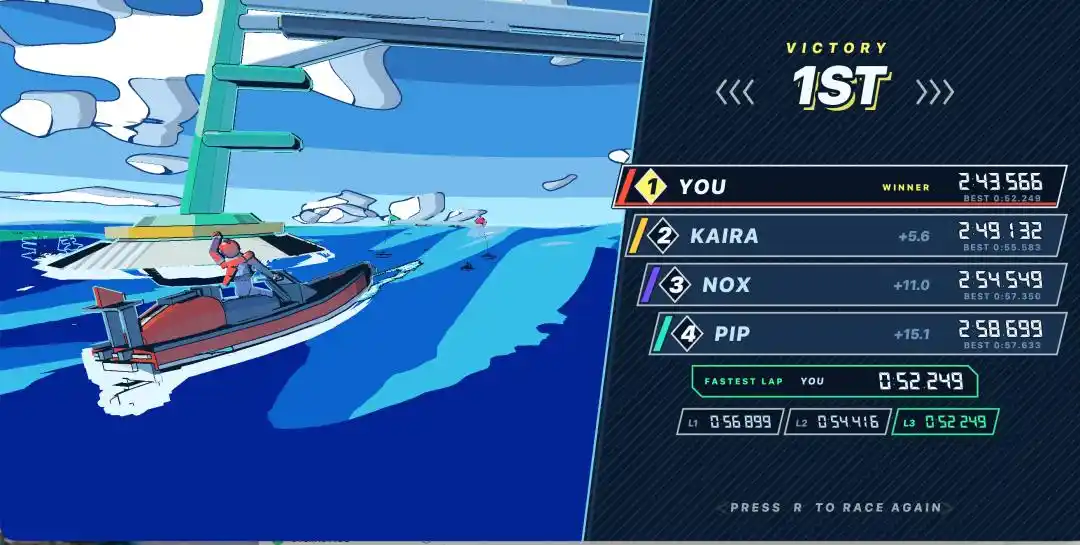
The author, Vyom, stated that this game was generated using just one prompt, one-shot.

It's a single prompt, alright, but you didn't mention that the prompt was 2000 words long...

Be like:

The game is developed using Vite, TypeScript, and Three.js, completely without any external resources. All models, textures, and sounds are generated by code.

No wonder such a polished demo could be generated in one go. This isn't just a prompt; it's a comprehensive requirements document.

The hierarchical structure is very clear: first define hard constraints, then visual standards, then functional requirements, then the development process, and finally delivery standards.

This is the same order a human project manager would follow when writing a requirements document.

From this, we can also decipher why the water effects in this game are so good. The prompt dedicates an entire chapter to the water system.

Notably, the prompt also includes a fairly detailed section on "Sub-Agent Division of Labor."
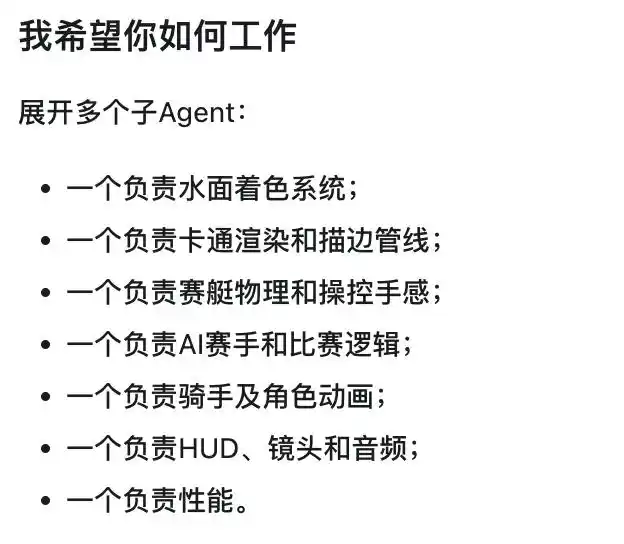
The author instructs Claude to first define a shared architecture, then split the project among multiple sub-agents:

One is responsible for water, another for cartoon rendering, another for boat physics, and others handle AI opponents, character animation, audiovisuals, and performance, all developing in parallel.

In a multi-agent workflow, each sub-agent receives a narrower task, focusing on its own module within a relatively independent context, before the main agent coordinates and integrates everything.

This arrangement is primarily to combat "attention dilution" in large tasks.

If water, rendering, physics, AI, UI, and audio are all thrown at the same agent, it can easily get sidetracked.

For example, modifying water might break physics, designing UI might forget about performance, and interfaces agreed upon earlier might be overturned later.

The author addresses this by assigning clear responsibilities to different sub-agents, even stipulating which files each can modify. Boundaries are fixed first, then they work in parallel.

Going a step further, the author also appoints a dedicated "Quality Inspector" for this agent team.

He instructs Claude to first create a screenshot harness, then run a visual review sub-agent that scrutinizes screenshots for flaws, with each subsystem iterating in cycles until the review has no more complaints.
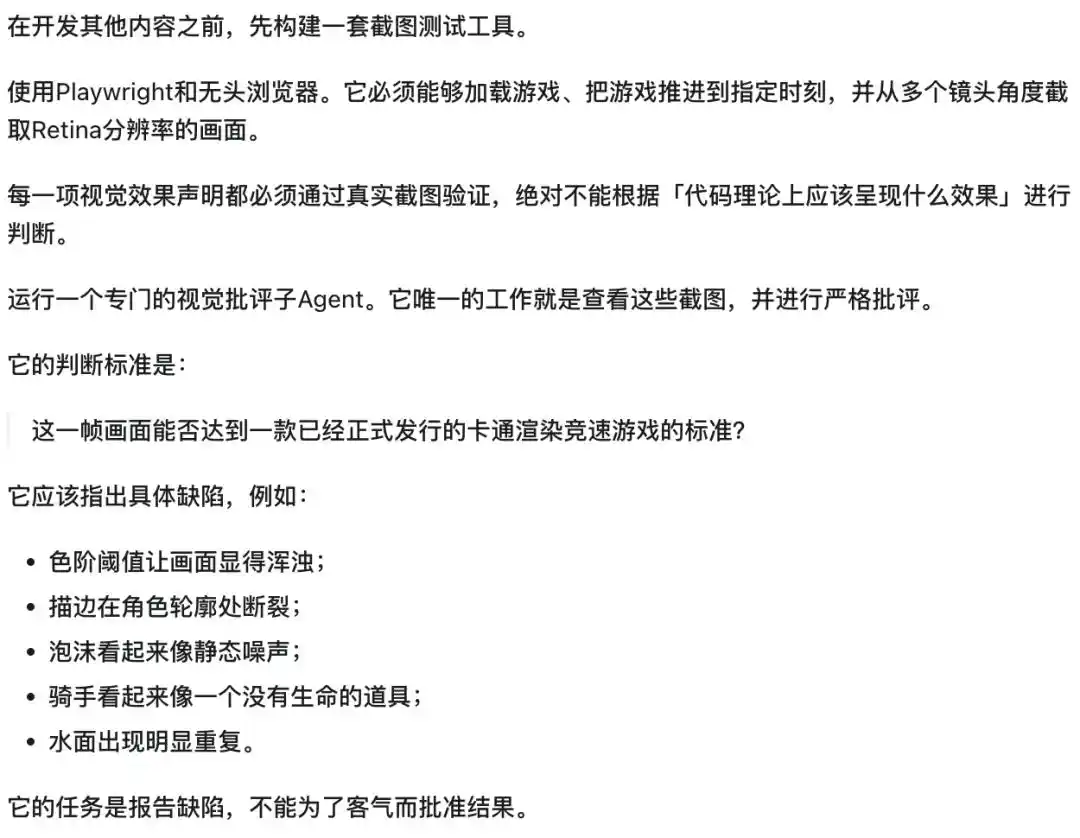
This is like having the AI act as its own inspector. After completing each module, it must actually run it, take screenshots for acceptance, and then rework based on specific issues found in the visuals.

I delved deeper into the project's GitHub repository and finally understood why the three AI opponents are so weak.
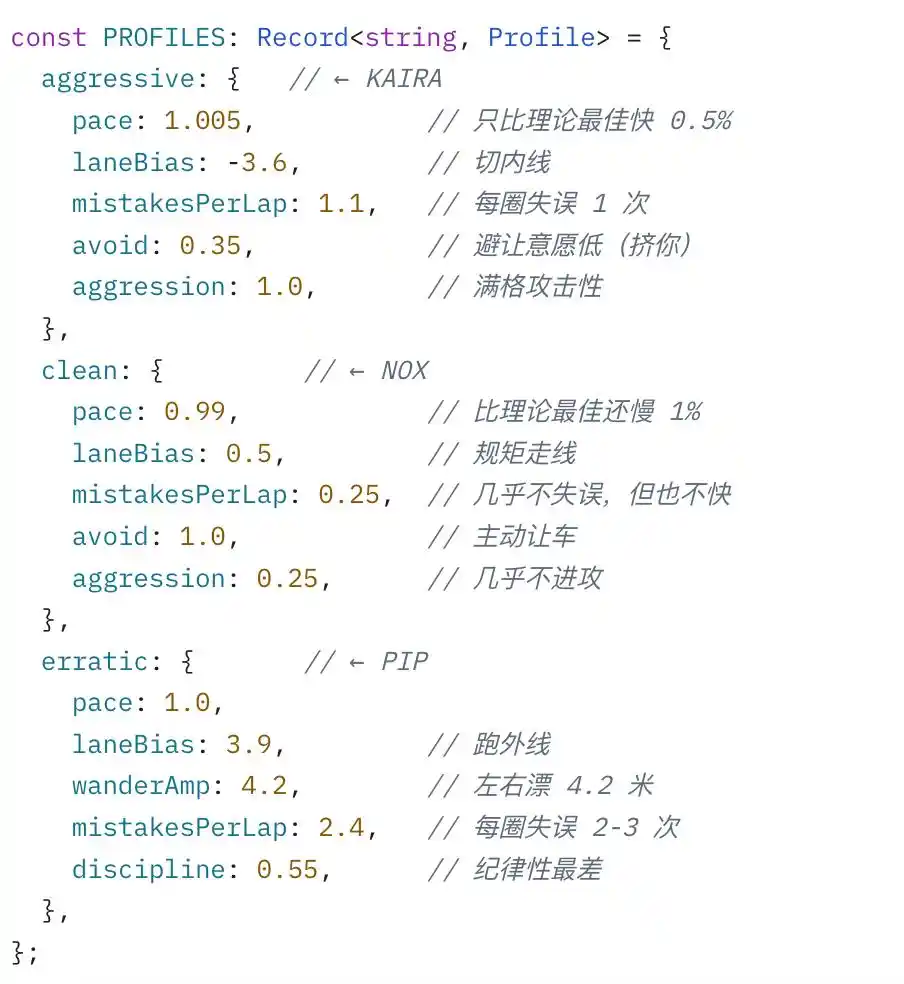
The parameters for the three NPCs are hardcoded. Even the fastest, KAIRA, is only 0.5% faster than the theoretical optimal speed.

As long as the player follows the racing line normally and uses drift boosts, they can easily outpace this margin.

Another opponent, PIP, is set to make 2-3 mistakes per lap—sometimes going wide, sometimes lifting off the throttle, sometimes veering off the track.

It's blatantly going easy on the player.

Perhaps the author also wanted to keep it simple to attract more players...

Overall, as a demo, this game is sufficiently polished and complete, but there's no advanced mechanics or gameplay yet. Hitting barriers or other boats has no consequences.

It's more like a single-player time-trial game.

Codex's $5 Replica is Here

Soon, the replica was served up.

Netizen Anul Agarwal created a similar game using Codex, taking about 5 hours and 2 input prompts.
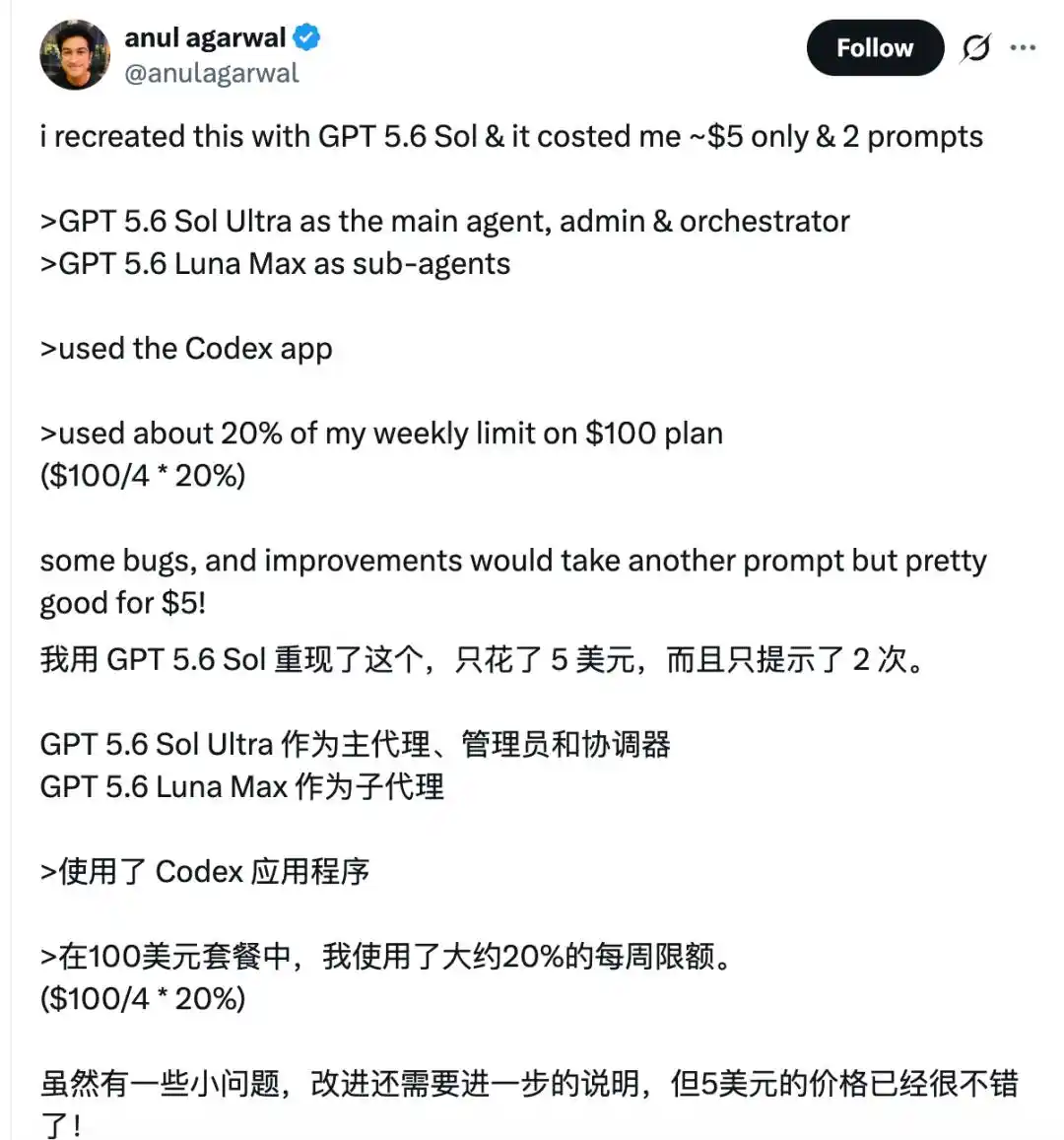
This time, he assembled an agent team:

GPT-5.6 Sol Ultra acts as the main agent, responsible for coordination, management, and scheduling;

GPT-5.6 Luna Max acts as the sub-agent, handling specific development tasks;

The entire process was completed in Codex.

The estimated cost was around just $5.

GPT...OpenAI...Long live Altman!!

Wait, before popping the champagne, you'll notice the two assignments aren't on the same level of completion.

While it replicates the most eye-catching elements of the original—also featuring boat racing on water, cartoon-style water rendering, a green track, racing UI, and multiple boats racing simultaneously—

Even the UI layout is somewhat similar.
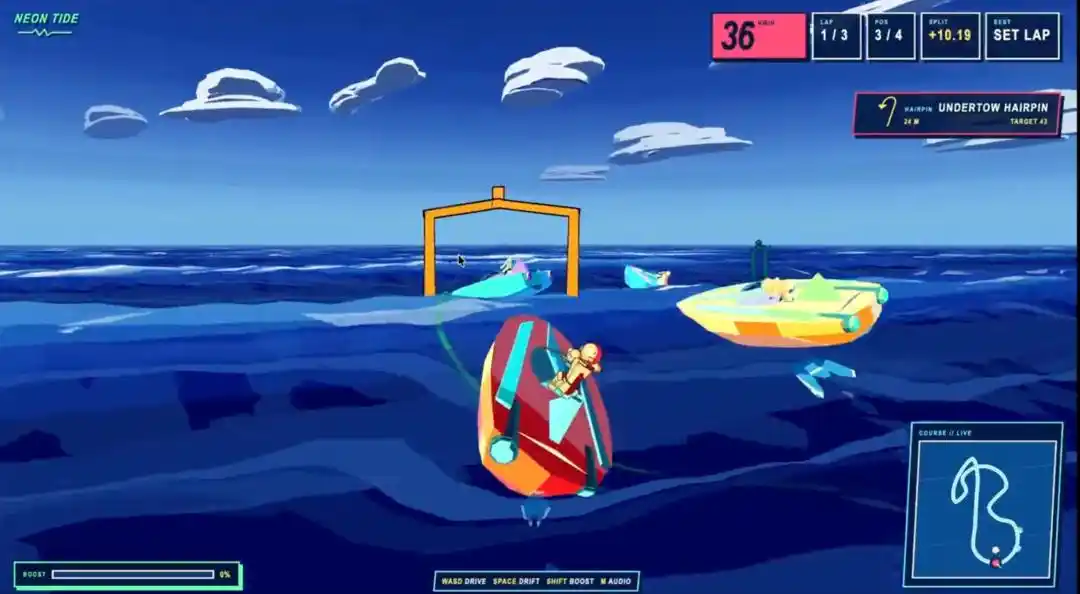
But when placed side by side, it's clear that the water detail, character presentation, and visual consistency of the replica above are relatively rough.

Which is superior is already obvious.

Also, the $5 isn't a strict cost; it mainly comes from折算 (zhesuan, conversion/calculation) of subscription package credits, not an independent API bill.

The author noted that he finds GPT-5.6 Sol particularly well-suited for game development.
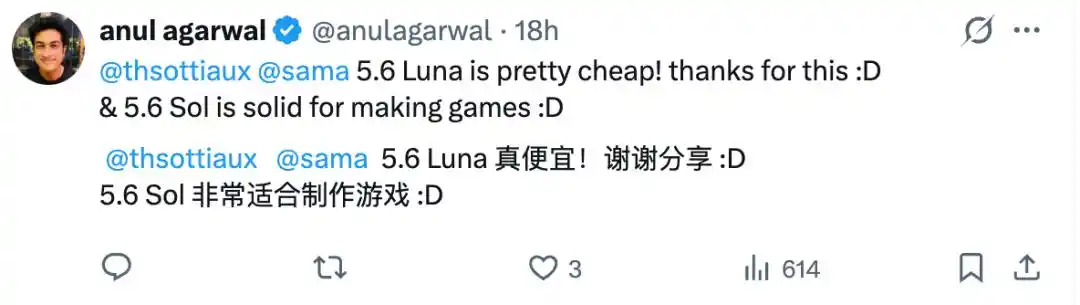
Creating this $5 alternative only used about 20% of the weekly quota. If you're just building an MVP, it's indeed quite cost-effective.

Premium edition vs. basic edition—it all depends on your budget~

It's evident that AI can now generate an engineering-viable game, but the ultimate quality ceiling still depends on human judgment.

And your bill.

Game Play Link: https://wave-racer.vercel.app/

Reference Links:

[1]https://x.com/HelloVyom/status/2083177530287353961

[2]https://github.com/Vyom-26/Wave-Racer3

[3]https://x.com/anulagarwal/status/2083847470920946152

This article is from the WeChat public account "QbitAI", author: Tingyu

Crypto di tendenza

Domande pertinenti

QWhat is the name of the game created using Opus 5 and a single prompt?

AThe game is called 'INK TIDE'.

QWhat development stack and technologies were used in the Opus 5-created game?

AThe game was developed using Vite, TypeScript, and Three.js. All models, textures, and sounds were code-generated without external resources.

QHow did the author structure the prompt to ensure high-quality output from Opus 5?

AThe author structured the prompt like a comprehensive project document. It included defining hard constraints, visual standards, functional requirements, development processes, and delivery standards. It also specified sub-Agent roles and a quality inspection mechanism.

QWhat was the key difference between the development approaches of the original Opus 5 project and the GPT-5.6 Sol replication?

AThe original Opus 5 project used a single, highly detailed 2000-word prompt (essentially a full project spec) in a one-shot generation. The GPT-5.6 Sol replication involved a two-prompt process over about 5 hours, using a team of Agents (GPT-5.6 Sol Ultra as the main agent and GPT-5.6 Luna Max as a sub-agent) within Codex.

QWhat is the estimated cost for creating the game replica using GPT-5.6 Sol, and how does its quality compare to the original?

AThe estimated cost for the GPT-5.6 Sol replica was approximately $5 (based on a subscription quota). While it captured core elements like cartoon water, racing UI, and multiple boats, its overall quality in terms of visual detail, character rendering, and graphical cohesion was noticeably lower than the more polished original version created with Opus 5.

Letture associate

Everyone Is Eyeing EUV Lithography Machines

The article "Everyone Has Their Eyes on EUV Lithography Machines" explores the ongoing expansion of EUV (Extreme Ultraviolet) lithography in semiconductor manufacturing. While EUV was once exclusive to giants like TSMC, Samsung, Intel, SK Hynix, and Micron, it's now appearing on the roadmaps of second-tier foundries like Nanya Technology and Winbond Electronics. This shift is driven by the diffusion of EUV into DRAM production, the economic boost from the AI boom making such investments viable, and the maturation of Low-NA EUV as a standard tool. Meanwhile, the "five-member club" of primary EUV users is seeing new entrants like Japan's Rapidus, a state-backed startup aiming for 2nm production. Concurrently, a wave of startups is challenging the traditional EUV model with alternative technologies. These challengers are categorized into four groups: those seeking to replace the light source (e.g., xLight's Free Electron Laser), those aiming to shorten the wavelength (e.g., Inversion Semiconductor, Substrate with BEUV/X-ray approaches), those promoting Nanoimprint Lithography (e.g., Canon), and those exploring maskless particle-based methods (e.g., Multibeam's multi-column e-beam, Lace's helium atom lithography). While these alternatives struggle with the throughput and stability required for high-volume manufacturing, they collectively signal a potential diversification of the future lithography landscape. The conclusion is that while EUV's technical and economic barriers remain high, its user base is broadening. The future may see a more competitive ecosystem, with Low-NA EUV serving mainstream needs, High-NA EUV for cutting-edge nodes, and novel technologies finding niches in specific applications.

marsbit5 min fa

Everyone Is Eyeing EUV Lithography Machines

marsbit5 min fa

Chip Stocks 'Hit a Wall,' But the Market Has Not

Chip stocks face volatility, driven by the blowup of an AI hedge fund (Situational Awareness), which briefly dragged the Philadelphia Semiconductor Index down 29%. However, the market has defied concerns, treating the sell-off as a buying signal. Investors injected over $11 billion into semiconductor ETFs in two days, fueling strong rallies in leveraged and non-leveraged funds. This dynamic is part of a broader surge in risk appetite: the S&P 500 hit a record high, high-yield bond funds saw their largest weekly inflow in two years, and Bitcoin ETFs attracted significant capital. Bank of America's Bull & Bear Index has risen to its highest level since 2021. Market strategists note the momentum-driven "tsunami" in buying, though concentration remains in mega-cap tech stocks. Despite the optimism, a key risk persists: elevated Treasury yields, with the 30-year yield near two-decade highs, pose a headwind. A weak July jobs report, however, eased near-term Fed hike fears and supported markets. Analysts suggest the economic backdrop remains solid, with AI infrastructure demand underpinning growth, though potential bottlenecks like power supply could emerge. The prevailing investor psychology is that recent pullbacks have been brief, reinforcing confidence to buy dips, as evidenced by a sharp drop in semiconductor volatility. The overarching narrative is one of resilient money flows toward risk assets despite a lengthening list of worries.

marsbit6 min fa

Chip Stocks 'Hit a Wall,' But the Market Has Not

marsbit6 min fa

Divergence in Regulated Token Protocol Standards: Issuance, Compliance, and Integration Each Assume Their Roles

Regulated token standards on EVM chains are diverging not towards a single unified standard, but into a modular, complementary architecture by function. Key examples include ERC-1450 (centered on a Registered Transfer Agent), ERC-3643 (a modular stack for policy), and ERC-7943 (a minimal integration layer). This reflects a broader industry trend: instead of bundling all regulatory functions into one standard, the ecosystem is separating **recurring, universal execution functions** (pre-transfer checks, freezing, forced transfers) from **product/jurisdiction-specific policies** (KYC providers, holding limits). Beyond EVM, other chains integrate comparable features at different architectural levels. Solana's Token Extensions provide hooks and controls at the program library level. Stellar and XRPL embed authorization and freezing natively in the ledger. Sui and Aptos place common controls in their Move frameworks. Networks like Canton and Avalanche L1 extend functionality to market operations and validator-level compliance. The competitive edge for regulated token standards will likely depend on **flexibility to adapt to regulatory changes** and the clarity of embedded controls for external integrators, rather than the sheer number of features. The future points towards a **compliance stack**: a base layer of standardized execution functions supporting interchangeable modules for identity, jurisdictional rules, and product-specific policies. This approach balances operational consistency with the necessary flexibility for diverse regulatory requirements across assets and regions.

marsbit1 h fa

Divergence in Regulated Token Protocol Standards: Issuance, Compliance, and Integration Each Assume Their Roles

marsbit1 h fa

$1.8 Million? Even Amazon Can't Afford to Burn Claude Anymore

Amazon was reportedly hit with a $1.8 million bill—860% over budget—after a five-month attempt to use Claude Sonnet AI to generate author information for its site. The project, which ultimately failed to deploy, consumed an estimated 6000 billion tokens, equivalent to twice GPT-3's training data. This incident highlights the hidden and often unpredictable costs of AI, even for tech giants. Despite such setbacks, Amazon is aggressively investing in automation, planning a record $2200 billion capital expenditure in 2026, primarily for AWS, AI chips, and infrastructure. This push is paying off: AWS saw a 37% revenue jump and contributes 60% of operating profit. Concurrently, Amazon aims to automate 75% of warehouse operations by around 2033, potentially reducing hundreds of thousands of jobs. Amazon's cost overrun is not isolated. Companies like Meta and Uber have faced similar AI spending spirals, leading to internal "token usage" rankings and, eventually, strict budgets and spending caps. Meta, for instance, once faced a potential monthly bill of $221 million before implementing limits. OpenAI's CEO Sam Altman noted that AI cost control, ignored earlier, has now become a major concern. The risks of unchecked automation echo past disasters like Knight Capital's 2012 $440 million loss from a faulty automated trading system. While automation promises efficiency, its failures can be amplified at the same scale and speed. For Amazon and others, managing these costs and risks is a critical, ongoing lesson.

marsbit1 h fa

$1.8 Million? Even Amazon Can't Afford to Burn Claude Anymore

marsbit1 h fa

Trading

Spot

Articoli Popolari

Come comprare ONE

Benvenuto in HTX.com! Abbiamo reso l'acquisto di Harmony (ONE) semplice e conveniente. Segui la nostra guida passo passo per intraprendere il tuo viaggio nel mondo delle criptovalute.Step 1: Crea il tuo Account HTXUsa la tua email o numero di telefono per registrarti il tuo account gratuito su HTX. Vivi un'esperienza facile e sblocca tutte le funzionalità,Crea il mio accountStep 2: Vai in Acquista crypto e seleziona il tuo metodo di pagamentoCarta di credito/debito: utilizza la tua Visa o Mastercard per acquistare immediatamente HarmonyONE.Bilancio: Usa i fondi dal bilancio del tuo account HTX per fare trading senza problemi.Terze parti: abbiamo aggiunto metodi di pagamento molto utilizzati come Google Pay e Apple Pay per maggiore comodità.P2P: Fai trading direttamente con altri utenti HTX.Over-the-Counter (OTC): Offriamo servizi su misura e tassi di cambio competitivi per i trader.Step 3: Conserva Harmony (ONE)Dopo aver acquistato Harmony (ONE), conserva nel tuo account HTX. In alternativa, puoi inviare tramite trasferimento blockchain o scambiare per altre criptovalute.Step 4: Scambia Harmony (ONE)Scambia facilmente Harmony (ONE) nel mercato spot di HTX. Accedi al tuo account, seleziona la tua coppia di trading, esegui le tue operazioni e monitora in tempo reale. Offriamo un'esperienza user-friendly sia per chi ha appena iniziato che per i trader più esperti.

493 Totale visualizzazioniPubblicato il 2024.12.12Aggiornato il 2026.06.02

Come comprare ONE

Discussioni

Benvenuto nella Community HTX. Qui puoi rimanere informato sugli ultimi sviluppi della piattaforma e accedere ad approfondimenti esperti sul mercato. Le opinioni degli utenti sul prezzo di ONE ONE sono presentate come di seguito.

活动图片