How To Avoid The Major Trap That Bitcoin Is Setting Up For Traders

bitcoinistPublished on 2026-06-03Last updated on 2026-06-03

Abstract

Bitcoin is testing a critical technical juncture after a recent 5% drop placed it near the lower boundary of an ascending channel on its daily chart. This pattern, formed since February, is starting to appear deceptive. While it offers a potential bullish path back toward $79,000, the structure has already shown weakness with a failed follow-through after its May peak above $82,000. Analysts warn this setup could be a trap for traders anticipating an automatic bounce from channel support. A clean break below this structure could invalidate the pattern of higher lows and trigger a significant decline, with targets between $54,000 and $58,000. The key to avoiding this trap is to not treat any initial rebound as confirmation of recovery, as a deceptive rally toward $75,000 could precede a deeper drop. The market is at a decisive point where support must hold to maintain the bullish structure.

Bitcoin is entering another decisive period after spending recent months trading inside a higher-timeframe ascending range. Technical analysis of the daily chart setup shows the Bitcoin price moving inside an ascending channel structure, but the structure is becoming more dangerous as the cryptocurrency is now approaching its lower boundary.

Bitcoin’s Ascending Channel Is Starting To Look Like A Trap

At the time of writing, Bitcoin is trading around $69,316 after falling almost 5% on the day, with the intraday move showing a drop from $72,926 to a low around the current price. That price action has now locked Bitcoin below the $73,000 to $76,000 zone that acted as a major battleground between buyers and sellers last week.

The concern now is that Bitcoin may be setting up a trap for traders who are chasing a clean continuation pattern without waiting for confirmation. The ascending channel still gives bulls a path back toward $79,000, but the same chart also shows how quickly the setup can turn into a breakdown if support fails.
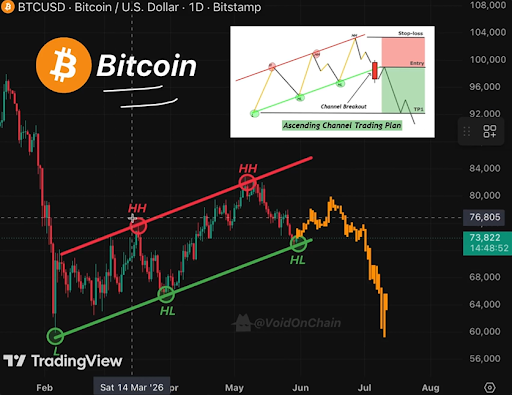
Source: Chart from Void on X

The daily chart shows Bitcoin building an ascending channel from the February low, with a sequence of higher lows forming across March up until the time of writing. This type of structure can look constructive at first glance because each major pullback has held above the previous one.

However, the problem is that the upper side of the structure has already shown weakness. The structure shows a higher high above $82,000 in early May, but Bitcoin failed to build a stronger continuation from that point. The move eventually rolled over, Bitcoin has returned to the lower side of the channel, and it is now testing whether price action will create a higher low. However, this might be a trap in waiting for bullish traders.

How To Avoid The Trap As Bitcoin Risks A Drop

Many traders may see the green ascending support line and assume that another bounce is automatic, especially because Bitcoin has respected that diagonal several times. Notably, crypto analyst Void is leaning towards a break below the structure, which would turn the higher lows into a failed pattern and open up a dump to anywhere between $54,000 and $58,000.

There are two possible scenarios for how Bitcoin’s price action could play out from this point. If the current support level holds, the rally may continue and push Bitcoin back to $79,000 and possibly return to the region above $80,000. However, if support breaks, Bitcoin could first retest $75,000 as a trap for traders before entering a deeper decline to as low as $54,000.

Therefore, avoiding the trap means not treating the first bounce as proof of recovery, as the Bitcoin price can still produce a short-term rebound to as high as $75,000 in the weak structure.

BTC trading at $69,691 on the 1D chart | Source: BTCUSDT on Tradingview.com

Related Questions

QWhat major technical pattern is Bitcoin's price currently trading within, according to the article?

ABitcoin's price is moving inside an ascending channel structure, formed from the February low.

QWhy does the article suggest Bitcoin's current ascending channel might be a trap for traders?

AIt might be a trap because the upper side of the structure has already shown weakness, and a bounce from the lower boundary could be a false signal before a potential breakdown to much lower prices.

QWhat is the key price level that Bitcoin failed to hold, which acted as a major battleground last week?

ABitcoin failed to hold the $73,000 to $76,000 zone, which acted as a major battleground between buyers and sellers.

QAccording to analyst Void cited in the article, what is the potential downside target if Bitcoin's ascending channel support breaks?

AIf the ascending channel support breaks, it could open up a price dump to anywhere between $54,000 and $58,000.

QWhat advice does the article give for traders to avoid the potential trap?

ATo avoid the trap, traders should not treat the first bounce from the channel's lower boundary as proof of recovery, as a short-term rebound to levels like $75,000 could still occur before a deeper decline.

Related Reads

a16z: Why Prediction Markets Could Become the Infrastructure for 'Future Probabilities'

The article explores the concept and potential of prediction markets, arguing that they are evolving from niche trading tools into a foundational infrastructure for assessing the probability of future events. A prediction market creates tradable contracts on specific event outcomes, using market price to aggregate dispersed information and approximate a collective probability assessment. This mechanism offers advantages over polls or expert forecasts by providing a real-time, incentivized signal, as participants risk real money on their judgments. Key strengths include the ability to generate probabilistic estimates, built-in financial incentives that encourage genuine information gathering, and the capacity to address specialized questions (e.g., AI model performance, geopolitical events) not easily captured by traditional financial markets. The author emphasizes that a prediction market is essentially a market—a tool for both resource allocation and information aggregation. However, the article also outlines significant challenges for reliability and effectiveness. Success depends on participation from well-informed traders, thoughtful contract design, unambiguous outcome resolution, and robust safeguards against manipulation (e.g., by insiders or groups seeking to influence public perception). Without these, prices may be mere noise or tools for propaganda. The future of prediction markets, therefore, lies not simply in scaling up trading volume, but in building more credible and transparent infrastructure. This includes clear rules for participation, auditable settlement mechanisms, and designs that mitigate manipulation. If these challenges can be addressed, prediction markets could become a vital public utility for navigating uncertainty, providing a new class of probability signals about the future.

marsbit33m ago

a16z: Why Prediction Markets Could Become the Infrastructure for 'Future Probabilities'

marsbit33m ago

Trading

Spot
Futures

Hot Articles

What is $BITCOIN

DIGITAL GOLD ($BITCOIN): A Comprehensive Analysis Introduction to DIGITAL GOLD ($BITCOIN) DIGITAL GOLD ($BITCOIN) is a blockchain-based project operating on the Solana network, which aims to combine the characteristics of traditional precious metals with the innovation of decentralized technologies. While it shares a name with Bitcoin, often referred to as “digital gold” due to its perception as a store of value, DIGITAL GOLD is a separate token designed to create a unique ecosystem within the Web3 landscape. Its goal is to position itself as a viable alternative digital asset, although specifics regarding its applications and functionalities are still developing. What is DIGITAL GOLD ($BITCOIN)? DIGITAL GOLD ($BITCOIN) is a cryptocurrency token explicitly designed for use on the Solana blockchain. In contrast to Bitcoin, which provides a widely recognized value storage role, this token appears to focus on broader applications and characteristics. Notable aspects include: Blockchain Infrastructure: The token is built on the Solana blockchain, known for its capacity to handle high-speed and low-cost transactions. Supply Dynamics: DIGITAL GOLD has a maximum supply capped at 100 quadrillion tokens (100P $BITCOIN), although details regarding its circulating supply are currently undisclosed. Utility: While precise functionalities are not explicitly outlined, there are indications that the token could be utilized for various applications, potentially involving decentralized applications (dApps) or asset tokenization strategies. Who is the Creator of DIGITAL GOLD ($BITCOIN)? At present, the identity of the creators and development team behind DIGITAL GOLD ($BITCOIN) remains unknown. This situation is typical among many innovative projects within the blockchain space, particularly those aligning with decentralized finance and meme coin phenomena. While such anonymity may foster a community-driven culture, it intensifies concerns about governance and accountability. Who are the Investors of DIGITAL GOLD ($BITCOIN)? The available information indicates that DIGITAL GOLD ($BITCOIN) does not have any known institutional backers or prominent venture capital investments. The project seems to operate on a peer-to-peer model focused on community support and adoption rather than traditional funding routes. Its activity and liquidity are primarily situated on decentralized exchanges (DEXs), such as PumpSwap, rather than established centralized trading platforms, further highlighting its grassroots approach. How DIGITAL GOLD ($BITCOIN) Works The operational mechanics of DIGITAL GOLD ($BITCOIN) can be elaborated on based on its blockchain design and network attributes: Consensus Mechanism: By leveraging Solana’s unique proof-of-history (PoH) combined with a proof-of-stake (PoS) model, the project ensures efficient transaction validation contributing to the network's high performance. Tokenomics: While specific deflationary mechanisms have not been extensively detailed, the vast maximum token supply implies that it may cater to microtransactions or niche use cases that are still to be defined. Interoperability: There exists the potential for integration with Solana’s broader ecosystem, including various decentralized finance (DeFi) platforms. However, the details regarding specific integrations remain unspecified. Timeline of Key Events Here is a timeline that highlights significant milestones concerning DIGITAL GOLD ($BITCOIN): 2023: The initial deployment of the token occurs on the Solana blockchain, marked by its contract address. 2024: DIGITAL GOLD gains visibility as it becomes available for trading on decentralized exchanges like PumpSwap, allowing users to trade it against SOL. 2025: The project witnesses sporadic trading activity and potential interest in community-led engagements, although no noteworthy partnerships or technical advancements have been documented as of yet. Critical Analysis Strengths Scalability: The underlying Solana infrastructure supports high transaction volumes, which could enhance the utility of $BITCOIN in various transaction scenarios. Accessibility: The potential low trading price per token could attract retail investors, facilitating wider participation due to fractional ownership opportunities. Risks Lack of Transparency: The absence of publicly known backers, developers, or an audit process may yield skepticism regarding the project's sustainability and trustworthiness. Market Volatility: The trading activity is heavily reliant on speculative behavior, which can result in significant price volatility and uncertainty for investors. Conclusion DIGITAL GOLD ($BITCOIN) emerges as an intriguing yet ambiguous project within the rapidly evolving Solana ecosystem. While it attempts to leverage the “digital gold” narrative, its departure from Bitcoin's established role as a store of value underscores the need for a clearer differentiation of its intended utility and governance structure. Future acceptance and adoption will likely depend on addressing the current opacity and defining its operational and economic strategies more explicitly. Note: This report encompasses synthesised information available as of October 2023, and developments may have transpired beyond the research period.

363 Total ViewsPublished 2025.05.13Updated 2025.05.13

What is $BITCOIN

Discussions

Welcome to the HTX Community. Here, you can stay informed about the latest platform developments and gain access to professional market insights. Users' opinions on the price of BTC (BTC) are presented below.

活动图片