Nobel Laureate Uses AI to Create Gene Scissors from Scratch, More Precise than the One Evolved Over Billions of Years

marsbitPubblicato 2026-07-28Pubblicato ultima volta 2026-07-28

Introduzione

Nobel laureate Jennifer Doudna and her team, along with the startup Profluent, have used AI to design novel CRISPR enzymes that do not exist in nature. These AI-generated gene-editing tools demonstrate superior performance compared to their natural counterparts. Doudna's team focused on engineering TnpB, a compact ancestor of Cas12, achieving functional enzymes with sequences approximately 30% different from natural versions—a drastic increase from the typical 1-2% modifications possible with prior methods. Meanwhile, Profluent generated entirely new Cas9 variants from scratch using protein language models. Their leading candidate, OpenCRISPR-1, exhibits higher on-target editing efficiency (55.7% vs. 48.3%) and a roughly 95% reduction in off-target editing compared to the commonly used SpCas9, despite having hundreds of mutations away from any known natural sequence. While these breakthroughs, published in *Science* and highlighted by *Nature*, mark a significant shift from discovering biological tools to actively designing them with AI, the results are currently confined to cellular experiments. The research underscores a future where AI accelerates protein design, but experts emphasize that deep biological insight remains essential to fully harness these models and advance towards therapeutic applications.

AI has created a pair of gene scissors that never existed in nature.

And they work better than the pair honed by billions of years of evolution.

On July 16th, Nature published news that scientists used AI to create CRISPR enzymes never seen in nature, which cut genes more cleanly than the "natural version." The paper was published in Science on the same day.
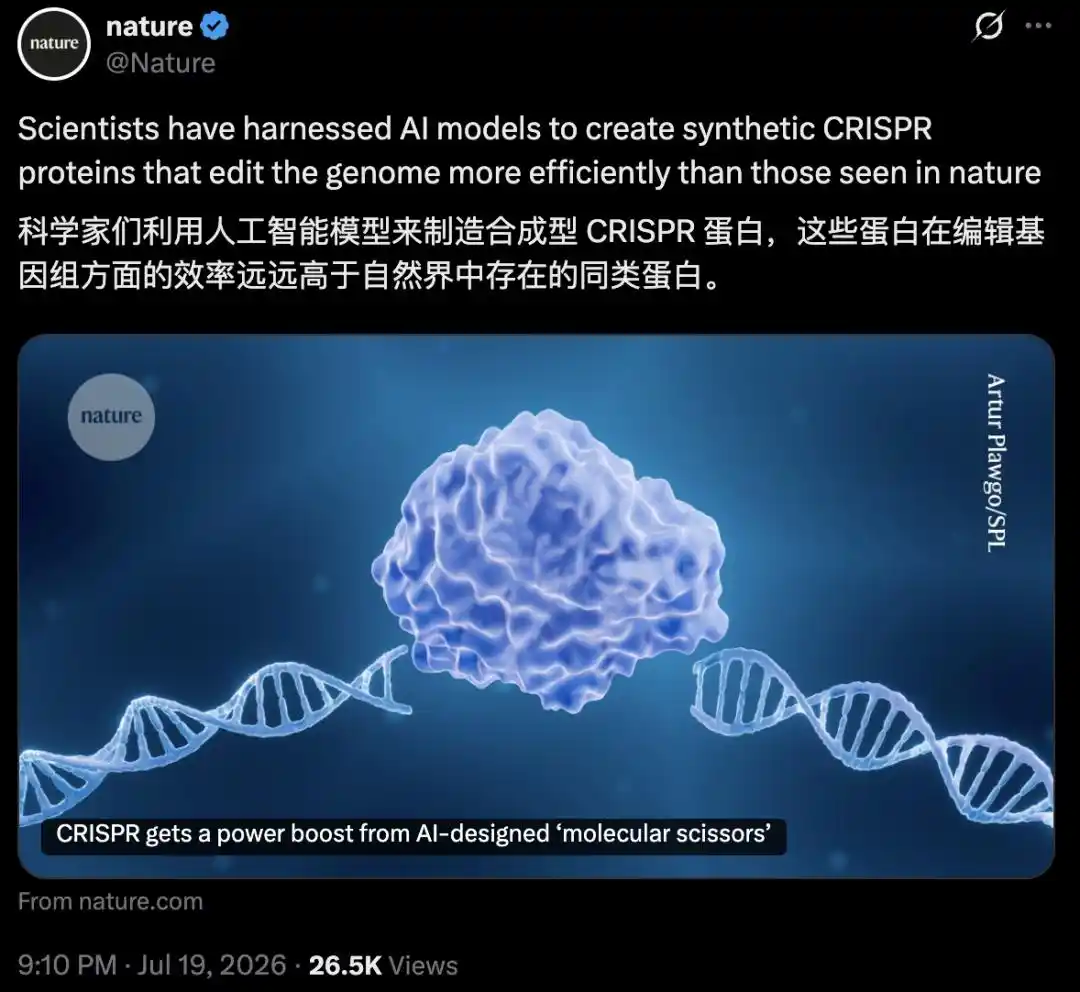
The project was led by Jennifer Doudna, who won the Nobel Prize in Chemistry in 2020 for CRISPR.

She once told Nature: proteins can be modified. But once you start, you find that after modification, it basically doesn't work anymore.

This problem has stumped humans for over a decade.

Then AI arrived, changing 30% of the protein sequence while keeping the enzyme functional.

And this is just one line of research.

On another front, the startup Profluent bypassed TnpB entirely and directly generated an entirely new Cas9.

The results were equally striking: it cuts the intended target more cleanly and barely touches unintended sites, with off-target editing rates approximately 95% lower than the most common SpCas9.

The tools produced by billions of years of evolution are being rewritten by AI in design space.
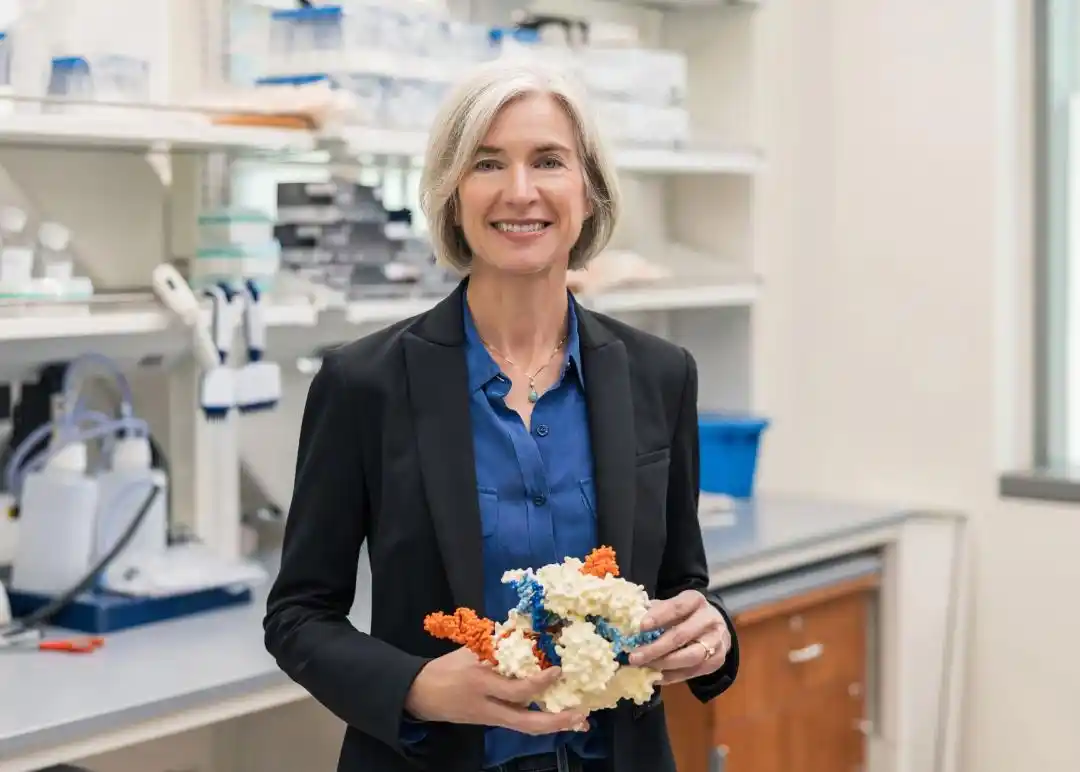
Jennifer Doudna, biochemist at UC Berkeley, 2020 Nobel Laureate in Chemistry, founder of the Innovative Genomics Institute. (Image source: Jussi Puikkonen/KNAW)

How Counterintuitive Is It to Remain Functional After 30% Modification?

CRISPR was not invented by humans.

Whether it's Cas9 or Cas12, they are all pre-existing "parts" borrowed from bacteria.

Bacteria use them to resist viral invasion. Humans took a liking to this mechanism, moved it into the lab, paired it with a guide RNA, and created "molecular scissors" that can precisely locate and cut a single position among 3 billion base pairs.

The Nobel Prize awarded to Doudna and Charpentier rewarded the "discovery" more than the "design."

But the problem lies here. Borrowed "parts" are not tailored to human needs in terms of size or behavior. To get smaller, more precise, less immunogenic, or capable of recognizing more targets, we could only rely on manual, incremental modifications.

But these things are notoriously difficult to modify.

Most Cas9 proteins are over 1000 amino acids long. The theoretical sequence space is 20 to the power of 1000: a number many orders of magnitude larger than the total number of atoms in the observable universe.

In such a vast space, viable solutions are extremely sparse, and the range humans can explore is pitifully small.

Therefore, in recent years, similar AI-assisted work has been done, but modification levels were generally kept timidly between 1% and 2%.

Modify a bit more, and it becomes useless.

AI's Two Moves

This time, Doudna's team didn't target Cas9. They chose a class of miniature nucleases called TnpB.

They are smaller and, evolutionarily speaking, are the ancestors of Cas12.

The team wanted to know: to what extent can this sequence be altered while still retaining its gene-editing capability.

The first step was handed to an AI model.

Researchers fed the model the target structure of a specific TnpB—what the protein should look like after folding—and then asked it the reverse question:

How should the amino acid sequence be modified so that the protein still folds into this shape.

The model spat out thousands of modifications.

But this step only solved "looking right." A correctly folded protein doesn't mean it's alive.

Hence the second step: train another model, feed it all the massive amounts of experimental data accumulated in labs over the years, and have it analyze the intricate interrelationships between various parts of the protein.

Specifically, which segments are untouchable vital points, where a single change destroys function.
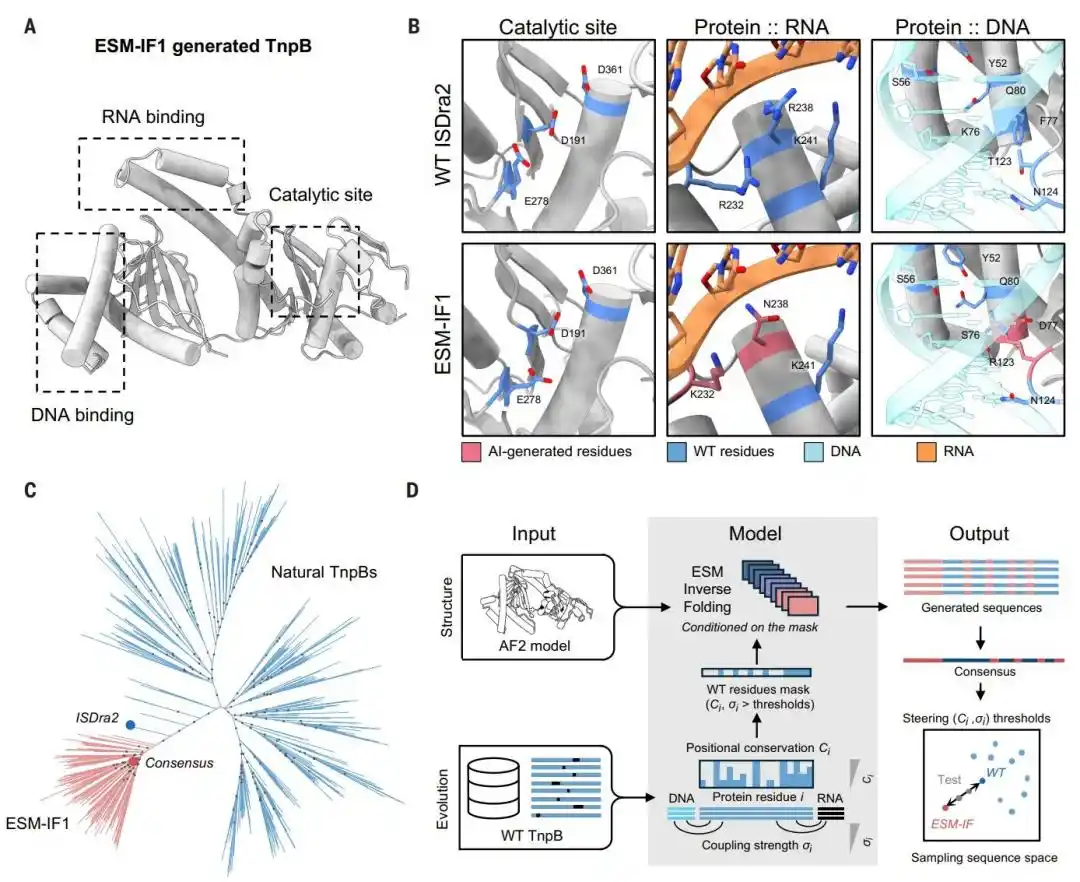
Doudna team's TnpB design process. Bottom left is the phylogenetic tree, blue represents naturally existing TnpBs, the red cluster represents AI-generated sequences, with little overlap. Bottom right shows the technical route: AF2 structure plus evolutionary constraint masking, fed into the ESM-IF1 model to generate new sequences. (Image source: Science 2026, DOI: 10.1126/science.aed6123)

The combination of the two models filtered out a small batch of synthetic nucleases.

Standard tests showed they could edit in bacteria, in plants, and in human cells.

The efficiency of inserting or deleting target fragments for some of them was even higher than their natural counterparts.

Doudna said of this result: quite exciting.

403 Mutations, These Scissors Have No Relatives in Nature

The first set of numbers was mentioned earlier: synthetic versions differ from the natural version by about 30% of their sequence, compared to 1%-2% modification in previous similar AI work.

The second set of numbers comes from protein design company Profluent, who took a different path: not modifying TnpB, but directly generating an entirely new Cas9.

They systematically mined 26TB of genomic and metagenomic data to build a database of 5.1 million CRISPR-Cas proteins, then used a protein language model to generate new sequences, achieving a diversity 4.8 times that of known natural levels.
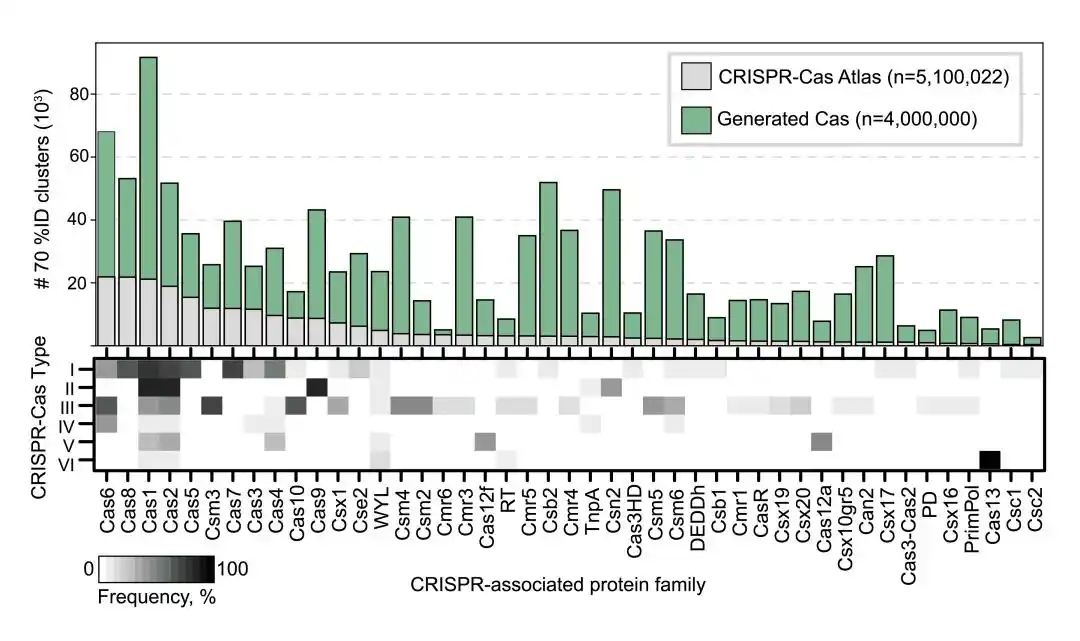
Diversity expansion of AI-generated sequences (light color) compared to natural CRISPR proteins (dark color), counted by protein cluster number. Heatmap shows distribution of protein families across different CRISPR-Cas systems. (Image source: Profluent)

They selected 48 sequences for functional validation in human cells. The best performer was named OpenCRISPR-1 and has been open-sourced.

Its report card looks like this:

On-target editing efficiency: 55.7% (SpCas9: 48.3%).

Off-target editing rate: 0.32% (SpCas9: 6.1%).

The latter represents a reduction of about 95%.

And this sequence has 403 mutations compared to SpCas9, and at least 182 mutations compared to any natural CRISPR protein in the database.

This is re-creating a "pair of scissors" from the concept itself, one that doesn't exist on Earth.
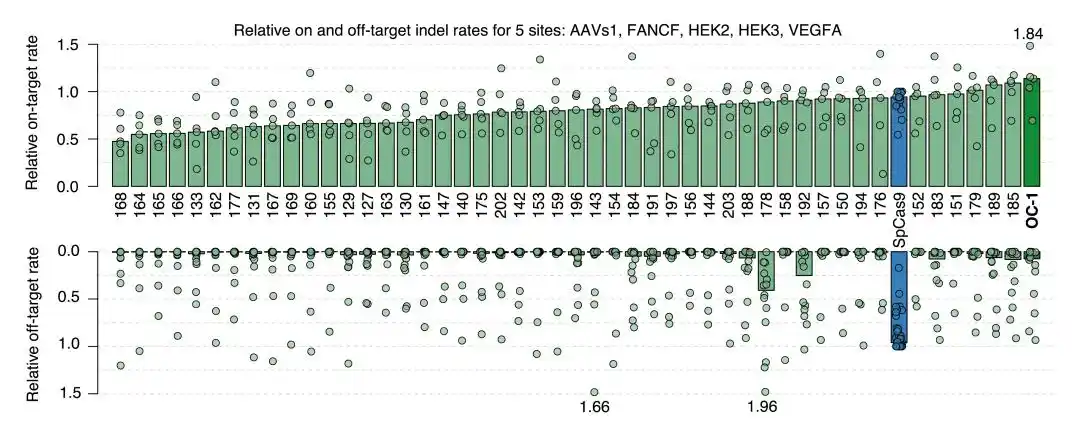
Multiple AI-generated nucleases (green, with dark green being OpenCRISPR-1) show on-target activity comparable to or higher than SpCas9 (blue), with significantly lower off-target activity. (Image source: Profluent)

The data for OpenCRISPR-1 comes from the company's own published research; independent replication will take more time.

The experiments from Doudna's line have undergone peer review by Science.

From "Discovering Nature" to "Creating Nature"

Looking at these two lines together reveals what is truly changing.

AlphaFold solved "what does this sequence look like": prediction, understanding.

Protein language models pushed further: what kind of sequence is alive, what are the patterns.

Now it's the third level: create a sequence never written by nature, and make it work in living cells.

Soeren Lienkamp, a molecular biologist at the University of Zurich, believes CRISPR allowed everyone to edit DNA as they wish, and AI-based protein design is now enabling everyone to create entirely new properties in protein space.

Those familiar with large language models might find this somewhat familiar: this approach is almost identical to how text models learn language.

Feed enough sequences, learn the internal grammar, then start generating sentences not in the corpus.

By comparison, how reliant on luck the old path was becomes clear.

Insulin was discovered in dogs, Cas9 was found in bacteria from a yogurt factory, botulinum toxin came from a food poisoning incident.

None of these tools were designed; almost all were found by chance. Now there's another path: starting from the desired function, design the molecule in reverse.

A Cas9 protein typically has over 1000 amino acids. The number of possible sequence combinations is 20^1000, far exceeding the total number of atoms in the observable universe.

Evolution groped through this space for billions of years; models can run through it in just hours.

This is the truly impactful part of this story.

Except, the AI that writes code runs its creations on computers; if it writes something bad, you delete and rewrite. The AI that writes proteins runs its creations in living cells. It alters real genetic information, not a run result that can be rolled back.

This is what makes it both more nerve-wracking and more exciting.

Can It Conquer Cancer or Delay Aging?

Not yet.

The achievements mentioned in the article currently stop at cell experiments; these validations are still in the laboratory stage.

Ahead lie animal trials, clinical trials, drug approvals—each hurdle can take years.

Has AI surpassed evolution?

A more appropriate statement is: some proteins generated by AI have exceeded specific natural versions in specific experimental metrics.

This is also not the first shot fired by AI protein design.

AlphaFold, RoseTTAFold, protein language models have been developing for five or six years now, and the preprint for OpenCRISPR-1 was posted on bioRxiv as early as April 2024.
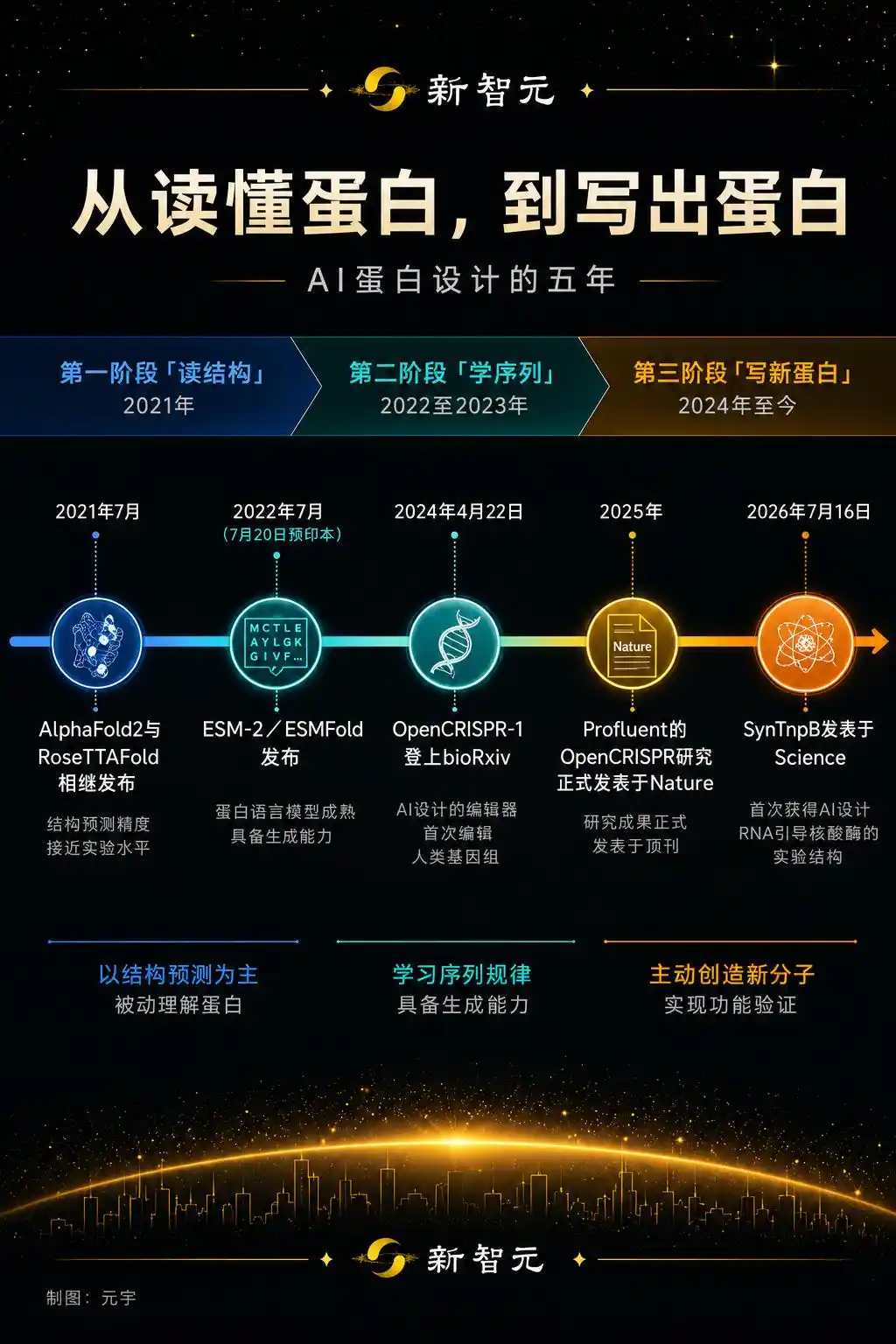
One significant meaning is that an AI-designed protein entered a more complex living system and successfully completed the entire gene-editing process.

Le Cong from Stanford University, who helped develop some of the earliest CRISPR tools for gene therapy, shares Doudna's view: basic research using natural nucleases must continue.

AI models can run so fast precisely because of the data painstakingly accumulated in labs over the past few decades. Cut off the data supply, and the models hit their limit.

Doudna says this work demonstrates the future form of AI and biology: we need AI tools to help us run faster, but to extract the maximum value from such models, we still need people who truly understand molecular mechanisms.

References:

https://x.com/Nature/status/2078829713942822983

https://www.nature.com/articles/d41586-026-02217-w

https://www.nature.com/articles/d41586-025-02135-3

https://press.airstreet.com/p/profluent-opencrispr-1-nature-magazine

https://www.iongenomics.bio/p/doudna-lab-uses-ai-to-create-new

This article is from WeChat public account "Xin Zhi Yuan", author: ASI启示录

Crypto di tendenza

Domande pertinenti

QWhat is the main breakthrough described in the article regarding CRISPR technology?

AThe main breakthrough is that AI was used to design novel CRISPR enzymes, specifically TnpB and Cas9 variants, that do not exist in nature. These AI-generated enzymes demonstrated superior performance in gene editing, with higher on-target efficiency and significantly lower off-target effects compared to their natural counterparts.

QHow significant was the sequence alteration in the AI-designed TnpB enzyme, and why is this notable?

AThe AI-designed TnpB enzyme had approximately 30% of its amino acid sequence altered from the natural version. This is highly notable because previous AI-assisted protein engineering efforts typically achieved only 1-2% alterations. Maintaining functionality with such extensive changes was previously considered nearly impossible, demonstrating the power of the new AI approach.

QWhat were the key performance results of the AI-generated OpenCRISPR-1 Cas9 enzyme compared to the standard SpCas9?

AIn tests, the AI-generated OpenCRISPR-1 achieved a 55.7% on-target editing efficiency compared to SpCas9's 48.3%. More impressively, its off-target editing rate was 0.32%, which is about 95% lower than SpCas9's rate of 6.1%.

QWhat is the fundamental shift in scientific approach illustrated by this AI protein design work?

AThe work represents a shift from 'discovering nature' to 'creating nature.' Historically, biological tools like insulin and Cas9 were discovered by chance in nature. Now, AI enables a rational design approach: starting with a desired function and working backwards to design a molecule that performs it, exploring a vast sequence space that evolution took billions of years to navigate.

QAccording to the researchers, what is the crucial role of human expertise in this AI-driven protein design process?

AResearchers like Jennifer Doudna emphasize that while AI tools accelerate exploration, maximizing the value of these models still requires scientists who truly understand molecular mechanisms. The AI models are trained on decades of experimental data generated by traditional lab work. This foundational research must continue to feed and validate the AI systems.

Letture associate

The CEO of MARA Holdings Compares AI Operations to Bitcoin Mining! Which is More Profitable?

Fred Thiel, CEO of MARA Holdings (a major Bitcoin mining company), states that the rapid growth of the artificial intelligence (AI) sector is transforming mining companies' business models. He claims that powering data centers for AI is significantly more profitable than Bitcoin mining. In a recent interview, Thiel explained why many mining firms are diversifying into AI infrastructure. According to Thiel, the energy demands of data centers are surging, especially due to the spread of generative AI applications. This creates new revenue opportunities for Bitcoin mining companies with robust power infrastructure. MARA Holdings is among those monitoring this shift and aims to develop its energy and infrastructure services for AI data centers. Thiel emphasized that this move toward AI does not mean the end of Bitcoin mining. He stated that Bitcoin mining remains a sustainable business model, especially for miners in regions with low electricity costs, and it is still a crucial field for utilizing excess or idle power capacity. In recent years, many Bitcoin mining companies have begun using their energy-intensive infrastructure not just for block production but also for high-performance computing (HPC) and AI applications. This strategy aims to diversify revenue sources and increase resilience against cryptocurrency market volatility. Analysts note that the growing energy demand in the AI sector presents significant transformation opportunities for mining companies. The need for high-power, uninterrupted electricity supply, particularly for large data centers, gives Bitcoin miners with existing energy infrastructure expertise a considerable advantage.

cryptonews.ru4 min fa

The CEO of MARA Holdings Compares AI Operations to Bitcoin Mining! Which is More Profitable?

cryptonews.ru4 min fa

Ratio's CEO Says Multi-Currency Stablecoins Could Eliminate Costly FX Conversions in Asia

The CEO of Ratio, John Cho, argues that multi-currency stablecoins could save Asia billions by eliminating costly foreign exchange conversions in regional trade. While USD stablecoins like USDT and USDC work for global settlements, local Asian trade is conducted in local currencies like the Korean won or Singapore dollar. Forcing these transactions through USD intermediaries creates unnecessary costs and currency risk. Cho envisions a complementary ecosystem where local-currency stablecoins work alongside USD stablecoins, enabling seamless cross-border settlements without conversion friction. A key pain point in traditional banking is the need for pre-funded Nostro and Vostro accounts, which lock up vast amounts of working capital. Blockchain-based settlement layers like Ratio offer a 24/7 alternative, using on-chain liquidity to enable instant execution even when traditional channels are closed. Modern Web3 infrastructure providers are focusing on pragmatic integration with existing corporate systems like ERPs, allowing businesses to gradually shift volumes to digital channels for better speed, cost, and reduced slippage. Clear regulation is cited as the critical catalyst for widespread institutional adoption. As jurisdictions like the U.S. advance legislation (e.g., the CLARITY Act) and Asian countries are expected to pass their own stablecoin laws within 12-24 months, regulatory uncertainty is receding. The ultimate vision is for regulated stablecoins to become an invisible settlement layer integrated into national payment systems, where payments simply happen on-chain, erasing the boundary between traditional banking and digital assets.

cryptonews.ru23 min fa

Ratio's CEO Says Multi-Currency Stablecoins Could Eliminate Costly FX Conversions in Asia

cryptonews.ru23 min fa

Huang Xiaoming, Li Bin, Lei Jun, Liang Wenfeng... Who Are the Biggest Winners in the CXMT IPO Feast?

Changxin Technology, a leading Chinese memory chip manufacturer, successfully listed on the Shanghai Stock Exchange's STAR Market (科创板) on July 8, 2026. Its share price surged from the IPO price of 8.66 yuan to close at 49 yuan on the first day, catapulting its market capitalization to 3.28 trillion yuan, making it the most valuable A-share company and triggering a massive wealth creation event. The biggest winners were the company's founder, Zhu Yiming, and its employees. Zhu Yiming's family wealth skyrocketed nearly 300% to approximately $13.9 billion, with his direct stake in Changxin valued at around 80 billion yuan. Additionally, over 6700 employees benefited from stock ownership plans, creating at least 237 new millionaires (in CNY). Zhu also pledged to donate 768 million shares, worth over 37.6 billion yuan, for future employee incentives over a ten-year period. Several prominent investors and corporate clients also reaped significant paper gains from the IPO. Notable figures include: * **Liang Wenfeng**, founder of DeepSeek, whose funds netted a paper profit of approximately 827 million yuan. * **Kong Jianping**, founder of Nano Labs, saw his indirect holdings valued at roughly 940 million yuan. * **Li Bin**, founder of Nio, whose company's strategic investment of 158 million yuan is now worth about 740 million yuan. * **Lei Jun**, founder of Xiaomi, whose subsidiary holds shares currently showing a paper gain of over 736 million yuan. Xiaomi clarified this is a corporate investment, not direct personal wealth. The article notes that while this IPO created immense wealth for insiders and large investors, retail investors who were lucky enough to win an allotment in the lottery typically profited by around 20,000 yuan. The listing solidifies Changxin's position as China's premier domestic memory chipmaker.

marsbit33 min fa

Huang Xiaoming, Li Bin, Lei Jun, Liang Wenfeng... Who Are the Biggest Winners in the CXMT IPO Feast?

marsbit33 min fa

IOSG: From Hot Storage to Cold Memory – Decentralized Storage in the AI Era's Storage Boom

This article explores the stark contrast between the booming AI storage sector and the currently undervalued decentralized storage market. It argues their core value propositions differ fundamentally: AI storage is a "hot data efficiency" system designed to maximize computational throughput, GPU utilization, and business monetization by accelerating data flow into processors. In contrast, decentralized storage represents a "cold data trust" system, prioritizing data immutability, censorship resistance, and the preservation of long-term human memory. The analysis details the multi-layered AI storage architecture, from high-bandwidth memory (HBM) and enterprise SSDs for high-performance needs to data lakes for capacity. It highlights how AI has repositioned storage from a cost center to a critical efficiency engine. Decentralized storage, exemplified by Filecoin and Arweave, is examined for its distinct philosophies and current challenges, including product-market fit, retrieval latency, and enterprise adoption hurdles. Despite its current quiet phase, the article posits that decentralized storage holds unique future value for AI data provenance, public dataset archiving, compliance, and safeguarding civilizational records against censorship. The conclusion suggests that while the market currently rewards efficiency, the need for trusted, permanent data layers may eventually lead to a revaluation of decentralized storage's role.

marsbit38 min fa

IOSG: From Hot Storage to Cold Memory – Decentralized Storage in the AI Era's Storage Boom

marsbit38 min fa

Trading

Spot

Articoli Popolari

Come comprare ONE

Benvenuto in HTX.com! Abbiamo reso l'acquisto di Harmony (ONE) semplice e conveniente. Segui la nostra guida passo passo per intraprendere il tuo viaggio nel mondo delle criptovalute.Step 1: Crea il tuo Account HTXUsa la tua email o numero di telefono per registrarti il tuo account gratuito su HTX. Vivi un'esperienza facile e sblocca tutte le funzionalità,Crea il mio accountStep 2: Vai in Acquista crypto e seleziona il tuo metodo di pagamentoCarta di credito/debito: utilizza la tua Visa o Mastercard per acquistare immediatamente HarmonyONE.Bilancio: Usa i fondi dal bilancio del tuo account HTX per fare trading senza problemi.Terze parti: abbiamo aggiunto metodi di pagamento molto utilizzati come Google Pay e Apple Pay per maggiore comodità.P2P: Fai trading direttamente con altri utenti HTX.Over-the-Counter (OTC): Offriamo servizi su misura e tassi di cambio competitivi per i trader.Step 3: Conserva Harmony (ONE)Dopo aver acquistato Harmony (ONE), conserva nel tuo account HTX. In alternativa, puoi inviare tramite trasferimento blockchain o scambiare per altre criptovalute.Step 4: Scambia Harmony (ONE)Scambia facilmente Harmony (ONE) nel mercato spot di HTX. Accedi al tuo account, seleziona la tua coppia di trading, esegui le tue operazioni e monitora in tempo reale. Offriamo un'esperienza user-friendly sia per chi ha appena iniziato che per i trader più esperti.

361 Totale visualizzazioniPubblicato il 2024.12.12Aggiornato il 2026.06.02

Come comprare ONE

Discussioni

Benvenuto nella Community HTX. Qui puoi rimanere informato sugli ultimi sviluppi della piattaforma e accedere ad approfondimenti esperti sul mercato. Le opinioni degli utenti sul prezzo di ONE ONE sono presentate come di seguito.

活动图片