Research: Miners sent 57K Bitcoin to exchanges in 2022; selling pressure decreasing

cryptoslate2022-12-19 tarihinde yayınlandı2022-12-19 tarihinde güncellendi

Özet

On-chain data shows miners have been capitulating en masse throughout the year. However, this doesn't mean that they have been selling all of their BTC.

This year hasn’t been kind to Bitcoin miners as the invasion of Ukraine in February 2022 triggered a global energy crisis, pushing mining costs through the roof.

”“

In addition, the collapse of Luna in June tanked Bitcoin’s price to a two-year low, wiping out the little profitability miners had left.

”“

After a challenging summer with skyrocketing electricity prices, miners welcomed winter scarred by the FTX fallout and even more uncertain prices.

”“

The 2022 crisis hit both large and small mining operations. Large, publicly-listed mining companies were the ones hit the worst, as a hugely profitable 2021 led many to take on debt and embark on expensive expansion projects.

”“

The struggle miners have been through isn’t anecdotal – on-chain data shows an incredibly stressful year, according to CryptoSlate’s analysis.

”“

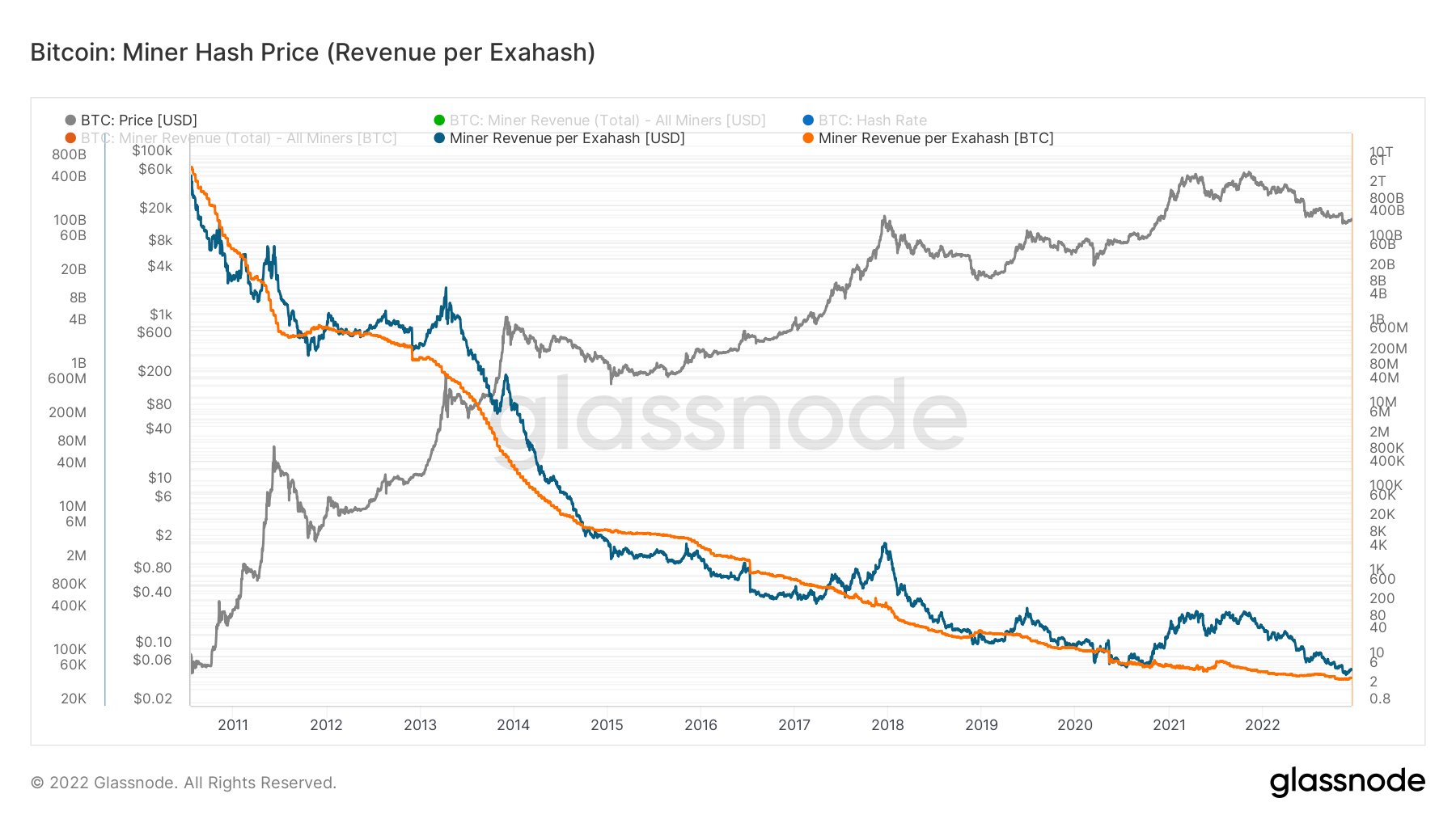
Miner revenue per Exahash has been dropping sharply since the beginning of the year. Revenue denominated in USD has seen significantly more volatility, spelling trouble for those that decided to sell their BTC holdings.
bitcoin miner revenue per exahash

Graph showing miner revenue per Exahash (Source: Glassnode)

”“

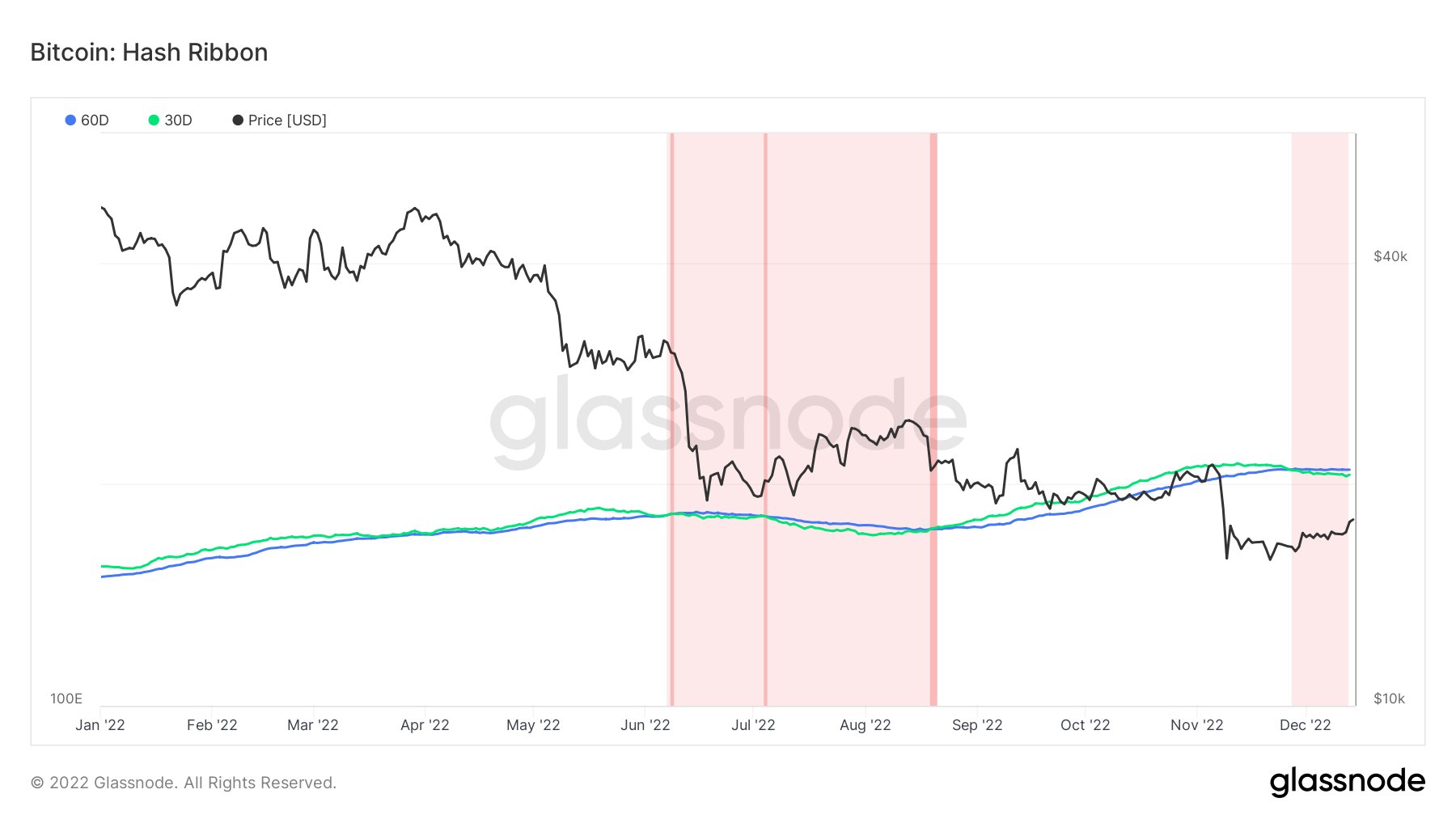
Looking at hash ribbons further confirms this trend. The metric analyzes the 30-day moving average and the 60-day moving average of the Bitcoin hash rate to determine when miners capitulate. When the 30-day MA drops below the 60-day MA, capitulation begins as Bitcoin becomes too expensive to mine. When the trend reverses, Bitcoin mining returns to being profitable.

”“

Since the beginning of the year, the market has seen three instances of these moving averages crossing — in June, July, and August. And now, the beginning of December saw the fourth reversal of moving averages, indicating another capitulation has begun.
bitcoin hash ribbons

Graph showing Bitcoin hash ribbons in 2022 (Source: Glassnode)

”“

On-chain data clearly shows miners have been capitulating en masse throughout the year. However, this doesn’t mean that they have been selling all their BTC.

”“

Data analyzed by CryptoSlate shows that there has actually been a notable decrease in the amount of BTC miners have been selling since the beginning of the year.

”“

Looking at the number of outgoing transactions from miner wallets in 2022 reveals a decreasing selling pressure. Outside of a short-lived spike in outgoing transfers in mid-November, the trend has been steadily declining.
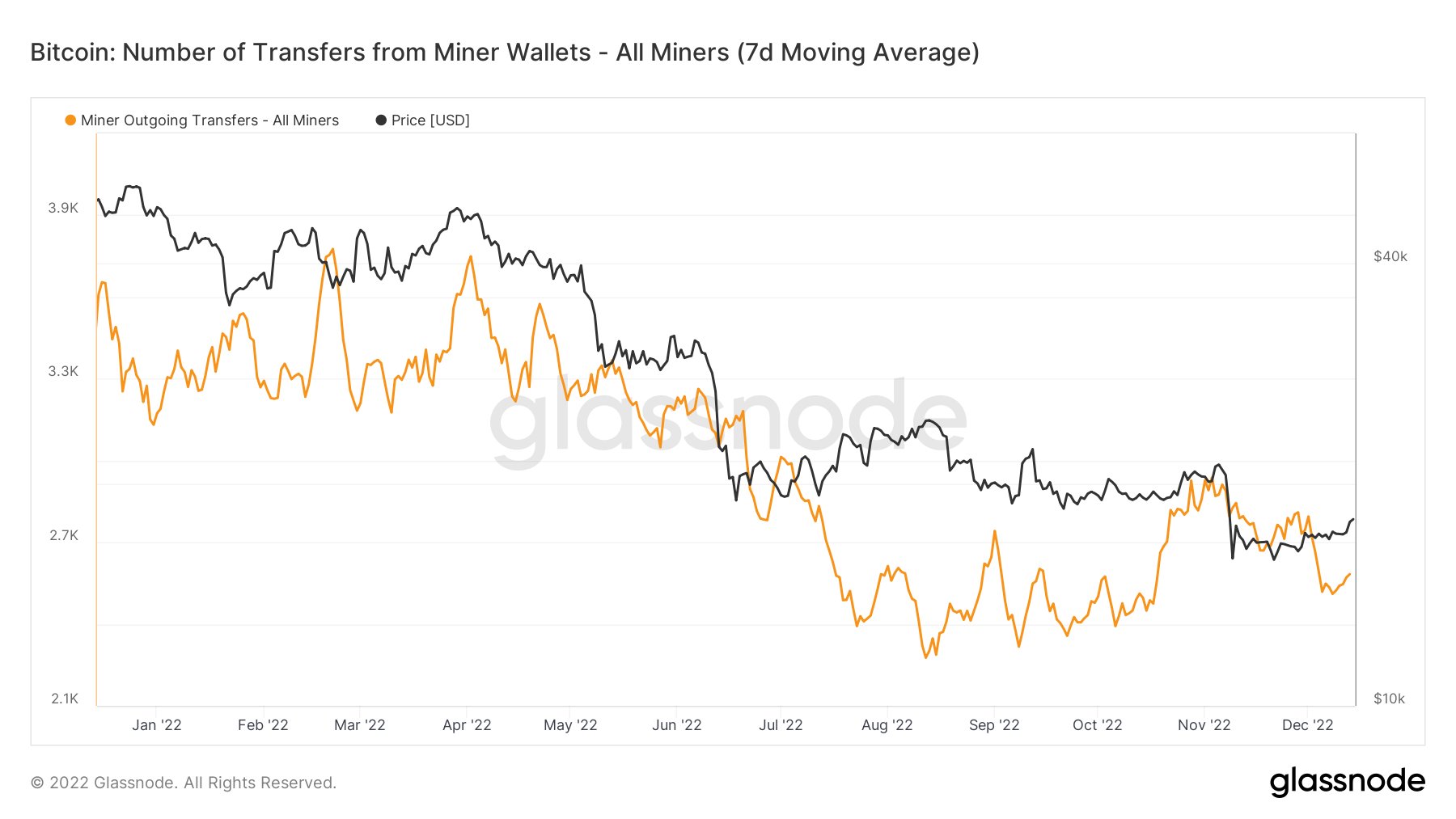
outgoing transfers from miner wallets

Graph showing the number of outgoing transfers from miner wallets in 2022 (Source: Glassnode)

”“

Transfers from miner wallets to exchanges further confirm this trend.

”“

Since the beginning of the year, miner transfers to all exchanges have been decreasing. Miners sent a total of around 57,000 BTC to exchanges in 2022, with 18,500 going to Binance and around 12,500 going to Coinbase.
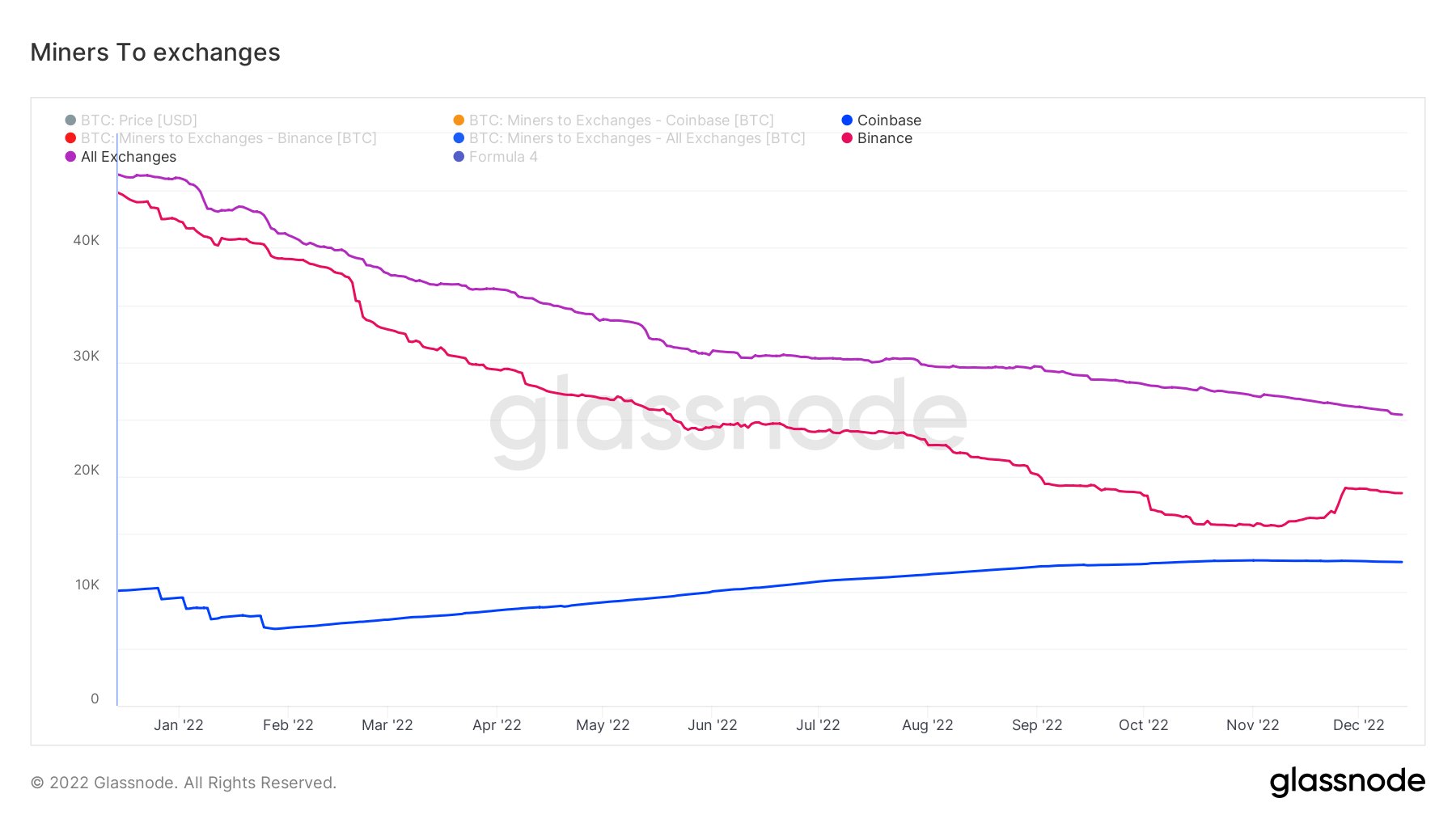
miner transfers to exchanges

Graph showing transfers from miner wallets to exchanges in 2022 (Source: Glassnode)

”“

Diving deeper into Bitcoin’s hash rate reveals that the strength of the network hasn’t been compromised. The selling pressure driven up by rising electricity prices and skyrocketing hardware costs hasn’t affected the hash rate. In fact, Bitcoin’s hash rate is currently climbing back to the yearly high it recorded in mid-November — in spite of Bitcoin’s dropping price.
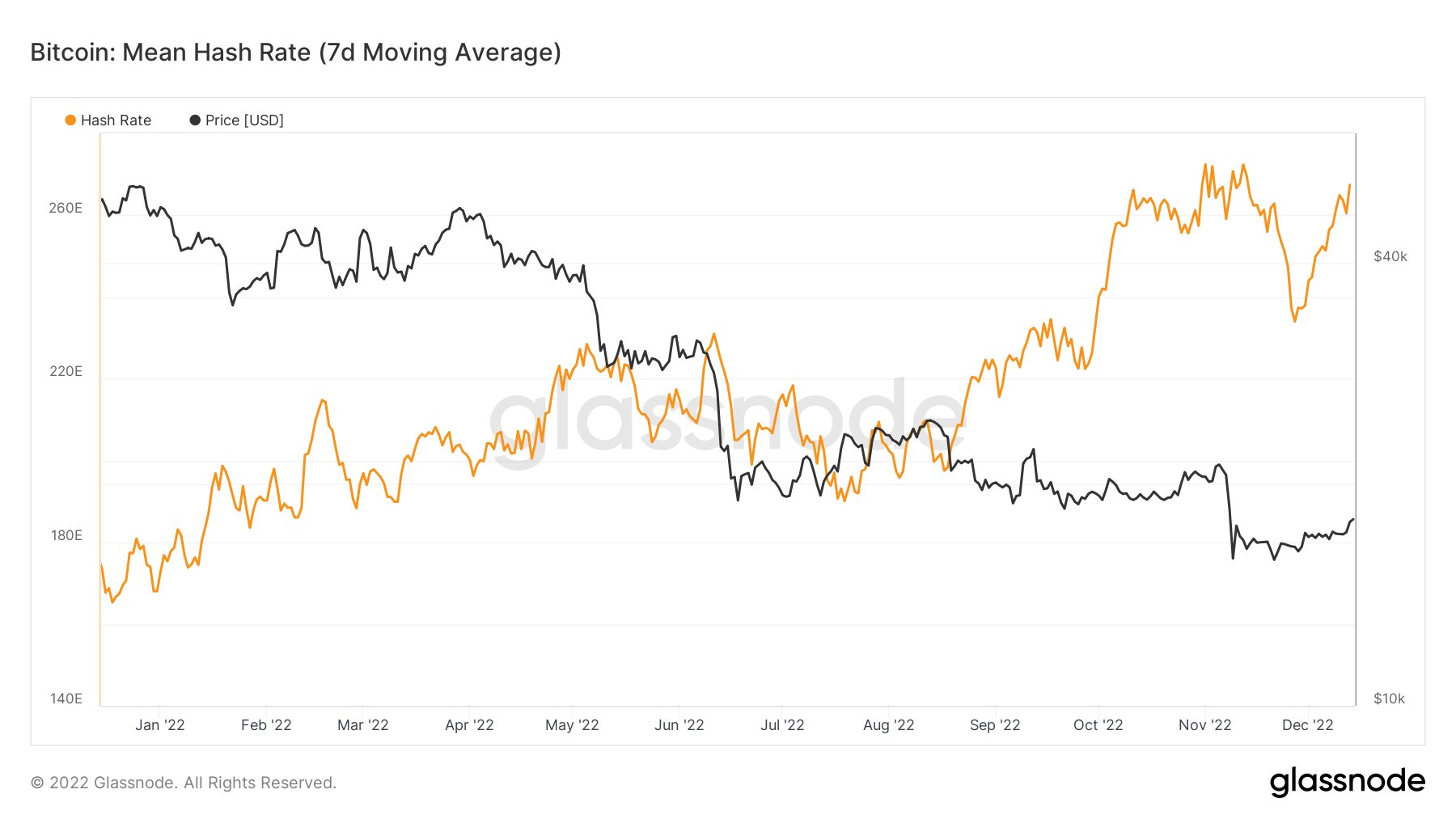
bitcoin price hash rate

Graph showing Bitcoin’s price and hash rate in 2022 (Source: Glassnode)
İlgili Okumalar

How to Regulate Single-Stock Leveraged ETFs? On Thursday, the Entire Market Is Watching This Korean Government Meeting

The highest-level economic coordination body in South Korea, the "F4" comprising the Ministry of Economy and Finance, the Financial Services Commission, the Bank of Korea, and the Financial Supervisory Service, will hold an emergency meeting on Thursday to discuss regulatory measures for single-stock leveraged ETFs. These products, launched just six weeks ago, have been widely blamed for exacerbating market volatility. The KOSPI's 8% plunge on Monday triggered the year's seventh trading halt, intensifying scrutiny. Regulators have expressed rare public regret over approving the products. FSS Governor Lee Bok-hyun stated he "regretted not doing everything possible to prevent" their introduction and acknowledged structural problems, citing massive retail investments and legal complications from a rushed rollout. Possible countermeasures under discussion include raising margin requirements, imposing daily price limits, and adjusting leverage caps. However, officials admit these may be temporary fixes. Data confirms the amplified volatility. Since the ETFs' launch, days with KOSPI moves exceeding 3% have nearly doubled. Trading halts have reached record levels, surpassing the 2008 financial crisis peak. The products allow 2x leveraged bets on giants like Samsung Electronics and SK Hynix. Their daily rebalancing to match returns is seen as mechanically fueling market swings. The outcome of Thursday's F4 meeting is highly anticipated, with expectations leaning towards stricter controls on leverage, investor access, or other structural constraints to curb the products' market impact.

marsbit3 dk önce

How to Regulate Single-Stock Leveraged ETFs? On Thursday, the Entire Market Is Watching This Korean Government Meeting

marsbit3 dk önce

AI Overhauled Terence Tao's 30-Year-Old Website, Uncovering Two Bugs Hidden for Over Two Decades in the Process

AI Revamps Terence Tao's 30-Year-Old Website, Unearthing Two 20-Year-Old Bugs in His Code Terence Tao, a renowned mathematician, has enlisted an AI agent to overhaul his personal academic website, which was built in 1997 with a static HTML, manually-maintained "Web 1.0" architecture. In just one day, the agent migrated 560 papers and preprints, 374 travel logs, 68 courses, 19 books, and 29 old math applets to a new system on GitHub Pages. The new site is structured around YAML files as the "single source of truth," with static HTML pages automatically generated from this data—a fundamental shift from maintaining individual documents to managing a centralized database. During the migration, the AI uncovered inconsistencies, outdated entries, and broken links that had accumulated over nearly three decades of manual updates. It also successfully ported a set of small educational Java 1.0 applets to JavaScript. Notably, while reviewing this translation, Tao found only one new bug introduced by the AI. Conversely, the AI identified two subtle bugs in his original Java code that he was previously unaware of. Tao emphasizes the project highlights AI's potential for automating tedious "digital housekeeping"—routine tasks like data migration and website maintenance that are costly and error-prone when done manually. He also revived a 27-year-old stalled project: a special relativity visualizer or "Minkowskian Inkscape." With AI assistance, a working alpha version was built in two hours. While AI still requires human oversight for critical work, Tao argues that for such structured, non-core tasks, "AI + human review" can result in lower error rates and drastically lower correction costs compared to purely manual maintenance over decades.

marsbit3 dk önce

AI Overhauled Terence Tao's 30-Year-Old Website, Uncovering Two Bugs Hidden for Over Two Decades in the Process

marsbit3 dk önce

ZORA Plunges 95%, Coinbase Finally Admits Creator Coins Failed

On July 13th, Coinbase CEO Brian Armstrong publicly declared the failure of Base network's year-long "content coins" strategy. Initially launched in 2025 via the Zora platform and integrated into Coinbase's wallet as a core feature, the model aimed to turn every social media post into a tradeable token. Each post or creator account would generate 1 billion ERC-20 tokens, with creators receiving an initial allocation. The concept briefly propelled Base to become the largest L2 by new token issuance. However, the model proved unsustainable. These tokens, explicitly not granting ownership or revenue shares, primarily functioned as speculative assets dependent on new buyers. While activity surged in mid-2025—with millions of tokens minted and billions in trading volume—it failed to build lasting user engagement or value. High-profile token launches, including one by Base's official account, experienced extreme volatility, often crashing shortly after spikes. The supporting infrastructure token, ZORA, plummeted approximately 95% from its August 2025 peak, losing nearly $520 million in market capitalization. Armstrong acknowledged the misstep, stating "it didn't work" and that Base had shifted focus earlier in the year toward its core competencies of trading and stablecoin payments. This pivot follows internal criticism that the content coin experiment consumed excessive resources, harmed other Base projects, and ultimately resulted in significant financial losses for participating users.

Foresight News19 dk önce

ZORA Plunges 95%, Coinbase Finally Admits Creator Coins Failed

Foresight News19 dk önce

İşlemler

Spot
活动图片