APE 质押上线第一天,获利最大的是套利者

Odaily星球日报Published on 2022-12-07Last updated on 2022-12-08

Abstract

对于 BAYC 及其衍生系列 NFT 和 APE 代币的持有者来说,APE 质押是近期最值得关注的大事,对于 NFT 行业后续发展也有借鉴性意义。

隐藏 BUG 导致部分 APE 的质押用户遭受损失。

对于 BAYC 及其衍生系列 NFT 和 APE 代币的持有者来说,APE 质押是近期最值得关注的大事,对于 NFT 行业后续发展也有借鉴性意义。

今日凌晨,经过了众多测试和审核的 APE 质押智能合约正式在主网上部署,这也意味着 APE 质押功能正式上线,用户现在可以通过 ApeStake.io 开启 APE 存款,质押奖励将于 12 月 12 日开放领取。

那在 APE 开放质押的第一天数据表现如何?用户反馈怎样?都出现了哪些奇葩新闻?Odaily 星球日报带大家回顾一下。

详解 Ape 质押机制

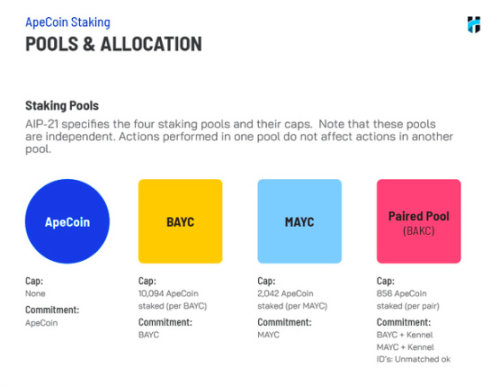
APE 质押系统有 4 个代币池,每个代币池的质押规则和奖励不同:

第一个池是「ApeCoin 池」。该矿池不要求用户持有 NFT,任何 APE 代币持有者都可以向该矿池存入尽可能多的 APE 代币。

第二个池是「BAYC 池」。该矿池要求用户持有一只 Bored Ape 才能参与其中。在 BAYC 池中,用户最多可以为他们持有的每个 Bored APE 存入 10, 094 枚 APE 代币。

第三个池是「MAYC 池」。该池要求用户持有一只 Mutant Ape 才能参与其中。在 MAYC 池中,用户最多可以为他们持有的每个 Mutant Ape 存入 2, 042 枚 APE。

第四个也是最后一个池是「BAKC + BAYC 或 MAYC」。该池不同于 BAYC 和 MAYC 池,因为用户不仅需要拥有一只 Bored Ape 或 Mutant Ape,还需要拥有一只 Bored Ape Kennel Club Dog,满足条件的用户可以为他们持有的每个 Bored Ape/Mutant Ape 和 BAKC Dog 存入最多 856 枚 APE。
APE 质押上线第一天,获利最大的是套利者在奖励分配上, 1.75 亿 APE(占总 Token 分配的 17.5% )将在 3 年内分配给四个池子,第一年为 1 亿枚 APE,第二年为 0.5 亿枚 APE,第三年为 0.25 亿枚 APE。

具体来说,对于 4 种代币池的奖励分配,将依据上一年 Q4 的 NFT 价格决定。其中,「ApeCoin 池」将固定分配当年总奖励池的 30% ,其余 3 个则随后续 NFT 价格浮动,NFT 价格越高,质押池对应的 APE 分配比率越高。

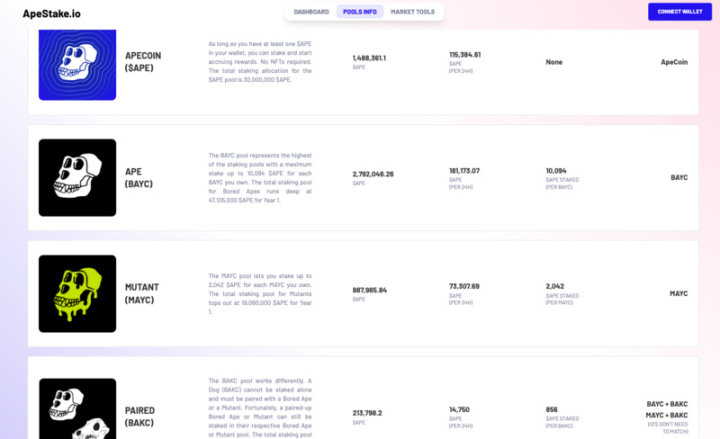
截止目前,共质押了 5, 377, 915 枚 APE,四个质押池的数据分别是:

ApeCoin 池:共质押 1, 488, 361.1 枚,占比 27.6%

BAYC 池:共质押 2, 792, 046.26 枚,占比 51.9%

MAYC 池:共质押 887, 965.84 枚,占比 16.5%

BAKC + BAYC 或 MAYC:共质押 213, 798.2 枚,占比 3.9%
隐藏 BUG 触发套利机制?

在 APE 质押功能上线前,就已经有大 V 在推特上提醒参与质押的用户需要把自己持有的 BAYC 及其衍生系列 NFT 从所有 NFT 市场上下架,否则如果有人购买了你上架的 NFT,那么你同时也会失去你质押的 APE 代币。
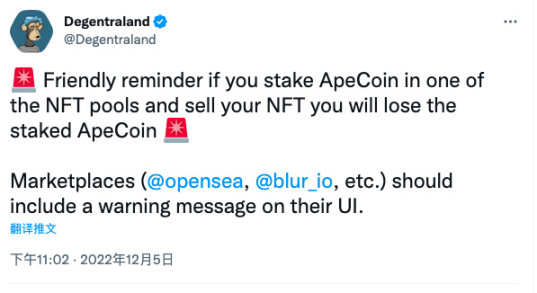
显然,这条友情提醒并没有被广泛传播,导致在 APE 质押功能上线几小时内,就触发了该套利机制。

据派盾监测,有套利者从 dYdX 以闪电贷的方式借入 82 ETH 购买 BAYC #6762 ,从而获得其质押的 64 00 枚 APE。套利者将 APE 卖出获得 20 ETH,后以 68 ETH 的价格卖出 BAYC #6762 ,净赚约 6 ETH。

很快,该套利模式就被成功复制。一套利者同样从 dYdX 平台以闪电贷的方式借出 90 枚 ETH,并购入 BAYC #1633 ,同时获得了该 NFT 下质押的 10, 000 枚 APE;套利者后又将所得 APE 分批兑换为约 9.1 枚 ETH 和 23.54 枚 ETH,共计 32.68 枚 ETH,然后将 BAYC #1633 以 65 ETH 价格出售,净赚约 7 ETH。
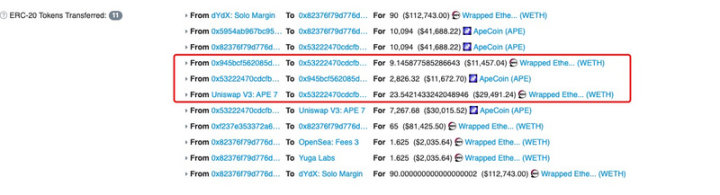
套利者发现了该漏洞赚取利润,但是 APE 的质押用户却遭受损失。ApeCoin DAO 质押计划的意义是激励生态参与者,显然机制上还是有待完善的空间。


Related Reads

The Hunter Becomes the Hunted: The Most Profitable MEV Bot Gets Hacked

A well-known and highly profitable Ethereum MEV Bot, Jaredfromsubway.eth, suffered a sophisticated on-chain attack this Saturday, losing over $7.5 million. Analysis by Blockaid and others reveals this was not a conventional phishing or smart contract exploit, but a targeted "counter-MEV honeypot attack." The attacker meticulously laid a trap over several weeks, deploying 66 fake token contracts and liquidity pools disguised as major assets like WETH and USDC. These pools created the illusion of arbitrage opportunities. The MEV Bot's automated system detected these signals, executed trades, and in the process, granted approval permissions to attacker-controlled contracts. These approvals were not revoked, creating a persistent vulnerability. The attacker then exploited this in a single transaction, draining the bot's ETH, USDC, and USDT holdings. Jaredfromsubway.eth is notorious as one of Ethereum's most active and profitable MEV Bots, primarily known for executing "sandwich attacks" to profit from transaction slippage. Estimates suggest it has earned tens of millions in MEV revenue. The incident highlights escalating crypto security threats, demonstrating that even top-tier automated "predators" are vulnerable to novel, logic-based attacks designed to exploit their own operational rules. Following the hack, an unverified X account impersonating Jaredfromsubway.eth emerged, falsely offering a bounty for the return of funds, prompting developer warnings for users to stay vigilant.

marsbit1h ago

The Hunter Becomes the Hunted: The Most Profitable MEV Bot Gets Hacked

marsbit1h ago

The Reality of Payments in Latin America Is Not What You Think

The payment landscape in Latin America is undergoing a fundamental shift, driven by on-the-ground realities that challenge common perceptions. Based on over 500 hours of field research across the region, key insights emerge. Firstly, QR code payments, like Brazil's Pix, are becoming the dominant payment method in most emerging markets, overtaking cards. However, these domestic instant payment systems lack international interoperability, creating a significant gap for cross-border users. Secondly, the narrative around crypto cards is often misunderstood; their primary volume comes from high-net-worth professionals using them for salary conversions (e.g., USDT to local currency via Pix), not retail micro-payments. Competition in payments is shifting from customer acquisition to controlling the settlement layer, leading fintechs to acquire banking licenses for efficiency. Thirdly, treating "Latin America" as a single market is a mistake. Countries like Argentina, Brazil, and Mexico have distinct economic realities, user segments, and regulatory approaches. Brazil alone has at least five distinct user segments with different financial flows. Overlooked markets like Guatemala, Honduras, and El Salvador (the "forgotten five") offer high remittance volumes with lower competitive density. Finally, regulation in Latin America is often ahead of the US, with clearer frameworks for digital assets and a pragmatic approach from regulators focused on safety rather than obstruction. The margin on stablecoin forex is rapidly compressing toward zero, meaning future winners will be those building value-added services on top of the infrastructure, not just the cheapest exchange.

marsbit1h ago

The Reality of Payments in Latin America Is Not What You Think

marsbit1h ago

Making Music in a Bear Market: The Survival Experiment of a Bitcoin Band

"Orange Pill Jam: A Bitcoin Band's Survival in the Bear Market" Orange Pill Jam is a musical group exploring themes of financial sovereignty and privacy, born from the Bitcoin community. Formed after singer Mermaid performed her song "Dollar Apocalypse" at a 2022 conference, the band creates music intended for both Bitcoin enthusiasts and general audiences. Their creative process involves Mermaid writing lyrics and melodies, which producer/multi-instrumentalist Michi then shapes with a precise, rhythm-focused approach, often demanding numerous retakes to achieve his unique standard of timing. Their songs, like "Cypherpunks' Manifesto" and "Fire of Freedom," tackle concepts of digital privacy, the pitfalls of "free" services, and personal sovereignty, influenced by experiences in places like El Salvador. Despite operating in a crypto bear market with a Copyleft model (offering music for free sharing/remixing and accepting optional Bitcoin donations), they face practical challenges. Their growth is slow on platforms like YouTube and Spotify, which aren't optimized for their niche content. The band also navigates the rise of AI-generated music. While acknowledging AI's efficiency for certain tasks, they believe human creativity occupies a unique space that algorithms cannot replicate—the ability to create new genres and capture intangible rhythmic feeling. For Orange Pill Jam, the core argument for both Bitcoin in a downturn and human artistry in the AI age lies in this irreplaceable, intentional, and imperfectly human creative process. Their project persists as an anti-algorithm experiment, valuing the unquantifiable impact of music over scalable metrics.

marsbit1h ago

Making Music in a Bear Market: The Survival Experiment of a Bitcoin Band

marsbit1h ago

Trading

Spot
Futures
活动图片