Polygon Poised For A Major Advance Next Year If MATIC Stays On This Course

newsbtcPubblicato 2022-11-23Pubblicato ultima volta 2022-11-23

Introduzione

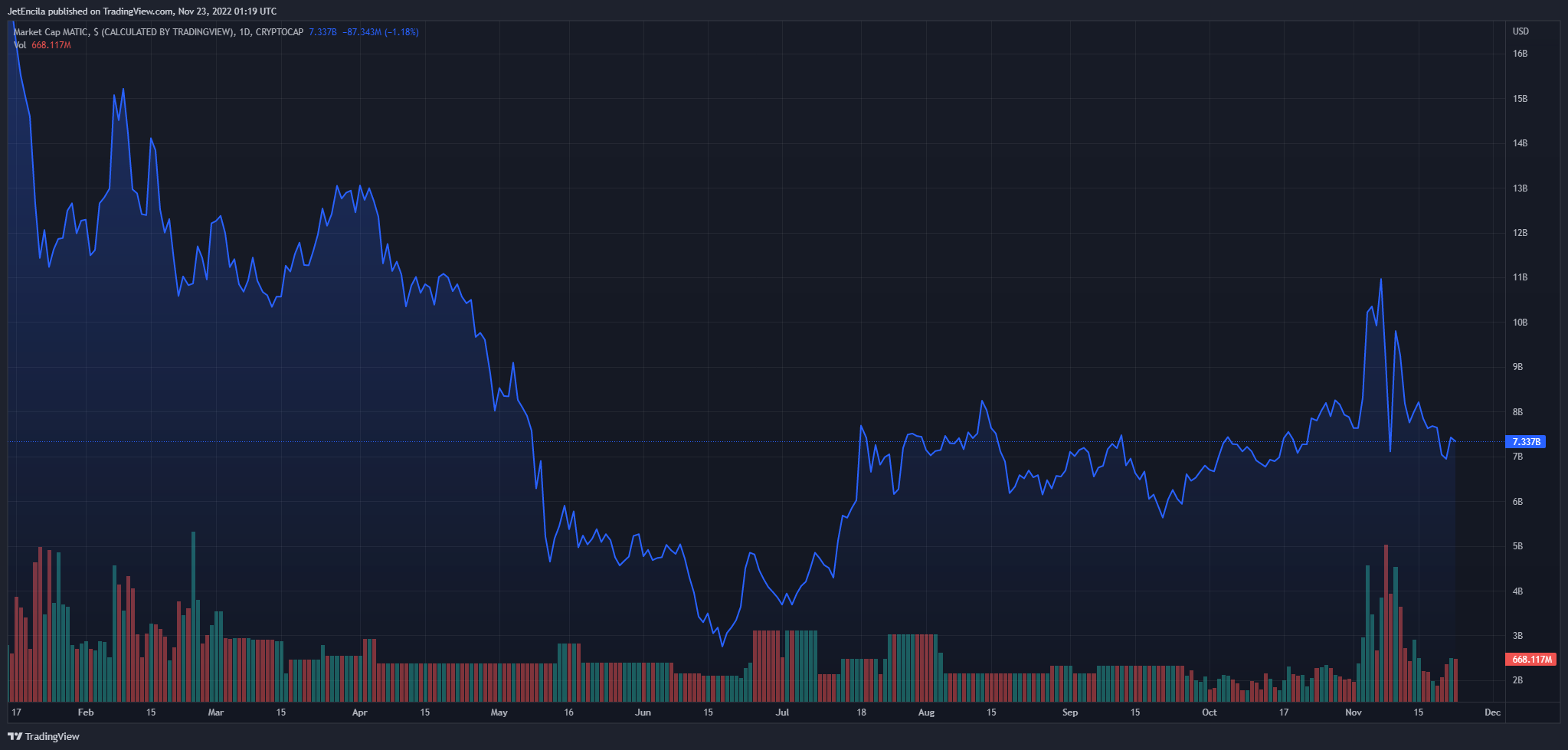
MATIC’s price action is difficult to ignore because it mirrors Ethereum’s price action from 2016 to 2017.

Even as the FTX-induced downward market continues, Polygon (MATIC) is closely following in the footsteps of its older relative ETH. Despite the bears’ dominance this year, many in the cryptocurrency industry see 2023 as the final chapter following a period of uncertainty.

A quick rundown of MATIC:

– MATIC down at $0.843512

– TradingShot analysts show that MATIC follows ETH price closely with a rejection by the 50-day MA

– 2023 not likely to bring a strong rally for MATIC by Shelby3

According to TradingShot, MATIC’s price action is difficult to ignore because it mirrors Ethereum’s price action from 2016 to 2017.

We all know that an investment’s past success is no indicator of its future success, but let’s see what this is about anyhow.

What’s In Store For MATIC In 2023

Based on the data, it is clear that MATIC has been following in ETH’s footsteps throughout 2016 and 2017.

Both were rejected at the 50-day moving average, a critical level because it was this situation that finally pushed the ETH bulls out of the bear market.

TradingShot predicts that there will be a significant increase in MATIC’s price in 2023 if the fractal keeps being replicated.

In contrast, the market in 2017 is radically different in terms of the crypto market’s size and the fundamental drivers that influence price movement.

Considering prior external influences such as the LUNA fall and the recent FTX collapse, we can all agree that the market will be wary regarding these assertions.

Another researcher by the name of Shelby3 contends that 2023 will bring far greater suffering. We may be able to discern a medium ground for investors and traders; 2023 will not deliver the anticipated significant rally, but it will end the bearish sentiment in the cryptocurrency market.

Extra Eye On MATIC

As of this writing, CoinGecko data is still flashing red across all timelines, indicating that it is losing value. Increasing exchange reserves for the token indicates a strong sell sentiment in the MATIC market.

MATIC is trading at $$0.843512, down 10.3% in the last seven days, data by Coingecko show, Wednesday.

With MATIC continuing to trade at a red candle at $0.7846, which is coupled with a restricted trading range, it would continue to face agony until later this year and maybe until the first quarter of 2023.

Investors and traders should be wary of MATIC on both the short- and long-term, as it continues to demonstrate a strong bearish bias.

Even if MATIC follows in the footsteps of ETH, market forces and macroeconomic variables will eventually affect the price of MATIC.

Letture associate

When 8 Million ETH Start 'Moving': The Post-Pectra Era Ushers in a Structural Transformation for Staking?

A major shift is underway in Ethereum staking, as Lido begins migrating over 8 million ETH (worth ~$16B) from traditional validators to a new architecture enabled by the Pectra upgrade. This migration involves consolidating over 265,000 legacy validators (using 0x01 withdrawal credentials) into a smaller number of higher-balance "0x02" validators, potentially reducing the total validator count on Ethereum by nearly a third. The core driver is EIP-7251 from the Pectra upgrade, which introduced "compounding validators." These allow a single validator's effective balance to grow up to 2048 ETH, with staking rewards automatically reinvested to compound earnings. This contrasts with the old model, where rewards exceeding 32 ETH were automatically sent to a withdrawal address, creating idle funds and operational complexity for reinvestment. While the direct APR boost from compounding is modest—estimated at a ~4.7% relative improvement for smaller validators—the structural benefits are significant. For large operators like Lido, the primary value is operational efficiency: managing fewer validators reduces node, key management, and network message overhead. For smaller individual stakers, the upgrade lowers the barrier to reinvestment by eliminating the need to manually accumulate 32 ETH for new validators. The migration signifies a deeper change in Ethereum's staking landscape. Competition is evolving beyond simple yield, focusing instead on capital efficiency, liquidity management, risk distribution, and infrastructure optimization. Lido's parallel move to require node operator security deposits further highlights this shift towards more robust, capital-backed services. Ultimately, Pectra's compounding validators represent a key step in maturing Ethereum's staking lifecycle, moving the ecosystem from standardized yield products towards more sophisticated capital management and infrastructure solutions.

marsbit8 min fa

When 8 Million ETH Start 'Moving': The Post-Pectra Era Ushers in a Structural Transformation for Staking?

marsbit8 min fa

Double Long Hynix ETF Plummets, Halved and Halved Again

On July 29th, shares of South Korean semiconductor firm SK Hynix plummeted over 19% intraday, marking its largest single-day drop on record. The Hong Kong-listed "CSOP SK Hynix Daily Leveraged (2x) Product" (Stock Code: 07709) tumbled more than 28% intraday before closing 13.99% lower at HK$32.70. This leveraged product, designed to deliver twice the daily return of SK Hynix, has seen a catastrophic decline of over 80% from its June 25th high of HK$193.65, far exceeding the underlying stock's roughly 50% drop from its peak. Its assets under management have shrunk dramatically, falling over 70% from a high of HKD 130 billion in June to approximately HKD 31.9 billion. This steep sell-off occurred despite SK Hynix reporting stellar Q2 2026 earnings, with revenue and operating profit surging 257% and 557% year-over-year, respectively. However, the results fell short of market expectations. Analysts cited concerns about potential oversupply from expansion and noted that long-term supply agreements for its high-bandwidth memory (HBM) chips might limit near-term price increases. In response to heightened volatility and regulatory changes, the product's issuer, CSOP Asset Management, announced a transition to a "flexible leverage mechanism" starting August 3rd. Under new Hong Kong SFC rules, the fund's daily leverage multiplier can now be dynamically adjusted between 1.1x and 2x (or -1.1x to -2x for inverse products) based on market conditions, moving away from a fixed 2x target. The fund's name will also be changed to clarify its nature as a daily trading tool unsuitable for long-term holding. Experts warn that this change means investors can no longer assume constant 2x returns and must check the disclosed leverage ratio daily.

marsbit24 min fa

Double Long Hynix ETF Plummets, Halved and Halved Again

marsbit24 min fa

A7 Discusses Accumulated Experience in Using Stablecoins

The Russian State Duma and Federation Council have passed the "Law on Digital Currencies and Digital Rights," which is set to expand the use of stablecoins in cross-border trade settlements starting September 1, 2026. According to the Bank of Russia, exporters and importers will be able to use cryptocurrency in international payments, both directly and through intermediaries, while domestic crypto payments will remain largely prohibited. Company A7, which facilitates operations with the A7A5 stablecoin—Russia's first ruble-pegged stablecoin classified as a Digital Financial Asset (DFA)—commented on the development. Oleg Ogienko, Director of Government Relations and International Affairs for the A7A5 project, stated that while digital asset settlements are still a new practice for many firms, A7 has already accumulated significant expertise in legal documentation, compliance, currency control, and working with infrastructure participants. He added that A7 will continue to apply this expertise for client operations after the law takes effect and will adapt its business processes as the Central Bank issues further regulations. A7 is a Russian international settlement system established in 2024 with participation from PSB Bank. It facilitates cross-border payments and supports foreign trade operations for Russian businesses. Its key instrument, the A7A5 stablecoin, operates on the Tron and Ethereum networks with a market capitalization exceeding $567 million and is circulated in Russia as a DFA via the "Token" platform.

cryptonews.ru39 min fa

A7 Discusses Accumulated Experience in Using Stablecoins

cryptonews.ru39 min fa

Trading

Spot
活动图片