FTX事件影响:行情及后续风险预判

火必研究院Published on 2022-11-10Last updated on 2022-11-11

Abstract

FTX事件到11月9日似乎进入了一个新的阶段,在过去24小时之内发生的事情几乎可以确定会被铭刻在加密货币行业的历史里。本文是事件目前的情况,我们希望通过一些关键的数字让读者了解到整个事情的全貌。

1. 事件回顾

”“

FTX事件到11月9日似乎进入了一个新的阶段,在过去24小时之内发生的事情几乎可以确定会被铭刻在加密货币行业的历史里。下面是事件目前的情况,我们希望通过一些关键的数字让读者了解到整个事情的全貌:

”“

1) 11月2日,Coindesk爆料称Alameda的资产负债表存在极大隐患,总共146亿美元的资产中约60亿是FTT和SOL。

”“

2) 11月6日,CZ发推表示将逐步抛售所持有的约2300万美元的FTT。消息传出后FTT开始下跌,在Alameda CEO表示愿意以22美元的价格收入CZ所要抛售的FTT后,价格稳定在22美元附近。但在这短短两天天时间内已经有近10亿美元的资产从FTX和Alameda流出。

”“

3) 11月8日11:00(UTC+8),市场传闻FTX抛售了持有的1亿个bit和其他代币以补充流动性,该消息进一步引发了市场对FTX资金链断裂的担忧并导致FTT一度跌至16美元。但在8日下午FTX几个热钱包2个小时没有币转出,进一步引发恐慌,ftt带领市场继续下探。

”“

4) 11月9日0:09(UTC+8),SBF和CZ同时发推表明FTX和币安已达成一个非约束性意向:币安将收购FTX全球站以帮助FTX应对流动性紧缩。声明发出后市场受到提振大幅反弹,FTT重回20美元上方,BTC和ETH也分别回到了20000美元和1500美元水平。

”“

5) 11月9日2:00,美国商品期货交易委员会表示正在监控币安收购FTX的交易。并且有声音认为这次并购的快速可能是因为并购金额相当便宜,这将使得FTX之前的投资人受到损失,并且可能违反各国的反垄断法。这些声音引发了市场对并购能否完成的担忧。雪上加霜的是SBF在周二早上给公司的内部信中表示过去三天内FTX被取走了60亿美元,这使得市场认识到FTX的资金缺口超出之前的预计。11月9日8:00,FTX暂停了所有加密货币提现。这一系列的事件导致了市场的进一步崩塌,到目前为止FTT价格已经跌到了5美元以下,BTC最低跌破了17000美元,ETH跌破1300美元。目前FTX的钱包中稳定币数量下跌超过80%,目前不足2亿美元,BTC更是只有不到40个。

”“

2. FTX事件影响范围与后续预判

”“

2.1 FTX事件的影响

”“

本次FTX暴雷事件的影响可能会超出此前Luna和3AC崩盘时受到牵连但未破产的机构的范围,并将影响深入到行业各个角落。本轮继续参与了对FTX的借贷的机构潜藏着巨大的清算风险。我们可以从三个层次理解本次事件带来的影响:

”“

a) 直接影响层:FTX和Alameda直接投资的项目以及与FTX有直接借贷与合作关系的中心化机构。项目层面主要包括Solana、Fantom和Serum在内的重要的公链和DEX等,如下表所示,这些是FTX暴雷事件的直接受害者。
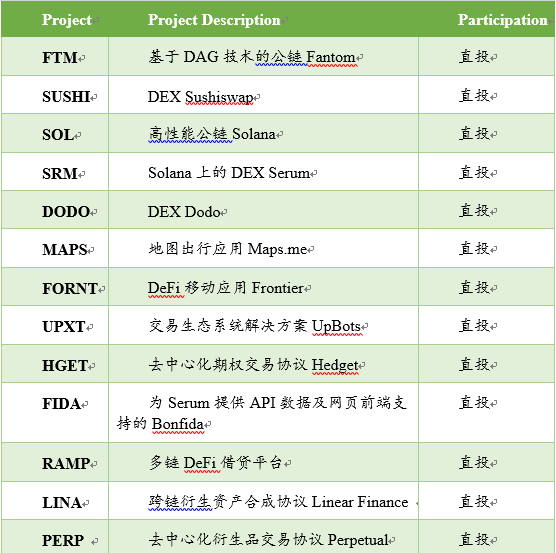
我们分析了Alameda的资产情况,目前Alameda的可监控钱包持有价值排名靠前的代币如下:BIT、SUSHI、FTT、SRM、LDO、MATIC、RNDR等。
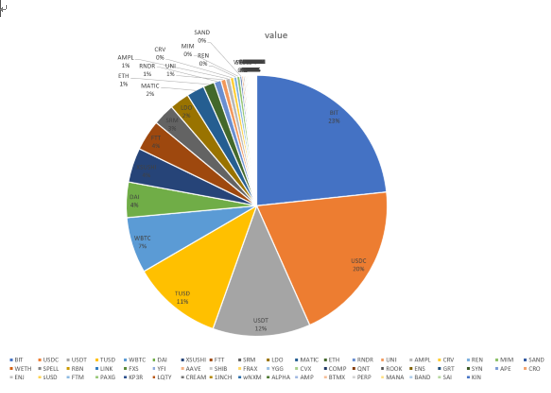
>BIT:目前无法确认是否会违背承诺进行解锁,FTX承诺不解锁,但bit在Alameda钱包中的价值已达23%,市场信心不足,是高危币种

>SUSHI: Alameda总计有340万个xSUSHI,可以提出480万个SUSHI,但SUSHI的链上大额清算的价格很低,预计无法到达,目前是相对比较安全的。目前主要是市场对Alameda巨量持仓的恐惧导致信心不足。

>MATIC和RNDR:流动性较强,且不是SOL系的资产,大概率会优先卖出回笼资金。RNDR已跌去26%,MATIC下跌20%。如果余额中的代币转入交易所会继续下跌。

>FTT:FTX本身的平台币,据说Alameda也和FTX借了不少而且用于抵押品。但是借贷都不存在链上,没法得知具体的清算细节。基于抵押品,FTT币价对于Alameda有利,可能会作为最后的手段。

>SRM:其中FTX和Alameda关系较近的项目,关系一直都很密切。目前币价已经严重破发,和其他Solana上的协议相同,TVL24小时都跌了20%-30%。

>SOL:链上有大额资产清算风险,一个链上大户目前拥有 2,095,598个SOL(价值超过 3800 万美元)担保物和48,038,000 USDC 债务,若预言机恢复将会引发清算,引起价格大幅下跌。

”“

至于与Alameda有业务关联的机构,目前暂无公开信息可确认,但一定存在。

”“

b) 间接影响层:Alameda作为做市商和股权置换的项目,或者和FTT等资产重度绑定的项目,如bitDao、MIM等。这些项目虽然没有FTX的投资,但与其存在较深入的业务往来,在当前的情况下也会受到较大的影响。

”“

c) 辐射层:大盘其他资产,主要受关联资产影响以及市场恐慌情绪带动。

”“

简而言之,在FTX崛起的这三年时间里,作为排名第二的中心化交易所,其触手已经深入行业的方方面面,我们已无法完全量化的分析出本次事件会给多少项目造成损失,但可以定性的说,与luna事件相比,FTX事件才算是币圈的雷曼事件。

”“

2.2 后续行情和进展预测

”“

a) 从行情上来说,在FTX暴雷之前,市场已经处于较为深入的熊市行情中了。随着宏观货币政策的收紧和luna、三箭资本等事件之后,BTC一路下跌到18000美元。但近几个月以来,虽然美联储持续的大幅加息使得宏观环境不断收紧,但整个市场行情已经进入相对平稳的阶段,BTC不但稳守18000美元关口,更一路缓慢反弹到21000美元左右。眼看着加息高峰将要过去,FTX的崩塌使得市场转向一路向下,BTC再次跌破17000美元且ETH跌破1300美元。而上次见到BTC在17000美元左右还是在两年之前的2020年11月。因此可以说除了支撑了五个月,久经考验的18000美元关口可以信任外,在其以下的价位目前都不太具有可信度,市场也没有就下一个关键点位达成共识。

”“

b) 从事件发展的可能路径推断上看,首先币安的收购面临诸多困难:本次收购面临着美国监管机构的审查风险和可能违反反垄断法的法律风险,这些都可能导致币安的收购失败。另外,FTX的财务漏洞远超市场预计以至于CZ也发推感慨,也吓退了市场上的其他可能的收购者,如Coinbase就明确表示不会收购FTX。综合以上分析,我们认为币安收购FTX的窗口是越来越小的,但为了保住美国本土精英在币圈的影响力,最终有可能会有美国本土力量出手完成对FTX的救助。但从目前来看整件事情仍没有见到任何曙光,在出现转机之前市场仍将受到痛苦的折磨。

”“

c) 从对行业的影响看:本次事件再次引发了业内对中心化交易所的不信任,为了坚定行业信心,Binance和Huobi都表示将在一个月内公开可审计的merkle树的储备证明或POF。同时行业内部加强监管的声音再次升起,如Coinbase CEO就表示FTX事件将导致加密行业在美国境内遭受更严格的监管。本次事件从行业规范的角度将成为一个标志性的历史事件。

Related Reads

SK Hynix Market Cap Exceeds Samsung for First Time in 26 Years, Korean Broker Calls for 50% More Upside

SK Hynix's market capitalization surpassed Samsung Electronics for the first time in 26 years on June 22, reaching 208.1 trillion won. The shift reflects a market trend where companies directly benefiting from AI infrastructure, like SK Hynix, are receiving higher valuation premiums than diversified giants. The surge is driven by AI-driven demand for High Bandwidth Memory (HBM), where SK Hynix holds a dominant 70-80% market share. Its Q1 2026 revenue exceeded 50 trillion won for the first time, with an operating profit margin of 72%. Hanwha Investment & Securities significantly raised its price target for SK Hynix to 430,000 won, the highest among Korean brokerages. The key rationale is that Long-Term Supply Agreements (LTAs) and robust HBM demand have fundamentally reduced the company's historical profit volatility. Several other brokers have also raised targets, arguing the valuation framework for memory semiconductors is being rewritten, moving away from a cyclical model. Despite the bullish outlook, the stock experienced a pullback of over 5% in regular trading on June 23 after briefly surpassing 3 million won pre-market, amid broader tech sector weakness. Some analysts caution that the市值 overtaking Samsung, whose profit scale and growth forecasts remain higher, could signal short-term overheating. However, high-return investors viewed the dip as a buying opportunity.

marsbit5m ago

SK Hynix Market Cap Exceeds Samsung for First Time in 26 Years, Korean Broker Calls for 50% More Upside

marsbit5m ago

GPU Rental Prices Drop 30% in Three Weeks: AI Value Chain Migrating from Nvidia to Memory Chips

GPU rental prices for Nvidia's flagship B200 chip have fallen by approximately 30% over three weeks, dropping from a high of $6.11/hour to $4.22/hour. This decline signals a potential easing of the "compute scarcity" narrative that has long supported AI hardware valuations. Concurrently, the semiconductor market is witnessing a significant divergence: while the VanEck Semiconductor ETF (SMH) has risen 15% in the past month, with memory giants Micron and SanDisk each surging nearly 60%, Nvidia's stock has declined about 3% over the same period. Analysts suggest this shift indicates that the AI value chain's bottleneck and profits are migrating from compute (GPUs) to memory. Demand for high-bandwidth memory (HBM) remains intensely strong, with contract prices soaring over 100% in H1 2026, granting memory manufacturers significant pricing power. In contrast, increased B200 supply from improved manufacturing yields and competitive pressure from new cloud providers are softening GPU rental rates. While long-term contracts, like SpaceX's $30 billion deal with Google, show sustained large-scale demand for Nvidia hardware, the softening spot prices pressure the margins of cloud providers and could eventually impact Nvidia's order flow if chip prices don't adjust. The key takeaway for investors is not a weakening AI thesis, but a recalibration within the sector: pricing power appears to be strengthening for memory chipmakers while showing signs of strain for leading GPU suppliers.

marsbit15m ago

GPU Rental Prices Drop 30% in Three Weeks: AI Value Chain Migrating from Nvidia to Memory Chips

marsbit15m ago

From Corning to Ciena: The 10X Stock Opportunities in the AI Optical Communication Chain

From Copper to Light: The AI-Driven Optical Communication Supply Chain and Investment Opportunities The exponential data demands of AI are pushing data centers beyond the physical limits of copper cables, forcing a critical transition to optical communication. This shift from electrical to photonic signals over distances greater than ~3 feet solves heat, power, and bandwidth constraints. The real investment opportunity lies not just in headline chipmakers, but across the entire essential photonics supply chain. **Key Investment Layers & Companies:** * **Glass & Fiber:** **Corning** is a dominant, irreplaceable supplier of advanced fiber to all major cloud/AI players (Meta, Amazon, Google, MSFT, OpenAI, NVIDIA), with multi-billion-dollar, multi-year contracts locked in years ahead of delivery. Its profit growth (93%) far outpaces revenue growth (36%), showing pricing power. * **Interconnects:** **Amphenol**, a consolidating giant in high-speed connectors (both copper and optical), shows robust growth (>80% in AI data centers) and expanding margins post-acquisition. **Credo Technology** bridges old and new worlds, extending copper's life in racks while moving into optics. It has hyper-growth but carries high customer concentration risk. * **Systems:** **Ciena** is a leader in coherent optics, enabling massive data capacity upgrades on existing fiber. It has a massive, growing order backlog ($~7B) and strong ties with cloud providers. * **Upstream & Enablers:** **AXT** produces mission-critical indium phosphide wafers for lasers, creating a supply bottleneck, but faces significant geopolitical/export license risk from its China-based manufacturing. **VEO Solutions** is the essential "picks and shovels" play, providing test equipment needed by every component in the optical chain, regardless of the eventual winner. A new pure-play photonics ETF (**FOTO**) offers a consolidated investment vehicle for this theme, though it is new and small. The core thesis is clear: the move from copper to light is inevitable and accelerating, with wealth creation spreading across this critical, multi-layered supply chain.

marsbit34m ago

From Corning to Ciena: The 10X Stock Opportunities in the AI Optical Communication Chain

marsbit34m ago

A Chip Company Releases AIDC Energy Storage Certification Standards. Why NVIDIA? Computing Power Reshapes Power Supply Logic. Who's in the Lead and Who's Left Out?

NVIDIA has released a "Battery Energy Storage System Self-Certification Guide," setting strict technical standards for energy storage systems specifically for AI data centers (AIDC). The guide focuses solely on certifying the Power Conversion System (PCS), not the batteries, with 10 mandatory performance metrics and 12 validation tests requiring real-world and simulation comparisons. Key requirements include rapid dynamic response to AI workloads, high-frequency system telemetry, and detailed electromagnetic transient models. The move is driven by the extreme and fluctuating power demands of next-generation AI hardware. Modern AIDCs require energy storage systems to act as intelligent, controllable grid assets, not just passive backup, to manage instantaneous, massive power load shifts that traditional UPS systems cannot handle. This redefines the competitive landscape for energy storage providers, shifting focus from capacity and cost to advanced control capabilities and system integration. While the market potential is significant—with forecasts of hundreds of GWh in new demand by 2030—the certification creates a high barrier to entry. It requires proven PCS delivery volumes and credible plans for rapid capacity scaling, favoring established, well-resourced players. Early movers like Fluence (partnering with Siemens) and several Chinese companies have secured projects ahead of the standard, but new entrants must now navigate this rigorous, costly, and time-intensive certification process to compete in the AIDC energy storage market.

marsbit1h ago

A Chip Company Releases AIDC Energy Storage Certification Standards. Why NVIDIA? Computing Power Reshapes Power Supply Logic. Who's in the Lead and Who's Left Out?

marsbit1h ago

Trading

Spot
Futures
活动图片